
Vy vs svt complete treatment real life
Reading File
VT (ventricular tachycardia) vs SVT (supraventricular tachycardia) is a classic clinical scenario. Let me get you authoritative textbook content and current evidence simultaneously.
Searching sources...
Finding Sources
Finding Sources
Searching PubMed
"wide complex tachycardia" AND "ventricular tachycardia" AND differentiation
Good - found key references in Tintinalli's, Harrison's, and Braunwald's. Let me pull the full treatment content from these sections now.
Reading File
Reading File
Finding Sources
Good content coming in. Let me pull the Tintinalli's wide-complex tachycardia treatment section and the Braunwald's flowchart image, plus the Harrison's PSVT/VT management section:
Reading File
Reading File
Reading File
Excellent - rich content. Let me fetch the Tintinalli's treatment flowchart image and get the ECG differentiation criteria section:
Loading Image
Loading Image
Reading File
I now have comprehensive content from multiple authoritative sources. Let me compile the full clinical answer.
VT vs SVT: Complete Real-Life Treatment Guide
This is one of the most consequential clinical scenarios in emergency medicine - treating a wide-complex tachycardia as SVT when it's actually VT can be fatal. Here is a complete, practical breakdown.
Step 1: Is the Patient Stable or Unstable?
This is the first and most important question - it determines the entire treatment pathway.
Signs of hemodynamic instability:
- Hypotension / altered mental status / chest pain / pulmonary edema / syncope
| Status | Action |
|---|---|
| Unstable (any of the above) | Immediate synchronized cardioversion - do not delay for diagnosis |
| Stable | Proceed to ECG analysis and targeted pharmacotherapy |
Key rule: If the patient is unstable, treat first, diagnose later. - Tintinalli's Emergency Medicine, p. 144
Step 2: Wide-Complex or Narrow-Complex?
Narrow-Complex Tachycardia (QRS < 120 ms)
This is almost always SVT (AVNRT, AVRT, AT, AF, flutter).
Wide-Complex Tachycardia (QRS ≥ 120 ms)
This is the dangerous diagnostic dilemma. It can be:
- VT (most common in patients with structural heart disease - ~80% of wide-complex tachycardias in the ED)
- SVT with aberrant conduction (BBB - pre-existing or rate-related)
- Preexcited tachycardia (WPW with AF/flutter - the most dangerous SVT mimic)
The golden rule: Treat all wide-complex tachycardia as VT until proven otherwise. - Harrison's Principles of Internal Medicine 22E (2025), p. 1986
Step 3: ECG Criteria to Differentiate VT from SVT with Aberrancy
These are used in stable patients to guide drug selection - never to delay cardioversion in an unstable patient.
Classic ECG features favoring VT (Tintinalli's, p. 158):
| Feature | Details |
|---|---|
| AV dissociation | P waves marching independently of QRS complexes - most specific sign for VT |
| Fusion beats | Hybrid QRS from simultaneous supra- and ventricular activation |
| Capture beats | Narrow QRS during wide tachycardia = ventricular capture from sinus node |
| QRS duration > 160 ms | Strongly favors VT |
| Northwest (extreme) axis | -90° to ±180° = strongly favors VT |
| Concordance | All precordial leads positive or all negative = VT |
| No RS complex in any V lead | Brugada criterion #1 = VT |
| RS nadir > 100 ms in any V lead | Brugada criterion #2 = VT |
Brugada Algorithm (1991):
Answer these 4 questions in sequence - any YES = VT:
- Absence of RS complex in ALL precordial leads?
- R-to-S nadir > 100 ms in any precordial lead?
- AV dissociation present?
- Morphologic VT criteria in V1-V2? (RBBB pattern: monophasic R, QR, QS; LBBB pattern: rS, QS, QR)
If all 4 are NO = SVT with aberrancy
Step 4: Real-Life Treatment by Scenario
SCENARIO A: Wide-Complex Tachycardia, Stable, Rhythm Uncertain or Likely VT
Treatment algorithm (from Tintinalli's Fig. 18-3):
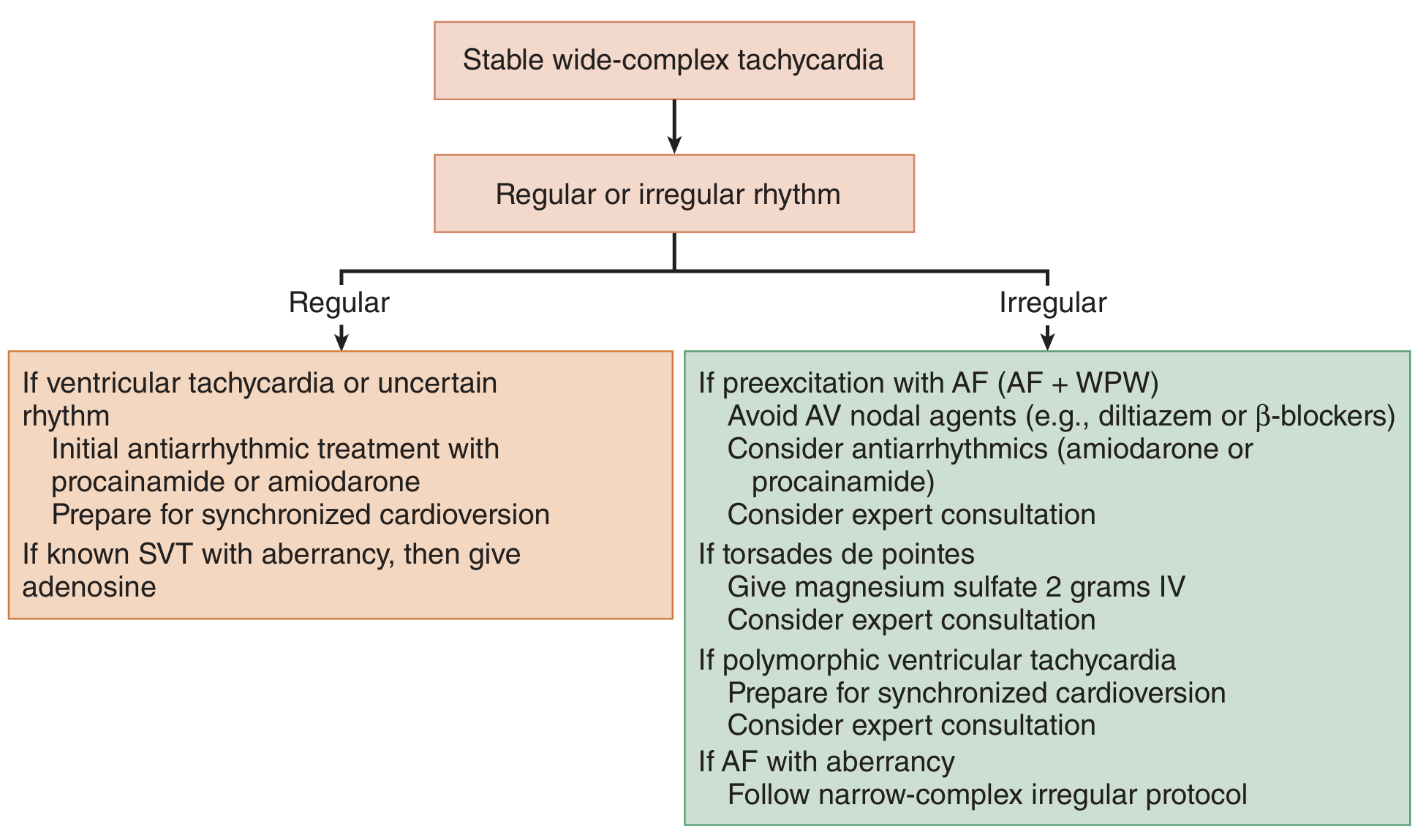
Drug of choice: Procainamide IV
- Superior to amiodarone and lidocaine for converting stable VT (Tintinalli's, p. 145 and p. 157)
- Also effective for SVT with aberrancy - safe to give even if diagnosis is uncertain
- Loading dose: 20-50 mg/min IV until conversion, hypotension, QRS widens >50%, or max 17 mg/kg
- Main caveat: slow infusion required to avoid hypotension
Second-line: Amiodarone IV
- 150 mg IV over 10 min, then 1 mg/min for 6 h
- Less effective than procainamide for VT conversion but safer in patients with poor LV function
Third-line: Lidocaine IV
- 1-1.5 mg/kg IV bolus, repeat every 5-10 min to max 3 mg/kg
- Least effective for conversion; reasonable for ischemia-related VT
If stable patient known to have SVT with aberrancy (prior episodes documented):
- Adenosine 6 mg IV rapid push is reasonable
- If no conversion: 12 mg IV x2
"If the diagnosis of PSVT with aberrancy is unequivocal, as may be the case in patients with prior episodes, treatment for PSVT with vagal maneuvers and adenosine is reasonable." - Harrison's 22E
SCENARIO B: Narrow-Complex SVT, Stable
Treatment algorithm (Harrison's Fig. 256-6):
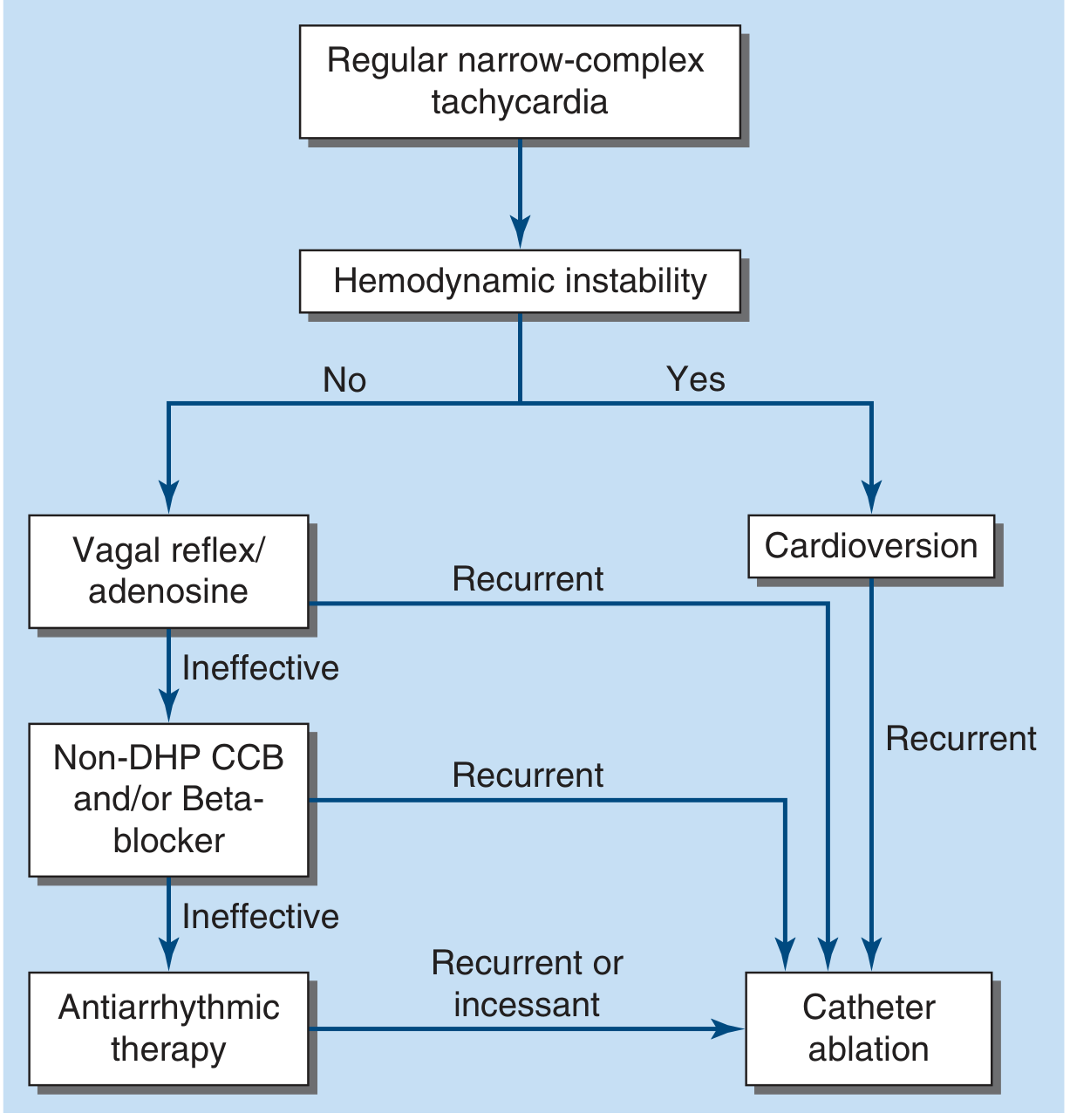
Step 1 - Vagal maneuvers (try first):
- Valsalva maneuver - modified technique is more effective: strain for 15 sec, then lie flat with legs raised for 15 sec (REVERT trial)
- Carotid sinus massage (contraindicated with carotid bruits or prior stroke)
- Ice water facial immersion (diving reflex, especially in children)
Step 2 - Adenosine IV (if vagal fails):
- 6 mg IV rapid push via large peripheral or central vein, immediately followed by 20 mL NS flush
- If no response in 1-2 min: 12 mg IV
- Can repeat 12 mg once more if needed
- Terminates the vast majority of PSVT by transiently blocking AV nodal conduction
- Warn patient: transient chest tightness, flushing, feeling of impending doom (lasts ~10-15 sec)
- Contraindications: cardiac transplant (hypersensitivity), severe reactive airway disease
- Caution with WPW - can precipitate AF with rapid ventricular response
Step 3 - AV nodal blockers (if adenosine fails or recurs):
- Metoprolol 5 mg IV q5min x3
- Verapamil 2.5-5 mg IV over 2 min (don't use with beta-blockers IV - risk of asystole)
- Diltiazem 0.25 mg/kg IV over 2 min
Step 4 - Antiarrhythmic drugs (refractory cases):
- Flecainide, propafenone (only in structurally normal hearts)
- Amiodarone for refractory cases
SCENARIO C: Wide-Complex Tachycardia, Irregular
Irregular + wide = most likely one of:
- AF with aberrancy (follow narrow-complex AF protocol)
- Preexcited AF/flutter (WPW) - the dangerous one
- Torsades de pointes
- Polymorphic VT
Critical rule for WPW + AF (preexcited AF):
- DO NOT give AV nodal blockers (adenosine, beta-blockers, calcium channel blockers, digoxin)
- These block the AV node but not the accessory pathway, potentially accelerating conduction and causing VF
- Treatment: Procainamide or amiodarone IV, or cardioversion (preferred if unstable)
For Torsades de Pointes (TdP):
- Check and correct QTc, potassium, and magnesium
- Magnesium sulfate 2 g IV over 1-2 min - first-line
- Discontinue all QT-prolonging drugs
- Overdrive pacing (temporary transvenous pacing at 90-110 bpm) is definitive treatment to suppress TdP
- Isoproterenol can be used as a bridge in drug-induced TdP while awaiting pacing
SCENARIO D: Any Wide or Narrow, Unstable
Immediate synchronized cardioversion:
- Narrow-complex (SVT): start at 50-100 J biphasic
- Regular wide-complex (VT with pulse): 100-200 J biphasic
- If pulseless VT or VF: Defibrillation (unsynchronized) 200 J biphasic
- Provide procedural sedation if time allows (e.g., etomidate 0.3 mg/kg + midazolam)
Drugs That Are Dangerous in the Wrong Setting
| Drug | Safe for SVT | Safe for VT | Dangerous When... |
|---|---|---|---|
| Adenosine | YES | Can be used cautiously for diagnostic/therapeutic trial | WPW + AF (can cause VF) |
| Verapamil / Diltiazem | YES | NO | Wide-complex tachycardia of uncertain origin; WPW + AF |
| Beta-blockers | YES | NO | Wide-complex of uncertain origin; WPW + AF |
| Procainamide | YES | YES (drug of choice) | Severe LV dysfunction, hypotension, QT prolongation |
| Amiodarone | YES | YES (2nd line) | Thyroid/liver toxicity concerns with long-term use |
| Digoxin | Atrial rate control only | NO | WPW + AF (extremely dangerous) |
| Magnesium | For TdP only | Polymorphic VT/TdP | Renal failure (accumulation) |
Long-Term Management After Acute Episode
| Rhythm | Long-Term Treatment |
|---|---|
| PSVT (AVNRT/AVRT) | Catheter ablation - curative, ~95% success; first-line for recurrent symptomatic SVT. Drug suppression (beta-blockers, CCBs, flecainide) is alternative if ablation declined |
| WPW with symptoms | EP study + catheter ablation (mandatory for high-risk pathways) |
| Sustained VT with structural heart disease | ICD implantation + catheter ablation + antiarrhythmic drugs (usually amiodarone or sotalol) |
| Idiopathic VT (structurally normal heart) | Catheter ablation is preferred; beta-blockers or CCBs for RVOT/verapamil-sensitive VT |
| VT storm (≥3 episodes VT/VF in 24 h) | Urgent catheter ablation + amiodarone IV; sedation/intubation + urgent electrophysiology consultation |
Quick Clinical Decision Rules
- Patient unstable? → Cardioversion immediately, no time for drugs or diagnosis
- Wide + uncertain? → Treat as VT (procainamide), never give verapamil
- Wide + irregular? → Think WPW + AF or TdP; avoid AV nodal blockers
- Narrow + stable? → Vagal first, then adenosine, then AV nodal blockers
- Known prior SVT with aberrancy? → Adenosine is reasonable
- AV dissociation on ECG? → VT confirmed, proceed with VT treatment
Sources:
- Tintinalli's Emergency Medicine, pp. 144-158 (Wide-Complex Tachycardia chapter)
- Harrison's Principles of Internal Medicine 22E (2025), pp. 1985-1986 (PSVT and Wide-Complex Tachycardia sections)
- Fuster and Hurst's The Heart, 15th Edition
- Braunwald's Heart Disease, 2-Vol Set
This is a shared conversation. Sign in to Orris to start your own chat.