
Different methods in treadmill to increase vo2 max in 31 yr old male
Reading File
VO2 max in a 31-year-old male can be improved through several treadmill protocols: interval training (HIIT), steady-state cardio, tempo runs, and progressive overload approaches. The key mechanisms involve increasing cardiac output, mitochondrial density, and oxygen extraction efficiency.
Searching sources...
Finding Sources
Searching PubMed
VO2max treadmill training interval exercise
Searching the Web
treadmill methods to increase VO2 max training protocols evidence
Finding Sources
Searching PubMed
VO2max high intensity interval training HIIT adults
Finding Sources
Searching PubMed
polarized training versus threshold VO2max improvement
Finding Sources
Reading File
I now have strong physiological grounding from Medical Physiology and good clinical evidence from PubMed. Let me compile a thorough answer.
Loading Image
Here is a complete, evidence-based breakdown of treadmill methods to increase VO2 max in a 31-year-old male.
Treadmill Methods to Increase VO2 Max - 31-Year-Old Male
What VO2 Max Means Physiologically
VO2 max (maximal oxygen uptake) is the ceiling rate at which your body can consume oxygen during maximal exercise. It depends on cardiac output, arteriovenous oxygen difference, and mitochondrial density in working muscle. The graph below shows how aerobic training shifts that ceiling significantly upward:
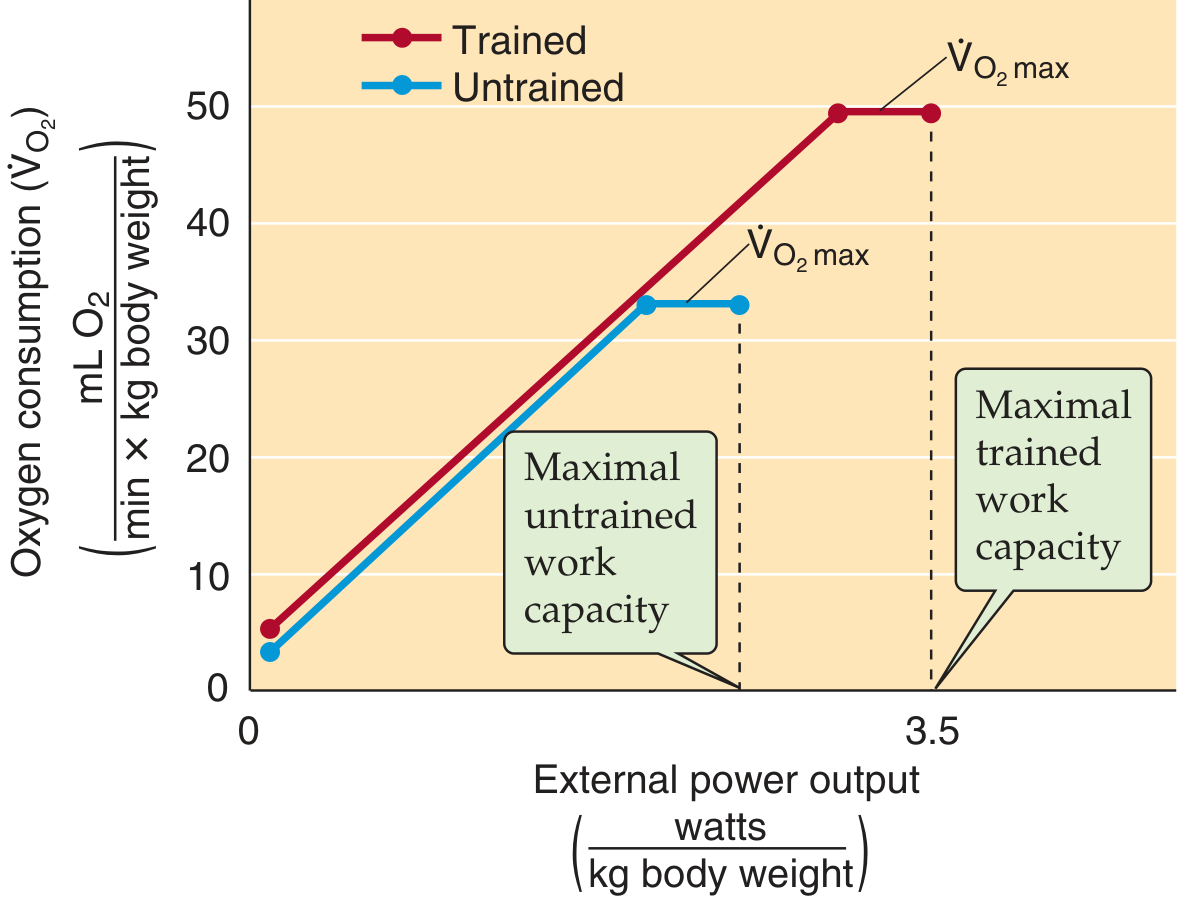
A mildly active 31-year-old man typically has a VO2 max of 35-45 mL O2/min/kg. A 3-month aerobic conditioning program can raise it by >20% - Medical Physiology, p. 1773.
Baseline Reference for a 31-Year-Old Male
| Fitness Level | VO2 Max (mL/kg/min) |
|---|---|
| Poor | <38 |
| Fair | 38-43 |
| Good | 44-51 |
| Excellent | 52-60 |
| Superior (athlete) | >60 |
Treadmill Training Methods
1. High-Intensity Interval Training (HIIT) - Most Effective
The 4x4 Protocol (Gold Standard)
- Warm-up: 10 min easy jog
- Main set: 4 intervals x 4 minutes at 90-95% max heart rate
- Recovery: 3 minutes easy jog/walk between intervals
- Cool-down: 5-10 min
- Frequency: 2-3x/week
- Duration: 8-10 weeks produces significant VO2 max gains
This is the most well-studied treadmill HIIT protocol. Multiple meta-analyses confirm HIIT produces superior VO2 max improvements compared to continuous aerobic exercise alone (PMID: 40312686, PMID: 38718488).
Max Heart Rate estimate (31-year-old male): 220 - 31 = ~189 bpm; target 170-180 bpm during intervals.
Why it works: Repeated near-maximal cardiac output demand forces central (heart stroke volume) and peripheral (muscle capillary density, mitochondrial biogenesis) adaptations simultaneously.
2. VO2 Max Sprint Intervals (Short, Very High Intensity)
Protocol:
- Warm-up: 15 min progressive easy jog
- Main set: 6-8 x 60-90 second sprints at true maximal effort (~100% VO2 max pace)
- Recovery: 3 min easy jog between sprints
- Cool-down: 7-10 min
- Frequency: 1x/week
- Progression: Start with 6 intervals, advance to 12 over several weeks, reduce recovery to 2 min
Best for runners who are already fit and want to push the upper ceiling. The fast leg turnover and high cadence target neuromuscular efficiency alongside VO2 max.
3. Tempo/Threshold Running (Sustained Moderate-High Intensity)
Protocol:
- Run at lactate threshold pace = roughly 85-90% max HR, a "comfortably hard" pace you can hold for 20-40 minutes
- Duration: 20-40 min continuous
- Frequency: 1-2x/week
- Incline: Can add 1-2% grade on treadmill to simulate outdoor running resistance
Lactate threshold training improves the fraction of VO2 max you can sustain for longer durations. It doesn't push VO2 max ceiling as much as HIIT but significantly improves race performance and time to exhaustion.
4. Long Slow Distance (LSD) / Continuous Aerobic Training
Protocol:
- Run at 65-75% max HR (~123-142 bpm for a 31-year-old)
- Duration: 30-60 minutes
- Frequency: 2-3x/week
- Incline options: Flat or variable 1-3% grade
This is the foundation. It builds aerobic base, increases mitochondrial density, improves fat oxidation, and enhances capillary supply to muscles. Less effective at raising VO2 max ceiling than HIIT but essential for recovery and volume.
5. Progressive Overload / Incremental Treadmill Protocol
Protocol (based on the Bouchard/HERITAGE model):
- Week 1-2: 30 min at 55% VO2 max pace (easy, conversational)
- Week 3-4: Increase pace by ~0.5 mph or 1% grade
- Repeat progression every 2 weeks
- Goal: By week 14, running 50 min at 75% VO2 max
This structured progression produced a mean VO2 max increase of ~0.4 L/min in sedentary adults over 20 weeks (PMC3774727).
6. Incline/Hill Treadmill Training
Protocol:
- Set treadmill to 5-10% incline
- Run or power-walk at moderate-high effort (80-85% max HR)
- Duration: 20-30 min
- Frequency: 1-2x/week
Incline running recruits more muscle mass (glutes, hamstrings, calves) compared to flat running at the same speed, producing a higher metabolic demand and oxygen cost per session without increasing injury risk from high speed.
7. Polarized Training (for those training 4+ days/week)
80/20 Split:
- 80% of weekly training volume at LOW intensity (below 75% max HR)
- 20% of weekly training volume at HIGH intensity (above 90% max HR)
- Avoid the "moderate" zone (75-85% HR)
Research consistently shows this distribution outperforms threshold-heavy programs for trained individuals doing high weekly volume. It prevents chronic fatigue while maintaining adaptation stimulus.
Combined Program: 8-10 Week Plan for a 31-Year-Old Male
| Day | Session | Intensity |
|---|---|---|
| Monday | 4x4 HIIT intervals | 90-95% max HR |
| Tuesday | Rest or easy walk | - |
| Wednesday | LSD run 35-40 min | 65-75% max HR |
| Thursday | Rest | |
| Friday | Tempo run 20-25 min | 85-90% max HR |
| Saturday | Long run 45-60 min | 65-70% max HR |
| Sunday | Rest |
Key Physiological Targets
| Adaptation | Method That Best Drives It |
|---|---|
| Increased stroke volume (cardiac output) | HIIT, 4x4 intervals |
| Mitochondrial biogenesis | LSD + HIIT combination (PMID: 38062841) |
| Capillary density in muscle | LSD, progressive overload |
| Lactate buffering / threshold | Tempo runs |
| Neuromuscular efficiency | Sprint intervals |
Practical Tips
- Heart rate monitor is essential - all these protocols hinge on hitting the correct intensity zones.
- Minimum 6-8 weeks before measuring meaningful VO2 max change. 12 weeks is ideal.
- Recovery matters - VO2 max adaptations occur during rest, not during the run itself.
- Hydration and altitude: Blood volume is a key determinant. Adequate hydration and sleep directly support VO2 max gains.
- Body weight reduction also increases relative VO2 max (mL/kg/min) even without improving absolute O2 uptake.
Sources: Medical Physiology (Boron & Boulpaep), p. 1773 | PMID: 38062841 (HIIT + mitochondria, 2023) | PMID: 40312686 (HIIT in young adults, 2025) | PMC3774727 (VO2 max trainability meta-analysis)
Can option 2 be done at 90 to 95 percent max hr 1 time per week, is it as beneficial, if so the protocol
Yes, the VO2 max sprint interval session can absolutely be modified to 90-95% max HR (instead of true 100% sprints) and done once per week - it remains highly beneficial, especially when combined with the rest of your weekly training.
Researching further...
Searching PubMed
VO2max sprint interval training once weekly frequency
Searching the Web
VO2 max sprint intervals 90-95% max HR once per week protocol benefits evidence
Searching PubMed
interval training frequency once weekly VO2max aerobic fitness
Good - I have solid evidence from the landmark Helgerud 2007 study and meta-analysis data to give a thorough, direct answer. Here it is:
Modified Option 2: Sprint Intervals at 90-95% Max HR, Once Per Week
Short Answer - Is it Beneficial?
Yes, absolutely. Running sprint intervals at 90-95% max HR (rather than true 100% all-out sprints) is actually the intensity that most of the research supports. The landmark Helgerud et al. 2007 study that validated this entire method used exactly 90-95% max HR - not 100%. So you're not watering it down, you're matching the evidence-based protocol.
Once per week is sufficient stimulus for meaningful VO2 max improvement, particularly when the rest of your week includes complementary training (easy runs, tempo). The evidence recommends 1-3 sessions/week - 1x is the entry point, not the bottom scrape.
For a 31-year-old male, max HR ≈ 189 bpm, so target zone = 170-179 bpm during work intervals.
The Protocol
Warm-Up (15 minutes)
| Time | Action | Intensity |
|---|---|---|
| 0-5 min | Easy jog | 55-60% max HR (~104-113 bpm) |
| 5-10 min | Progressive jog, slightly faster | 65-70% max HR (~123-132 bpm) |
| 10-13 min | Comfortable run | 70-75% max HR (~132-142 bpm) |
| 13-15 min | 2-3 x 20-sec strides (short accelerations), walk back | ~85% max HR briefly |
Main Set (starting point - Week 1-2)
6 intervals x 60-90 seconds at 90-95% max HR (170-179 bpm)
| Interval | Work | Recovery |
|---|---|---|
| 1 | 60-90 sec hard run (170-179 bpm) | 3 min easy jog/walk |
| 2 | 60-90 sec hard run | 3 min easy jog/walk |
| 3 | 60-90 sec hard run | 3 min easy jog/walk |
| 4 | 60-90 sec hard run | 3 min easy jog/walk |
| 5 | 60-90 sec hard run | 3 min easy jog/walk |
| 6 | 60-90 sec hard run | 3 min easy jog/walk |
Cool-Down (10 minutes)
- 5-7 min easy jog (55-60% max HR)
- 3-5 min walk + leg shake-out
Total session time: ~45-50 minutes
Progression Over 10 Weeks
| Phase | Intervals | Work Duration | Recovery | Notes |
|---|---|---|---|---|
| Weeks 1-2 | 6 | 60 sec | 3 min | Build comfort with intensity |
| Weeks 3-4 | 7 | 75 sec | 3 min | Add 1 rep + slight duration |
| Weeks 5-6 | 8 | 90 sec | 3 min | Full starting target |
| Weeks 7-8 | 8-10 | 90 sec | 2.5 min | Reduce recovery |
| Weeks 9-10 | 10-12 | 90 sec | 2 min | Peak challenge |
How to Hit 90-95% on a Treadmill
The challenge with treadmills is the belt speed lag - your HR won't spike until 30-45 seconds in. Two approaches:
Option A - Speed-based
- Find a pace during warm-up that puts you at ~85% HR
- Add 0.8-1.2 mph for your intervals
- For most trained 31-year-old males this is roughly 9.5-11.5 mph depending on fitness
Option B - Incline-based (lower injury risk)
- Keep speed constant at a comfortable hard run (e.g., 7-8 mph)
- Bump incline to 4-6% during intervals to drive HR up to 90-95%
- Return to 0-1% incline during recovery
- This is easier on knees than high-speed flat running
Option C - Combined
- Moderate incline (2-3%) + speed increase
- More sport-specific, closest to outdoor running feel
Is Once Per Week As Effective As 2-3x Per Week?
Honestly - no, not equally effective in absolute terms. The studies showing the largest VO2 max gains (7-13% in 8 weeks, per Helgerud 2007 - PMID 17414804) used 3 sessions per week. However:
- Once per week still produces meaningful and measurable VO2 max improvement (estimated 3-6% over 8-10 weeks) when combined with other training
- For a healthy 31-year-old male who is also doing tempo runs and LSD on other days, 1 high-intensity session/week is appropriate and sustainable long-term
- Recovery quality is better with 1x/week - the adaptation actually occurs during rest, and overloading with 3x/week of 90-95% HR work is a fast path to overtraining for most non-elite athletes
- The PMC8294064 review confirms 1 session/week is the minimum effective dose when embedded within a broader training program
Bottom line: Once per week at 90-95% max HR is the sweet spot for most recreational runners - enough stimulus to drive adaptation, enough recovery to actually absorb it.
Rate of Perceived Exertion (RPE) Guide for 90-95% HR
If you don't have a HR monitor handy, use these cues during intervals:
- You cannot hold a conversation - even one word is hard
- Breathing is very loud and rapid
- Legs feel heavy and burning toward the end
- You feel like you could not hold the pace more than 2-3 more minutes
- Borg scale: 17-18 out of 20 ("very hard")
This is a shared conversation. Sign in to Orris to start your own chat.