
Coagulation cascade simplify
coagulation cascade
coagulation cascade intrinsic extrinsic common pathway Merck Manual
Coagulation cascade, simplified
Injury → factor activation chain → thrombin → fibrin clot
1. Primary hemostasis first
- Blood vessel constricts
- Platelets stick to the damaged area and form a quick, temporary plug
2. Two pathways start the cascade
| Pathway | Trigger | Key factors | Lab test |
|---|---|---|---|
| Extrinsic | Tissue injury exposes tissue factor (III) | VII | PT/INR |
| Intrinsic | Blood contacts damaged/abnormal surface | XII, XI, IX, VIII | aPTT |
Easy mnemonic
- Extrinsic = 7
- Intrinsic = 12, 11, 9, 8
- Common = 10, 5, 2, 1
3. Both meet at the common pathway
Extrinsic: tissue factor + VII
                    ↓
Intrinsic: XII → XI → IX + VIII
                    ↓
              Factor X activated
                    ↓
               Xa + Va
                    ↓
      Prothrombin (II) → Thrombin (IIa)
                    ↓
     Fibrinogen (I) → Fibrin
                    ↓
       Factor XIII cross-links fibrin
                    ↓
           Stable blood clot
The high-yield core
Factor X becomes Xa. Xa converts prothrombin to thrombin.
Thrombin converts fibrinogen to fibrin.
Fibrin forms the stable clot.
Why thrombin matters
- Converts fibrinogen to fibrin
- Activates factors V, VIII, XI, and XIII
- Activates platelets
- Amplifies clot formation
Real-life note
Clinical links
- Warfarin reduces vitamin K-dependent factors: II, VII, IX, X. It mainly prolongs PT/INR.
- Heparin enhances antithrombin, inhibiting mainly IIa (thrombin) and Xa. Unfractionated heparin prolongs aPTT.
- Hemophilia A: factor VIII deficiency, intrinsic pathway, prolonged aPTT.
- Hemophilia B: factor IX deficiency, intrinsic pathway, prolonged aPTT.
- Factor XIII deficiency: a clot may initially form but is poorly stabilized because fibrin cannot be properly cross-linked.
One-line memory aid
“7 starts it, 10 joins it, 5 helps it, 2 makes thrombin, 1 makes fibrin, 13 locks it.”
Create a one-page coagulation cascade cheat sheet
blood coagulation cascade
coagulation cascade intrinsic extrinsic common pathway laboratory tests PT aPTT official
A one-page study cheat sheet titled “COAGULATION CASCADE”. Include a clean accurate flow diagram: vessel injury leads to platelet plug (primary hemostasis), then two secondary-hemostasis paths. Extrinsic pathway: Tissue factor (III) + VII → X. Intrinsic pathway: XII → XI → IX + VIII → X. Common pathway: X + V → II (prothrombin) → IIa (thrombin) → I (fibrinogen) → fibrin; XIII cross-links fibrin to make a stable clot. Include a lab-test box: PT/INR tests extrinsic + common and aPTT tests intrinsic + common. Include a memory box: ‘Extrinsic: 7. Intrinsic: 12, 11, 9, 8. Common: 10, 5, 2, 1, 13.’ Include a clinical box: Hemophilia A = VIII deficiency, Hemophilia B = IX deficiency, warfarin affects II, VII, IX, X, heparin enhances antithrombin against IIa and Xa. Make every arrow and factor label large, legible, and high contrast for printing.
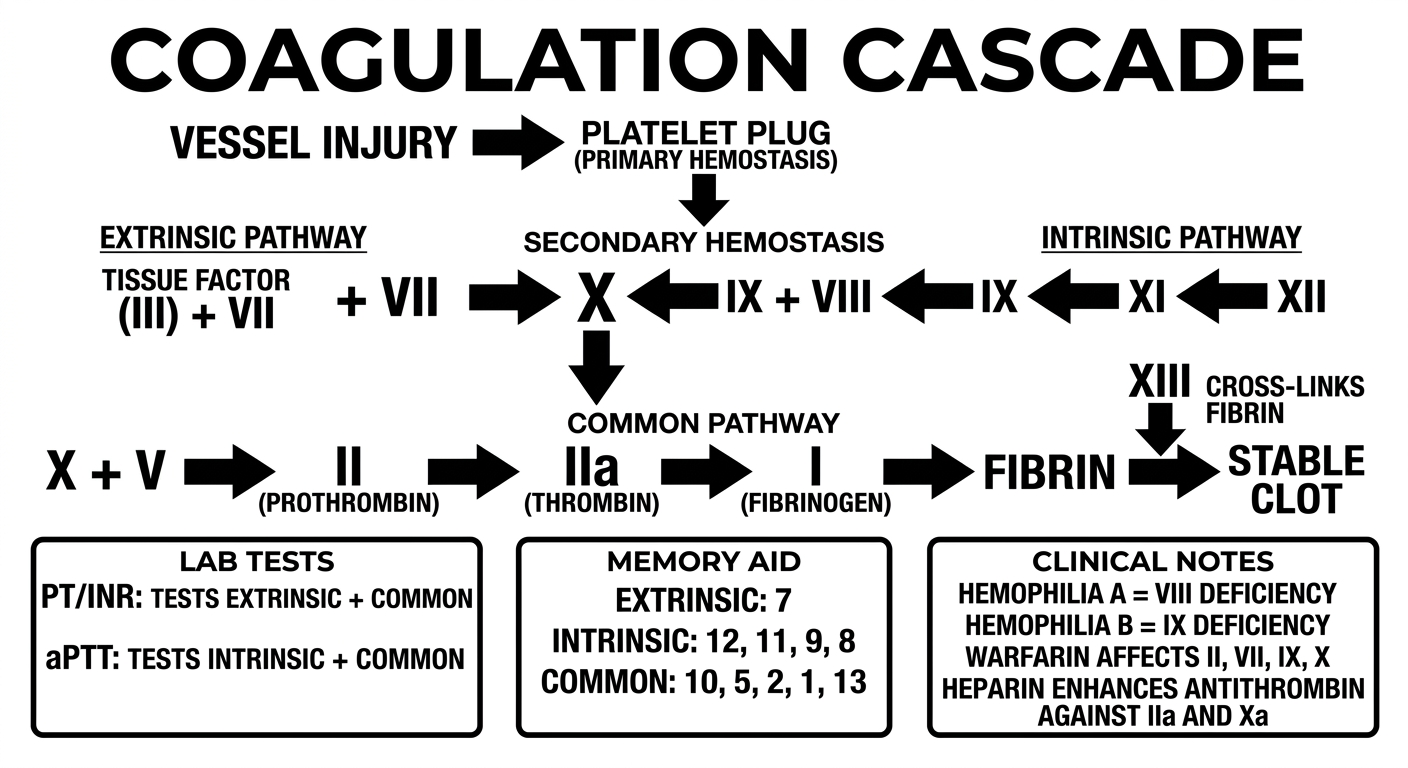
7 starts the extrinsic pathway.
12, 11, 9, 8 are intrinsic.
10, 5, 2, 1, 13 form and stabilize the fibrin clot.
Create a coagulation cascade vs anticoagulants comparison table
anticoagulants factor Xa thrombin
anticoagulant reversal agents warfarin heparin direct thrombin factor Xa FDA
Coagulation cascade vs anticoagulants
| Cascade target | Normal role in clotting | Anticoagulant class | Examples | How it works | Monitoring / reversal |
|---|---|---|---|---|---|
| Vitamin K-dependent factor production: II, VII, IX, X | Provides several factors needed across the cascade | Vitamin K antagonist | Warfarin | Decreases hepatic synthesis of functional factors II, VII, IX, X | PT/INR monitoring. Reversal: vitamin K, with 4-factor PCC for major bleeding |
| Antithrombin | Natural inhibitor of thrombin and Xa | Unfractionated heparin (UFH) | Heparin | Potentiates antithrombin, inhibiting mainly IIa (thrombin) and Xa | aPTT or anti-Xa. Reversal: protamine |
| Factor Xa, indirectly | Xa forms the prothrombinase complex with Va and converts II to IIa | LMWH | Enoxaparin, dalteparin | Antithrombin-mediated inhibition, mainly of Xa | Usually no routine test; anti-Xa in selected cases. Protamine gives partial reversal |
| Factor Xa, indirectly | Same Xa step | Indirect Xa inhibitor | Fondaparinux | Antithrombin-mediated, selective Xa inhibition | Usually no routine test; protamine does not reverse it reliably |
| Factor Xa, directly | Xa converts prothrombin to thrombin | Direct oral Xa inhibitors | Apixaban, rivaroxaban, edoxaban | Directly inhibits Xa, reducing thrombin generation | Routine PT/aPTT is unreliable for drug level. Specific reversal: andexanet alfa for apixaban/rivaroxaban in appropriate major bleeding settings |
| Thrombin (IIa) | Converts fibrinogen (I) into fibrin | Direct thrombin inhibitor, oral | Dabigatran | Directly inhibits thrombin | aPTT may suggest presence but is not a precise measure. Reversal: idarucizumab |
| Thrombin (IIa) | Same final fibrin-forming enzyme | Parenteral direct thrombin inhibitors | Argatroban, bivalirudin | Direct thrombin inhibition | aPTT commonly used. No routinely used specific antidote |
| Fibrin formation | Thrombin converts fibrinogen to fibrin; XIII cross-links it | No major standard drug directly targets fibrinogen or XIII | - | Most anticoagulants act upstream by reducing Xa or thrombin activity | - |
Put it onto the cascade
Intrinsic:  XII → XI → IX + VIII
                         ↓
Extrinsic: Tissue factor + VII
                         ↓
                       X → Xa  ← LMWH, fondaparinux, apixaban/rivaroxaban/edoxaban
                         ↓
               II (prothrombin) → IIa (thrombin)  ← UFH, dabigatran, argatroban, bivalirudin
                         ↓
             I (fibrinogen) → fibrin → XIII cross-linked stable clot

Warfarin lowers production of: II, VII, IX, X
Exam shortcuts
- Warfarin: decreases 2, 7, 9, 10; check PT/INR.
- UFH: inhibits 2a and 10a through antithrombin; check aPTT.
- LMWH: predominantly inhibits 10a through antithrombin.
- DOAC Xa inhibitors: end in -xaban and inhibit Xa.
- Dabigatran: direct thrombin (IIa) inhibitor.
- Antiplatelet drugs such as aspirin or clopidogrel are different: they impair the platelet plug in primary hemostasis, rather than the coagulation-factor cascade.