
High output GI fistula management
I'll read the medical library skill first, then search for high output GI fistula management content in parallel.
Reading File
Now I'll run parallel searches across the textbook library and PubMed simultaneously.
Finding Sources
Finding Sources
Searching PubMed
"enterocutaneous fistula" AND "high output" AND management
Excellent sources found. Now I'll read the most relevant blocks in parallel - Fischer's Mastery of Surgery, Current Surgical Therapy, and Yamada's/Sleisenger for fistula management.
Reading File
Reading File
Reading File
Now let me read the dedicated ECF sections from Fischer's Mastery of Surgery and Current Surgical Therapy for the full management algorithms.
Reading File
Reading File
Finding Sources
Excellent. Let me now read the Sleisenger somatostatin section and Schwartz/Sabiston ECF sections for the full picture.
Reading File
Reading File
Reading File
Let me get the Maingot's approach table and Sleisenger's somatostatin section to complete the picture, plus fetch the treatment algorithm image.
Reading File
Reading File
Loading Image
Now I have comprehensive data from multiple authoritative surgical textbooks. Let me compile the full answer.
High-Output GI Fistula Management
Definition and Classification
An enterocutaneous fistula (ECF) is classified by daily output volume:
| Category | Volume (mL/day) |
|---|---|
| Low output | < 200 |
| Moderate output | 200 - 500 |
| High output | > 500 |
Note: Some texts (Schwartz, Current Surgical Therapy) use >500 mL/day as the threshold for "high output," while Maingot's applies >500 mL/day as well. Fischer's Mastery uses >500 mL/day consistently.
High-output fistulas carry substantially higher mortality. Maingot's cites a 50-54% mortality in high-output ECF vs. 16-26% in low-output fistulas.
Pathophysiology and Consequences
High fistula output leads to:
- Volume depletion and electrolyte imbalances - loss of Na, K, HCO3-, Cl in quantities depending on origin (proximal > distal)
- Protein losses through the fistula effluent, worsening existing catabolism
- Malnutrition - both a consequence and a contributing factor; high-output ECF itself accelerates malnutrition
- Skin excoriation from caustic effluent (especially small bowel/pancreatic content)
- Sepsis from peritoneal contamination
The SNAP Framework (Schwartz's ordered approach)
Management proceeds through a defined sequence:
- Stabilization - Fluid/electrolyte resuscitation, nutrition support, sepsis control, skin protection
- Investigation - Define fistula anatomy (CT with enteral contrast, small bowel series, fistulogram)
- Decision - Conservative vs. surgical; establish timeline
- Definitive Management - Planned surgical repair
- Rehabilitation
A useful mnemonic from Maingot's is SNAP: Sepsis control, Nutrition, Anatomy, Procedure.
1. Sepsis Control (Priority #1)
- Establish adequate drainage immediately - percutaneous catheter placement to drain collections; abdominal exploration for peritonitis when needed
- Broad-spectrum antibiotics targeting enteric flora
- Percutaneous or surgical abscess drainage
- Do NOT attempt definitive fistula repair at the time of initial sepsis control - it almost always fails
- Diverting enterostomies placed when appropriate
- Consult IR for image-guided drain placement
2. Fluid and Electrolyte Replacement
Replacement must be tailored to fistula origin (see electrolyte composition by location):
| Source | Volume (mL/day) | Na | K | HCO3- | Cl |
|---|---|---|---|---|---|
| Gastric | 2000-2500 | Low | Low | Low | High |
| Small bowel | 3000-6000 | High | Moderate | High | High |
| Pancreatic | 500-1000 | High | Low | Very high | Low |
| Biliary | 500-1000 | High | Low | High | High |
Replace losses ml-for-ml with appropriate crystalloid. Monitor serum electrolytes daily.
3. Wound Care and Skin Protection
- Consult Wound, Ostomy, and Continence Nurses (WOCN) - essential
- Protect perilesional skin with hydrocolloid barriers (DuoDerm, stoma powder, ion exchange resin)
- For simple/small ECF: manage like a stoma; apply pouching system
- VAC (vacuum-assisted closure) devices: very effective for low/moderate-output ECF (>85% closure). High-output ECF has lower VAC success rates; fistulas with visible mucosa are unlikely to close with VAC
- For complex/enteroatmospheric fistulas: modified sump tubes (latex Robinson nephrostomy tubes with Intracath to break suction) placed under a VAC device, connected to continuous suction
- Goal: protect skin + quantify output
4. Nutritional Support
This is the cornerstone of management. Malnourished patients fail to close spontaneously and face higher operative complications.
High-output ECF: Make the patient NPO + Start TPN
- NPO + TPN is the standard approach for high-output ECF (>500 mL/day)
- Enteral nutrition alone is generally not feasible in high-output proximal fistulas
- TPN reduces intestinal secretions and fistula output by eliminating luminal stimulation
- Protein target: 1.5-2.0 g/kg/day; increase further with enteroatmospheric fistula
- Calorie target: 25-35 kcal/kg/day; indirect calorimetry preferred in complex cases
- Monitor for refeeding syndrome when restarting nutrition (watch phosphate, K, Mg)
When enteral nutrition is possible:
- If fistula is distal (colon, distal ileum) and low/moderate output, try enteral feeding
- If a surgical feeding jejunostomy was placed, feed distally while the proximal fistula drains
- Fistuloclysis (fistulolysis): reinfusion of fistula effluent into the efferent distal limb - makes fluid/electrolyte management easier and decreases proximal output. Effective in selected patients without distal obstruction
- Glutamine-supplemented formulas may benefit; TPN with oral glutamine supplementation has shown some benefit for spontaneous closure
- Note: TPN alone leads to gut mucosal atrophy - supplement enterally when feasible
5. Pharmacologic Output Reduction
Treatment Algorithm for High-Output ECF (Fischer's Mastery of Surgery, Fig. 130.2):
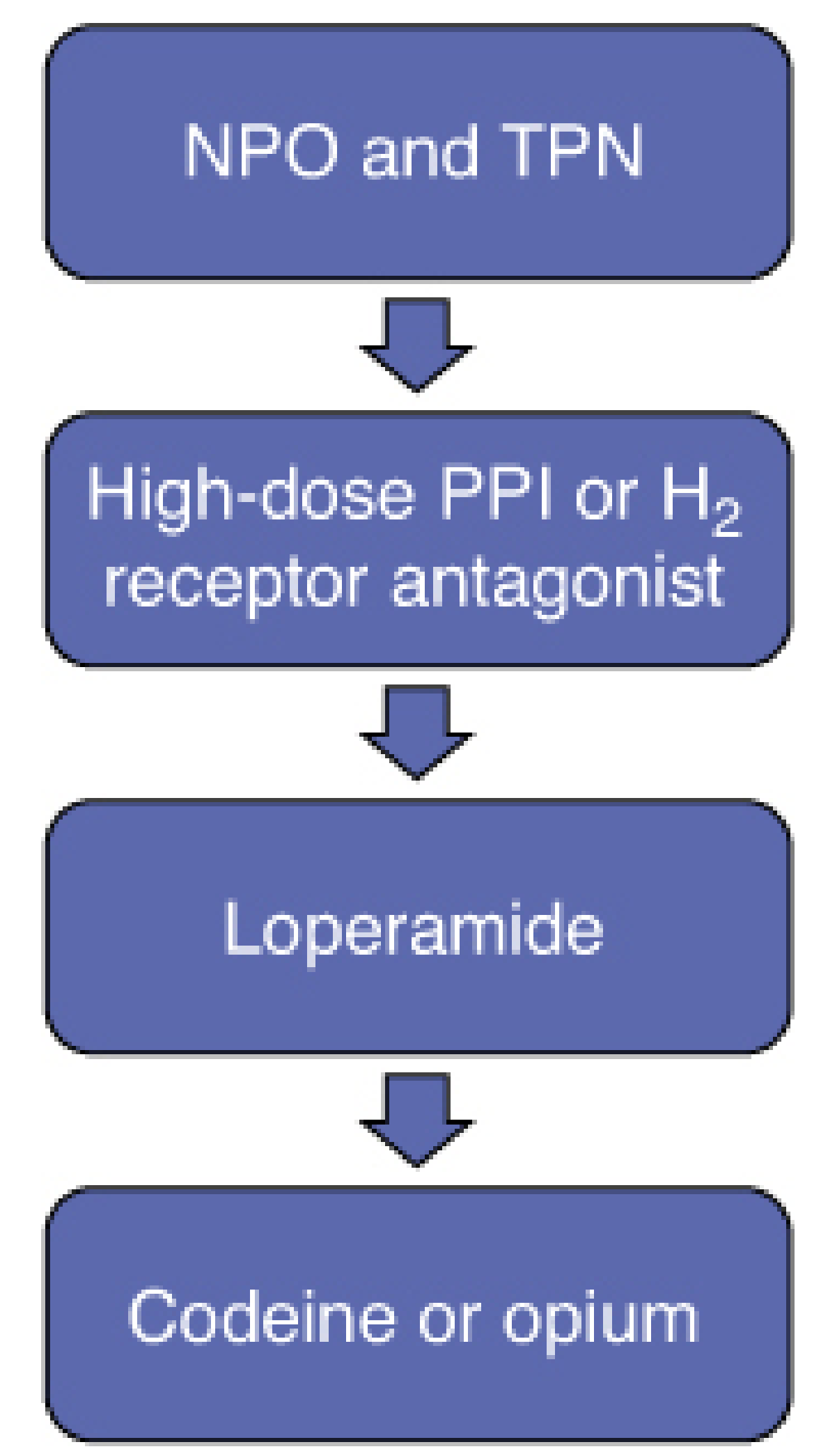
Step 1 - NPO + TPN (as above)
Step 2 - Antisecretory agents:
- High-dose PPI (e.g., omeprazole 40 mg IV BID) - reduces gastric acid and overall luminal volume
- H2 receptor antagonist as alternative; also used for refractory hypomagnesemia
- Rationale: reduces gastric secretion, decreasing total luminal fluid load
Step 3 - Antimotility agents:
- Loperamide: start 2-4 mg four times daily; max 8 mg four times daily. Dose individually based on short gut status
- Add codeine: start 10 mg TID; up to 20 mg TID
- Or tincture of opium: 0.5 mL (10 mg/mL) four times daily
- Note: opioid antimotility agents are not first-line due to risk of dependence/tolerance
Step 4 - Somatostatin analogs:
- Octreotide or lanreotide as adjunct to TPN
- Mechanisms: (1) inhibits gastrin, CCK, secretin and other GI hormones, reducing water/electrolyte/enzyme secretion; (2) relaxes intestinal smooth muscle, increasing capacity; (3) increases intestinal water/electrolyte absorption
- Dose: continuous infusion 50-250 mcg/hr OR subcutaneous 50-150 mcg TID; start low and titrate
- Meta-analyses show somatostatin analogs: reduced fistula output, shorter time to closure, shorter hospital stay - but no significant improvement in mortality or ultimate closure rate
- Octreotide converts high-output ECF to low-output ECF, which then can close spontaneously
- 72-hour rule: if output does not decrease within 72 hours of starting, discontinue octreotide
- Risks: gallstones, cholecystitis, hyperglycemia, mucosal atrophy
- Special role: octreotide may increase spontaneous closure rate specifically for pancreatic fistulas
6. Crohn's Disease-Related ECF
When the underlying cause is Crohn's disease, biologic therapy can achieve spontaneous closure:
- Infliximab (anti-TNF-alpha): ~50% complete spontaneous closure of all ECFs after 3 doses (5 mg/kg at weeks 0, 2, 6). Long-term remission is lower (~15%)
- Adalimumab alone or combined with infliximab: some benefit
- Ensure sepsis is controlled before starting biologics (immunomodulatory risk)
- Success is higher with simple ECF without distal stenosis
7. Factors Preventing Spontaneous Closure (Schwartz/Fischer)
The mnemonic FRIENDS captures most:
| Factor | Effect |
|---|---|
| Foreign body (mesh, suture) | Blocks closure |
| Radiation to fistula field | Impairs healing |
| Inflammation/Infection (ongoing sepsis) | Prevents closure |
| Epithelialization of tract | Permanent tract |
| Neoplasm (malignant fistula) | Cannot close |
| Distal obstruction | Diverts flow through fistula |
| Short tract (<2 cm) / Steroids | Mechanical + pharmacologic |
Also: Crohn's disease, poor nutrition, gastric/duodenal origin (high secretory load).
8. Surgical Management
Timing
- Do NOT operate within the first 4-6 weeks of ECF diagnosis (frozen abdomen from inflammation)
- Optimal timing: 3-6 months after initial sepsis control, once:
- Nutritional status optimized
- Sepsis fully resolved
- Abdominal wall softened
- Complete anatomic delineation achieved
Operative principles
- Resect fistula and diseased bowel segment; primary anastomosis
- Avoid anastomosis in irradiated, inflamed, or poorly perfused tissue
- Definitive repair at time of initial peritonitis washout almost never succeeds
9. Monitoring
- Daily fistula output measurement
- Serum electrolytes, BUN/Cr, Mg, phosphate, zinc daily (initially)
- Nutritional markers (prealbumin, transferrin) weekly
- Blood glucose (especially with octreotide/TPN)
- RFTs if nephrotoxic antibiotics used
- Wound reassessment for skin breakdown
Key Points Summary
| Domain | High-Output ECF (>500 mL/day) |
|---|---|
| Nutrition | NPO + TPN; protein 1.5-2 g/kg/day |
| Antisecretory | High-dose PPI or H2RA |
| Antimotility | Loperamide (first line among antimotility agents); add codeine/opium if needed |
| Somatostatin | Octreotide SC/IV; stop if no response in 72h |
| Sepsis | Drainage + antibiotics; no definitive repair during acute phase |
| Wound | WOCN consult; VAC less reliable; custom sump + VAC for complex/EAF |
| Surgery | Defer 3-6 months; plan resection + anastomosis |
| Crohn's | Infliximab after sepsis control |
Sources: Fischer's Mastery of Surgery 8e, p. 3476-3479 | Schwartz's Principles of Surgery 11e, p. 1268 | Sleisenger & Fordtran's GI and Liver Disease, p. 441-442 | Current Surgical Therapy 14e, p. 1646 | Maingot's Abdominal Operations, p. 224
Recent literature: A 2025 review (Kumpf & Yeh, PMID 39601380) specifically addresses parenteral nutrition in ECF management. A 2022 review (Ghimire, PMID 35199684) provides a current overview of ECF management. No recent meta-analyses contradict these textbook recommendations.
Search for recent clinical guidelines on enterocutaneous fistula management 2024-2026
Searching PubMed and the web simultaneously for the most recent ECF guidelines.
Searching PubMed
"enterocutaneous fistula" AND guideline
Searching the Web
enterocutaneous fistula management clinical guidelines 2024 2025 2026
Searching PubMed
"intestinal fistula" AND ("consensus" OR "guideline" OR "practice update")
Good hits. Now let me pull abstracts for the three most relevant ones - the ESPEN 2023 guideline, the GETECCU 2025 position paper, and the 2025 PN review - and search for ASPEN/SCCM and WSES guidelines simultaneously.
Reading Article
PMID: 37639741
Reading Article
PMID: 39601380
Reading Article
PMID: 40250758
Searching PubMed
"enterocutaneous fistula" AND ("ASPEN" OR "ESPEN" OR "WSES" OR "nutrition" OR "surgical")
Excellent - two very fresh 2026 reviews found. Let me pull their abstracts in parallel alongside the 2022 meta-analysis.
Reading Article
PMID: 41945042
Reading Article
PMID: 42356313
Reading Article
PMID: 35915291
I now have a comprehensive picture. Here is the full curated summary of recent clinical guidelines and evidence.
Recent Clinical Guidelines & Evidence on ECF Management (2022-2026)
Here is everything published in the peer-reviewed literature in the last 2-4 years, ranked by evidence level and relevance.
1. ESPEN Guideline on Chronic Intestinal Failure - Update 2023
Pironi L et al. | Clinical Nutrition | Oct 2023 | PMID 37639741
- Type: Practice Guideline (Evidence Tier 6)
- Issuing body: European Society for Clinical Nutrition and Metabolism (ESPEN)
Key content:
- Updated the 2016 ESPEN CIF guideline with 149 recommendations and 16 statements
- Added a new dedicated chapter on chronic enterocutaneous fistulas, recognizing them as a distinct clinical entity within intestinal failure
- 99.3% of recommendations achieved "strong consensus"
- Confirms that CIF (including chronic ECF) management requires multidisciplinary teams at specialized IF centers, home parenteral nutrition (HPN) infrastructure, and expertise in the underlying GI disease
- Most recommendations graded as GPP (Good Practice Points, 64%), reflecting the ongoing lack of high-quality RCT evidence in this field
- Grading: A = 3.4%, B = 12.7%, 0 = 19.5%, GPP = 64.4%
Significance: The only major society guideline to explicitly address chronic ECF within intestinal failure. No high-output-specific dosing algorithms, but confirms TPN/HPN as the central nutritional strategy.
2. GETECCU Position Paper: Non-Perianal Fistulizing Crohn's Disease
Rodríguez-Lago I et al. | Gastroenterología y Hepatología | Aug-Sep 2025 | PMID 40250758
- Type: Practice Guideline / Position Paper (Evidence Tier 6)
- Issuing body: Spanish Working Group in Crohn's Disease and Ulcerative Colitis (GETECCU)
Key content:
- Addresses entero-enteric, entero-urinary, and entero-cutaneous fistulas in Crohn's disease - a gap explicitly noted in current guidelines
- Recommends a multidisciplinary strategy combining medical, interventional, and surgical approaches
- Emphasizes biologics (especially anti-TNF agents) as core medical therapy after sepsis control
- Acknowledges that evidence for specific therapies in non-perianal fistulas remains limited, and most current guidelines do not provide dedicated recommendations for this subtype
Significance: First major position paper to fill the explicit gap in guidelines regarding non-perianal (including EC) fistulizing Crohn's. Directly relevant when Crohn's is the underlying etiology.
3. Parenteral Nutrition in ECF Management - ASPEN-Affiliated Expert Review
Kumpf VJ & Yeh DD | Nutrition in Clinical Practice (ASPEN journal) | Feb 2025 | PMID 39601380
- Type: Expert Review with practice recommendations (Evidence Tier 7)
- Journal: Official publication of the American Society for Parenteral and Enteral Nutrition (ASPEN)
Key recommendations:
- Strict bowel rest + PN warranted on initial presentation for all ECF
- Transition to oral/enteral nutrition is feasible if output is low (<500 mL/day) and drainage is well controlled
- High-output ECF (>500 mL/day): PN required to meet fluid, electrolyte, and nutrient needs for spontaneous or surgical closure
- Discharge home on HPN should be considered when medically stable (acknowledges that healing can take months)
- Discharge criteria: stable fluid/electrolyte balance, glycemic control achieved, ECF output contained, patient/caregiver trained
- Outlines a long-term PN plan framework for outpatients: monitoring frequency, target weight, PN end-point determination
- Explicitly notes: "practice guidelines are often vague because of limited evidence" - current guidance relies heavily on expert consensus
Significance: Most current ASPEN-aligned practical guidance on PN use in ECF. Fills a gap since no dedicated standalone ASPEN ECF guideline exists.
4. Enterocutaneous Fistula: Update in 2026
Pastier C, Collard MK, Challine A et al. | Journal of Visceral Surgery | Apr 2026 | PMID 41945042
- Type: Comprehensive narrative review / update (Evidence Tier 7)
- The most current comprehensive ECF update available
Key updates vs. older guidelines:
| Domain | 2026 Update |
|---|---|
| Nutrition targets | 25-35 kcal/kg/day; protein 1.5-2.5 g/kg/day (higher ceiling than older texts, adjusted for degree of muscle wasting) |
| PN | Still central in the initial period |
| Fistuloclysis (chyme re-instillation) | Explicitly recommended when feasible (proximal + distal orifices individualized) - provides ileal brake effect, improved liver function, bowel stimulation |
| Enteral nutrition | Can be gradually increased as tolerated; oral nutrition now considered in well-controlled fistulas - highlighted for psychological benefit |
| Surgical timing | Traditionally >6 months, but new data supports early curative surgery (<4 months) in selected patients |
| Surgical principles | Complete viscerolysis, residual bowel length measurement, resection of fistulated segment, re-anastomosis; parietal closure may need component separation or flaps |
| Outcomes | ~80% success rate; recurrence ~17%; permanent stoma ~10% |
| Economic impact | ECF doubles hospitalization costs on average |
Significance: The most up-to-date single-source review on ECF as of mid-2026. Introduces the emerging concept of early surgery (<4 months) in selected patients - a shift from the traditional "wait 6 months" dogma.
5. Enterocutaneous Fistulas: Current Management (2026)
Rashed AM, Mendoza A, Yeh DD | Nutrients | Jun 2026 | PMID 42356313
- Type: Narrative review (Evidence Tier 7; open access via PMC)
- Published June 14, 2026 - the most recently published review in this search
Key points:
- Confirms standard staged approach: fluid resuscitation → sepsis control → wound management → nutritional optimization
- Spontaneous closure most commonly occurs within the first 2 months
- Roles of fistuloclysis, biologics, NPWT, and pharmacologic agents (octreotide, PPIs, antimotility agents) reviewed and confirmed
- Optimal surgical timing: at least 6-12 months from fistula development in non-selected patients (noting emerging data for earlier intervention in selected cases)
- Calls for standardization of treatment protocols and further research - no universal guideline currently exists
Significance: Most recently published review (June 2026); confirms and synthesizes current best practice.
6. Systematic Review and Meta-Analysis (2022)
Gefen R et al. | Techniques in Coloproctology | Nov 2022 | PMID 35915291
- Type: Systematic Review + Meta-Analysis (Evidence Tier 1)
- 53 studies, 3,078 patients, spanning 1975-2020
Quantitative outcomes:
- Overall healing rate: 89%
- Recurrence rate: 11.1%
- Mortality rate: 8.5%
- ECF was postoperative in 89.4% of cases
- 62.4% of patients received PN
- 72.5% ultimately underwent surgery
- Combined ECF takedown + abdominal wall reconstruction: 78% fascial closure; mesh used in 72%
- Treatment must be individualized to etiology, fistula location, and patient factors
Significance: The highest-quality evidence aggregate (systematic review + meta-analysis) for ECF treatment outcomes.
Summary: What Has Changed vs. Standard Textbook Teaching
| Topic | Classic Teaching | 2024-2026 Update |
|---|---|---|
| Protein target | 1.5-2.0 g/kg/day | Up to 2.5 g/kg/day for severe muscle wasting (2026) |
| Surgical timing | Always wait 3-6 months | <4 months feasible in selected patients (2026) |
| Oral nutrition | Avoid in high-output ECF | Can be considered when fistula well-controlled (psychological benefit) (2026) |
| Fistuloclysis | Mentioned, rarely formalized | Explicitly recommended when proximal+distal orifices are individualized (2026) |
| HPN/discharge | Implicitly mentioned | Formally addressed: criteria, monitoring plan, PN end-points (ASPEN 2025) |
| Crohn's ECF | Anti-TNF briefly mentioned | Dedicated position paper (GETECCU 2025) |
| Economic burden | Not formally quantified | ECF doubles hospitalization cost (2026 data) |
What Does NOT Yet Exist
- No dedicated ASPEN, SCCM, or WSES standalone guideline specifically for high-output ECF
- No RCT-based guideline recommendations; the ESPEN 2023 guideline itself notes 64% of recommendations are GPP-level
- No consensus on optimal octreotide dosing protocol
- No validated predictive tool for spontaneous closure
The closest to a unified, authoritative document is the ESPEN 2023 Chronic Intestinal Failure Guideline (PMID 37639741) combined with the 2026 Journal of Visceral Surgery update (PMID 41945042) for surgical and nutritional current practice.
PDF of both
Attempting to download both PDFs simultaneously.
Fetching Full Text
PMID: 37639741
Fetching Full Text
PMID: 41945042
This is a shared conversation. Sign in to Orris to start your own chat.