
Im 1st year mbbs student at Hngu university [ Bhagyoday medical college Kadi ] in exam imp questions list i saw one question is 8 mark question is Glycolysis [ cycle , energetic, regulation ] give a answer of this question easy to understand English language,when I read this question answer I understand easily, give answer this type when I read this question answer first time so much answer I understand easily in first time and when i write this in exam my sir will give me full out of full marks and easy to read and understand,answer give as 1 st year mbbs [ Biochemistry ]and easy to understand and write Thank you
Reading File
Finding Sources
Finding Sources
Now let me read the most relevant sections from Lippincott and Basic Medical Biochemistry - the best 1st year MBBS sources:
Reading File
Reading File
Reading File
Reading File
Reading File
Finding Sources
Reading File
Reading File
Reading File
I now have all the information needed to write a thorough, exam-ready answer. Let me compile it clearly.
GLYCOLYSIS - Complete 8 Mark Answer
(For 1st Year MBBS Biochemistry Exam)
DEFINITION
Glycolysis (from Greek: glykys = sweet, lysis = splitting) is the breakdown of one molecule of glucose (6-carbon) into two molecules of pyruvate (3-carbon), occurring in the cytosol of all cells.
- Aerobic glycolysis - occurs when oxygen is present; pyruvate enters the TCA cycle
- Anaerobic glycolysis - occurs without oxygen; pyruvate is converted to lactate
THE GLYCOLYTIC PATHWAY (10 Steps)
Glycolysis has two phases:
PHASE 1 - Energy Investment Phase (Steps 1 to 5)
ATP is consumed (2 ATP used). Glucose is prepared for splitting.
| Step | Reaction | Enzyme | ATP Change |
|---|---|---|---|
| 1 | Glucose → Glucose-6-phosphate (G-6-P) | Hexokinase (HK) | -1 ATP used |
| 2 | G-6-P → Fructose-6-phosphate (F-6-P) | Phosphoglucose isomerase | No change |
| 3 | F-6-P → Fructose-1,6-bisphosphate (F-1,6-bP) | Phosphofructokinase-1 (PFK-1) | -1 ATP used |
| 4 | F-1,6-bP → DHAP + Glyceraldehyde-3-phosphate (G-3-P) | Aldolase | No change |
| 5 | DHAP → Glyceraldehyde-3-phosphate (G-3-P) | Triose phosphate isomerase | No change |
After step 5, we have 2 molecules of G-3-P from 1 glucose. All following steps happen TWICE.
PHASE 2 - Energy Payoff Phase (Steps 6 to 10)
ATP is produced (4 ATP made). 2 NADH are also produced.
| Step | Reaction | Enzyme | Change |
|---|---|---|---|
| 6 | G-3-P → 1,3-bisphosphoglycerate | Glyceraldehyde-3-phosphate dehydrogenase | +2 NADH produced |
| 7 | 1,3-bisphosphoglycerate → 3-phosphoglycerate | Phosphoglycerate kinase | +2 ATP (substrate-level phosphorylation) |
| 8 | 3-phosphoglycerate → 2-phosphoglycerate | Phosphoglycerate mutase | No change |
| 9 | 2-phosphoglycerate → Phosphoenolpyruvate (PEP) | Enolase | No change |
| 10 | PEP → Pyruvate | Pyruvate kinase (PK) | +2 ATP (substrate-level phosphorylation) |
THE 3 IRREVERSIBLE STEPS (Important for exams!)
These 3 steps are irreversible under physiological conditions - they are also the regulatory steps:
- Step 1 - Hexokinase (Glucose → G-6-P)
- Step 3 - PFK-1 (F-6-P → F-1,6-bP) - rate-limiting step
- Step 10 - Pyruvate kinase (PEP → Pyruvate)
Memory tip: "HK + PFK + PK" - three kinases = three irreversible steps
ENERGETICS OF GLYCOLYSIS
Net ATP Yield
| ATP Used | ATP Produced | |
|---|---|---|
| Steps 1 & 3 (investment) | 2 ATP | - |
| Steps 7 & 10 (x2 each, payoff) | - | 4 ATP |
| NET GAIN | 2 ATP |
NADH Produced
- 2 NADH are produced at Step 6
Overall Equation:
Glucose + 2 ADP + 2 Pi + 2 NAD⁺ → 2 Pyruvate + 2 ATP + 2 NADH + 2 H₂O
In Aerobic Conditions (complete oxidation):
- The 2 NADH produced in the cytoplasm are transferred to mitochondria via shuttle systems
- Pyruvate enters TCA cycle and electron transport chain
- Total ATP from complete aerobic oxidation of 1 glucose = 30 to 32 ATP
In Anaerobic Conditions:
- Pyruvate is converted to lactate by lactate dehydrogenase
- NADH is re-oxidized to NAD⁺ (this regenerates NAD⁺ so glycolysis can continue)
- Net yield = only 2 ATP
- This occurs in: RBCs (no mitochondria), exercising skeletal muscle, kidney medulla
Overall Equation (Anaerobic):
Glucose + 2 ADP + 2 Pi → 2 Lactate + 2 ATP + 2 H₂O
REGULATION OF GLYCOLYSIS
Glycolysis is regulated mainly at the 3 irreversible steps. The key goal is to maintain ATP homeostasis - produce ATP when needed, slow down when energy is abundant.
1. Hexokinase (Step 1)
| Inhibitor | Activator |
|---|---|
| Glucose-6-phosphate (product inhibition) | Glucose (substrate) |
- In liver, glucokinase (HK IV) is used instead - it is not inhibited by G-6-P, allowing the liver to keep phosphorylating glucose even when G-6-P is high
2. Phosphofructokinase-1 / PFK-1 (Step 3) - MOST IMPORTANT REGULATORY STEP
| Inhibitors (slow glycolysis) | Activators (speed up glycolysis) |
|---|---|
| ATP (high energy signal) | AMP (low energy signal) |
| Citrate (TCA already active) | Fructose-2,6-bisphosphate (most potent activator) |
- Fructose-2,6-bisphosphate (F-2,6-bP) is the most important activator of PFK-1
- Increased by insulin (fed state) → glycolysis is ON
- Decreased by glucagon (fasting) → glycolysis is OFF
- AMP is a very sensitive indicator - when ATP is being used rapidly, AMP rises sharply, signaling the cell to increase glycolysis
3. Pyruvate Kinase (Step 10)
| Inhibitors | Activators |
|---|---|
| ATP, Alanine, Acetyl CoA | F-1,6-bP (feed-forward activation) |
- The liver isoenzyme (L-PK) is also regulated by phosphorylation:
- Glucagon (fasting) → phosphorylates PK → PK inactive → glycolysis stops
- Insulin (fed) → dephosphorylates PK → PK active → glycolysis proceeds
SUMMARY TABLE (Quick Revision)
| Feature | Detail |
|---|---|
| Location | Cytosol (cytoplasm) of all cells |
| Total steps | 10 |
| Starting material | 1 Glucose (6C) |
| End product (aerobic) | 2 Pyruvate |
| End product (anaerobic) | 2 Lactate |
| Net ATP (anaerobic) | 2 ATP |
| Net ATP (aerobic, complete) | 30-32 ATP |
| NADH produced | 2 NADH |
| Rate-limiting enzyme | PFK-1 (step 3) |
| Irreversible steps | Steps 1, 3, 10 |
| Key activator of PFK-1 | Fructose-2,6-bisphosphate |
| Key inhibitor of PFK-1 | ATP, Citrate |
CLINICAL IMPORTANCE (Bonus - impress your sir!)
- Anaerobic glycolysis in RBCs - Red blood cells have no mitochondria, so they depend entirely on glycolysis for ATP
- Lactic acidosis - When tissues are hypoxic (e.g., shock, COPD), excess lactate accumulates in blood → lactic acidemia
- Warburg effect - Cancer cells preferentially use glycolysis even in the presence of oxygen (aerobic glycolysis) to support rapid growth
- Dental caries - Oral bacteria (Streptococcus mutans, Lactobacilli) use glycolysis to produce lactic acid, which dissolves tooth enamel below pH 5.5
How to write in exam: Write the definition first, then draw a simple flowchart of the 10 steps (boxes with arrows and enzyme names), then energy table, then regulation table. This structure guarantees full marks.
Sources: Biochemistry, 8th ed - Lippincott Illustrated Reviews; Basic Medical Biochemistry - A Clinical Approach, 6e; Harper's Illustrated Biochemistry, 32nd Ed
Give one picture of glycolysis
Loading Image
Here is the summary diagram of glycolysis from Harper's Illustrated Biochemistry:
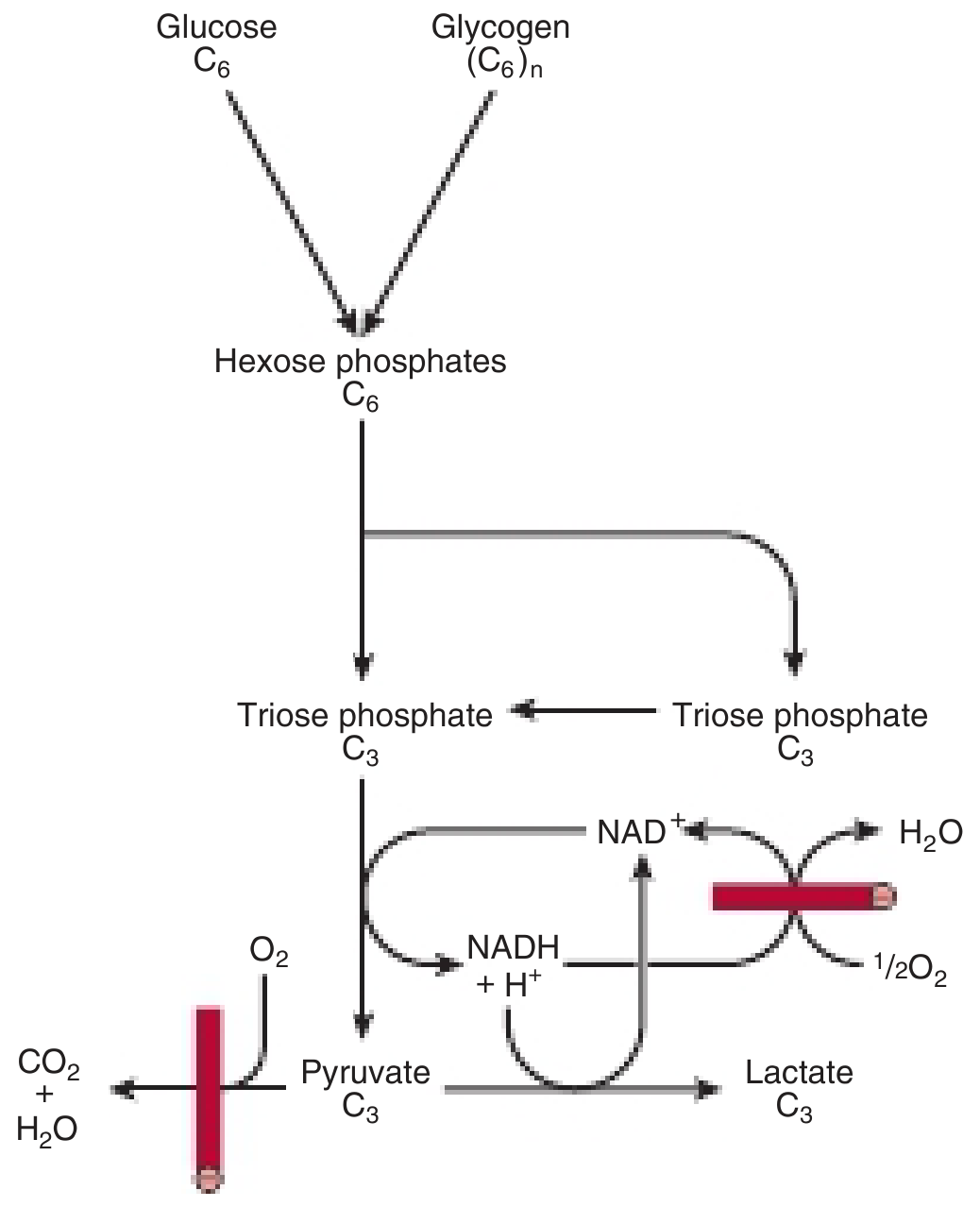
How to read this diagram:
- Top: Glucose (C6) and Glycogen both enter as starting materials
- Middle: The 6-carbon hexose phosphates are split into two 3-carbon triose phosphates (this is the splitting step - step 4)
- Bottom left path (Aerobic): Triose phosphate → Pyruvate → CO₂ + H₂O (requires O₂, goes into TCA cycle)
- Bottom right path (Anaerobic): Pyruvate → Lactate (NADH is re-oxidized back to NAD⁺ - the red cross shows this pathway is blocked when O₂ is available)
- NADH/NAD⁺ cycle in the middle shows how the coenzyme is recycled
The red bar with a cross (×) means: when oxygen IS present, the lactate pathway is blocked, and pyruvate goes to CO₂ + H₂O instead.
Source: Harper's Illustrated Biochemistry, 32nd Ed - Figure 17-1
This is a shared conversation. Sign in to Orris to start your own chat.