
Diagram with prothese and orthoses in detailed
Reading File
Finding Sources
Searching Images
prosthesis orthosis types diagram upper lower limb
Reading File
Reading File
Loading Image
Searching Images
upper limb prosthesis transradial transhumeral types classification
Finding Sources
Searching Images
spinal orthosis cervical thoracolumbar TLSO CTLSO scoliosis brace types
Loading Image
Reading File
Loading Image
Loading Image
Now I have enough material to deliver a comprehensive, well-illustrated reference. Let me compile it all.
Prostheses & Orthoses — Detailed Illustrated Reference
PART 1 — DEFINITIONS
| Term | Definition |
|---|---|
| Prosthesis | An artificial device that replaces a missing body part (limb, joint, organ) |
| Orthosis | An external device that supports, corrects, or augments a body segment that is still present |
PART 2 — ORTHOSES
Core Principle
"The primary function of an orthosis is control of the motion of certain body segments. Orthoses are named according to the joints they control, the function they provide, and the method used to obtain or maintain that control." — Miller's Review of Orthopaedics, 9th Ed.
Orthoses may be static (no movement allowed), static-progressive (gradually adjustable), or dynamic (spring/hinge-assisted motion).
2A — LOWER LIMB ORTHOSES
Foot Orthoses (FO)
| Type | Material | Function |
|---|---|---|
| Rigid | Hard plastic | Limits joint motion, stabilizes flexible deformities |
| Semirigid | Semi-flexible | Support + shock absorption |
| Soft | Foam/viscoelastic | Shock absorption; accommodates fixed/neuropathic deformities |
Ankle-Foot Orthosis (AFO) — Most common lower limb orthosis
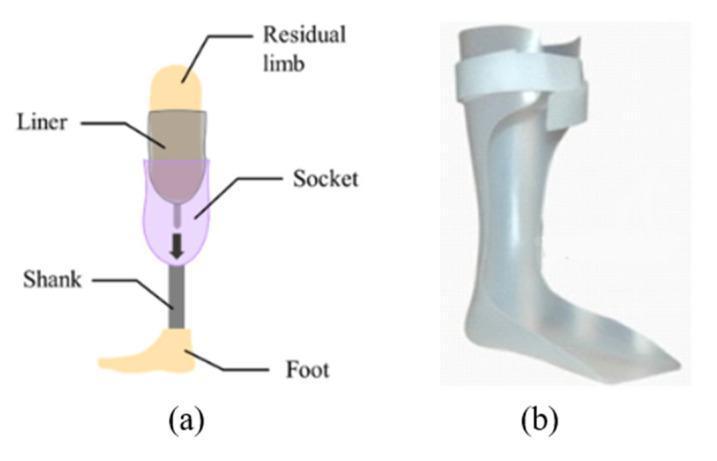
Indications: Foot drop, plantar spasticity, spinal cord injury, post-hindfoot fusion
Trimlines: Posterior → intermediate → full/anterior (increasing mediolateral control)
Materials: Metal bars attached to shoe OR thermoplastic elastomer (TPE)
Knee-Ankle-Foot Orthosis (KAFO)
- Controls knee + ankle
- Indications: Quadriceps paralysis, knee instability, post-polio, genu valgum/varum
Hip-Knee-Ankle-Foot Orthosis (HKAFO)
- Controls hip + knee + ankle
- Indications: High-level paraplegia (T12–L2), spina bifida
- Heavy; functional ambulation limited
Pediatric — Pavlik Harness
- Mainstay for early treatment of developmental dislocation of the hip (DDH)
- Dynamic; allows hip motion without total immobilization
2B — UPPER LIMB ORTHOSES
Elbow Orthoses
| Type | Use |
|---|---|
| Hinged-elbow | Ligament instability (minimal stability) |
| Dynamic spring-loaded | Flexion/extension contractures |
| Elbow strap | Lateral epicondylitis |
| Long-arm splint (45° flexion) | Cubital tunnel syndrome |
Wrist-Hand Orthoses (WHO)
| Type | Use |
|---|---|
| Static/static-progressive/dynamic | Post-operative after injury or reconstructive surgery |
| Opponens splint | Thumb prepositioning (impairs tactile sensation) |
| Wrist-driven hand orthosis | Lower cervical quadriplegia; body-powered by tenodesis |
2C — SPINE ORTHOSES
Cervical Orthoses
Effective immobilization ranges from soft collars → rigid collars → posted orthoses (shoulder/chin purchase) → halo vest (greatest stability; pins fixed to skull)
Thoracolumbar Orthoses (for Scoliosis)
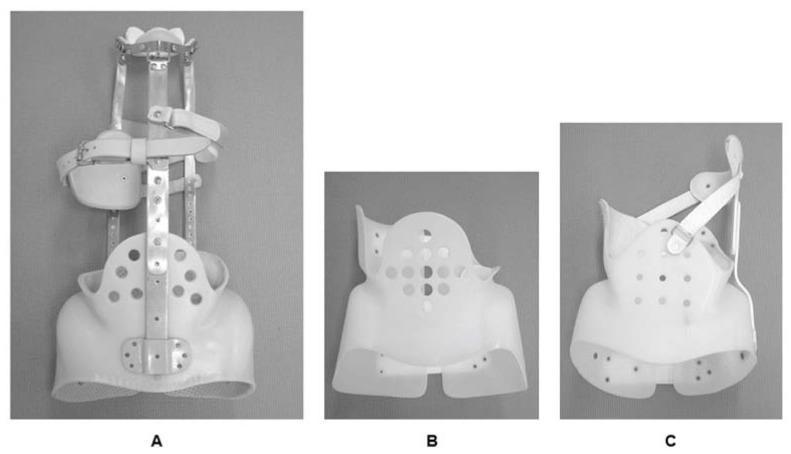
| Orthosis | Coverage | Key Feature |
|---|---|---|
| CTLSO (Milwaukee) | Cervical → sacral | Pelvic mold + metal bars + neck ring; longitudinal distraction |
| TLSO (Boston) | Below axilla → pelvis | Rigid symmetric plastic shell; under-arm trim line |
| LSO | Lumbar → sacral | Three-point pressure mechanism; reduces back pain |
2D — FRACTURE BRACES
- Remain valuable for isolated tibia/fibula fractures
- Prefabricated versions for ankle sprains, simple foot/hand fractures
PART 3 — PROSTHESES
3A — LOWER LIMB PROSTHESES
Levels of Amputation → Prosthesis Type
| Amputation Level | Prosthesis |
|---|---|
| Toe/partial foot | Toe fillers, foot orthosis |
| Transtibial (below-knee) | BK prosthesis |
| Knee disarticulation | Through-knee prosthesis |
| Transfemoral (above-knee) | AK prosthesis with prosthetic knee |
| Hip disarticulation | Hip disarticulation prosthesis |
Transtibial Prosthesis Components
(as seen in the diagram above, panel a)
- Residual limb (stump)
- Liner — soft silicone/urethane interface; reduces shear
- Socket — rigid custom-molded; transfers body weight distally
- Shank — exoskeletal (hard outer shell) or endoskeletal (pylon)
- Prosthetic foot — SACH (Solid Ankle Cushion Heel), energy-storing carbon fiber, or multiaxial
Transfemoral Prosthesis — Additional Components
- Prosthetic knee joint: mechanical (single-axis, polycentric) or microprocessor-controlled
- Suspension systems: suction socket, pin-lock, lanyard
Pediatric — Combined Prosthetic + Orthotic Use
This clinical photo illustrates integration in a child with congenital limb deficiencies: a transfemoral prosthesis on one side and a KAFO/AFO supporting a shortened limb on the other — a common rehabilitation strategy.
3B — UPPER LIMB PROSTHESES
Levels of Amputation → Prosthesis Type
| Level | Prosthesis |
|---|---|
| Partial hand | Finger/partial-hand prosthesis |
| Wrist disarticulation | Below-elbow (transradial) variant |
| Transradial (below-elbow) | TR prosthesis |
| Elbow disarticulation | Through-elbow prosthesis |
| Transhumeral (above-elbow) | TH prosthesis with powered elbow |
| Shoulder disarticulation | Shoulder prosthesis |
Types by Control Mechanism
| Type | Mechanism | Components |
|---|---|---|
| Body-powered | Harness + cable system | Hook or mechanical hand terminal device |
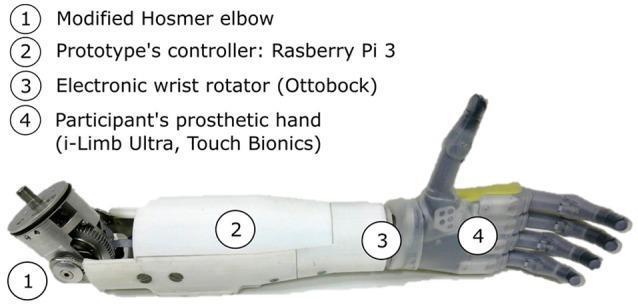
| Myoelectric (EMG-controlled) | Surface EMG signals from residual muscles | Motorized hand, wrist rotator |
| Hybrid | Combination of body-powered + myoelectric | |
| Bionic/Multi-articulating | Myoelectric + microprocessor, individual finger control | i-Limb, Bebionic |
Transhumeral Prosthesis — Labeled Components
PART 4 — QUICK COMPARISON TABLE
| Feature | Orthosis | Prosthesis |
|---|---|---|
| Limb present? | ✅ Yes | ❌ No (replaces it) |
| Purpose | Support / correct / protect | Replace / substitute |
| Named by | Joints controlled (e.g., AFO, KAFO) | Level of amputation (e.g., transtibial) |
| Examples | AFO, TLSO, Pavlik harness, elbow strap | BK prosthesis, myoelectric hand, SACH foot |
| Fixation | External straps, shells, uprights | Socket + suspension system |
PART 5 — NAMING CONVENTIONS
Orthoses use acronyms based on anatomical coverage:
- FO = Foot Orthosis
- AFO = Ankle-Foot Orthosis
- KAFO = Knee-Ankle-Foot Orthosis
- HKAFO = Hip-Knee-Ankle-Foot Orthosis
- WHO = Wrist-Hand Orthosis
- EWHO = Elbow-Wrist-Hand Orthosis
- SO = Shoulder Orthosis
- LSO = Lumbar-Sacral Orthosis
- TLSO = Thoracic-Lumbar-Sacral Orthosis
- CTLSO = Cervical-Thoracic-Lumbar-Sacral Orthosis
Prostheses are named by amputation level and side (e.g., right transtibial prosthesis, left transhumeral myoelectric prosthesis).
Sources: Miller's Review of Orthopaedics 9th Ed.; Rockwood and Green's Fractures in Adults 10th Ed. 2025
This is a shared conversation. Sign in to Orris to start your own chat.