
Staghorn stones
Reading File
Finding Sources
Finding Sources
Searching PubMed
"staghorn calculi" management
Good results. Now let me read the key sections from Campbell-Walsh Urology and the Nephrology textbook in parallel.
Reading File
Reading File
Now let me read the rest of the Campbell-Walsh staghorn section (treatment, PCNL, etc.) and the Brenner & Rector content:
Reading File
Reading File
Reading File
Now let me get the composition/pathophysiology section and the radiology description, plus any imaging:
Reading File
Reading File
Finding Sources
Let me get the struvite/pathogenesis content and fetch the radiology image:
Finding Sources
Loading Image
Now let me get the struvite pathogenesis details and the Goldman-Cecil section:
Reading File
Reading File
Reading File
I have comprehensive information to compose a thorough answer. Let me also fetch the struvite pathophysiology diagram:
Loading Image
I now have everything needed for a comprehensive answer. Here is a full synthesis:
Staghorn Calculi
Definition
Staghorn calculi are large renal stones that occupy most or all of the renal collecting system - the renal pelvis and one or more surrounding infundibula and calyces. The name comes from their branched appearance on imaging, resembling a stag's antlers. There is no universally standardized definition, but by convention:
-
Complete staghorn: occupies the entire collecting system
-
Partial staghorn: extends into some but not all calyces
-
Campbell-Walsh-Wein Urology, p. 2754
Composition
While struvite (magnesium ammonium phosphate) is the classic and most common composition, any stone type can form a staghorn configuration:
| Composition | Notes |
|---|---|
| Struvite (MgNH₄PO₄) | Most common; infection-related |
| Calcium carbonate apatite | Co-precipitates with struvite |
| Cystine | Autosomal recessive disorder |
| Uric acid | Less common |
| Calcium oxalate | Can form staghorn in favorable anatomy |
A notable caveat: one series of 52 complete staghorn stones found 56% were metabolic in nature and 44% were infectious - a reminder that not all staghorn stones are struvite.
- Campbell-Walsh-Wein Urology, p. 2758
Pathogenesis of Struvite Stones
Struvite stones form only in the presence of urease-producing bacteria. The mechanism:
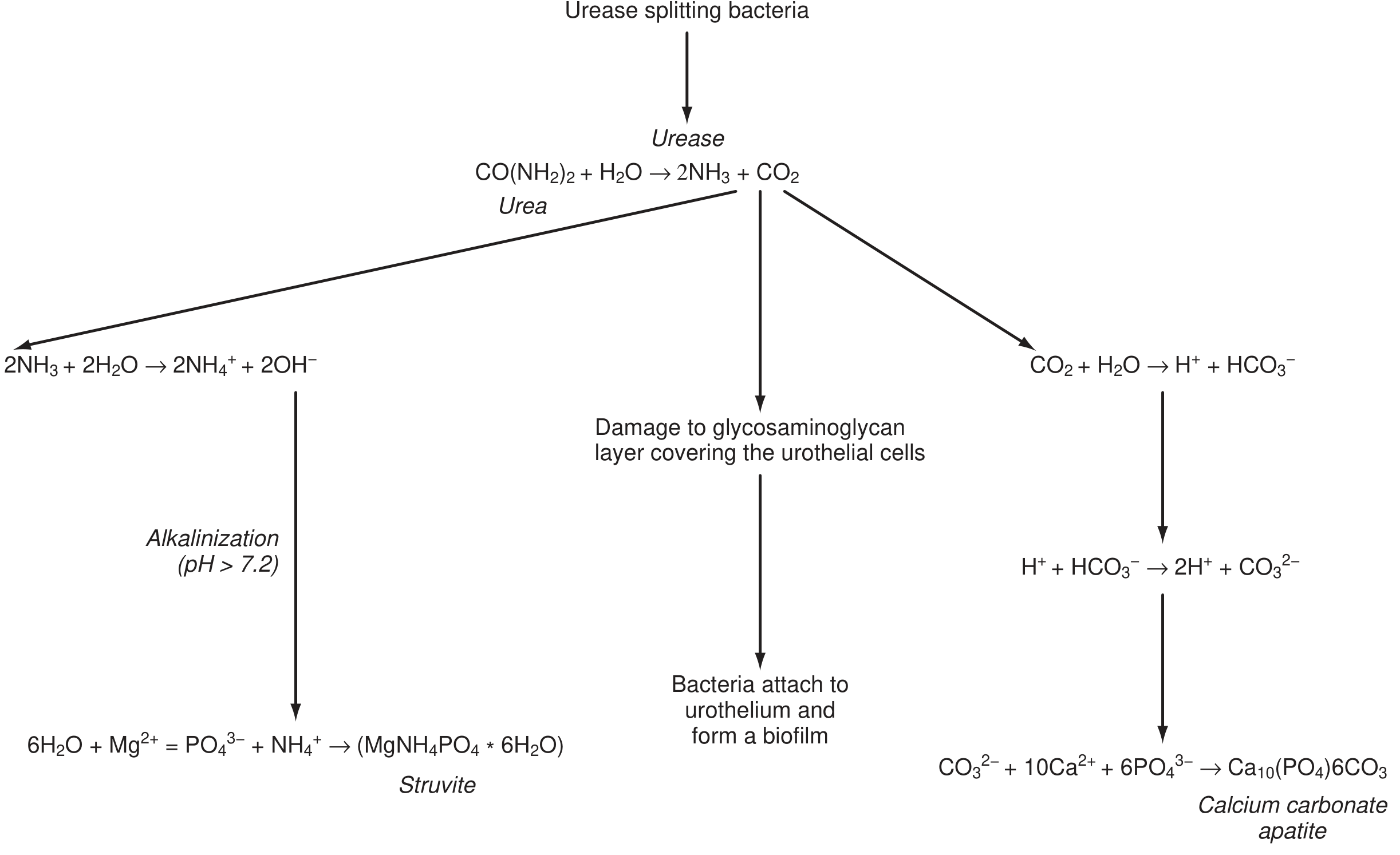
- Urease-splitting bacteria hydrolyze urea: CO(NH₂)₂ + H₂O → 2NH₃ + CO₂
- NH₃ + H₂O → NH₄⁺ + OH⁻ → alkalinizes urine (pH >7.2)
- At alkaline pH, phosphate becomes insoluble and precipitates with Mg²⁺ and NH₄⁺ → struvite (MgNH₄PO₄·6H₂O)
- CO₂ → CO₃²⁻, which combines with Ca²⁺ and PO₄³⁻ → calcium carbonate apatite
- Ammonia also damages the glycosaminoglycan layer of the urothelium, allowing bacteria to attach and form a biofilm - which perpetuates stone growth
Key urease-producing organisms:
| Usually (>90%) | Occasionally (5-30%) |
|---|---|
| Proteus mirabilis, P. vulgaris, P. rettgeri | Klebsiella pneumoniae |
| Staphylococcus aureus | Pseudomonas aeruginosa |
| Haemophilus influenzae | Serratia marcescens |
| Bordetella pertussis | Enterococcus spp. |
Note: E. coli - the most common uropathogen - does not produce urease (only ~1.4% of strains do).
- Campbell-Walsh-Wein Urology, p. 2736; Goldman-Cecil Medicine, p. 1290; Comprehensive Clinical Nephrology, p. 706
Risk Factors
- Female sex (increased susceptibility to upper UTI)
- Indwelling urinary catheters
- Neurogenic bladder
- Spinal cord injury
- Urinary tract anomalies with stasis
- Prior urologic surgery
Natural History (Why Treatment is Mandatory)
Untreated staghorn stones carry a serious prognosis:
- 50% complete renal function loss in affected kidney within 2 years
- Recurrent UTIs and urosepsis
- End-stage renal disease
- Increased overall mortality (up to 28% in some series)
- Conservative management carries nephrectomy rates up to 50%
The AUA guideline (2016, with specific staghorn guidance from 2005) advocates for surgical treatment in all patients healthy enough to undergo it, with complete stone clearance as the goal.
- Campbell-Walsh-Wein Urology, p. 2754; Comprehensive Clinical Nephrology, p. 2403
Surgical Management
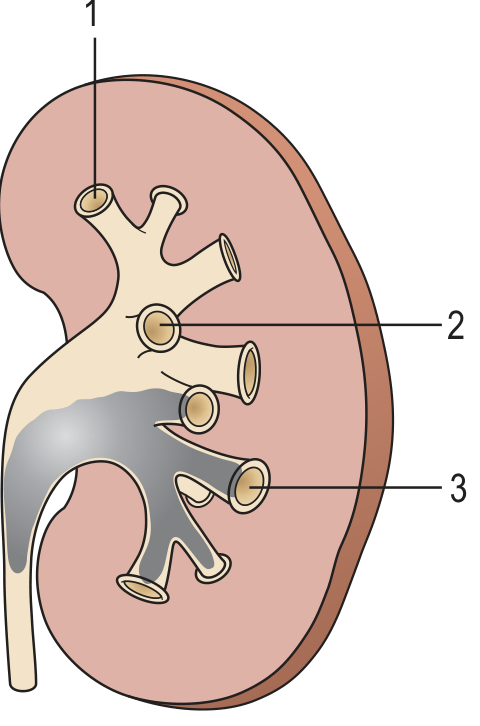
The diagram below shows the three PCNL access routes for a complete staghorn stone:
First-Line: Percutaneous Nephrolithotomy (PCNL)
PCNL is the method of choice for both partial and complete staghorn stones (AUA and EAU guideline recommendation).
Stone-free rates by modality:
| Modality | Stone-free rate |
|---|---|
| PCNL | ~78% (up to 91-96%) |
| Open nephrolithotomy | ~71-85% |
| SWL monotherapy | 22-54% |
Key PCNL principles for staghorn stones:
- Upper pole access is generally preferred for single-tract approach - allows access to upper pole, renal pelvis, and many lower pole stones with the rigid nephroscope; mid-calyceal stones treated with flexible nephroscopy
- Flexible nephroscopy during PCNL improves clearance and reduces the number of access tracts needed
- Multiple tracts are often required for complete calculi
- Retrograde flexible ureteroscopy (URS) can be used as an adjunct (ECIRS - endoscopic combined intrarenal surgery)
SWL (Shockwave Lithotripsy)
- Should not be used as monotherapy for staghorn stones
- High failure rate + risk of steinstrasse (stone street)
- In the only prospective RCT comparing SWL vs. PCNL for staghorn stones, PCNL provided superior stone-free rates (74% vs. 22%), shorter treatment duration, and fewer septic complications
- May be used as adjunct to PCNL (sandwich therapy) for residual inaccessible fragments
Ureteroscopy (URS)
- As sole modality for complete staghorn stones: highly unlikely to succeed and not recommended
- May be considered for simple partial staghorn stones with favorable anatomy or PCNL contraindications, but often requires multiple stages
Laparoscopic/Robotic Approaches
- Described in small series; stone-free rates relatively low (29-67%)
- No obvious advantage over PCNL in routine cases
- May help in ectopic kidneys where percutaneous access is challenging
Open Nephrolithotomy
- Now reserved for rare cases where PCNL is impossible or likely to fail within an acceptable number of procedures
- Stone-free rates up to 85%, but inferior to modern PCNL with respect to length of stay, transfusion risk, renal function loss, and recovery
Nephrectomy
-
Indicated for poorly functioning or nonfunctioning kidneys
-
Also appropriate when xanthogranulomatous pyelonephritis is present
-
Conservative therapy without treatment leads to nephrectomy in up to 50% of patients
-
Campbell-Walsh-Wein Urology, pp. 2758-2762; Comprehensive Clinical Nephrology, p. 2403-2405; Brenner & Rector's The Kidney, p. 1252
Prevention and Medical Management
Complete stone clearance is essential for infectious stones - residual fragments harbor urease-producing bacteria within the stone matrix, perpetuating bacteriuria and enabling rapid stone recurrence. PCNL achieves stone-free status ~90% of the time; recurrence rate is only ~10% in stone-free kidneys vs. ~60% at 6 months if fragments remain (Brenner & Rector data).
Post-treatment measures:
- Treat underlying UTI with appropriate antibiotics
- Surveillance urine cultures
- Urease inhibitor acetohydroxamic acid (AHA) can be used adjunctively but has significant side effects (thromboembolism, neuropsychiatric effects)
- Urine acidification with vitamin C or ammonium chloride to keep pH <6.5
- Address predisposing structural/functional abnormalities (catheterizable channels, neurogenic bladder management)
Summary Box
| Feature | Detail |
|---|---|
| Definition | Branched stone filling renal pelvis ± calyces |
| Predominant composition | Struvite (infection), but also cystine, uric acid, CaOx |
| Causative bacteria | Proteus spp., Staph aureus, Klebsiella (not E. coli) |
| Key mechanism | Urease → alkaline urine → MgNH₄PO₄ precipitation |
| Untreated consequence | 50% renal loss at 2 years; urosepsis; death |
| First-line treatment | PCNL |
| SWL | Adjunct only; never monotherapy |
| Goal | Complete stone clearance (stone free) |
Recent evidence note: A 2024 systematic review and meta-analysis (PMID 39120845) on robotic pyelolithotomy for large renal stones (including staghorn configuration) confirms feasibility of robotic approaches as an emerging option, though PCNL remains the established standard.
This is a shared conversation. Sign in to Orris to start your own chat.