
Ant spinothelamic tract
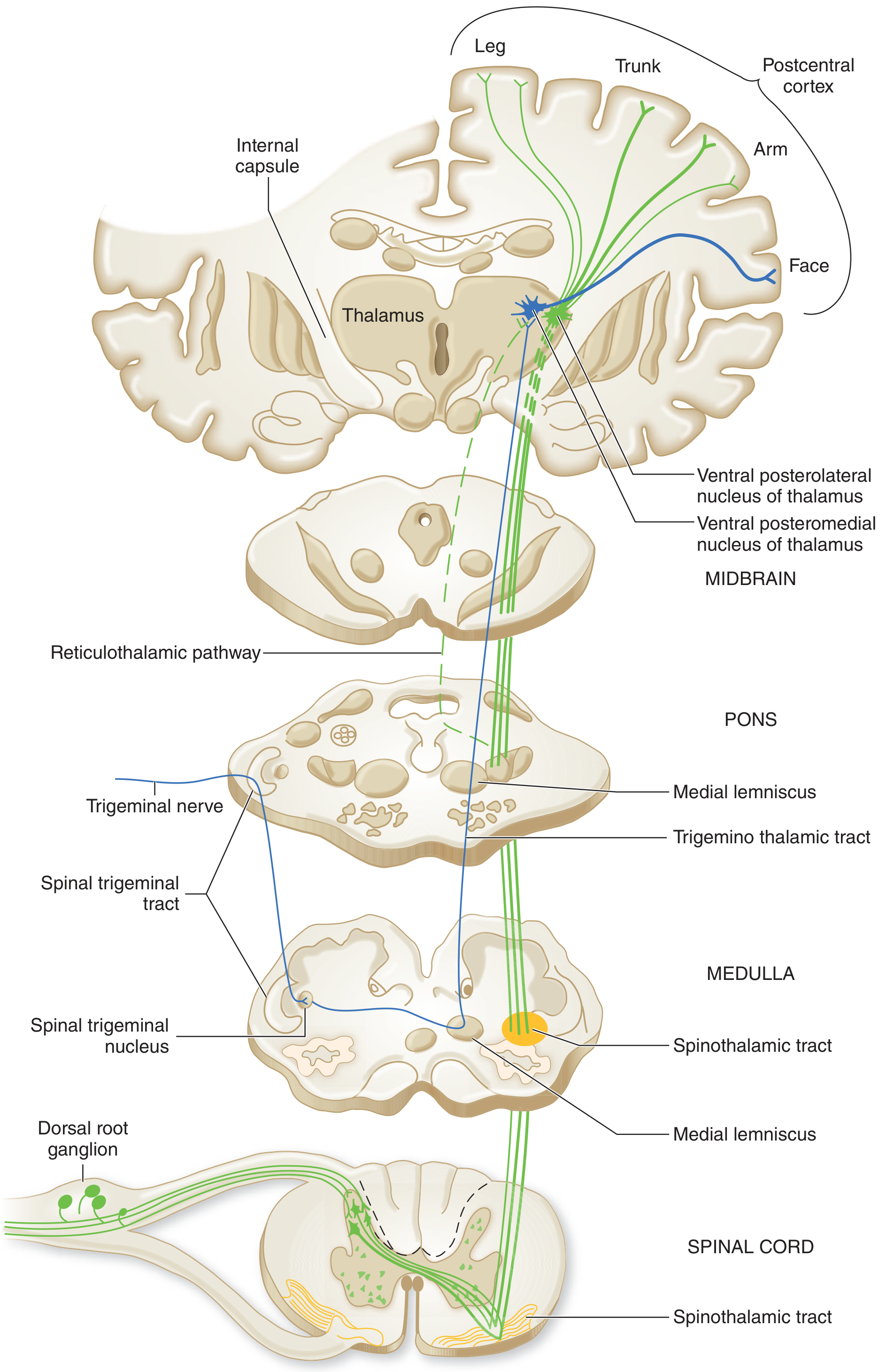
The anterior spinothalamic tract carries crude touch and pressure sensations from the contralateral side of the body. It originates from second-order neurons in the dorsal horn (Rexed laminae IV-V), crosses in the anterior white commissure within 1-2 spinal segments, and ascends to the thalamus (VPL nucleus), which relays to the somatosensory cortex.
Searching sources...
Reading File
Finding Sources
Reading File
Reading File
Loading Image
Here is a thorough breakdown of the Anterior (Ventral) Spinothalamic Tract:
Anterior Spinothalamic Tract
What It Carries
The anterior spinothalamic tract transmits crude (non-discriminative) touch and pressure sensations. It is distinct from the lateral spinothalamic tract (pain and temperature) but both travel together in the anterolateral system (anterolateral fasciculus/funiculus).
The Three-Neuron Arc
| Neuron | Location | Details |
|---|---|---|
| 1st order | Dorsal root ganglion | Peripheral receptor → enters spinal cord via dorsal root |
| 2nd order | Dorsal horn (laminae IV-V mainly) | Cell body in posterior gray; axon crosses midline |
| 3rd order | VPL nucleus of thalamus | Projects to primary somatosensory cortex (postcentral gyrus, areas 3, 1, 2) |
Pathway in Detail
-
Entry: First-order axons (carrying crude touch/pressure) enter the cord via the dorsal root entry zone.
-
Synapse in dorsal horn: They synapse on second-order neurons primarily in laminae IV and V of the dorsal horn.
-
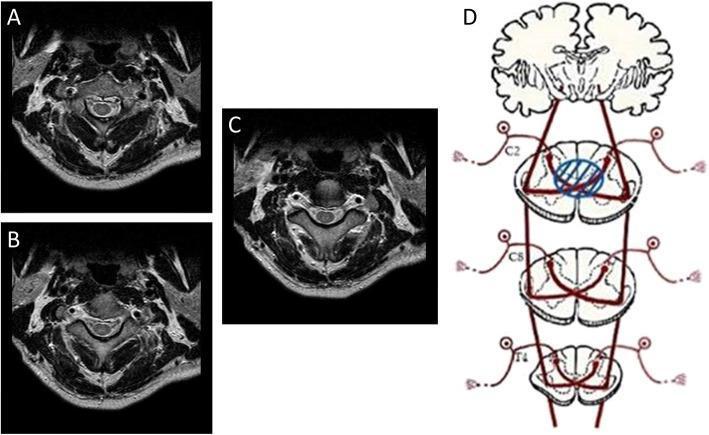
Decussation: Second-order axons cross the midline in the anterior white commissure (ventral commissure). Importantly, this crossing takes 2-3 spinal segments to complete - so a cord lesion affects contralateral sensation beginning 2-3 levels below the lesion.
-
Ascent: Crossed fibers ascend in the anterolateral white matter on the opposite side.
-
Somatotopic organization: As fibers from successively higher levels join the tract medially, the sacral/lower limb fibers lie most laterally (superficially), and cervical/upper limb fibers lie more medially. This explains the phenomenon of "sacral sparing" in central cord lesions.
-
Brainstem course: At the medulla, the tract runs laterally between the inferior olive and inferior cerebellar peduncle. In the pons and midbrain, it lies just lateral to the medial lemniscus.
-
Thalamic relay: Terminates in the VPL (ventral posterolateral) nucleus of the thalamus.
-
Cortex: Via thalamic somatosensory radiations through the internal capsule → postcentral gyrus (primary somatosensory cortex).
Anterolateral System - Three Tracts
The anterior spinothalamic tract is one of three tracts in the anterolateral system:
| Tract | Function | Thalamic Terminus |
|---|---|---|
| Spinothalamic | Discriminative pain, temperature, crude touch | VPL nucleus |
| Spinoreticular | Emotional/arousal aspects of pain; diffuse visceral pain | Intralaminar nuclei (centromedian) via brainstem reticular formation |
| Spinomesencephalic | Pain modulation; connects to PAG and parabrachial nuclei | Midbrain structures |
Anterior vs. Lateral Spinothalamic Tract
| Feature | Anterior (Ventral) | Lateral |
|---|---|---|
| Modality | Crude touch, pressure | Pain, temperature |
| Location in cord | Anterior funiculus | Lateral funiculus |
| Decussation | Anterior white commissure | Anterior white commissure |
| Clinical lesion | Touch may be preserved (bilateral input) | Contralateral loss below lesion |
Key clinical note: Unlike the lateral spinothalamic (pain/temp), crude touch carried by the anterior spinothalamic tract has some representation via both the ipsilateral posterior column and contralateral spinothalamic tract. So a unilateral cord lesion may only mildly impair crude touch, but completely abolish pain/temp on the contralateral side - the basis of Brown-Sequard syndrome.
Clinical Correlation - Brown-Sequard Syndrome
In a hemisection of the spinal cord:
- Ipsilateral: Loss of fine touch, proprioception (posterior column)
- Contralateral: Loss of pain and temperature starting 2-3 levels below (lateral spinothalamic)
- Crude touch: Often relatively preserved bilaterally due to dual pathways
Sources: Neuroanatomy through Clinical Cases, 3rd Edition, p. 304; Adams and Victor's Principles of Neurology, 12th Edition, p. 149
This is a shared conversation. Sign in to Orris to start your own chat.