
pagets disease 15 marks ortho
Reading File
Paget's disease of bone is a chronic metabolic bone disorder with excessive, disorganized bone remodeling. It's commonly tested in orthopedics exams. Let me pull comprehensive textbook content now.
Searching sources...
Finding Sources
Searching PubMed
"Paget disease" bone management
Now let me read the most comprehensive sources in parallel - Harrison's, Rockwood & Green (ortho-specific), Robbins, and Goldman-Cecil:
Reading File
Reading File
Reading File
Reading File
Reading File
Reading File
I now have comprehensive content from multiple authoritative sources. Let me also fetch the histology image from Robbins for visual reference.
Loading Image
I now have all the content needed for a thorough 15-mark answer. Here is the complete structured response:
Paget's Disease of Bone (Osteitis Deformans) - 15 Marks
Definition
Paget's disease of bone (PDB) is a chronic, focal metabolic bone disorder characterized by accelerated but disorganized bone remodeling - excessive osteoclastic resorption followed by a compensatory osteoblastic response - resulting in structurally abnormal, enlarged, and mechanically weak bone.
- Harrison's Principles of Internal Medicine 22E p. 3355
- Rockwood & Green's Fractures in Adults 10th ed. p. 123
Epidemiology
- Age of onset: rarely before 50; prevalence increases with age (~3% autopsy prevalence in those >40 years)
- More common in males (M:F ratio 1.4:1)
- High prevalence in UK, France, Spain, Italy, and European migrant populations (Australia, USA, New Zealand)
- Rare in Scandinavia, Africa, Far East, Indian subcontinent
- Prevalence and severity have been declining over recent decades
- Monostotic: ~15% of cases; Polyostotic: ~85% of cases
- Axial skeleton or proximal femur involved in up to 80% of cases
Etiology and Pathogenesis
Genetic Factors
The most important gene is SQSTM1 (sequestosome-1), mutated in ~50% of familial and ~10% of sporadic cases. SQSTM1 mutations lead to increased NF-kB activity, which drives osteoclast overactivity.
| Gene/Locus | Association |
|---|---|
| SQSTM1 (5q35) | Classic PDB - activates NF-kB |
| TNFRSF11A (RANK) | Juvenile PDB - activating mutation |
| TNFRSF11B (OPG) | Juvenile PDB - inactivating mutation |
| VCP | Inclusion body myopathy + PDB + frontotemporal dementia |
| DCSTAMP | Promotes osteoclast precursor fusion |
- First-degree relatives have ~7-fold increased risk
- Positive family history found in 15-25% of patients
Environmental Factors
- Paramyxovirus (measles virus) infection of osteoclast precursors was historically proposed; now questioned by large-scale serological studies
- Low dietary calcium/vitamin D in childhood, mechanical loading, and toxin exposure have also been proposed
Pathophysiology - The 3 Phases
- Osteolytic (hot) phase: Numerous large osteoclasts (up to 100 nuclei per cell) with active resorption pits. The hallmark is a "blade of grass" or "flame-shaped" lytic front on radiograph.
- Mixed phase: Concurrent osteoblastic and osteoclastic activity. Bone formation begins but is disorganized (woven bone laid down randomly, not along stress lines). Marrow fibrosis and hypervascularization occur.
- Osteosclerotic (burned-out/quiescent) phase: Predominantly osteoblastic activity. Bone is thickened but structurally weak due to the mosaic pattern of lamellar bone joined by irregular cement lines (jigsaw puzzle appearance).
Histopathology
The hallmark is a mosaic pattern of lamellar bone - haphazardly oriented units of lamellar bone joined by prominent, irregular cement lines, producing a "jigsaw puzzle" appearance.
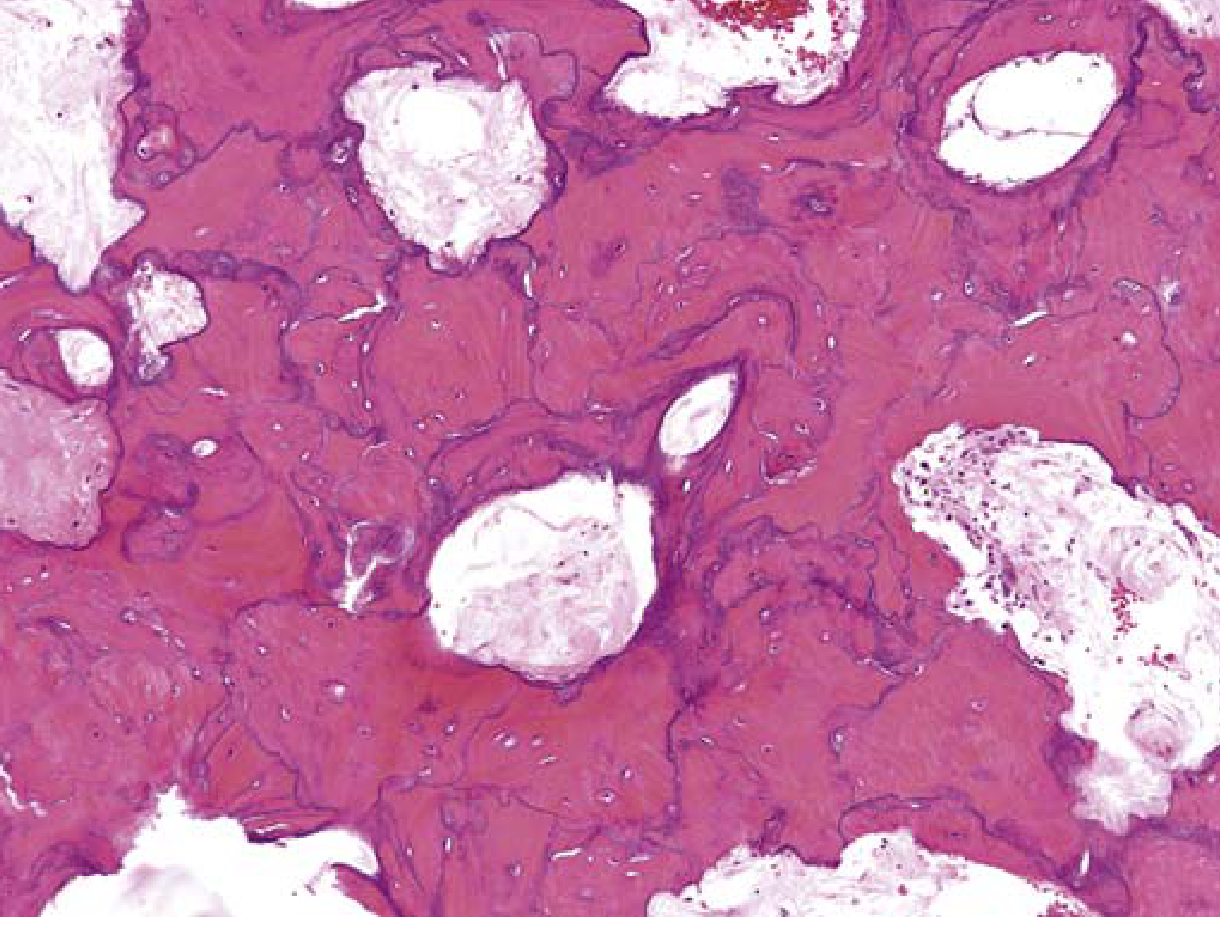
Robbins & Kumar Basic Pathology - FIG. 19.10: Mosaic pattern of lamellar bone pathognomonic of Paget disease
Clinical Features
Most patients (majority) are asymptomatic - discovered incidentally on radiograph or as elevated serum alkaline phosphatase (ALP).
Symptoms (when present)
| System | Manifestation |
|---|---|
| Bone | Deep, aching bone pain (most common symptom); worse at rest and at night |
| Skull | Enlarging hat size, frontal bossing, leontiasis ossea (lion face), platybasia (skull base invagination), deafness (CN VIII compression or cochlear involvement) |
| Spine | Kyphosis, spinal cord compression, nerve root compression (radiculopathy) |
| Long bones | Anterior bowing of femur and tibia ("sabre tibia"), chalk-stick (banana) fractures |
| Joints | Secondary osteoarthritis (femoral head distortion, acetabular involvement) |
| Vascular | Increased bone vascularity -> high-output cardiac failure (rare, only in extensive polyostotic disease) |
| Malignant transformation | Osteosarcoma (most serious complication): <1% of cases but should be suspected with sudden worsening of pain or soft tissue mass |
Classic Physical Findings
- Enlarged skull with prominent veins
- Anterior bowing of tibia (sabre tibia)
- Waddling gait
- Angioid streaks on fundoscopy
Investigations
Biochemical Markers (most important)
| Test | Finding |
|---|---|
| Serum Alkaline Phosphatase (ALP) | Most sensitive marker - markedly elevated; reflects osteoblastic activity |
| Serum calcium | Normal (distinguishes from hyperparathyroidism) |
| Serum phosphate | Normal |
| Urinary hydroxyproline / NTx / CTx | Elevated (reflect osteoclastic bone resorption) |
| Serum bone-specific ALP | More specific than total ALP |
Note: Immobilization may rarely cause hypercalcemia in active PDB. Discovery of hypercalcemia should prompt search for another cause (e.g., primary hyperparathyroidism, malignancy).
Imaging
Plain X-ray - key diagnostic tool:
- Lytic phase: "Blade of grass" or "flame-shaped" advancing lytic front
- Mixed/sclerotic phase: Bone expansion with thickened, coarsened trabeculae; cortical thickening; "cotton wool" appearance in skull; "picture frame" vertebra
- Long bones: Anterior bowing (tibia, femur); chalk-stick fractures (transverse, cortical)
- Skull: "Osteoporosis circumscripta" (lytic phase), then "cotton wool" skull
Radionuclide Bone Scan (Tc-99m):
- Most sensitive for detecting extent and activity of disease
- Shows "hot spots" in affected bones
- Best for mapping distribution before treatment
CT scan: Best for assessing structural detail, especially vertebral involvement and neural compression
MRI: Used when cord or nerve root compression is suspected
Differential Diagnosis
- Osteoblastic metastases (prostate, breast)
- Fibrous dysplasia
- Primary hyperparathyroidism (brown tumors)
- Osteomalacia
- Osteosarcoma (in rapidly progressing lesion)
Treatment
Indications for Treatment
- Symptomatic disease (bone pain, fracture, headache, radiculopathy)
- High disease activity (markedly elevated ALP) with involvement of weight-bearing bones, joints, vertebral bodies, skull
- Pre-operative (to reduce vascularity and blood loss)
- Hypercalciuria during immobilization
- Neurological complications
Pharmacological Treatment
Bisphosphonates are the first-line treatment:
| Drug | Dose | ALP Normalization |
|---|---|---|
| Zoledronic acid (most effective) | 5 mg IV over 15 min (single infusion) | ~90% at 6 months |
| Risedronate | 30 mg/day PO x 2 months | 73% |
| Alendronate | 40 mg/day PO x 6 months | 63% |
| Pamidronate | 30 mg/day IV x 3 days | ~50% |
| Etidronate | 200-400 mg/day PO x 6 months | 15% (weakest) |
| Calcitonin | 100 U SC daily x 6-18 months | ALP reduction ~50% |
Zoledronic acid is now the treatment of choice for most patients - a single IV infusion produces sustained remission.
Important: Adequate calcium and vitamin D supplementation must be given before and during bisphosphonate therapy. Bisphosphonates rapidly suppress bone resorption while active formation continues, risking hypocalcemia especially in vitamin D-deficient patients.
Calcitonin is now rarely used (reserved for those who cannot tolerate bisphosphonates).
Surgical Treatment
Indications:
- Correction of long bone deformity (osteotomy for sabre tibia)
- Pathological fracture fixation (intramedullary nailing preferred; pre-treat medically to reduce vascularity and blood loss)
- Joint replacement for severe secondary osteoarthritis
- Spinal decompression for cord/nerve root compression
- Biopsy/resection if osteosarcoma is suspected
Pre-operative bisphosphonate therapy (zoledronic acid) is given 4-6 weeks before elective surgery at pagetic sites to reduce blood loss.
Monitoring Treatment Response
- Serum ALP is the primary monitoring marker
- Measured every 3-6 months initially
- Bone scan for distribution mapping and follow-up
- Aim: normalization of ALP
Complications (Summary)
| Complication | Notes |
|---|---|
| Pathological fracture | Chalk-stick (banana) fractures; transverse cortex of long bones |
| Secondary osteoarthritis | Hip most commonly affected |
| Deafness | Both sensorineural and conductive |
| High-output cardiac failure | Only in severe polyostotic disease with extensive AV shunting |
| Osteosarcoma | <1%, but most feared; usually osteoblastic; very poor prognosis |
| Spinal stenosis/cord compression | Vertebral involvement |
| Cranial nerve palsies | Skull base foraminal narrowing |
Key Exam Points (15-mark Answer)
- Definition: Focal metabolic bone disorder with disorganized remodeling
- Pathology: 3 phases - lytic, mixed, sclerotic; mosaic (jigsaw) pattern on histology
- Genetics: SQSTM1 mutation most common; RANK/OPG in juvenile PDB
- Most common site: Pelvis > lumbar spine > femur > skull > tibia
- Key lab: Elevated ALP with normal serum calcium - distinguishes from hyperparathyroidism
- Best imaging for extent: Bone scan (Tc-99m); best for diagnosis: X-ray
- Best treatment: Zoledronic acid 5 mg IV single infusion (90% ALP normalization)
- Most feared complication: Osteosarcoma
- Surgical pearl: Pre-treat with bisphosphonate before operating on pagetic bone to minimize bleeding
- Chalk-stick fracture: Transverse fracture through sclerotic cortex of long bones; starts on convex side
Sources: Harrison's Principles of Internal Medicine 22E | Rockwood & Green's Fractures in Adults 10th ed. | Robbins & Kumar Basic Pathology | Goldman-Cecil Medicine
This is a shared conversation. Sign in to Orris to start your own chat.