
Laser surgery answer 10 marks for anaesthesia exam
Reading File
Now let me search the medical library for laser surgery anaesthesia content in parallel.
Finding Sources
Finding Sources
Good - found the main source. Let me read the dedicated LASER SURGERY section from Scott-Brown's:
Reading File
Finding Sources
Excellent! Found both sources. Let me now read the airway fires section from Barash and also search for more laser anaesthesia content:
Reading File
Finding Sources
Reading File
Finding Sources
Reading File
Finding Sources
I now have comprehensive content from both Barash and Scott-Brown's. Let me fetch the key image and also get the Scott-Brown's high-frequency jet ventilation section for completeness:
Reading File
I now have sufficient, comprehensive material from authoritative textbooks to write a complete 10-mark exam answer. Let me compose it.
Anaesthesia for Laser Surgery (10 Marks)
Introduction
Laser surgery, particularly of the airway (larynx, trachea, bronchi), poses unique challenges for the anaesthetist. The word LASER stands for Light Amplification by Stimulated Emission of Radiation. The laser emits a collimated, focused beam of high-power density heat to tissue, and the shared airway between surgeon and anaesthetist creates a risk triad of ignition source + fuel + oxidiser -- the classic fire triangle.
Types of Lasers Used
| Laser | Medium | Wavelength | Use | Eye Protection |
|---|---|---|---|---|
| CO2 | Carbon dioxide | 10,600 nm | Airway (larynx, trachea) | Clear lens glasses |
| Nd:YAG | Neodymium:YAG | 1,064 nm | Deep tissue, bronchi | Tinted glasses |
| KTP | Potassium titanyl phosphate | 532 nm | Vascular lesions | Tinted glasses |
| Blue light | - | ~445 nm | Airway | Tinted glasses |
- CO2 laser interacts with any surface and water -- everyone in the room requires eye protection.
- KTP, Nd:YAG, and blue light lasers interact with tissue pigment and can be delivered via glass fibres through a bronchoscope.
(Barash's Clinical Anaesthesia, 9e, p. 393)
The Fire Triad (Mandatory Knowledge)
An airway fire requires three elements:
- Ignition source -- the laser beam
- Fuel -- the endotracheal tube (especially PVC), surgical drapes, charred tissue, adipose tissue
- Oxidiser -- oxygen, and to a lesser extent nitrous oxide
Airway laser surgery is the most common cause of airway fires in operating theatres.
Key risk factors identified by Huang et al. (KTP laser study):
- Fire risk increases 2.3 times for every 10% rise in O2 concentration above 60%
- Continuous lasing >5 seconds increases fire risk by a factor of 72
- Lasing charred tissue increases fire risk by a factor of 98
(Barash's Clinical Anaesthesia, 9e, p. 393-394)
Anaesthetic Concerns and Goals
- Safe shared airway management with the surgeon
- Prevention of airway fire
- Adequate anaesthesia and immobility (neuromuscular blockade often required)
- Clear surgical field (ideally tubeless)
- Post-operative airway oedema management
Airway Management Strategies
1. Conventional Endotracheal Intubation
- Standard PVC endotracheal tubes are combustible and must NOT be used unprotected in airway laser surgery.
- Wrapping PVC tubes with metallic tape reduces but does not eliminate risk.
2. Laser-Resistant Endotracheal Tubes (Preferred when intubation is used)
- Specially designed tubes made from metals, ceramics, and Teflon
- Examples include: Laserguard (copper foil), Norton tube (stainless steel), Laser-Flex Mallinckrodt (corrugated stainless steel)
- Feature double cuffs -- reduces leak risk if one cuff is damaged by laser
- Cuffs are inflated with coloured saline (e.g., methylene blue-tinted) rather than air:
- Makes cuff strike immediately apparent (colour leaks out)
- Prolongs time to full cuff deflation
- Delays leak of oxygen into the lasing field
- These are "laser-resistant" NOT laser-proof -- they may still combust under certain conditions
(Scott-Brown's Otorhinolaryngology, p. 387; Barash's, p. 394)
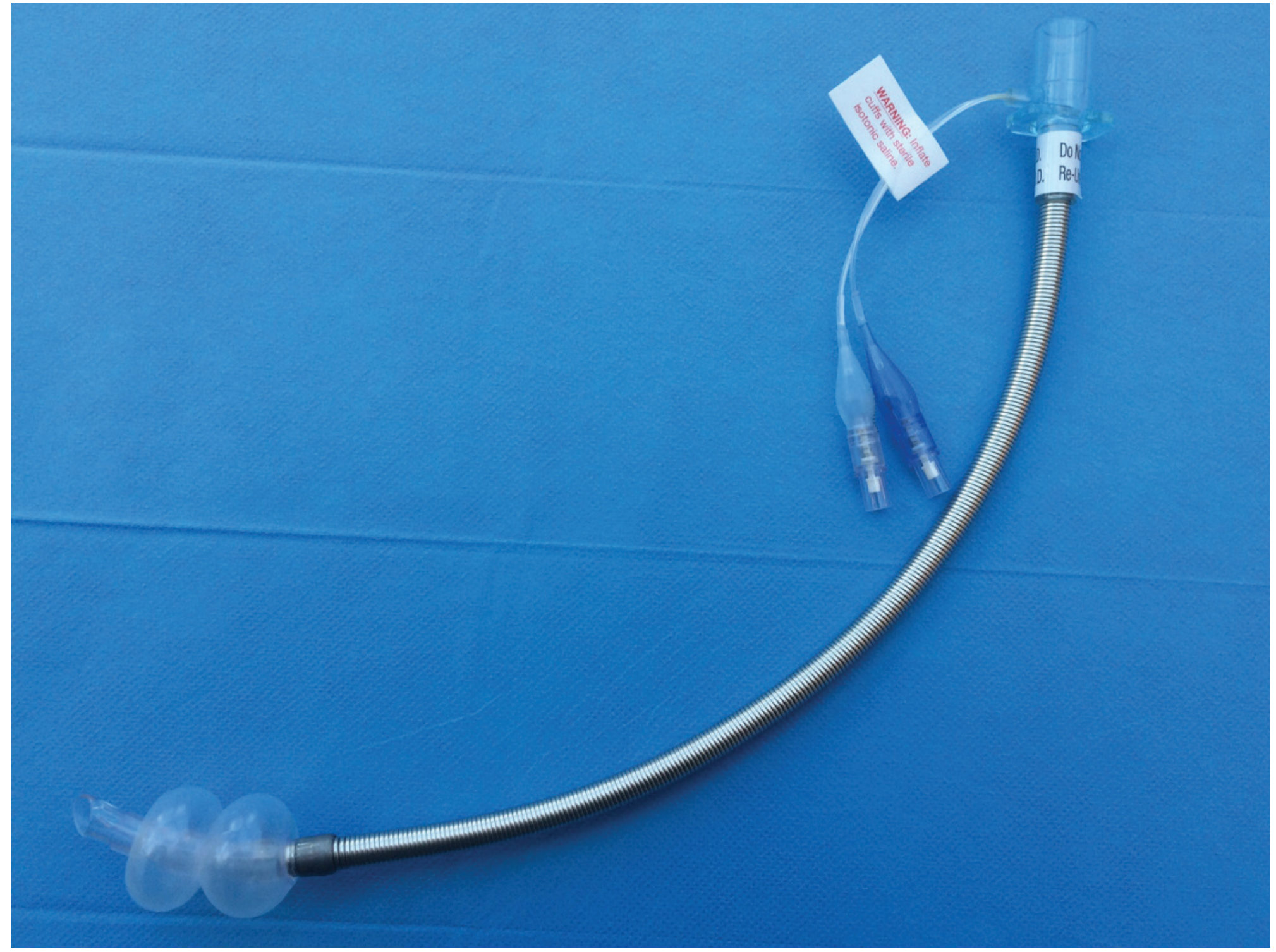
Laser-resistant tube with twin cuffs inflated with saline/methylene blue (Scott-Brown's, Figure 32.9)
3. Tubeless Techniques (Avoid combustible material in airway entirely)
These are preferred where feasible:
- Intermittent apnoea and mask ventilation -- patient is apnoeic during lasering; laser is suspended during ventilation
- Jet ventilation (Sanders injector) -- low-frequency or high-frequency jet via rigid laryngoscope
- High-Frequency Jet Ventilation (HFJV) -- delivered supraglottically, glottically, subglottically, or via transtracheal/cricothyroidotomy route. Widely used for endolaryngeal laser surgery.
- Advantages: no combustible material in airway, clear unobstructed surgical view, deep anaesthesia possible
- Complications: pneumothorax (~1%), hypoventilation (~2%), surgical emphysema (~8%) - from large multicentre studies
- Contraindications: unstable/obstructed airway, micrognathia, severe respiratory failure/emphysematous bullae
- With tubeless techniques, a higher FiO2 can be used safely because there is no flammable material present
4. Supraglottic Airway Devices
- The flexible wire-reinforced LMA has some laser resistance but is not used routinely
- SADs can be used for non-airway head and neck cases (tonsils, nose, ears, teeth)
(Scott-Brown's Otorhinolaryngology, p. 387; Scott-Brown's Vol 2, p. 957-958)
Precautions to Prevent Airway Fire (Summary)
| Precaution | Detail |
|---|---|
| FiO2 | Limit to ≤0.30 during lasering; use air/O2 mixture |
| Avoid N2O | Nitrous oxide supports combustion -- use TIVA |
| Cuff inflation | Use coloured saline (methylene blue), not air |
| Moisture | Keep gauze sponges moistened; moisten tube exterior if hydratable coating present |
| Laser settings | Use intermittent/pulsed mode at lowest clinically effective power |
| Avoid prolonged lasing | Keep lasing bursts <5 seconds |
| Eye protection | All personnel must wear appropriate glasses (clear for CO2; tinted for KTP/Nd:YAG) |
| Avoid lasing charred/adipose tissue | Dramatically increases ignition risk |
Anaesthesia Technique
- TIVA (Total Intravenous Anaesthesia) is strongly preferred -- propofol-based infusion avoids volatile agents and eliminates N2O from the circuit
- Neuromuscular blockade is required for laryngeal laser surgery (prevents coughing, swallowing, movement during microsurgery). Rocuronium with sugammadex reversal is ideal for short procedures
- Deep anaesthesia is necessary to allow microsurgery
- Tubeless TIVA is only undertaken by those expert in the technique
- Pre-oxygenation is important but FiO2 must be reduced well before lasering begins (several minutes needed to wash out high O2 from FRC)
Management of Airway Fire (If it occurs)
- Stop the laser immediately
- Disconnect breathing circuit (prevent bellows from blowing air onto fire)
- Remove the burning ET tube from the airway
- Flood the airway with water/saline
- Mask ventilate once fire is extinguished; re-intubate
- Assess extent of airway injury with bronchoscopy
- Post-operative ICU admission and ventilation may be required if significant airway burns
Special Considerations in Paediatrics
- Laser-resistant tubes are not available in the smallest sizes; uncuffed tubes allow oxygen-enriched gas to leak into the operative field
- Maintain the lowest possible FiO2 and avoid N2O
- Intermittent apnoea or low-frequency jet ventilation via Sanders injector is commonly preferred
- Leak pressure should be >12 cmH2O around an uncuffed tube
Summary Points
- Laser = ignition source; ET tube = fuel; O2/N2O = oxidiser -- address all three
- Use laser-resistant tubes with methylene blue-filled double cuffs if intubation is required
- TIVA + neuromuscular blockade + FiO2 ≤ 0.30 is the standard approach
- Tubeless techniques (HFJV, intermittent apnoea, jet ventilation) eliminate tube fire risk entirely
- Eye protection is mandatory for all theatre personnel
Sources: Barash's Clinical Anaesthesia 9e (pp. 389-395) | Scott-Brown's Otorhinolaryngology Head & Neck Surgery Vol 1 (p. 387) | Scott-Brown's Vol 2 (pp. 957-958)
This is a shared conversation. Sign in to Orris to start your own chat.