
Submental flap
Reading File
The submental flap is a pedicled regional flap from the submental region used for head and neck reconstruction, based on the submental artery (a branch of the facial artery). Let me search the textbook library and recent literature in parallel.
Searching sources...
Finding Sources
Searching PubMed
submental flap reconstruction head neck
No dedicated heading. Let me search paragraphs and broaden the library search.
Finding Sources
Searching PubMed
submental island flap anatomy indications complications
Excellent - found the key sections. Let me read all three main textbook blocks in parallel.
Reading File
Reading File
Reading File
I have excellent content. Let me also read a bit more from the Cummings section (line 794 onward) to capture complications and indications, and grab the Scott-Brown section before line 4660 to get the intro/anatomy.
Reading File
Reading File
I now have comprehensive content from multiple textbooks. Let me fetch the key clinical image from Cummings showing the flap harvest:
Loading Image
I now have all the information needed for a comprehensive answer. Here is a complete overview of the submental flap:
Submental Flap
Overview
The submental island flap was first described by Martin et al. in 1993 as a versatile pedicled regional flap for head and neck reconstruction. It can be harvested as a fasciocutaneous, myocutaneous, or even osteocutaneous flap, making it a regional alternative to free flaps such as the radial forearm or anterolateral thigh (ALT).
Vascular Anatomy
- Arterial supply: The submental artery, a branch of the facial artery, arises deep to the submandibular gland. It is 1-2 mm in diameter and courses anteriorly between the anterior belly of the digastric muscle and the mylohyoid muscle. Perforating branches supply the submental skin from both the medial and lateral borders of the anterior digastric.
- Venous drainage: The submental vein drains into the facial vein, the external jugular vein, or both. The venous drainage is variable and this is the main source of complications (venous congestion).
- Pedicle length: The maximum pedicle length is approximately 8 cm via anterograde flow (facial artery → submental artery). Pedicle length can be extended by ligating the facial artery proximal to the takeoff of the submental artery, thereby creating retrograde flow from the facial artery back through the submental artery.
Flap Design
- Designed as an ellipse in the submental midline, with the superior incision ~1 cm below the inferior margin of the mandible (to hide the scar beneath the mandibular arch projection).
- Dimensions can reach up to 7 cm wide × 18 cm long.
- A pinch test is performed to assess submental skin redundancy and determine the maximum paddle width that permits primary closure of the donor site.
Surgical Technique
- Dissection is usually initiated on the contralateral side to the planned pedicle.
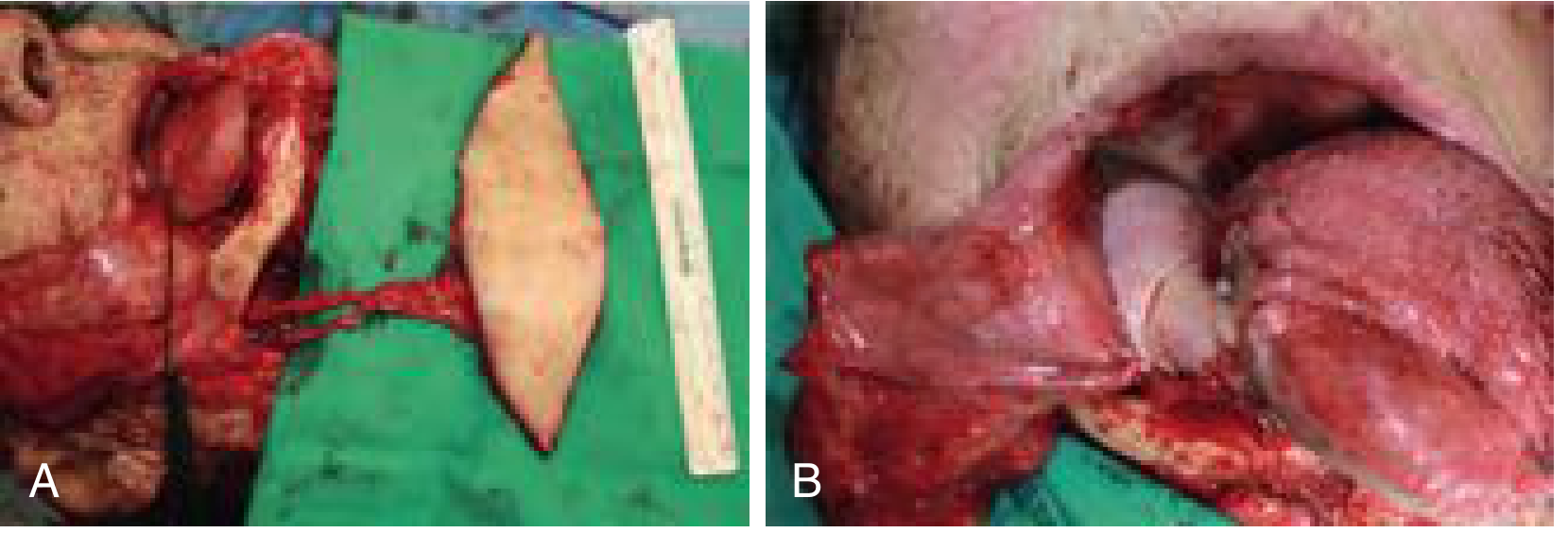
- Skin and subcutaneous tissue are incised to the level of the investing fascia of the digastric muscle, with the plane of dissection at the level of the mylohyoid in the submental triangle.
- The ipsilateral anterior belly of digastric is divided distally and proximally to preserve the blood supply, and dissection proceeds in a retrograde fashion to the facial artery and vein.
- The mylohyoid and ipsilateral anterior belly of digastric can be partially incorporated with the overlying platysma to protect the perforating branches.
- The flap can be identified by dissecting the facial artery proximally, or by identifying the submental artery overlying the mylohyoid and dissecting retrograde.
- Transposition: The flap is tunnelled under the mandible and through the submandibular and submental space for oral reconstruction, or rotated/transposed onto the face for soft tissue coverage.
Indications / Applications
| Defect | Notes |
|---|---|
| Oral cavity (floor of mouth, tongue, buccal mucosa, retromolar trigone) | Primary use; flap tunnelled submandibularly |
| Oropharynx (tonsillar fossa, soft palate, tongue base, lateral pharyngeal wall) | Increasingly popular regional alternative |
| Face / cheek / perioral region | Excellent color match with facial skin |
| Parotid and temporal bone reconstruction | Based on submental vessels |
| Intraoral reconstruction | Thin, pliable tissue ideal for mucosa |
Its thin, pliable paddle and excellent color match with facial skin are key advantages. The donor site scar is well hidden by the shadow of the mandibular arch.
Advantages
- Thin, pliable tissue paddle - ideal for intraoral mucosal reconstruction
- Reliable and well-described blood supply
- Accessible during oropharyngeal resections (no need for a second surgical team)
- Donor site closes primarily with a concealed scar
- Minimal donor site morbidity
- Shorter operative time compared to free flap reconstruction
- Can be performed with or without concurrent neck dissection
Disadvantages and Complications
- Venous congestion: The main concern, particularly with reverse-flow design or when tunnelled through the submandibular space (valves in the facial vein can obstruct retrograde venous drainage).
- Oncologic concern: When harvested during a selective neck dissection, there is a theoretical risk of translocating nodal tissue (level I lymph nodes) along with the flap pedicle into the oral cavity defect. This is the most frequently cited limitation for use after cancer resection, though its clinical significance remains debated.
- Wound dehiscence / hypertrophic scarring at the donor site, especially when closed under tension.
- Limited parallel access: Difficult for two surgical teams to work simultaneously, unlike free flap harvest.
- Requires preservation of submental vessels during neck dissection - if neck dissection is performed carelessly, the flap may be devascularized.
Comparison with Other Regional Flaps
| Flap | Pedicle | Best Use |
|---|---|---|
| Submental island flap | Submental a. (facial a.) | Oral cavity, oropharynx, face |
| Pectoralis major myocutaneous | Thoracoacromial a. | Hypopharynx, great vessel coverage, salvage |
| Supraclavicular flap | Supraclavicular a. (transverse cervical a.) | Neck, oropharynx - rapid harvest |
| Platysma myocutaneous | Submental branch of facial a. | Oropharynx - thin but less reliable |
The platysma myocutaneous flap (also based on the submental branch of the facial artery) is considered a related but less reliable option, with partial skin loss reported in up to 25% of cases; the submental island flap is now generally preferred.
Sources:
- Cummings Otolaryngology Head and Neck Surgery (Regional Flaps, Ch. 98)
- Scott-Brown's Otorhinolaryngology Head & Neck Surgery (Submental island flaps, Ch. 92)
- Schwartz's Principles of Surgery, 11th Ed. (Regional Flaps, Ch. 18)
This is a shared conversation. Sign in to Orris to start your own chat.