
Gover’s sign
Reading File
Gower's sign (also spelled Gowers' sign) is a classic clinical finding in muscular dystrophy - particularly Duchenne muscular dystrophy (DMD). When a child with proximal lower limb weakness tries to rise from the floor, they use their hands to "walk up" their own legs (thighs) to achieve a standing position, compensating for weak hip extensors and quadriceps.
Searching sources...
Finding Sources
Searching the Web
Gower's sign muscular dystrophy clinical significance mechanism
I can see there's content in Campbell's Operative Orthopaedics about Gower's sign. Let me read that section and also search more specifically.
Reading File
Finding Sources
I found the image and content. Let me fetch the Gower's sign figure and read the neurology textbooks for more detail.
Loading Image
Reading File
Reading File
I now have excellent content from multiple textbooks. Let me also read a bit more from Campbell's to get the other Gower's signs and the physical exam context.
Reading File
Finding Sources
I now have comprehensive information from multiple authoritative textbooks. Let me compile the full answer.
Gower's Sign
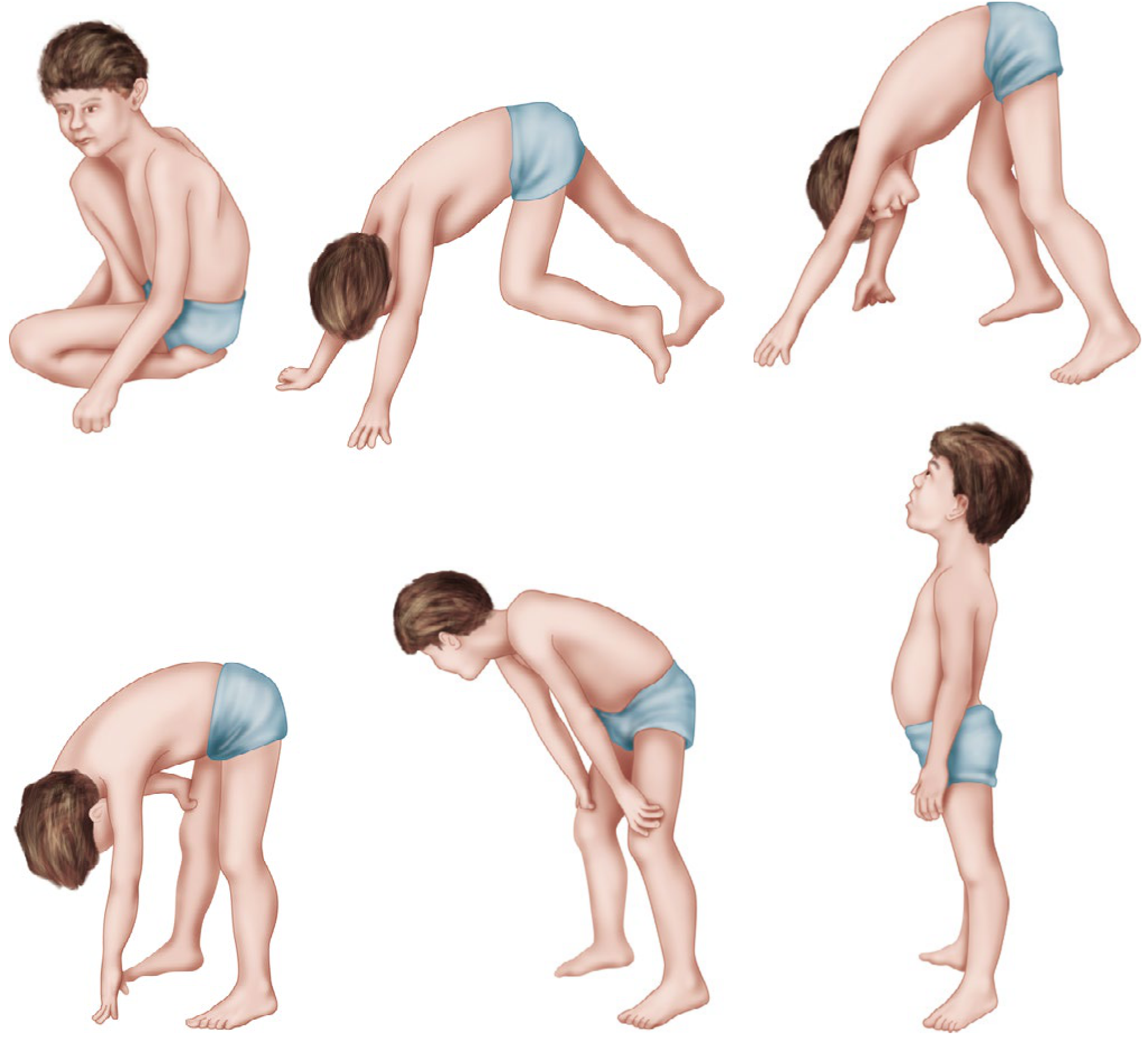
Figure: Gower sign - child must use hands to rise from sitting position. (From Campbell's Operative Orthopaedics, 15th ed.)
Definition
Gower's sign (also "Gower maneuver") is a clinical indicator of proximal lower limb muscle weakness, first described in 1879 by neurologist Sir William Richard Gowers in patients with Duchenne muscular dystrophy (DMD). The patient, unable to extend at the hips and knees from sitting/lying, compensates by using their hands to "walk up" their own legs - pushing off the floor, then pushing on the thighs - to achieve a standing position.
Mechanism
The weakness affects proximal muscles before distal ones. Specifically:
- Gluteus maximus (hip extensors) and quadriceps are predominantly weak
- The child cannot extend the hips and knees against gravity alone
- To compensate, the child presses their hands into the floor, raises hips high into the air ("butt-first maneuver"), forming a triangle with hips at the apex and hands+feet at the base, then "walks" both hands up the thighs to push the trunk upright
This entire process is the Gower maneuver, and it can be broken into component parts to document disease severity:
-
Degree of initial turn (>90 degrees?)
-
Unilateral vs bilateral hand support on thigh
-
Whether support is transitory or sustained
-
Whether a butt-first prone crawl maneuver is needed
-
Bradley and Daroff's Neurology in Clinical Practice, block 6
Classical Association: Duchenne Muscular Dystrophy (DMD)
Gower's sign is most classically associated with DMD, an X-linked recessive condition caused by absence of dystrophin. Key features in DMD:
| Feature | Detail |
|---|---|
| Onset | Signs appear between ages 3-6 years |
| Gait | Waddling Trendelenburg gait, toe-walking, lumbar lordosis |
| Calf muscles | Pseudohypertrophy - firm, rubbery feel due to fat/fibrosis infiltration |
| CK level | 50-100x normal (dramatically elevated) |
| Progression | Wheelchair by ~12 years (with steroids + physio) |
| Inheritance | X-linked recessive; ~1/3 sporadic (new mutations) |
Apparent improvement may occur between ages 2-6 as natural developmental gains temporarily outpace muscle weakness - this is illusory.
- Campbell's Operative Orthopaedics, 15th ed. 2026, p. 1725
- Bradley and Daroff's Neurology in Clinical Practice, block 29
Other Causes of Gower's Sign
Gower's sign is not exclusive to DMD - it occurs in any condition with pelvic girdle or proximal lower limb weakness:
-
Other muscular dystrophies (Becker, limb-girdle, Emery-Dreifuss)
-
Inflammatory myopathies (polymyositis, dermatomyositis - notably, dermatomyositis in children shows Gowers' sign with symmetric limb girdle weakness)
-
Spinal muscular atrophy (SMA)
-
Glycogen storage diseases (e.g., Pompe disease)
-
Congenital myopathies
-
Myasthenia gravis (severe cases)
-
Rheumatology, 2-Volume Set (Elsevier, 2022), block 14 and 21
Three Described Gower's Signs
As noted by StatPearls (NCBI), three Gower's signs exist in the literature:
- Gower's sign (1879) - The classic maneuver described above (rising from the floor by climbing up the thighs) - indicator of proximal muscle weakness
- Gower's sign in tabes dorsalis - Loss of knee jerk reinforcement by hand clenching, indicating posterior column disease
- Gower's hemianopic pupillary sign - Pupil contracts to diffuse light but not to a beam shone from the blind side; related to optic tract lesions
The first is by far the most clinically relevant and commonly tested.
Grading of Severity (Gower Maneuver)
| Severity | Description |
|---|---|
| Mild (1-4 pts) | Prolonged/strained rise; one-hand support on thigh; hand on floor without thigh support |
| Moderate (5-7 pts) | Prone crawl position + 1-2 hands on thigh |
| Severe (8-10 pts) | Prone crawl + >2 hand-on-thigh maneuvers; needs additional aid; unable to rise |
Associated Signs in DMD (Physical Examination)
- Meryon sign - child slides through examiner's arms when lifted under the chest (shoulder girdle weakness)
- Trendelenburg gait - waddling, from gluteus medius weakness
- Thomas test - hip flexion contracture (later disease)
- Ober test - hip abduction contracture (later disease)
- Calf pseudohypertrophy - firmer than normal to palpation
Investigations to Confirm
-
Serum CK - dramatically elevated (50-100x normal); first-line test
-
DNA analysis (dystrophin gene mutation) - confirmatory
-
Muscle biopsy - variable fiber size, internal nuclei, split fibers, degenerating/regenerating fibers, fibrofatty infiltration; dystrophin staining absent
-
EMG - myopathic pattern
-
Campbell's Operative Orthopaedics, 15th ed. 2026; Miller's Review of Orthopaedics, 9th ed.
This is a shared conversation. Sign in to Orris to start your own chat.