
Articulation of elbow joints
Reading File
The elbow is a compound synovial joint involving three bones (humerus, radius, ulna) forming three articulations within a single joint capsule. Now searching the medical library for detailed anatomy content.
Finding Sources
Searching the Web
elbow joint articulation anatomy humeroulnar humeroradial radioulnar
Finding Sources
Reading Web Page
https://teachmeanatomy.info/upper-limb/joints/elbow-joint
Reading File
Reading File
Reading File
Now I have comprehensive information. Let me fetch the key diagram images and compile a thorough answer.
Loading Image
Loading Image
Here is a complete account of the articulation of the elbow joint, drawn from Gray's Anatomy for Students and supplemented by StatPearls/Kenhub.
Articulation of the Elbow Joint
Overview
The elbow is a compound synovial joint involving three bones - the humerus, radius, and ulna - forming three separate articulations that share a single synovial cavity. All articular surfaces are covered with hyaline cartilage.
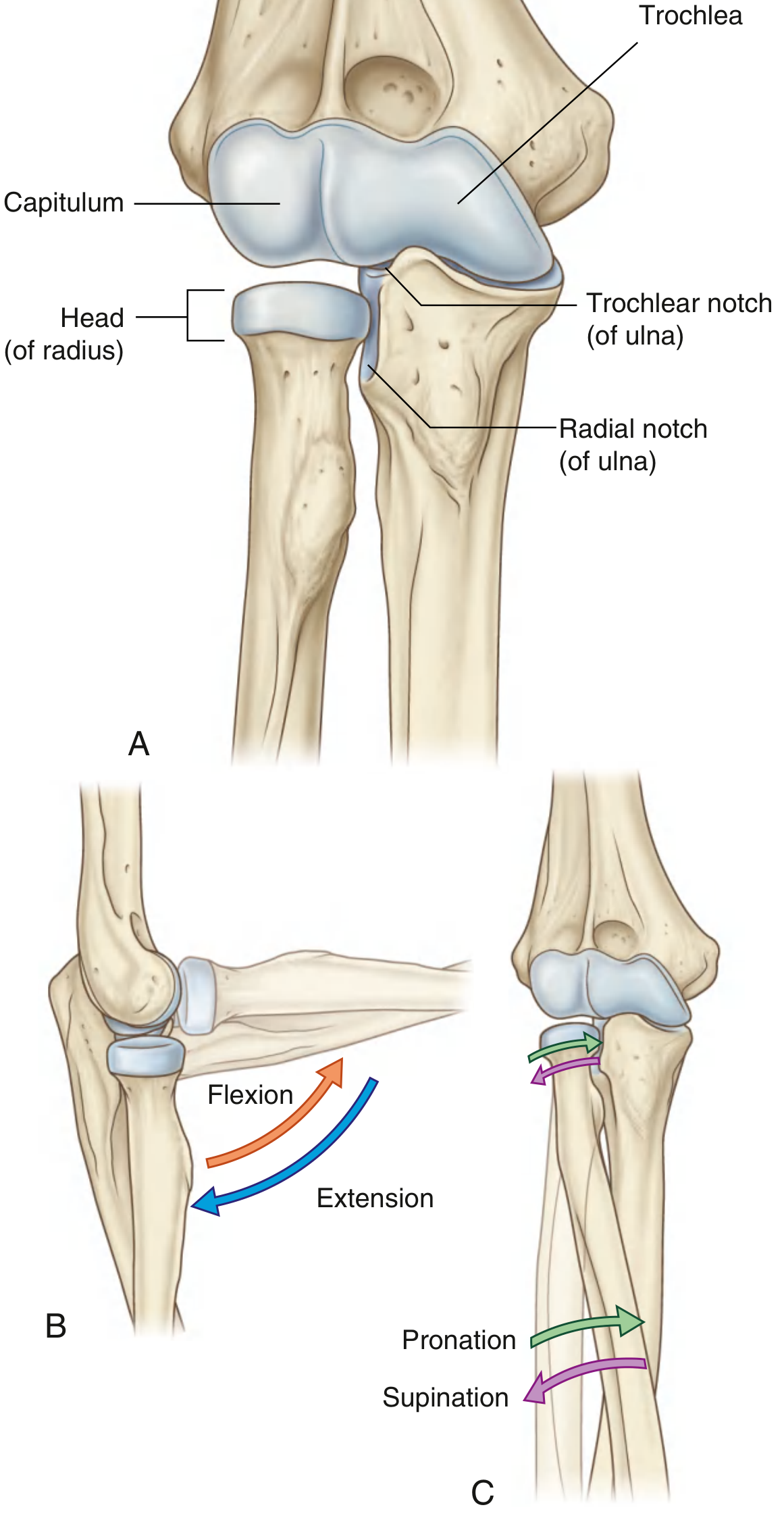
The Three Articulations
1. Humeroulnar (Trochleoulnar) Joint
- Bones: Trochlear notch of the ulna articulates with the trochlea of the humerus
- Type: Hinge (ginglymus) joint
- Function: Primarily responsible for flexion and extension of the forearm
- The trochlea is spool-shaped and fits snugly into the deep trochlear notch, making this the most stable articulation of the three
2. Humeroradial (Radiohumeral) Joint
- Bones: Head of the radius articulates with the capitulum of the humerus
- Type: Ball-and-socket (but functionally constrained)
- Function: Participates in flexion and extension, and also permits pronation and supination in combination with the proximal radioulnar joint
3. Proximal Radioulnar Joint
- Bones: Head of the radius articulates with the radial notch of the ulna; held in place by the annular ligament
- Type: Pivot (trochoid) joint
- Function: Exclusively for pronation and supination of the forearm
- The annular ligament of the radius forms a fibro-osseous ring around the radial head, allowing it to rotate while the radial head slides against the radial notch
Joint Capsule
The fibrous joint capsule encloses all three articulations. Key attachments:
- Proximally: Margins of the olecranon fossa, coronoid fossa, and radial fossa of the humerus; medial epicondyle
- Distally: Coronoid process and olecranon of the ulna; laterally, the free inferior margin wraps around the neck of the radius
The synovial membrane lines the deep surface of the capsule and arises from the edges of articular cartilage. It lines the radial fossa, coronoid fossa, and olecranon fossa. Fat pads overlie these fossae (separated from the fibrous capsule by the synovial membrane) and are pulled clear by brachialis and triceps attachments during movement.
A sacciform recess of the synovial membrane protrudes from the inferior free margin of the capsule and facilitates rotation of the radial head during pronation and supination.
Ligaments
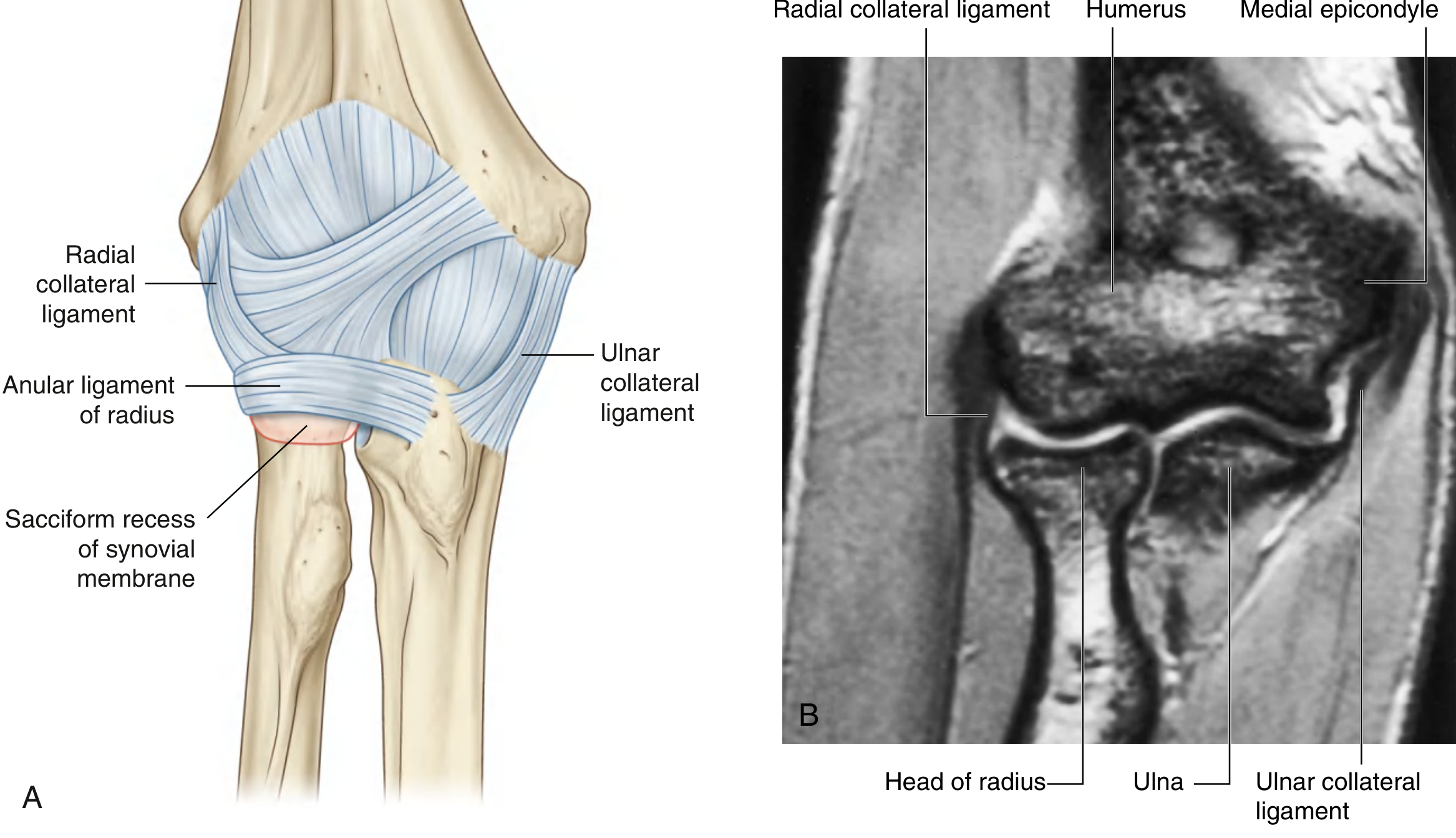
Ulnar (Medial) Collateral Ligament (UCL/MCL)
A triangular ligament with three bands:
- Anterior oblique band - from the anterior-inferior surface of the medial epicondyle to the coronoid process; the strongest medial stabilizer, resists valgus stress
- Posterior oblique band - from the medial epicondyle to the olecranon; taut in flexion
- Transverse (Cooper's) ligament - bridges the coronoid process and olecranon tip
Radial (Lateral) Collateral Ligament Complex
- Radial collateral ligament - from the lateral epicondyle, blends with the annular ligament
- Lateral ulnar collateral ligament - from the lateral humeral epicondyle to the supinator crest of the ulna, crossing the inferior aspect of the radial head; the principal stabilizer against posterolateral rotational instability
- Annular ligament of the radius - encircles and holds the radial head in the radial notch of the ulna; blends with the radial collateral ligament anteriorly and posteriorly; its deep surface is lined with cartilage
Movements and Range
| Movement | Joint(s) Involved | Range |
|---|---|---|
| Flexion | Humeroulnar + humeroradial | 0-145° |
| Extension | Humeroulnar + humeroradial | 145-0° (hyperextension ~5-10°) |
| Supination | Proximal radioulnar + humeroradial | ~90° |
| Pronation | Proximal radioulnar + humeroradial | ~80° |
Muscles Producing Movements
- Flexion: Biceps brachii, brachialis (prime movers), brachioradialis
- Extension: Triceps brachii, anconeus
- Supination: Biceps brachii, supinator
- Pronation: Pronator teres, pronator quadratus
Carrying Angle
In the anatomical position (forearm extended and supinated), the forearm deviates laterally from the arm. This is the carrying angle - normally 10° in males and 20° in females. It disappears on flexion or pronation. Disruption of this angle indicates a varus/valgus deformity (e.g., cubitus valgus after a poorly reduced lateral condyle fracture, or cubitus varus/"gunstock deformity" after supracondylar fracture).
Blood Supply
The elbow receives blood via an anastomotic network formed by collateral and recurrent branches of:
- Brachial artery
- Profunda brachii artery
- Radial artery (radial recurrent)
- Ulnar artery (anterior and posterior ulnar recurrent, inferior ulnar collateral)
Nerve Supply
The joint is innervated predominantly by:
- Radial nerve - supplies lateral/posterior capsule; also supplies anconeus, brachioradialis, supinator, brachialis (lateral part), and triceps
- Musculocutaneous nerve - anterior capsule
- Ulnar nerve - medial capsule; travels in the cubital tunnel posterior to the medial epicondyle
- Median nerve - anterior capsule (variable contribution)
Clinical Relevance
| Condition | Key Point |
|---|---|
| Pulled elbow (nursemaid's elbow) | In children <5 years, radial head subluxes from annular ligament when arm is pulled; treated by supination + compression |
| Supracondylar fracture | Distal humerus fracture above epicondyles in children; brachial artery at risk of "bowstringing" over proximal fragment, causing forearm ischemia |
| Olecranon fracture | Triceps avulsion force; direct blow or FOOSH (fall on outstretched hand) |
| Tennis elbow (lateral epicondylitis) | Tenderness at common extensor origin on lateral epicondyle |
| Golfer's elbow (medial epicondylitis) | Tenderness at common flexor origin on medial epicondyle |
| UCL tear | Common in overhead athletes (pitchers); valgus instability, ulnar nerve symptoms |
| Posterior dislocation | Most common type; named by position of ulna/radius, not humerus; often tears UCL |
| Effusion | Joint held in ~90° semiflexion (position of maximal capacity); fills hollows on either side of olecranon |
Sources: Gray's Anatomy for Students (9780323934237), S. Das Manual of Clinical Surgery, StatPearls (NBK532948)
This is a shared conversation. Sign in to Orris to start your own chat.