
Peptic ulcer pathophysiology and treatment yo get full marks in mbbs physiology university exam
Reading File
Now let me search the medical library for comprehensive content on peptic ulcer pathophysiology and treatment.
Finding Sources
Finding Sources
Excellent - I have several great sources. Let me read the most relevant ones for MBBS physiology - Guyton & Hall, Costanzo Physiology, and Robbins Pathology simultaneously.
Reading File
Reading File
Reading File
Excellent content. Now let me get the treatment section from Guyton & Hall and Costanzo, plus the table comparing gastric vs duodenal ulcers.
Reading File
Reading File
The Guyton section offset went past peptic ulcer. Let me get the treatment section from Guyton (around line 1320) and the Costanzo table comparing gastric vs duodenal ulcers.
Reading File
Finding Sources
Now let me get the Costanzo table (gastric vs duodenal ulcer comparison) and the pharmacology treatment section from Katzung.
Reading File
Reading File
Let me get the Katzung drug table for PUD treatment and the Costanzo comparison table.
Reading File
Finding Sources
Let me get Harrison's treatment section and the Costanzo comparison table for gastric vs duodenal ulcers.
Reading File
Finding Sources
I now have very comprehensive material. Let me also grab the Harrison's H. pylori therapy section and the Costanzo table on gastric vs duodenal ulcer comparison.
Reading File
Loading Image
I now have comprehensive content from Guyton & Hall, Costanzo Physiology, Robbins Pathology, and Harrison's. I have everything needed to write a full-marks MBBS physiology answer. Let me compose it now.
Peptic Ulcer Disease - Pathophysiology & Treatment
(Full-Marks MBBS Physiology Answer)
DEFINITION
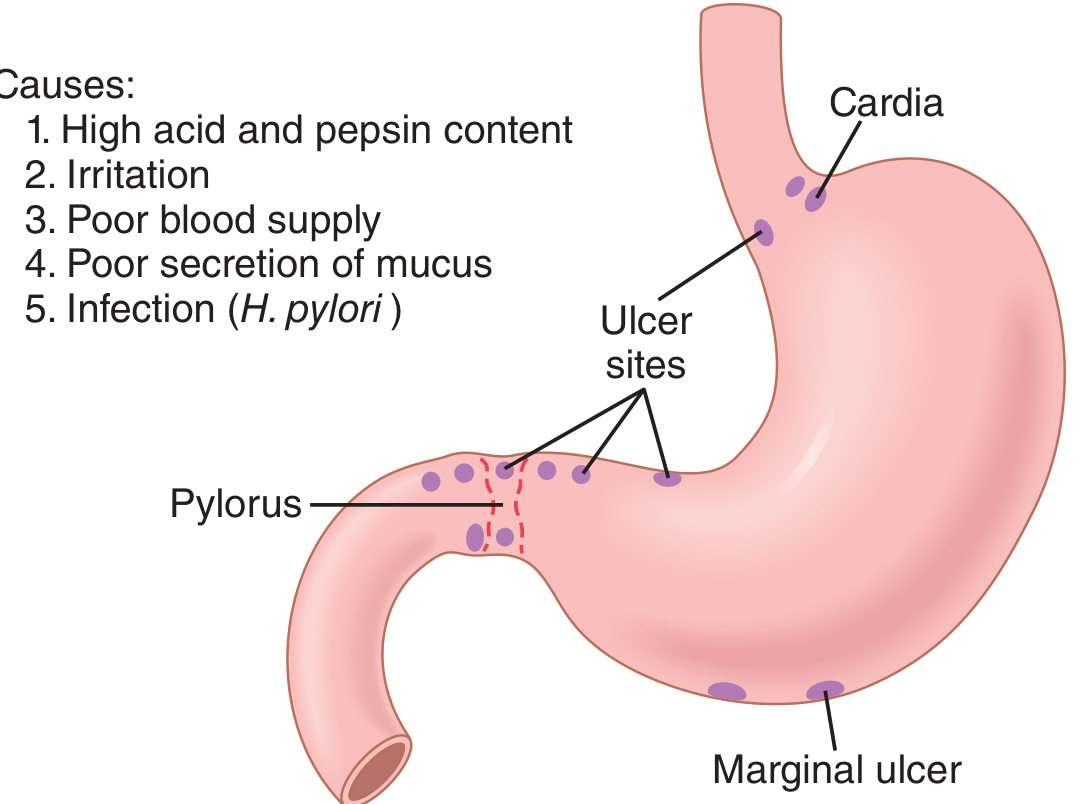
A peptic ulcer is an excoriated (ulcerated) area of the gastric or duodenal mucosa caused by the digestive action of gastric acid (HCl) and pepsin, occurring when the balance between aggressive (damaging) factors and defensive (protective) factors is disrupted.
- Most common sites: within a few cm of the pylorus, the duodenal cap (D1), and the lesser curvature of the gastric antrum
- A marginal ulcer can occur at a surgical gastrojejunostomy anastomosis
PATHOPHYSIOLOGY
Core Concept: Imbalance Between Aggressive and Defensive Factors
Peptic ulcer results from an imbalance where aggressive factors overwhelm defensive factors. This is the single most important concept to state at the start.
Aggressive Factors > Defensive Factors → PEPTIC ULCER
A. DEFENSIVE (MUCOSAL PROTECTIVE) FACTORS
| Factor | Mechanism |
|---|---|
| Mucus layer | Mucous neck cells secrete a gel-like protective barrier between luminal acid and epithelial cells |
| Bicarbonate (HCO3-) | Trapped in mucus; neutralizes any H+ before it reaches epithelium; secreted by epithelial cells and duodenal Brunner's glands |
| Prostaglandin E2 (PGE2) | Maintains mucosal barrier integrity; stimulates HCO3- and mucus secretion; maintains mucosal blood flow |
| Mucosal blood flow | Supplies O2 and nutrients for rapid cell renewal |
| Epithelial regeneration | Rapid turnover of surface epithelium (3-5 days) |
| Pancreatic bicarbonate | Secretin-stimulated NaHCO3 from pancreas neutralizes duodenal acid |
| Brunner's glands | Secrete alkaline mucus in the proximal duodenum |
B. AGGRESSIVE (DAMAGING) FACTORS
1. Helicobacter pylori (Most Important - >70% of PUD)
- Gram-negative, spiral, flagellated bacterium that colonizes gastric mucosa
- Survives in acidic pH by producing urease enzyme → converts urea to NH3 → alkalinizes the local microenvironment
- NH4+ (in equilibrium with NH3) is itself cytotoxic to mucosal cells
- Releases cytotoxins (CagA toxin, VacA) that break down the protective mucous barrier
- Burrows through mucus, adheres to gastric epithelial cells, and triggers inflammation
H. pylori's role in gastric vs duodenal ulcers differs:
- Gastric ulcer: Direct mucosal damage - H. pylori colonizes antral mucosa, breaks down barrier → H+ and pepsin attack unprotected epithelium
- Duodenal ulcer (indirect): H. pylori inhibits somatostatin secretion from D cells → loss of somatostatin inhibition of G cells → ↑ gastrin → ↑ H+ secretion → excess acid load in duodenum. Additionally, H. pylori spreads to duodenum and inhibits duodenal HCO3- secretion → insufficient neutralization → duodenal erosion
Diagnostic test: 13C-urea breath test - patient drinks 13C-labelled urea; H. pylori urease converts it to 13CO2 → detected in expired breath
2. NSAIDs and Aspirin
- Inhibit cyclo-oxygenase (COX-1) → reduced prostaglandin (PGE2) synthesis
- Loss of PGE2 → reduced mucus and HCO3- secretion, reduced mucosal blood flow → barrier breakdown
- NSAIDs also have a direct topical irritant effect on gastric epithelium
3. Acid Hypersecretion
- In duodenal ulcer: acid secretion can be up to twice normal
- In Zollinger-Ellison syndrome: gastrinoma (pancreatic islet cell tumor) secretes gastrin constitutively → massive acid hypersecretion → multiple peptic ulcers (stomach, duodenum, even jejunum)
- Parietal cell hyperplasia (increased parietal cell mass) in duodenal ulcer patients
4. Other Factors
| Factor | Mechanism |
|---|---|
| Smoking | Reduces mucosal blood flow; increases gastric acid; impairs healing |
| Alcohol | Directly breaks down mucosal barrier |
| Corticosteroids | Suppress prostaglandin synthesis; impair healing |
| Psychological stress | Increases nervous stimulation of gastric secretory glands |
| Hypercalcaemia (hyperparathyroidism, CRF) | Stimulates gastrin secretion → ↑ acid |
| Blood group O | Statistical association with duodenal ulcer |
C. FEEDBACK CONTROL MECHANISMS (NORMALLY PROTECTIVE - IMPAIRED IN PUD)
Two key physiological negative feedback loops normally protect the duodenum:
- When excess acid enters the duodenum → inhibits gastric secretion and peristalsis via nervous reflexes and hormonal feedback → slows gastric emptying
- Acid in the small intestine → releases secretin from S cells → stimulates pancreatic NaHCO3 secretion → neutralizes acid
In PUD, these mechanisms are overwhelmed or disrupted.
COMPARISON: GASTRIC ULCER vs DUODENAL ULCER
| Feature | Gastric Ulcer | Duodenal Ulcer |
|---|---|---|
| Incidence | Less common | More common (4:1 ratio) |
| H+ secretion | Normal or LOW (secreted H+ leaks back into mucosa) | HIGH (up to 2x normal) |
| Gastrin levels | Increased (due to reduced net H+ in lumen) | Normal baseline; exaggerated post-meal response |
| Primary mechanism | Defective mucosal barrier | Acid hypersecretion |
| H. pylori role | Direct mucosal damage | Indirect - via ↑ gastrin, ↓ duodenal HCO3- |
| Parietal cell mass | Normal | Increased |
| Food effect on pain | Pain worsened by eating | Pain relieved by eating (then worsens 2-3h later) |
| Risk of malignancy | Yes (must exclude carcinoma) | Very rare |
| Blood group | Blood group A | Blood group O |
ZOLLINGER-ELLISON SYNDROME (Special High-Yield Topic)
- Pancreatic islet cell adenoma (gastrinoma) secretes gastrin uncontrollably
- Massive H+ secretion → multiple, refractory peptic ulcers in stomach, duodenum, and jejunum
- Steatorrhoea: excess H+ inactivates pancreatic lipase → fat malabsorption
- Gastrin not feedback-inhibited by H+ (unlike normal G cells)
- Treatment: PPIs (high-dose), surgical removal of tumor
TREATMENT OF PEPTIC ULCER DISEASE
Treatment is based on two pillars: eradicate H. pylori + suppress acid secretion.
1. H. PYLORI ERADICATION THERAPY
Standard Triple Therapy (14 days - first line where clarithromycin resistance <15%):
- PPI (omeprazole 20 mg BD) + Clarithromycin 500 mg BD + Amoxicillin 1g BD
- Eradication rates: 70-85%
- If penicillin-allergic: replace amoxicillin with metronidazole
Bismuth Quadruple Therapy (first line where clarithromycin resistance >15%):
- PPI + Bismuth subcitrate + Tetracycline + Metronidazole × 14 days
Test of cure: Repeat 13C-urea breath test or stool antigen test 4 weeks after completing therapy (while OFF PPIs)
2. ACID SUPPRESSION DRUGS
A. Proton Pump Inhibitors (PPIs) - Drug of Choice
- Drugs: Omeprazole, Pantoprazole, Lansoprazole, Rabeprazole, Esomeprazole
- Mechanism: Irreversibly bind and block H+/K+-ATPase (proton pump) on the luminal surface of parietal cells → inhibit final step of acid secretion → suppress acid by ~90%
- Note: Are prodrugs - require acidic environment for activation
- Uses: PUD, GERD, Zollinger-Ellison, H. pylori eradication regimens
- Side effects (long-term): Hypomagnesaemia, C. difficile infection, osteoporosis, dementia risk, community-acquired pneumonia, renal injury
- Drug interaction: PPIs (especially omeprazole) inhibit CYP2C19 → reduce activation of clopidogrel (give PPI in morning, clopidogrel at night to minimize)
B. H2-Receptor Blockers (H2 Antagonists)
- Drugs: Ranitidine, Famotidine, Cimetidine, Nizatidine
- Mechanism: Competitively block H2 receptors on parietal cells → reduce histamine-stimulated acid secretion by 70-80%
- Cimetidine special points: weak anti-androgenic effect; potent CYP enzyme inhibitor (multiple drug interactions)
- Use: Milder PUD; maintenance therapy; OTC heartburn relief
C. Potassium-Competitive Acid Blockers (P-CABs) - Newer Class
- Drug: Vonoprazan (FDA-approved), Tegoprazan, Revaprazan
- Mechanism: Competitively bind to the potassium-binding site of H+/K+-ATPase → reversible inhibition
- Advantage: Faster onset than PPIs; effective in H. pylori eradication (may be superior to PPIs in combination therapy)
D. Antacids
- Drugs: Aluminium hydroxide [Al(OH)3], Magnesium hydroxide [Mg(OH)2], Sodium bicarbonate, Calcium carbonate
- Mechanism: Chemically neutralize secreted HCl → raise gastric pH → inactivate pepsin (inactive above pH 4)
- Use: Symptomatic relief only; not disease-modifying
- Side effects: Al(OH)3 → constipation; Mg(OH)2 → diarrhoea; combined to cancel out
E. Sucralfate (Cytoprotective)
- Mechanism: Sucrose sulfate-aluminum complex; polymerizes in the acidic ulcer bed forming a viscous paste that physically coats and protects the ulcer crater; binds growth factors (EGF), stimulates prostaglandin synthesis and mucus/HCO3- secretion
- Given: 4x daily (1g before meals and at bedtime) - very insoluble, no systemic effects
- Use: Adjunct in PUD; safe in pregnancy and renal failure (minimal absorption)
F. Misoprostol (Cytoprotective Prostaglandin Analogue)
- Mechanism: PGE1 analogue → replaces prostaglandins inhibited by NSAIDs → maintains mucosal barrier, stimulates mucus and HCO3- secretion
- Use: Prevention of NSAID-induced gastric ulcers (especially in high-risk patients)
- Side effects: Diarrhoea, abdominal cramps; contraindicated in pregnancy (uterotonic - used in obstetrics for this reason)
3. GENERAL MEASURES (Lifestyle)
- Avoid NSAIDs, aspirin (use paracetamol instead)
- Stop smoking (reduces mucosal blood flow, impairs healing)
- Avoid alcohol
- Avoid caffeine (stimulates acid secretion)
- Small, frequent meals
- Avoid eating 2-3h before bedtime
4. SURGICAL TREATMENT (Rarely needed now)
Reserved for complications or failure of medical therapy:
- Highly selective vagotomy (HSV) / Proximal gastric vagotomy: Cuts vagal branches to parietal cells only (preserves antral innervation) → reduces acid secretion
- Truncal vagotomy + pyloroplasty/drainage: Cuts both vagal trunks; needs drainage procedure because of gastric atony
- Partial gastrectomy (Billroth I or II): Removes acid-secreting mucosa; rarely done today
- Complications: Dumping syndrome, diarrhoea, afferent loop syndrome, pernicious anaemia (after total gastrectomy)
COMPLICATIONS OF PEPTIC ULCER (MBBS Must-Know)
| Complication | Key Features |
|---|---|
| Haemorrhage | Most common complication; haematemesis, melaena; posterior duodenal ulcer erodes gastroduodenal artery |
| Perforation | Anterior duodenal ulcer; sudden-onset severe "board-like" abdominal rigidity; free air under diaphragm on X-ray |
| Pyloric stenosis | Repeated ulceration and scarring → gastric outlet obstruction; projectile vomiting |
| Malignant transformation | Gastric ulcer only; always biopsy edges; duodenal ulcers virtually never become malignant |
| Penetration | Ulcer burrows into adjacent organ (pancreas) → back pain |
QUICK SUMMARY DIAGRAM
H. pylori / NSAIDs / Acid Hypersecretion
              ↓
  Breakdown of Mucosal Barrier
  ↓                        ↓
  ↓ Mucus/HCO3-       ↑ H+ & Pepsin
              ↓
       PEPTIC ULCER

Treatment:
  Eradicate H. pylori (Triple/Quadruple therapy)
  + Suppress Acid (PPI > H2 blocker)
  + Protect Mucosa (Sucralfate, Misoprostol)
Sources used: Guyton and Hall Textbook of Medical Physiology (Ch. 67), Costanzo Physiology 7th Edition (Ch. 8), Robbins & Kumar Basic Pathology, Harrison's Principles of Internal Medicine 22E (Ch. 335), Katzung's Basic and Clinical Pharmacology 16th Edition.
This is a shared conversation. Sign in to Orris to start your own chat.