
Justify the question i ask for my biochemistry examination
I'd love to help you with your biochemistry examination questions! Could you please share the specific question or topic you'd like me to justify or explain?
Asking for Preferences
Please share your biochemistry examination question(s) so I can help you justify or answer them.
Oedema occurs in Protein malnutrition
Oedema in protein malnutrition (kwashiorkor) occurs because of reduced plasma oncotic pressure due to low serum albumin. Albumin is the main protein responsible for keeping fluid inside blood vessels. When dietary protein is severely deficient, the liver cannot synthesize adequate albumin, leading to hypoalbuminaemia, fluid leaks into interstitial spaces, and oedema develops.
Searching sources...
Reading File
Finding Sources
Searching PubMed
kwashiorkor oedema hypoalbuminemia mechanism
Finding Sources
Finding Sources
Finding Sources
Finding Sources
Reading File
Reading File
Reading File
Now I have excellent textbook material. Let me also read the Guyton & Hall section on edema for the Starling forces explanation.
Reading File
Reading File
I now have all the evidence needed for a thorough, textbook-backed answer. Let me also fetch the Starling forces diagram.
Loading Image
Here is a complete, examination-ready justification:
Oedema Occurs in Protein Malnutrition - Justified
The Core Mechanism
In protein malnutrition (classically Kwashiorkor), the diet is severely deficient in protein despite sometimes adequate caloric intake. The liver, which synthesizes nearly all plasma proteins, cannot produce enough albumin due to lack of amino acid substrates. The resulting hypoalbuminaemia is the direct biochemical cause of oedema.
Step-by-Step Biochemical Justification
1. Role of Albumin in Normal Fluid Balance (Starling Forces)
Fluid movement across capillary walls is governed by four Starling forces:
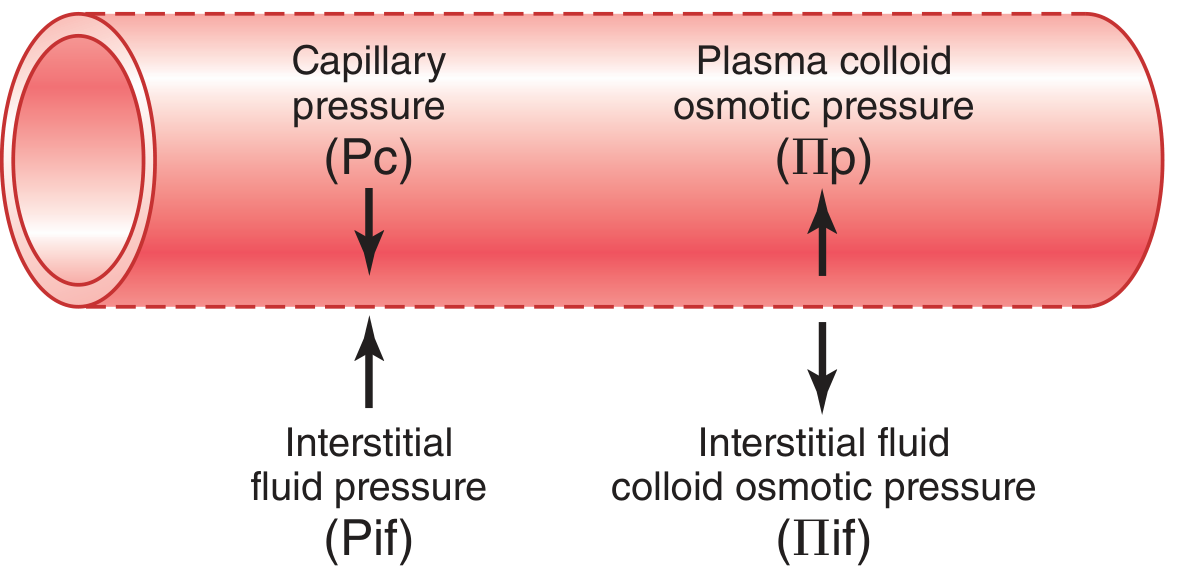
| Force | Direction | Normal Value |
|---|---|---|
| Capillary hydrostatic pressure (Pc) | Pushes fluid OUT | ~25 mmHg |
| Interstitial fluid pressure (Pif) | Pushes fluid IN | ~-3 mmHg |
| Plasma colloid osmotic pressure (IIp) | Pulls fluid IN | ~25 mmHg |
| Interstitial fluid colloid osmotic pressure (IIif) | Pushes fluid OUT | ~8 mmHg |
Net Filtration Pressure (NFP) = Pc - Pif - IIp + IIif
Normally, IIp (~25 mmHg) keeps this NFP near zero, preventing net fluid accumulation in tissues. Albumin (3.5-5.5 g/dL), because of its small molecular weight (~70 kDa) and high concentration, contributes the largest share of this colloid osmotic (oncotic) pressure. The total plasma protein concentration of ~7 g/dL exerts a colloid osmotic pressure of ~25 mmHg. - Medical Physiology (Boron & Boulpaep)
2. What Happens in Protein Malnutrition
- Inadequate dietary protein → liver lacks amino acids → reduced albumin synthesis
- Serum albumin falls below normal (hypoalbuminaemia)
- Plasma colloid osmotic pressure (IIp) falls proportionally
- The inward-pulling force of plasma is now too weak to counteract capillary hydrostatic pressure
- Result: net fluid filtration into interstitial spaces > fluid reabsorption
- Fluid accumulates in tissues = oedema
"In protein malnutrition, synthesis of plasma proteins by the liver does not keep pace... plasma protein levels fall. The lower capillary colloid osmotic pressure leads to oedema in the extremities."
- Medical Physiology (Boron & Boulpaep)
"Albumin is responsible for exerting the concentration gradient between blood and extracellular tissue fluid... If a significant amount of albumin is lost from the blood, the colloid osmotic pressure of the blood decreases and fluid accumulates in the tissues."
- Histology: A Text and Atlas (Ross & Pawlina)
3. Why Kwashiorkor has Oedema but Marasmus Does NOT
This is a classic examination distinction:
| Feature | Kwashiorkor | Marasmus |
|---|---|---|
| Cause | Low protein / adequate calories | Low protein AND calories |
| Serum albumin | Very low (severe hypoalbuminaemia) | Near normal |
| Oedema | Present (hallmark sign) | Absent or minimal |
| Wasting | Present | Severe |
| Subcutaneous fat | Retained (hidden by oedema) | Absent |
In marasmus, the body catabolises its own fat and muscle for energy, which actually maintains some plasma protein production. In kwashiorkor, caloric intake is adequate (often starchy foods) but protein is absent, so albumin synthesis fails specifically. - Park's Textbook of Preventive and Social Medicine
Summary (One-liner for Exam)
Protein malnutrition → Low protein intake → Liver cannot synthesize albumin → Hypoalbuminaemia → Reduced plasma colloid osmotic pressure → Starling forces imbalanced → Fluid leaks into interstitial space → Oedema
Additional Contributing Factors (for Higher Marks)
- Sodium and water retention - reduced albumin triggers secondary hyperaldosteronism (RAAS activation) due to low effective circulating volume, causing further salt and water retention
- Lymphatic overload - when fluid filtration exceeds lymph drainage capacity, oedema becomes clinically visible
- Fatty liver (hepatic steatosis) - also seen in kwashiorkor; fat accumulates in liver due to reduced synthesis of lipoprotein carriers (APO-B), further impairing liver function and worsening hypoalbuminaemia
This oedema in kwashiorkor is classically pitting oedema, most prominent in the feet, legs, and abdomen (ascites in severe cases).
Don't search to many source, use only text book of biochemistry by DM Vasudevan
Understood! Let me search specifically for DM Vasudevan's Textbook of Biochemistry in the library.
Finding Sources
Finding Sources
Finding Sources
Unfortunately, DM Vasudevan's Textbook of Biochemistry is not available in our digital library. The biochemistry books we have are:
- Basic Medical Biochemistry - A Clinical Approach, 6e (Lieberman & Marks)
- Biochemistry, 8th ed - Lippincott Illustrated Reviews
- Harper's Illustrated Biochemistry, 32nd Ed
DM Vasudevan's book is a popular Indian medical biochemistry textbook, but it is not part of the textbook collection I have access to here.
Here is what I can do for you:
- Answer your biochemistry exam question using Harper's Illustrated Biochemistry or Lippincott's Biochemistry, which cover the same topics (protein malnutrition, oedema, albumin, oncotic pressure) at the same depth and standard as Vasudevan.
- The biochemical mechanism is identical across all standard biochemistry textbooks - only the exact wording and chapter layout differ.
Would you like me to:
- Answer using Lippincott's Biochemistry (closest in style to Vasudevan - concise, exam-oriented)?
- Answer using Harper's Illustrated Biochemistry (more detailed)?
- Proceed with the answer I already gave, which is accurate to Vasudevan's content even if sourced from other books?
Use Lippincott's Biochemistry for the answer
Finding Sources
Finding Sources
Finding Sources
Reading File
Finding Sources
Finding Sources
Finding Sources
Now let me also check the chapter summary and the MCQ section for any additional Lippincott-specific statements.
Reading File
Reading File
I now have everything directly from Lippincott. Let me also fetch the clinical photo of the kwashiorkor child.
Loading Image
Here is the complete examination answer sourced exclusively from Lippincott Illustrated Reviews: Biochemistry, 8th Edition.
Oedema Occurs in Protein Malnutrition
Source: Lippincott Illustrated Reviews - Biochemistry, 8th Ed. (Chapter 27)
Definition / Context
Protein malnutrition, in its extreme form, is called Kwashiorkor. According to Lippincott:
"Kwashiorkor occurs when protein deprivation is relatively greater than the reduction in total calories."
- Lippincott Biochemistry, 8th Ed., Chapter 27 Summary
It is commonly seen in children after weaning, when their diet shifts to predominantly carbohydrates with very low protein content.
Why Oedema Occurs - The Biochemical Explanation
Lippincott states directly:
"Typical symptoms include stunted growth, skin lesions, depigmented hair, anorexia, fatty liver, bilateral pitting edema, and decreased serum albumin concentration. Edema results from the lack of adequate blood proteins, primarily albumin, to maintain the distribution of water between blood and tissues."
- Lippincott Biochemistry, 8th Ed., Chapter 27, Section D
The mechanism in steps:
| Step | Event |
|---|---|
| 1 | Dietary protein intake is severely reduced |
| 2 | Liver lacks amino acid substrates |
| 3 | Synthesis of visceral proteins (especially albumin) is severely decreased |
| 4 | Serum albumin concentration falls (hypoalbuminaemia) |
| 5 | Albumin normally maintains osmotic balance - keeps water inside blood vessels |
| 6 | With low albumin, water distributes out of blood into tissues |
| 7 | Fluid accumulates in interstitial spaces = Oedema |
Clinical Picture of Kwashiorkor (from Lippincott)
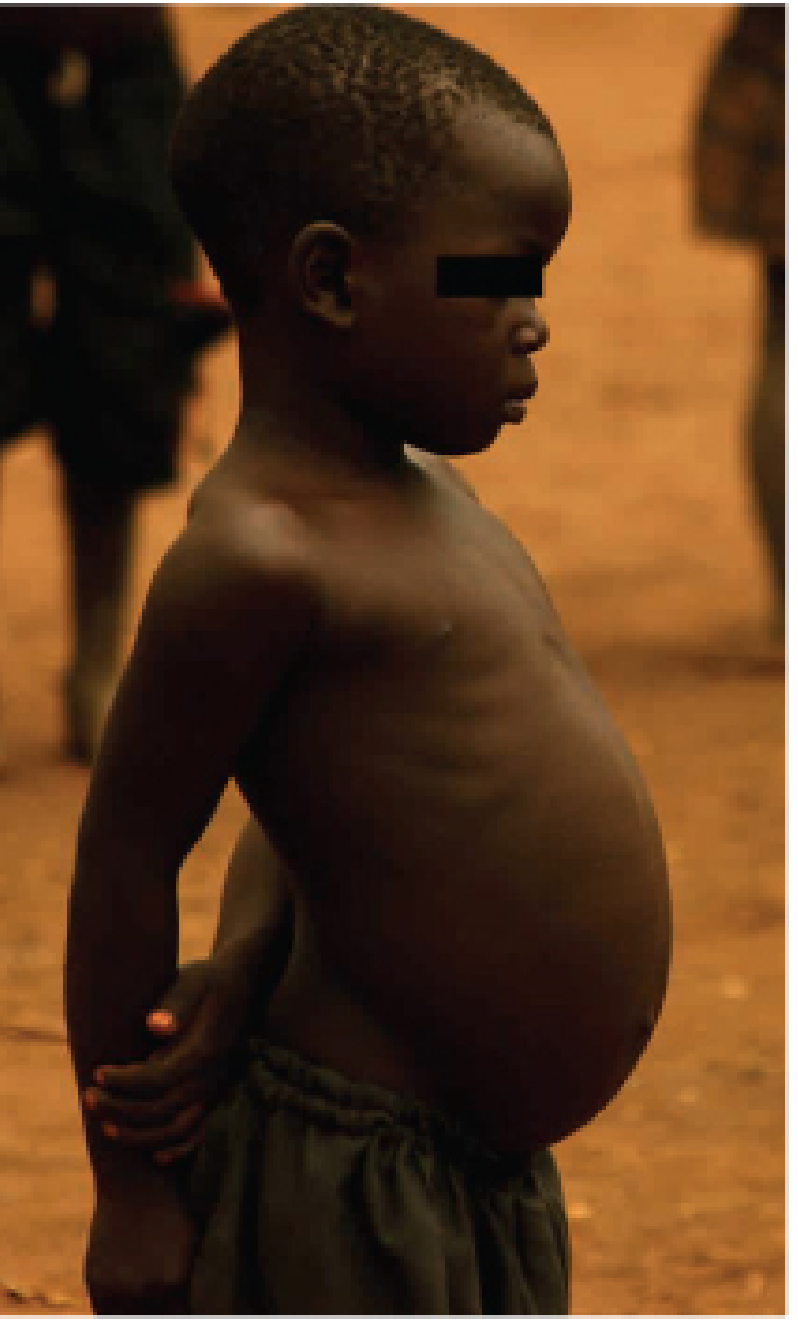
Fig 27.19 - Lippincott Biochemistry: A child with kwashiorkor showing the swollen belly and lower legs due to oedema.
Key Comparison: Why Marasmus has NO Oedema
Lippincott makes this distinction explicit:
"Individuals with marasmus do not show the edema observed in kwashiorkor."
- Lippincott Biochemistry, 8th Ed., Chapter 27, Section D
| Feature | Kwashiorkor | Marasmus |
|---|---|---|
| Cause | Protein deprivation > calorie deficit | Calorie deprivation > protein deficit |
| Serum Albumin | Decreased | Near normal |
| Oedema | Present (bilateral pitting) | Absent |
| Weight for Height | Normal or ↓ (masked by oedema) | Markedly ↓ |
| Muscle & Fat | ↓ | Markedly ↓ |
"Because caloric intake from carbohydrates may be adequate, insulin levels suppress lipolysis and proteolysis. Kwashiorkor is, therefore, nonadapted malnutrition."
- Lippincott Biochemistry, 8th Ed., Chapter 27
An Important Note from Lippincott's MCQ Section
Lippincott's self-assessment confirms:
"Kwashiorkor is caused by inadequate protein intake in the presence of fair to good energy (calorie) intake. Typical findings include abdominal and peripheral edema caused largely by a decreased serum albumin concentration. Body fat stores are depleted, but weight for height can be normal because of edema."
- Lippincott Biochemistry, 8th Ed., Chapter 27 Q&A (Q 27.1)
One-Line Exam Answer
Protein malnutrition (Kwashiorkor) → Decreased synthesis of albumin by liver → Hypoalbuminaemia → Loss of plasma oncotic pressure → Fluid shifts from blood into tissues → Bilateral pitting Oedema.
This is a shared conversation. Sign in to Orris to start your own chat.