
I need an authentic answer and reference from text book like bailay and love or shwartz or cusheri that what is the land mark of deep inguinal ring and what is the land mark of femoral artery regarding inguinal ligament
Reading File
Now let me search the medical library for the specific landmarks.
Finding Sources
Finding Sources
Excellent results. Let me now read the exact Bailey & Love text and Fischer's Mastery of Surgery text for precise wording.
Reading File
Reading File
Reading File
Now let me also fetch the Bailey & Love anatomical diagram and the S Das diagram, which are directly relevant.
Loading Image
Loading Image
I now have all the authoritative textbook content needed. Here is the complete, referenced answer:
Landmark of the Deep Inguinal Ring
Bailey & Love's Short Practice of Surgery, 28th Edition (p. 1087)
"This ring lies midway between the anterior superior iliac spine and the pubic tubercle, approximately 2-3 cm above and marginally lateral to the femoral artery pulse in the groin. The inferior epigastric vessels lie just medial to the deep inguinal ring, passing from the iliac vessels to rectus abdominis."
So Bailey & Love gives two landmarks for the deep inguinal ring:
- Midpoint of the line between ASIS and pubic tubercle (surface landmark)
- ~2-3 cm above and slightly lateral to the femoral artery pulse (vascular landmark)
- Inferior epigastric vessels lie just medial to it (intraoperative landmark)
The deep inguinal ring is a defect in the transversalis fascia, just deep to the abdominal muscles.
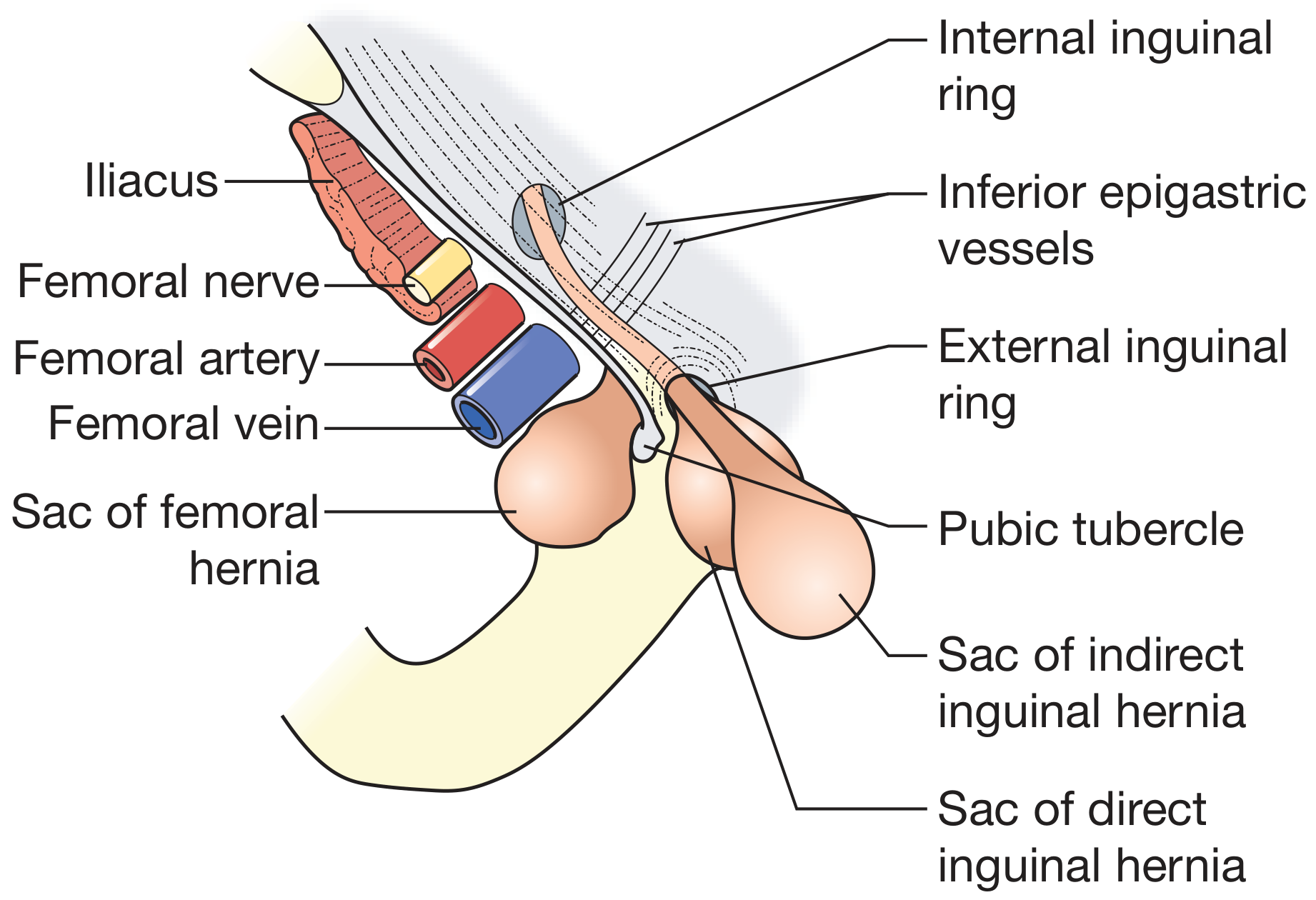
Figure 64.10 from Bailey & Love 28th Ed. - Close relationships of direct inguinal, indirect inguinal and femoral hernias. Note the internal inguinal ring (= deep inguinal ring), inferior epigastric vessels immediately medial to it, and the femoral artery below.
Landmark of the Femoral Artery Regarding the Inguinal Ligament
Fischer's Mastery of Surgery, 8th Edition (p. 6469)
"Femoral artery reliably bisects the inguinal ligament at its midpoint. This relationship can be used to locate the femoral artery, even when occlusive disease prevents location of a palpable pulse. Keep in mind that the inguinal groove (crease) is a cutaneous and subcutaneous reflection of the inguinal ligament. Because of the pendulous nature of these tissues, the groove is typically 3 to 4 cm distal to the inguinal ligament and may be even more distal in obese patients."
Gray's Anatomy for Students (Finding the femoral artery in the femoral triangle)
"The femoral artery descends into the thigh from the abdomen by passing under the inguinal ligament and into the femoral triangle. In the femoral triangle, its pulse is easily felt just inferior to the inguinal ligament midway between the pubic symphysis and the anterior superior iliac spine. Medial to the artery is the femoral vein and medial to the vein is the femoral canal, which contains lymphatics and lies immediately lateral to the pubic tubercle. The femoral nerve lies lateral to the femoral artery."
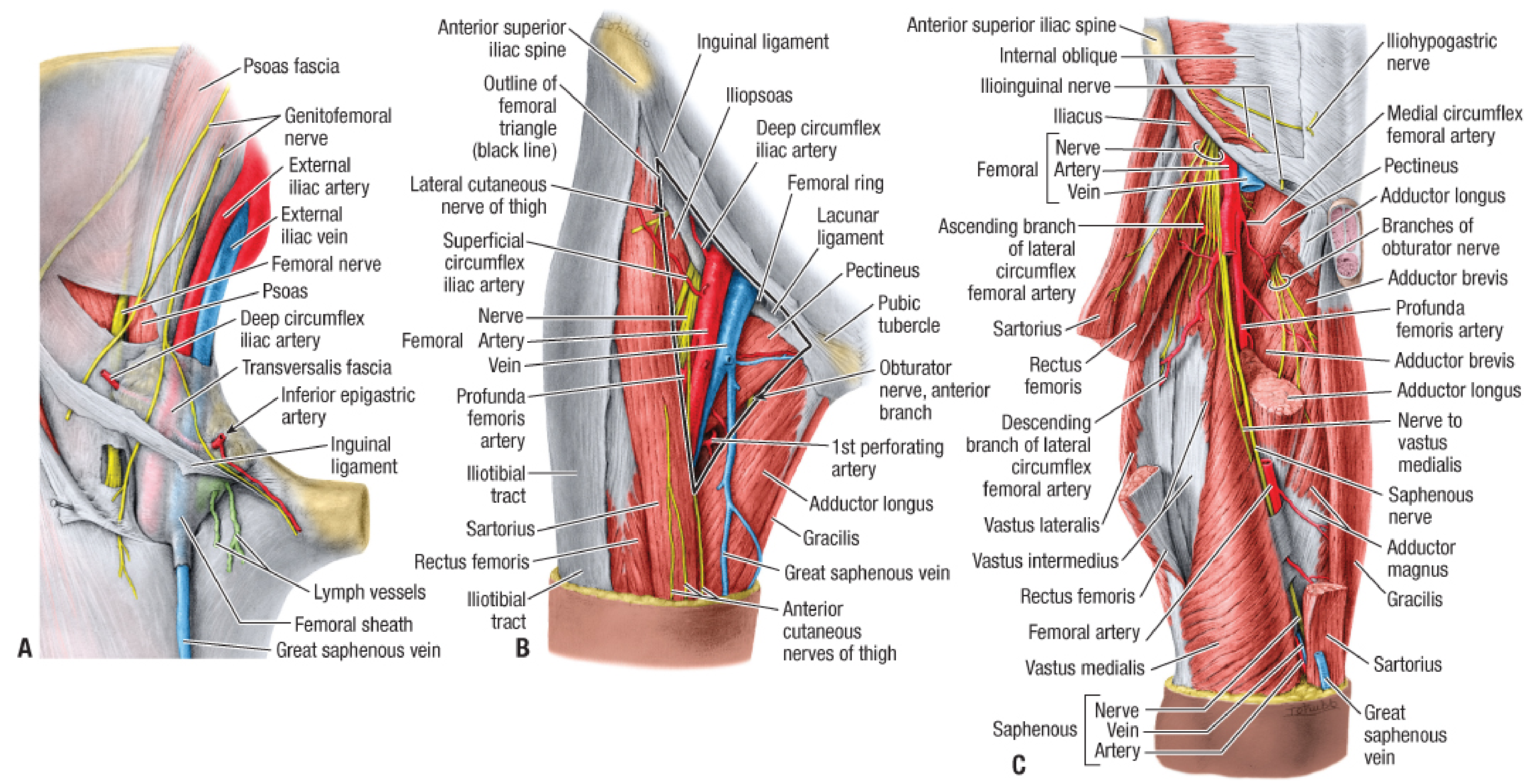
Figure 238.1 from Fischer's Mastery of Surgery 8th Ed. - Panel A shows the femoral sheath with the femoral nerve (lateral), femoral artery (middle), and femoral vein (medial). Panel B shows the femoral triangle with the ASIS, inguinal ligament, and midpoint landmark clearly visible.
Summary Table
| Structure | Landmark | Source |
|---|---|---|
| Deep Inguinal Ring | Midpoint between ASIS and pubic tubercle | Bailey & Love 28th Ed. |
| Deep Inguinal Ring | 2-3 cm above and slightly lateral to femoral artery pulse | Bailey & Love 28th Ed. |
| Deep Inguinal Ring | Inferior epigastric vessels just medial to it | Bailey & Love 28th Ed. |
| Femoral Artery | Bisects the inguinal ligament at its midpoint | Fischer's Mastery of Surgery 8th Ed. |
| Femoral Artery | Midway between pubic symphysis and ASIS, just inferior to inguinal ligament | Gray's Anatomy for Students |
| Inguinal groove (crease) | Is 3-4 cm distal to the actual inguinal ligament (important clinical note!) | Fischer's Mastery of Surgery 8th Ed. |
Key clinical takeaway: The deep inguinal ring lies just above and lateral to the femoral artery pulse, while the femoral artery itself lies at the midpoint of the inguinal ligament (i.e., midpoint between ASIS and pubic symphysis). Surgeons must be careful not to confuse the inguinal skin crease with the inguinal ligament, as the crease can be 3-4 cm more distal - especially relevant in obese patients when accessing the femoral artery.
This is a shared conversation. Sign in to Orris to start your own chat.