
Calcanuem fractures and management
Reading File
Finding Sources
Searching PubMed
"calcaneus fracture" AND management
Finding Sources
Searching PubMed
"calcaneal fracture" AND surgery
Now I'll read the main sources in parallel - Rockwood & Green's block 29 (the dedicated calcaneus fractures chapter) and Miller's Review:
Reading File
Reading File
Reading File
Reading File
Reading File
Reading File
Reading File
Reading File
Reading File
I now have comprehensive content. Let me fetch a couple of the key radiographic images to include in the response:
Loading Image
Loading Image
I now have comprehensive material to write a complete, well-structured answer. Here it is:
Calcaneum (Calcaneus) Fractures
Epidemiology
The calcaneus is the most commonly fractured tarsal bone, accounting for 65% of tarsal injuries and 2% of all skeletal fractures, with an incidence of approximately 11.5 per 100,000 population per year. Fractures occur most commonly in young, active working males aged 20-29. In older women (>50), the incidence rises due to low-energy falls on osteoporotic bone. Up to 75% are intra-articular, and 3-7.9% are bilateral. Associated injuries are seen in 25-50% of cases, including lumbar spine fractures (6-20%), pilon fractures, ankle fractures, and femoral fractures. Alcohol use is associated with 20% of cases.
- Rockwood and Green's Fractures in Adults, 10th ed. 2025, p. 3412
Anatomy
The calcaneus is the largest tarsal bone with four articulating facets:
- Three superior facets (posterior, middle, anterior) articulating with the talus
- One anterior facet articulating with the cuboid (calcaneocuboid/CC joint)
Key landmarks:
- Sustentaculum tali - located 2.5 cm below the medial malleolus; contains the FHL tendon groove inferiorly; remains attached to the talus by the deltoid and interosseous talocalcaneal ligaments (this is the "constant fragment" in fractures)
- Critical angle of Gissane - the lateral cortical strut from the anterior process to the posterior facet; normal 120-145 degrees
- Bohler's angle - formed on lateral radiograph; normal 25-40 degrees; reduction indicates posterior facet collapse
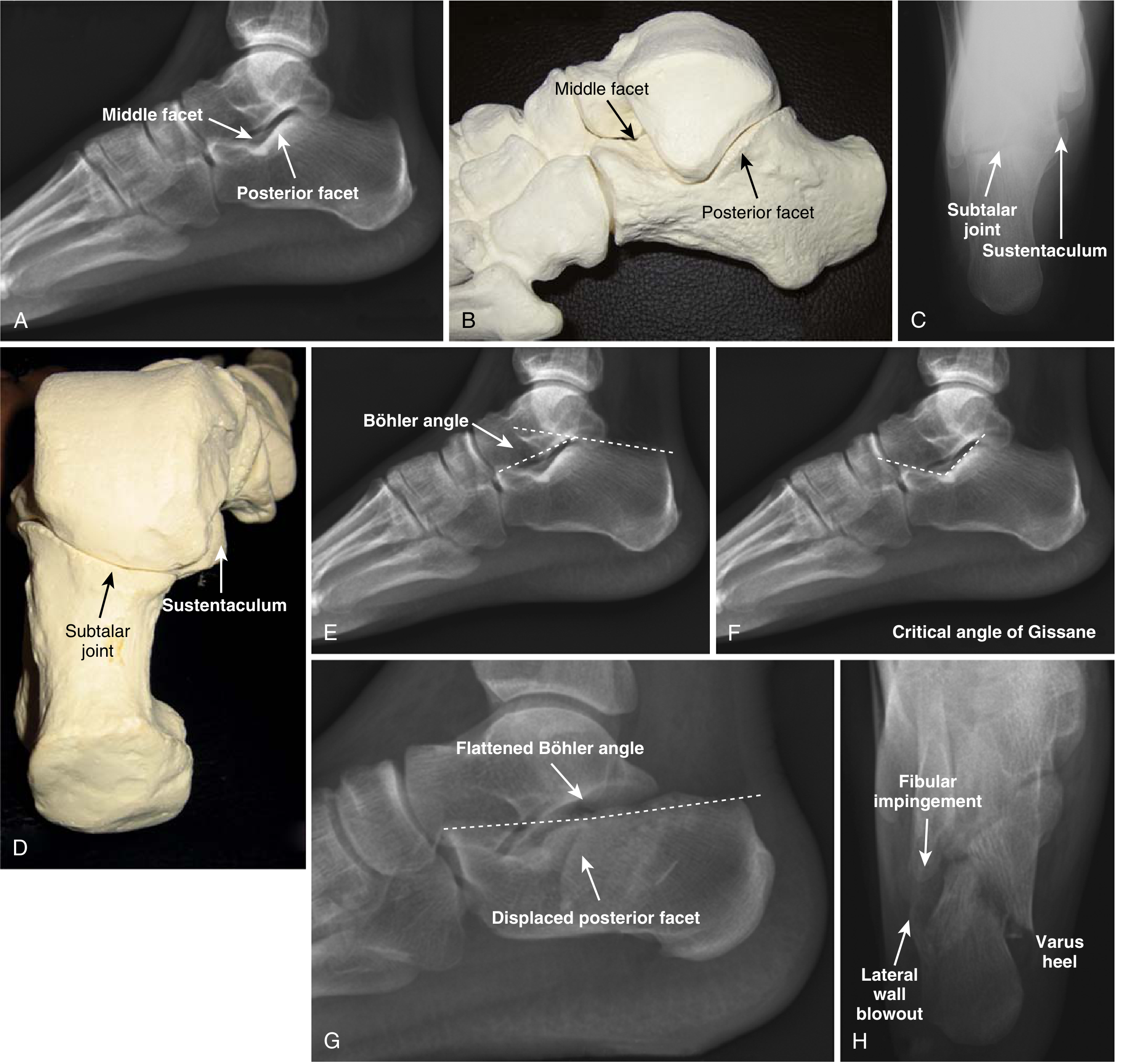
- Rockwood and Green's, p. 3424 | Miller's Review of Orthopaedics 9th ed., p. 621
Mechanism of Injury
- Intra-articular (75%): High-energy axial loading - falls from height, motor vehicle collisions. The lateral process of the talus acts as a wedge, driving into the calcaneus and splitting it into primary and secondary fracture lines.
- Extra-articular (25%): Include tuberosity avulsions (forceful Achilles contraction), anterior process avulsions (forced inversion/plantarflexion at the bifurcate ligament), and sustentaculum fractures.
Resulting deformity: The calcaneus becomes shortened, widened, and varus. The lateral wall "blows out" causing subfibular and peroneal tendon impingement. Posterior facet collapses with loss of Bohler's angle.
Classification
Essex-Lopresti (plain radiograph based)
- Joint depression type - secondary fracture line exits posteriorly above the Achilles insertion
- Tongue type - secondary fracture exits below the Achilles insertion, producing a large tongue fragment attached to the tuberosity
Sanders Classification (CT-based, most widely used)
Based on the number of fracture lines through the posterior facet on coronal CT:
| Type | Description | Treatment |
|---|---|---|
| I | Non-displaced (any number of lines) | Non-operative |
| II | 2-part posterior facet fracture (IIA, IIB, IIC) | ORIF generally recommended |
| III | 3-part fracture (IIIAB, IIIAC, IIIBC) | ORIF; consider primary subtalar fusion |
| IV | Highly comminuted (4+ fragments) | ORIF + primary subtalar arthrodesis |
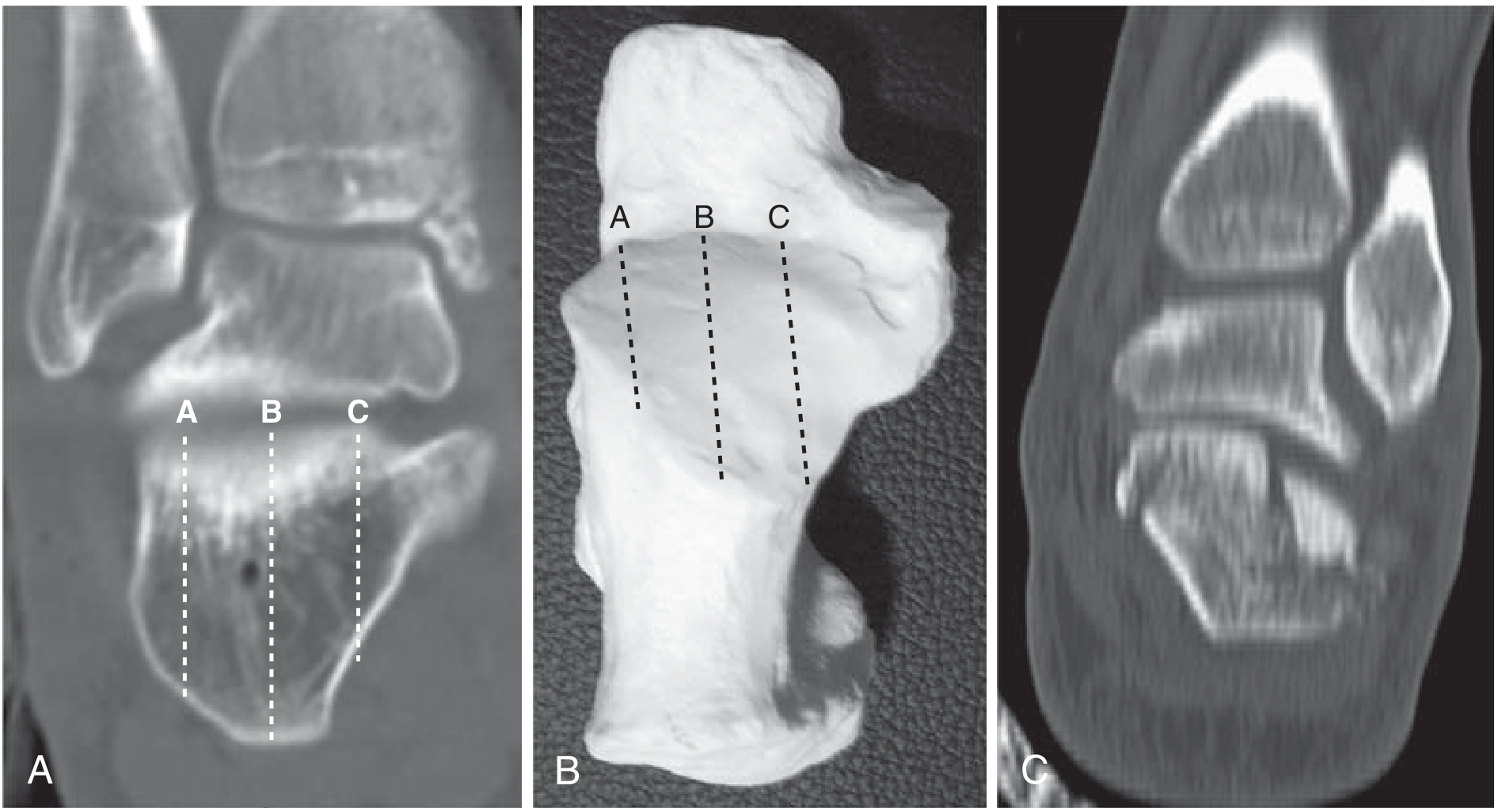
- Miller's Review of Orthopaedics 9th ed., p. 622
Imaging Evaluation
Plain Radiographs
- Lateral hindfoot view - confirms fracture, assesses Bohler's angle, classifies tongue vs. joint depression type; identifies anterior process fractures
- Harris axial heel view - shows tuberosity displacement, varus angulation, fibular abutment, lateral wall blowout
- Broden views (ankle internal rotation 15-40 degrees with X-ray beam centered 35 degrees cephalad) - evaluates posterior facet displacement
CT Scan (mandatory for intra-articular fractures)
- Semicoronal (30-degree) plane - posterior and middle facet displacement
- Axial plane - CC joint involvement
- Sagittal plane - tuberosity displacement
CT is essential for Sanders classification, pre-operative planning, and detection of sustentaculum fractures.
- Rockwood and Green's, p. 3420
Management
Extra-articular Fractures
Tuberosity avulsion fractures:
- Non-displaced: immobilization
- Displaced (tenting skin): emergent percutaneous fixation with lag screws from posterior superior tuberosity directed inferior and distal - skin compromise risk is a surgical emergency
Anterior process fractures:
- Often misdiagnosed as ankle sprains
- Most: immobilization in boot/brace
-
25% CC joint involvement or significant displacement: ORIF
- Symptomatic nonunion: fragment excision
Sustentaculum fractures:
- Rarely isolated; usually with posterior facet involvement
- Displaced: ORIF via lag screws through a medial approach
Intra-articular Fractures (Displaced)
Non-operative Treatment
Indications: non-displaced fractures (Sanders I), medically unfit patients, elderly low-demand patients with minimal deformity, patients with severe peripheral vascular disease/diabetes where wound risk is prohibitive.
Protocol: Non-weight-bearing for 6-8 weeks, early ROM of ankle/subtalar joint (to prevent stiffness), gradual return to weight-bearing.
Operative Treatment
Timing: Surgery should be delayed 10-21 days until soft tissue swelling subsides. The "wrinkle sign" (skin wrinkles present over lateral hindfoot) confirms readiness. Operating through swollen tissue dramatically increases wound complications.
Contraindications to surgery: Uncontrolled diabetes, smoking (relative), severe peripheral vascular disease, open wounds, medical instability.
Surgical Approaches
1. Extensile Lateral Approach (ELA)
- Full-thickness L-shaped flap over lateral hindfoot
- Excellent visualization of subtalar and CC joints, allows plate fixation
- Wound complication rate: 25-30% (delayed healing); deep infection 1-4%
- Complications increase in smokers, diabetics, open fractures
2. Sinus Tarsi Approach (STA) - increasingly preferred
- Smaller incision over the sinus tarsi
- Lower wound complication rate
- Requires good understanding of fracture anatomy; malreduction risk if technique is not mastered
- Can be used within 0-2 weeks of injury (before callus formation makes fragment mobilization difficult)
- Recent meta-analyses confirm significantly lower wound complication rates vs. ELA
3. Percutaneous techniques
- For tongue-type fractures and some simpler Sanders II fractures
- Minimal soft tissue disruption
Treatment by Sanders Type
- Type I: Non-weight-bearing 6 weeks, early ROM, no surgery
- Type II & III: ORIF (ELA or STA); primary subtalar arthrodesis if articular cartilage is destroyed or fracture is highly comminuted
- Type IV: ORIF + primary subtalar arthrodesis is the treatment of choice
Operative fixation typically uses lateral-to-medial 3.5 or 4.0 mm cortical screws targeting the sustentacular fragment (constant fragment). Low-profile locking plates are used with the ELA.
Open Calcaneus Fractures
- Standard open fracture protocol: IV antibiotics, tetanus prophylaxis, urgent washout and debridement
- Bony stabilization with external fixator, K-wires, or Schanz pins
- Definitive fixation deferred until clean wound bed achieved (reassess every 48-72 hours)
- Plastic surgery early involvement - 5-8% eventual below-knee amputation rate
- Average 2.8 procedures per open calcaneal fracture
Postoperative Protocol (ORIF)
- Splint for 1 week → wound check → cast
- Non-weight-bearing with limb elevation
- Sutures removed ~2 weeks
- CAM boot and gentle ROM at 6 weeks
- Progressive weight-bearing from 10-12 weeks
Complications
| Complication | Notes |
|---|---|
| Wound dehiscence/infection | Most common after ELA; 25-30% wound issues, 1-4% deep infection |
| Calcaneal osteomyelitis | Serious; may require debridement, flap coverage |
| Posttraumatic subtalar arthritis | Most common long-term complication; 50% decreased subtalar ROM regardless of treatment |
| Peroneal tendon impingement/dislocation | From lateral wall blowout; 20% have peroneal dislocation |
| Calcaneal malunion | Shortened, widened, varus calcaneus; may need corrective osteotomy or subtalar arthrodesis |
| Subfibular impingement | From persistent lateral wall expansion |
| Nerve entrapment/cutaneous nerve injury | Sural nerve most at risk with lateral approaches |
| Heel pad pain | From fat pad crush injury |
| Anterior ankle pain | From horizontal talus and reduced declination; may need bone-block distraction arthrodesis |
Prognosis
- Patients can be totally incapacitated up to 3 years and partially impaired up to 5 years
- Outcomes improve with operative management in: significant intra-articular displacement, flattened Bohler's angle, female sex, age <29, non-workers' compensation cases
- Secondary subtalar arthrodesis after primary ORIF has better outcomes than fusion after failed non-operative management (due to better preserved calcaneal height and width)
- Bone-block distraction arthrodesis of the subtalar joint is needed when significant calcaneal height loss has produced a horizontal talus with anterior ankle impingement
- Rockwood and Green's Fractures in Adults, 10th ed. 2025 | Miller's Review of Orthopaedics 9th ed.
Recent Evidence Note
A 2026 systematic review (PMID: 40375052) supports primary subtalar arthrodesis in severely displaced intra-articular calcaneal fractures. A 2024 meta-analysis (PMID: 38729077) confirms the sinus tarsi approach has significantly lower wound complication rates than the extensile lateral approach, reinforcing its growing adoption as the preferred technique.
This is a shared conversation. Sign in to Orris to start your own chat.