
51 year old male patient is newly diagnosed with axial spondylarthritis HLAB27 positive after one episode of uveitis left eye. he has has lumbar inflamatory pain when he was under 30, that was improved with nsaids. the mri shows active sacroiliitis. what is the tretament for this patient? should he be given sulfasalazine after just one episode of uveitis?
Reading File
Now let me run parallel searches across the medical library, PubMed, and web for current guidelines.
Finding Sources
Finding Sources
Searching PubMed
axial spondyloarthritis treatment guidelines biologic
Searching PubMed
spondyloarthritis uveitis sulfasalazine prevention
Good - found key textbook sections. Let me read the most relevant ones in parallel along with a targeted PubMed search on uveitis in axSpA.
Reading File
Reading File
Searching PubMed
axial spondyloarthritis uveitis TNF inhibitor recurrence
Searching the Web
ASAS EULAR 2022 axial spondyloarthritis treatment recommendations sulfasalazine uveitis
Excellent - I now have very rich data from all sources. Let me also get the PubMed abstract on the uveitis network meta-analysis and read the textbook section on sulfasalazine/uveitis.
Reading Article
PMID: 40621455
Finding Sources
Reading File
I now have comprehensive data from the 2022 ASAS/EULAR guidelines, two major rheumatology textbooks, and a 2025 network meta-analysis. Let me also fetch the ASAS/EULAR treatment algorithm figure from the textbook.
Loading Image
I now have everything needed for a thorough, evidence-based answer. Let me compose it.
Treatment of Axial Spondyloarthritis - Case Analysis
This patient has a well-supported diagnosis: HLA-B27 positive, prior inflammatory back pain (IBP) before age 30 responding to NSAIDs, MRI-confirmed active sacroiliitis, and one episode of anterior uveitis. This satisfies ASAS classification criteria for axial SpA (axSpA). Here is what current guidelines recommend.
Step 1: NSAIDs - First-Line Treatment (Always Start Here)
Per the 2022 ASAS/EULAR recommendations (Rec. 5), NSAIDs are the first-choice pharmacological treatment for axSpA. The guidance is:
- Use a full-dose NSAID continuously for at least 4 weeks - not on-demand
- Naproxen, diclofenac, celecoxib, or indomethacin are all acceptable (no single NSAID is superior)
- An extended-release formulation helps with night pain and morning stiffness
- Monitor GI, cardiovascular, and renal tolerability
Given that this patient had NSAID-responsive IBP in the past, he is likely to respond again. Start with a full-dose NSAID and reassess at 2-4 weeks.
ASAS/EULAR Recommendation 4 explicitly states that NSAIDs should be used at the maximum tolerated dose, and there is a conditional recommendation to use them continuously in patients with persistently active disease.
Step 2: csDMARDs (Sulfasalazine) - When to Use?
This is the key question you are asking, and the answer from guidelines is quite clear:
"Patients with purely axial disease should normally NOT be treated with csDMARDs; sulfasalazine may be considered in patients with peripheral arthritis."
- ASAS/EULAR 2022 Recommendation 8 (Level 1a/A evidence)
This is also confirmed in Firestein & Kelley's Textbook of Rheumatology (2022):
"Traditional csDMARDs have been studied without demonstration of benefit in axial disease. In a subgroup of patients with peripheral synovitis, there may be benefit on the peripheral arthritis."
The ESTHER trial (Etanercept vs. Sulfasalazine in Early Axial SpA) directly compared the two - etanercept was significantly superior to sulfasalazine in early axSpA. Sulfasalazine showed no meaningful benefit on axial outcomes.
For this patient specifically:
- He has purely axial disease (lumbar IBP + sacroiliitis) with no mention of peripheral arthritis, enthesitis, or dactylitis
- He had only ONE episode of uveitis
- Sulfasalazine has no proven efficacy in preventing uveitis recurrence in axSpA
Conclusion: Sulfasalazine is NOT indicated in this patient at this time. A single episode of uveitis that resolved does not change this. Sulfasalazine should only be considered if he develops peripheral arthritis.
Step 3: When to Escalate to Biologic (bDMARD/tsDMARD)?
The ASAS/EULAR treatment algorithm criteria for starting a biologic are all of the following:
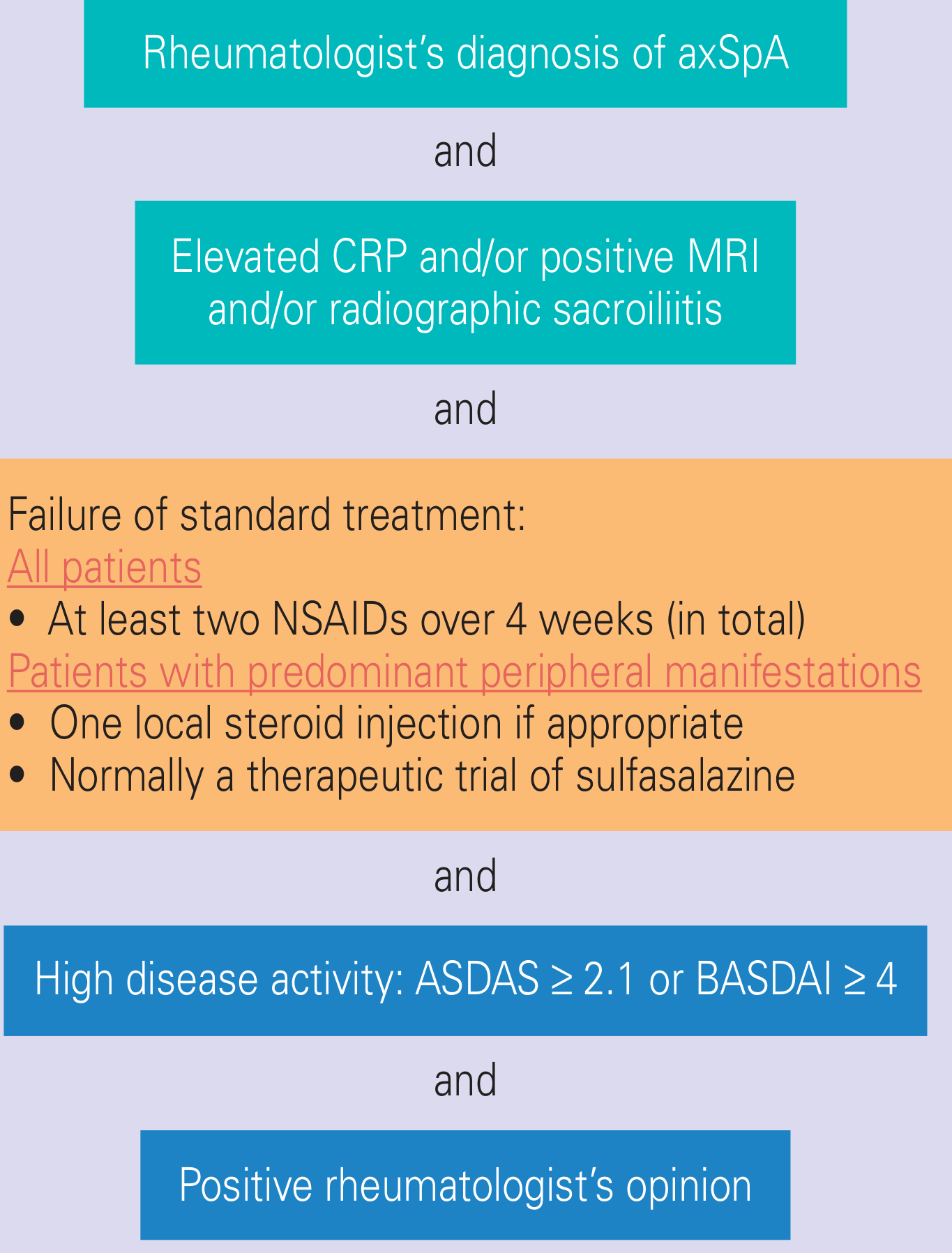
- Rheumatologist's diagnosis of axSpA ✓ (this patient qualifies)
- Objective signs of inflammation: elevated CRP and/or positive MRI and/or radiographic sacroiliitis ✓ (active MRI sacroiliitis)
- Failure of standard treatment: at least 2 NSAIDs over a total of 4 weeks
- High disease activity: ASDAS ≥ 2.1 or BASDAI ≥ 4
- Positive rheumatologist's opinion
So the pathway is: optimize NSAIDs first → assess ASDAS/BASDAI → if high disease activity persists → biologic.
Step 4: Choosing the Right Biologic - Uveitis Matters Here
This is where the history of uveitis becomes critically important for drug selection, not for starting sulfasalazine.
ASAS/EULAR 2022 Recommendation 10:
"If there is a history of recurrent uveitis or active IBD, preference should be given to a monoclonal antibody against TNF."
TNF Inhibitor class differences for uveitis:
| Drug | Uveitis protection | Class |
|---|---|---|
| Adalimumab | Best - reduces both new-onset and recurrent uveitis | Monoclonal antibody (IgG1 fully human) |
| Infliximab | Good | Monoclonal antibody (chimeric) |
| Golimumab | Good | Monoclonal antibody |
| Certolizumab | Good | PEGylated Fab fragment |
| Etanercept | Inferior - increases risk of uveitis compared to monoclonal antibodies | TNF receptor fusion protein |
| IL-17i (secukinumab, ixekizumab) | Potentially harmful - may increase uveitis risk | IL-17A inhibitors |
| Bimekizumab | Protective (IL-17A+F dual inhibitor) | IL-17A/F inhibitor |
| JAKi (upadacitinib) | Appears protective for new-onset uveitis | JAK inhibitor |
This comes directly from a 2025 network meta-analysis (Zhao et al., Front Immunol 2025, PMID 40621455) of 17 studies/11,529 AS patients: adalimumab significantly reduced uveitis risk vs. etanercept (RR 0.30), while secukinumab and ixekizumab performed worse than placebo for uveitis.
For this patient: if biologic therapy is needed, adalimumab is the preferred agent - it works for axial disease AND offers the best protection against uveitis recurrence.
Practical Management Plan
| Phase | Action |
|---|---|
| Now | Start full-dose NSAID (e.g. diclofenac SR 75mg BID or naproxen 500mg BID) continuously |
| Now | Measure ASDAS-CRP (baseline) and BASDAI |
| Now | Non-pharmacological: physiotherapy, supervised exercise, spinal mobility program |
| 4 weeks | If inadequate response, trial a second NSAID at full dose for another 2-4 weeks |
| After NSAID failure | If ASDAS ≥ 2.1 or BASDAI ≥ 4 persists: start biologic |
| Biologic choice | Adalimumab (preferred given uveitis history) - covers axial disease AND is the best TNFi for uveitis prevention |
| Uveitis monitoring | Ophthalmology follow-up; systemic local steroids (eye drops) for acute flares |
| Do NOT start | Sulfasalazine (no axial benefit; not indicated for single uveitis episode) |
| Avoid if biologic needed | Etanercept (increases uveitis risk); secukinumab/ixekizumab (no uveitis benefit) |
Summary on the Sulfasalazine Question
No, sulfasalazine should NOT be given to this patient based on one episode of uveitis. The rationale:
- Sulfasalazine has no proven efficacy in axial disease (the dominant feature here)
- There is no evidence sulfasalazine prevents uveitis recurrence in axSpA
- ASAS/EULAR 2022 explicitly restricts its use to patients with peripheral arthritis
- The correct strategy for uveitis prevention, if/when a biologic is needed, is choosing adalimumab over etanercept or IL-17 inhibitors
The single uveitis episode should instead be a flag to: (a) monitor closely with ophthalmology, (b) treat acute flares with topical steroids promptly, and (c) if biologic therapy is eventually needed, select a monoclonal anti-TNF.
Sources: Firestein & Kelley's Textbook of Rheumatology (2022), Rheumatology 2-Volume Set (2022, Elsevier/van der Heijde), ASAS/EULAR 2022 recommendations, Zhao et al. 2025 network meta-analysis PMID 40621455.
This is a shared conversation. Sign in to Orris to start your own chat.