
Fire in Anaesthesia- MD Anaesthetia PG Exam answer
Reading File
Fire in anaesthesia is a classic PG exam topic covering the fire triad, risk factors, prevention, and management in the OR setting. Let me search the medical library and supplement with web sources simultaneously.
Searching sources...
Finding Sources
Finding Sources
Searching the Web
Fire in anaesthesia MD PG exam answer fire triad prevention management OR
Good - I have hits from Morgan & Mikhail and Barash (the two major anaesthesia textbooks). Let me read the relevant sections now.
Reading File
Reading File
Excellent content from Barash (chapter 5). Let me read more of the Barash content on the fire triangle, prevention and management sections.
Reading File
Reading File
I now have comprehensive content. Let me fetch the fire triangle diagram image and read a bit more on laser safety and specific fire management from Barash.
Loading Image
Reading File
I now have sufficient content for a comprehensive PG exam answer. Let me compile it.
Fire in Anaesthesia - MD Anaesthesia PG Exam Answer
Introduction
Fire in the operating room (OR) is a preventable catastrophe. Although relatively rare (incidence ~1 in 87,000 surgical cases), fires account for over 600 OR incidents annually, with approximately 20% resulting in serious injury or death. Nearly all OR fires are preventable. Fire in anaesthesia deserves the same attention as wrong-site surgery and retained foreign objects.
The Fire Triad (Fire Triangle)
Every fire requires the simultaneous presence of three elements - together called the fire triad or fire triangle:
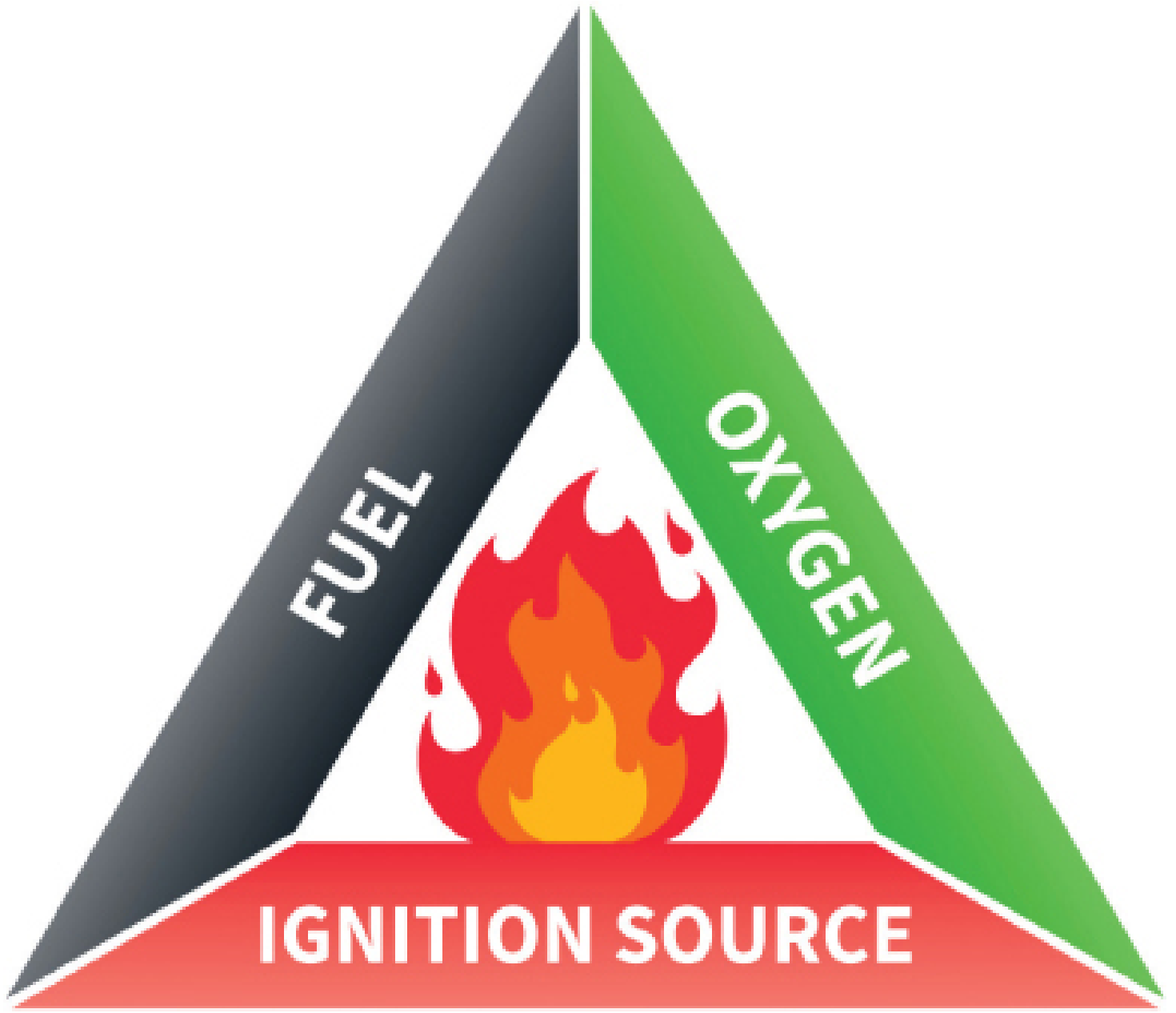
| Component | OR Examples |
|---|---|
| Fuel | Endotracheal tubes, surgical drapes, sponges, gauze, alcohol-based skin prep (chlorhexidine, benzoin, acetone), petroleum products, gowns, surgical mesh, intestinal gases, patient hair |
| Oxidizer | Oxygen (O2), Nitrous oxide (N2O) |
| Ignition source | Electrosurgical unit (ESU/electrocautery), lasers (CO2, KTP, Nd:YAG), fiberoptic light cables (distal tip), drills and burrs, external defibrillators |
Fire Tetrahedron: A fourth element - an uninhibited chemical chain reaction between fuel and oxidizer - is now recognized. This sustains the fire. Disrupting any one of the four elements extinguishes the fire.
- Barash, Clinical Anesthesia 9e, p. 376; Morgan & Mikhail, Clinical Anesthesiology 7e, p. 58
Team Responsibility for Each Component
Each OR team member controls a different arm of the triad:
- Anaesthesiologist - controls the oxidizer (FiO2, use of N2O) and whether the airway is open (nasal cannula/mask) or sealed (cuffed ETT/LMA)
- Surgeon - controls the ignition source (electrocautery settings, laser)
- Circulating nurse/scrub technician - manages fuels (alcohol-based prep solutions, drying time, draping, moistening of gauze/sponges, ESU holster)
High-Risk Situations
High fire risk = ignition source in close proximity to an oxidizer. The most common setting is:
- Upper body procedures under Monitored Anaesthesia Care (MAC) with open oxygen delivery (nasal cannula or face mask)
- Head, neck, face, chest surgeries
- Airway surgeries (laser, tracheostomy, tonsillectomy)
- Eye surgery
- Procedures where alcohol-based prep is used
The most common type of OR fire is an on-patient fire during upper-body MAC cases with nasal cannula or face mask oxygen. - Barash, p. 376
Flammability and Oxygen Concentration
Flammability increases non-linearly with oxygen enrichment. Any increase in O2 concentration above room air (21%) constitutes an oxygen-enriched atmosphere (OEA):
| Ambient O2 | Median ignition time (drape, match as source) |
|---|---|
| 21% | 0.9 seconds |
| 50% | 0.4 seconds |
| 100% | 0.2 seconds |
- Even 2 L/min via nasal cannula delivers 100% O2 out of the cannula prongs
- An air:O2 ratio of at least 7:1 is required to keep ambient O2 concentration no higher than 30%
- Nitrous oxide actively supports combustion (oxidizer); it does not simply dilute the mixture
Types of OR Fires
1. On-Patient Fires
- Most common type
- Drapes, gowns, hair ignited
- Usually during MAC with open O2
2. Airway Fires
Most dangerous fires. Three major scenarios:
a) Laser Airway Fire
- Lasers used: CO2, KTP, Nd:YAG
- CO2 laser interacts with any surface - goggles needed for all staff (clear lens sufficient for CO2)
- KTP/Nd:YAG require tinted safety glasses
- Ignites the ETT creating a "blowtorch" effect - severe tracheobronchial injury
- Prevention: use laser-resistant ETT (e.g., Laser-Flex, Bivona Fome-Cuf), fill cuff with saline (not air), reduce FiO2 as low as clinically acceptable (ideally <30%), avoid N2O, consider jet ventilation without ETT
b) Tracheostomy Fire
- ESU used to enter trachea in presence of high O2 concentrations
- Results in major morbidity
c) Tonsillectomy Fire
- ESU in oropharynx near oxygen-enriched atmosphere
3. Breathing Circuit Fire
- Rare; from electrical short in circuit warmer or exothermic reaction between desiccated CO2 absorbent (soda lime) and sevoflurane
- Risk eliminated by using non-strong-alkali absorbents (e.g., Amsorb, Dragersorb Free, LithoLyme)
Prevention of OR Fires (ASA Practice Advisory 2013)
A. Managing Oxidizers (Anaesthesiologist's domain)
- Does the patient really need supplemental O2? Room air is preferred if SpO2 is acceptable without supplemental oxygen
- If supplemental O2 is required and fire risk is high:
- If FiO2 > 0.3 is needed - secure the airway (cuffed ETT or SGA) rather than using open delivery
- Do not deliver O2 via nasal cannula barbed flowmeter (delivers 100% O2); use an air/O2 blender instead
- Reduce O2 for a sufficient time before use of ignition device (laser/cautery) to allow dissipation at the surgical site
- Configure surgical drapes to minimize accumulation of O2 beneath drapes and at the surgical field
- Avoid N2O for high-risk head/neck/airway cases
B. Managing Ignition Sources (Surgeon's domain)
- Use the lowest effective ESU settings
- Place ESU in a holster when not in use
- Activate laser/cautery only when the surgical field is clearly visualised
- Substitute radiofrequency plasma ablation where possible (lower ignition risk)
- For laser surgery: use appropriate laser-resistant ETT specific to the laser wavelength
C. Managing Fuels (Nurse/tech domain)
- Allow adequate drying time for alcohol-based skin prep before draping (pooling must be avoided)
- Moisten gauze and sponges when near ignition sources
- Keep flammable materials away from the surgical field
D. Pre-procedural Fire Time-Out
- Incorporate fire risk assessment into the universal protocol time-out
- Team members identify fire risks, confirm roles, locate fire extinguishers/gas cutoff valves, and have saline ready on the field
Management of OR Fires
Step 1: Classify fire location immediately
A. AIRWAY FIRE - Management
Immediate actions (do ALL simultaneously, without waiting for a sequence):
- Stop all airway gas flow - Turn off flowmeters, disconnect circuit from machine, OR disconnect circuit from ETT
- Remove the ETT immediately
- Pour sterile saline or water into the airway to extinguish burning tissue/material
- After above steps: Re-establish ventilation using room air only (no O2 or N2O)
- Examine the removed ETT for missing fragments (risk of retained debris in airway)
- Re-establish the airway
- Perform rigid bronchoscopy to assess thermal injury (flexible bronchoscope risks re-igniting residual material)
- If fragments are retained in the airway - retrieve them
- Consider admission to ICU, treat for smoke inhalation injury, transfer to burn centre if indicated
B. ON-PATIENT FIRE (fire on surgical drapes/patient surface)
- Stop O2/N2O flow
- Remove burning drapes/materials from the patient
- Use CO2 fire extinguisher on the burning material (not on the patient)
- Pour saline/water on the fire if appropriate
- If fire not immediately controlled:
- Activate the fire alarm
- Evacuate the patient per institutional protocol
- Close the OR door to contain fire
- Turn off medical gas supply to the room
- Do NOT re-enter the room
C. EQUIPMENT/ELECTRICAL FIRE
- Disconnect power to the device
- Use CO2 fire extinguisher
- Evacuate per protocol if fire spreads
Laser Safety - Additional Points for PG Exam
| Laser type | Wavelength | Eye protection | ETT required |
|---|---|---|---|
| CO2 | 10,600 nm | Clear safety glasses (interacts with any surface) | Laser-resistant ETT |
| KTP (532 nm) | 532 nm | Tinted glasses (colour-specific) | Laser-resistant ETT |
| Nd:YAG | 1064 nm | Tinted glasses | Laser-resistant ETT |
- Laser-resistant ETT cuffs must be filled with saline (not air) - saline absorbs heat and prevents cuff perforation
- Double-cuffed tubes (e.g., Laser-Flex, Bivona) provide added safety
- Metal foil ETTs (e.g., Norton tube) are used for CO2 laser cases
Key Exam Points (High-Yield Summary)
| Point | Detail |
|---|---|
| Incidence | ~1 in 87,000 cases |
| Most common fire type | On-patient fire during upper body MAC with nasal cannula O2 |
| Most dangerous fire | Airway fire (blowtorch effect) |
| Most common ignition source in OR | ESU/electrocautery |
| Most common oxidizer risk | Open O2 delivery via nasal cannula (delivers 100% O2) |
| Safe FiO2 threshold | Keep < 30% at surgical site for high-risk cases |
| Airway fire - first action | Stop gas flow AND remove ETT (simultaneously) |
| Flush airway with | Sterile saline or water |
| Bronchoscopy type post-airway fire | Rigid (flexible can reignite) |
| Desiccated absorbent risk | Soda lime + sevoflurane = exothermic reaction/fire |
| Safe absorbent alternatives | Amsorb, Dragersorb Free, LithoLyme (no strong alkali) |
| ASA advisory last updated | 2013 |
| APSF safety statement | "No one shall be harmed by anesthesia care" |
References
- Barash Clinical Anesthesia 9e, Chapter 5: Electrical Safety and Fires in the OR, pp. 375-400
- Morgan & Mikhail's Clinical Anesthesiology 7e, Chapter 2, pp. 57-62
- ASA Practice Advisory for Prevention and Management of OR Fires, 2013
- APSF Surgical Fire Prevention Review
This is a shared conversation. Sign in to Orris to start your own chat.