
Explain the metabolism of nucleotides in simplest way with flowchart
Nucleotide Metabolism - Simplified
What is a Nucleotide?
| Component | Options |
|---|---|
| Base | Purine (A, G) or Pyrimidine (C, T, U) |
| Sugar | Ribose (RNA) or Deoxyribose (DNA) |
| Phosphate | 1, 2, or 3 groups |
The Big Picture - Nucleotide Metabolism Has 3 Parts
NUCLEOTIDE METABOLISM
        │
   ┌────┴─────┐
   │          │
PURINES   PYRIMIDINES
(A, G)    (C, T, U)
   │          │
   └────┬─────┘
        │
   Each has 3 fates:
   ┌────┴──────┬──────────┐
   │           │          │
DE NOVO     SALVAGE  DEGRADATION
SYNTHESIS   PATHWAY   (breakdown)
(build       (recycle   (waste
 from        old bases)  products)
 scratch)
PART 1 - PURINE METABOLISM
Purine Bases: Adenine (A) and Guanine (G)
A. De Novo Synthesis (Building from Scratch)
Ribose-5-phosphate (from pentose phosphate pathway)
           │
           ▼  (activated by PRPP synthetase)
          PRPP
(5-phosphoribosyl-1-pyrophosphate)
           │
           ▼  ← Glutamine donates N
           │    [REGULATED STEP - enzyme: GPAT]
           │    inhibited by AMP & GMP (end-products)
           ▼
  5-Phosphoribosylamine
           │
           ▼  (10 more enzymatic steps
           │   atoms come from: Glycine, Glutamine,
           │   CO₂, Aspartate, Folate/THF)
           ▼
          IMP  ← (Inosine Monophosphate = branch point)
        ┌──┴──┐
        ▼     ▼
       AMP   GMP
        │     │
        ▼     ▼
       ADP   GDP
        │     │
        ▼     ▼
       ATP   GTP    ← Used in RNA synthesis
B. Salvage Pathway (Recycling Old Bases)
Free purine bases (from cell turnover / diet)
        │
        ▼  + PRPP
  HGPRT enzyme  → Hypoxanthine → IMP → AMP/GMP
  APRT enzyme   → Adenine → AMP

[HGPRT deficiency = Lesch-Nyhan Syndrome]
(self-mutilation, hyperuricemia, gout)
C. Purine Degradation
AMP → Adenosine → Inosine → Hypoxanthine
GMP → Guanosine → Guanine → Xanthine
                              │
                              ▼  (xanthine oxidase - XO)
                           XANTHINE
                              │
                              ▼  (xanthine oxidase - XO)
                           URIC ACID
                         (final waste product)
                              │
                    ┌─────────┴─────────┐
                    ▼                   ▼
              Excreted in urine    ↑ Uric acid = GOUT
              (normal)            (MSU crystal deposits)

[Allopurinol inhibits XO → treats gout]
PART 2 - PYRIMIDINE METABOLISM
Pyrimidine Bases: Cytosine (C), Uracil (U), Thymine (T)
A. De Novo Synthesis
CO₂ + Glutamine + ATP
           │
           ▼  [REGULATED STEP - enzyme: CPS II]
           │  Inhibited by UTP (end-product)
           │  Activated by PRPP
           ▼
    Carbamoyl Phosphate
           │
           ▼  + Aspartate
    Carbamoyl Aspartate
           │
           ▼
    Dihydroorotate
           │
           ▼
         Orotate
           │
           ▼  + PRPP  (now attached to ribose)
          OMP  (Orotidine 5'-monophosphate)
           │
           ▼
          UMP  (Uridine monophosphate)
           │
     ┌─────┴──────┐
     ▼             ▼
    UTP           dUMP
     │              │  (thymidylate synthase + folate/THF)
     ▼              ▼
    CTP            dTMP  ← needed for DNA only
PART 3 - DEOXYRIBONUCLEOTIDE SYNTHESIS
Ribonucleoside diphosphates (ADP, GDP, CDP, UDP)
               │
               ▼  [Ribonucleotide reductase - RNR]
               │  NADPH provides reducing power (via Thioredoxin)
               │  Strongly inhibited by dATP
               ▼
Deoxyribonucleoside diphosphates (dADP, dGDP, dCDP, dUDP)
               │
               ▼
         Used in DNA synthesis

[Hydroxyurea inhibits RNR → anticancer drug]
Master Overview Flowchart
DIETARY NUCLEOTIDES (mostly degraded in GI tract)
             │
             ▼
    ┌────────────────────────────────────┐
    │        CELL MAKES NUCLEOTIDES       │
    │  via 2 routes:                      │
    │   1. DE NOVO (from amino acids,    │
    │      CO₂, folate, ribose-5-P)      │
    │   2. SALVAGE (recycle old bases)   │
    └────────────────────────────────────┘
             │
     ┌───────┴────────┐
     ▼                ▼
  PURINES         PYRIMIDINES
 (IMP → AMP/GMP) (OMP → UMP → UTP/CTP)
     │                │
     └───────┬─────────┘
             ▼
    RIBONUCLEOTIDES (NTPs)
     → Used in RNA synthesis
     → Used as energy (ATP)
     → Signal molecules (cAMP, cGMP)
             │
             ▼  [Ribonucleotide reductase]
    DEOXYRIBONUCLEOTIDES (dNTPs)
     → Used in DNA synthesis
             │
     ┌───────┴────────┐
     ▼                ▼
  PURINES          PYRIMIDINES
  degraded to      degraded to
  URIC ACID        CO₂ + NH₃
  (excreted)       (easily cleared)
Key Concept Map (from Lippincott's Biochemistry)
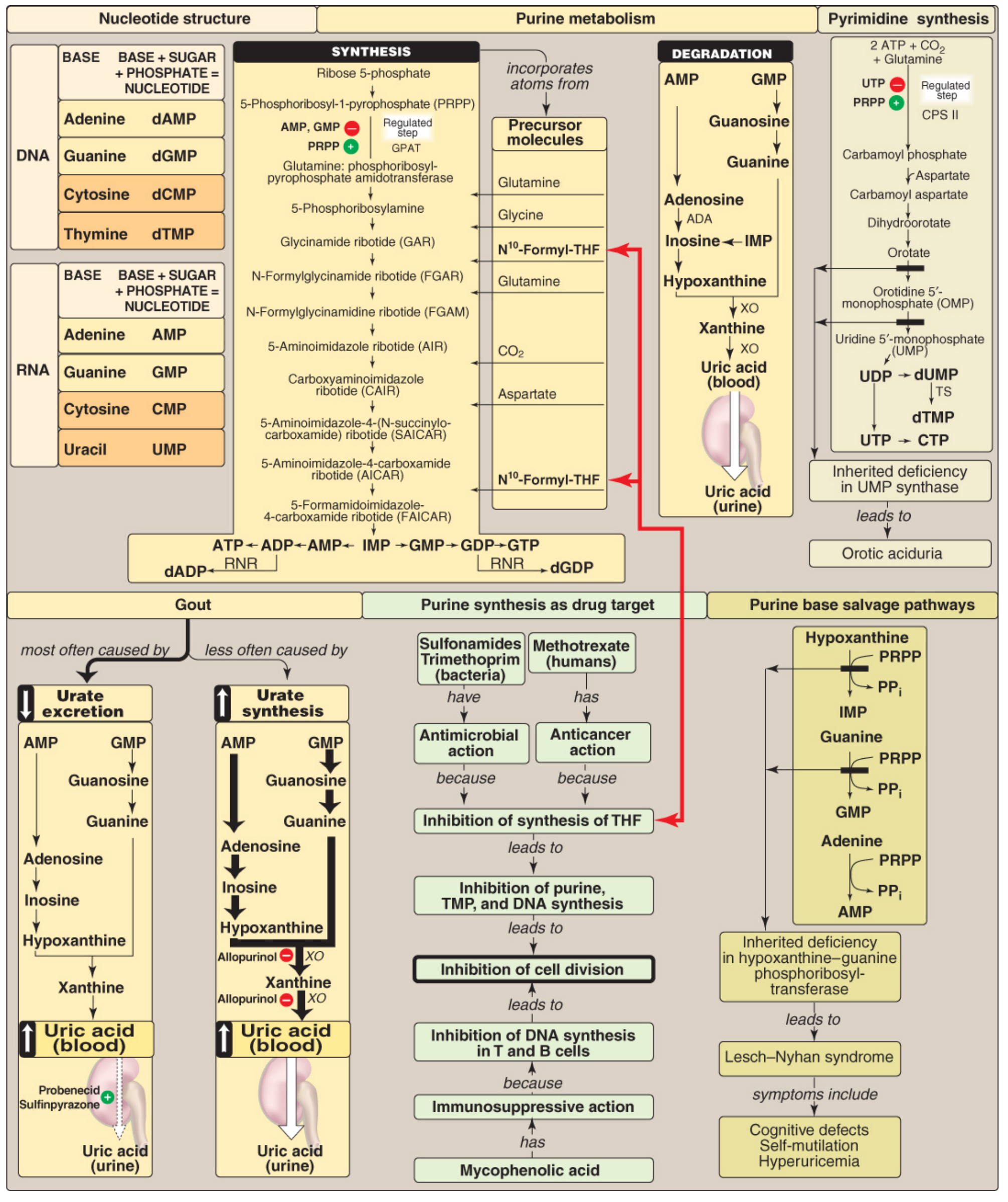
Quick Summary Table
| Feature | Purines (A, G) | Pyrimidines (C, U, T) |
|---|---|---|
| Ring built | On ribose (PRPP first) | Off ribose, then attached |
| Regulated step | GPAT (inhibited by AMP, GMP) | CPS II (inhibited by UTP) |
| Activated by | PRPP | PRPP |
| Salvage enzyme | HGPRT / APRT | Not prominent |
| Degradation product | Uric acid | CO₂ + NH₃ |
| Key disease | Gout, Lesch-Nyhan | Orotic aciduria |
Key Drugs That Target Nucleotide Metabolism
| Drug | Target | Use |
|---|---|---|
| Allopurinol | Xanthine oxidase | Gout |
| Hydroxyurea | Ribonucleotide reductase | Cancer, sickle cell |
| Methotrexate | Dihydrofolate reductase (blocks THF for TMP synthesis) | Cancer, autoimmune |
| 5-Fluorouracil | Thymidylate synthase (blocks dTMP) | Cancer |
| Sulfonamides | Folate synthesis in bacteria | Antibacterial |
Create a visual diagram/infographic poster on nucleotide metabolism pathways
A detailed, colorful medical education infographic poster on nucleotide metabolism pathways. The poster has a dark navy blue background with bright, clear text and arrows. It is organized into clear sections: TOP SECTION - Title: "NUCLEOTIDE METABOLISM" in large bold white letters with a subtitle "De Novo Synthesis | Salvage | Degradation" LEFT PANEL - "PURINE METABOLISM" (blue/teal color theme): - De Novo Synthesis flowchart: Ribose-5-Phosphate → PRPP → 5-Phosphoribosylamine (labeled "GPAT enzyme, regulated step, inhibited by AMP/GMP") → 10 steps with atoms from Glycine, Glutamine, CO2, Aspartate, Folate → IMP → branches to AMP and GMP → ADP/GDP → ATP/GTP - Salvage Pathway box: Free bases + PRPP → HGPRT/APRT → AMP/IMP/GMP. Red warning label: "HGPRT deficiency = Lesch-Nyhan Syndrome" - Degradation flowchart: AMP/GMP → Adenosine/Guanosine → Inosine → Hypoxanthine/Xanthine → Uric Acid (xanthine oxidase steps labeled). Red box: "↑Uric Acid = GOUT". Green box: "Allopurinol inhibits XO" RIGHT PANEL - "PYRIMIDINE METABOLISM" (orange/amber color theme): - De Novo Synthesis: CO2 + Glutamine + ATP → Carbamoyl Phosphate (labeled "CPS II, regulated, inhibited by UTP, activated by PRPP") → Carbamoyl Aspartate → Dihydroorotate → Orotate → OMP + PRPP → UMP → UTP → CTP (one branch) and dUMP → dTMP via Thymidylate Synthase (second branch). Red note: "UMP Synthase deficiency = Orotic Aciduria" CENTER BOTTOM PANEL - "DEOXYRIBONUCLEOTIDE SYNTHESIS" (purple theme): - Ribonucleoside diphosphates (ADP, GDP, CDP, UDP) → Ribonucleotide Reductase (RNR) → Deoxyribonucleoside diphosphates → DNA synthesis - "Powered by NADPH via Thioredoxin", "Inhibited by dATP", "Hydroxyurea inhibits RNR → anticancer" DRUG TARGETS BOX (red/pink highlight) at bottom right: Table with columns Drug | Target | Use: Allopurinol | Xanthine oxidase | Gout Hydroxyurea | RNR | Cancer Methotrexate | DHFR | Cancer 5-Fluorouracil | Thymidylate Synthase | Cancer Arrows throughout are bright yellow or white. Enzyme names in cyan. Disease states in red boxes. Drug names in green boxes. Clean, professional medical textbook style with high contrast. All text is clearly legible.