
Joints its classsification, types and function from grays
Reading File
Now let me search Gray's Anatomy for joints classification content.
Finding Sources
Finding Sources
Finding Sources
Finding Sources
Finding Sources
Finding Sources
Finding Sources
Finding Sources
Found the key section. Now let me read the full joints classification content from block1.
Reading File
Reading File
I have the core joints content. Let me also fetch the key diagram images and read the section on types of synovial joints.
Loading Image
Reading File
Reading File
Loading Image
Now let me get the solid joints section and the types-of-synovial-joints diagram:
Reading File
I now have all the content needed. Let me also fetch the solid joints diagram:
Loading Image
Loading Image
I now have everything needed for a comprehensive, well-illustrated answer directly from Gray's Anatomy for Students. Here it is:
Joints - Classification, Types, and Functions
Gray's Anatomy for Students
Definition
The sites where two skeletal elements come together are termed joints. Blood vessels that cross over a joint, and nerves that innervate muscles acting on a joint, usually contribute articular branches to that joint.
Overall Classification
Joints fall into two broad categories (Fig. 1.20):
| Category | Defining Feature |
|---|---|
| Synovial joints | Skeletal elements separated by a cavity |
| Solid joints | No cavity; components held together by connective tissue |
I. SYNOVIAL JOINTS
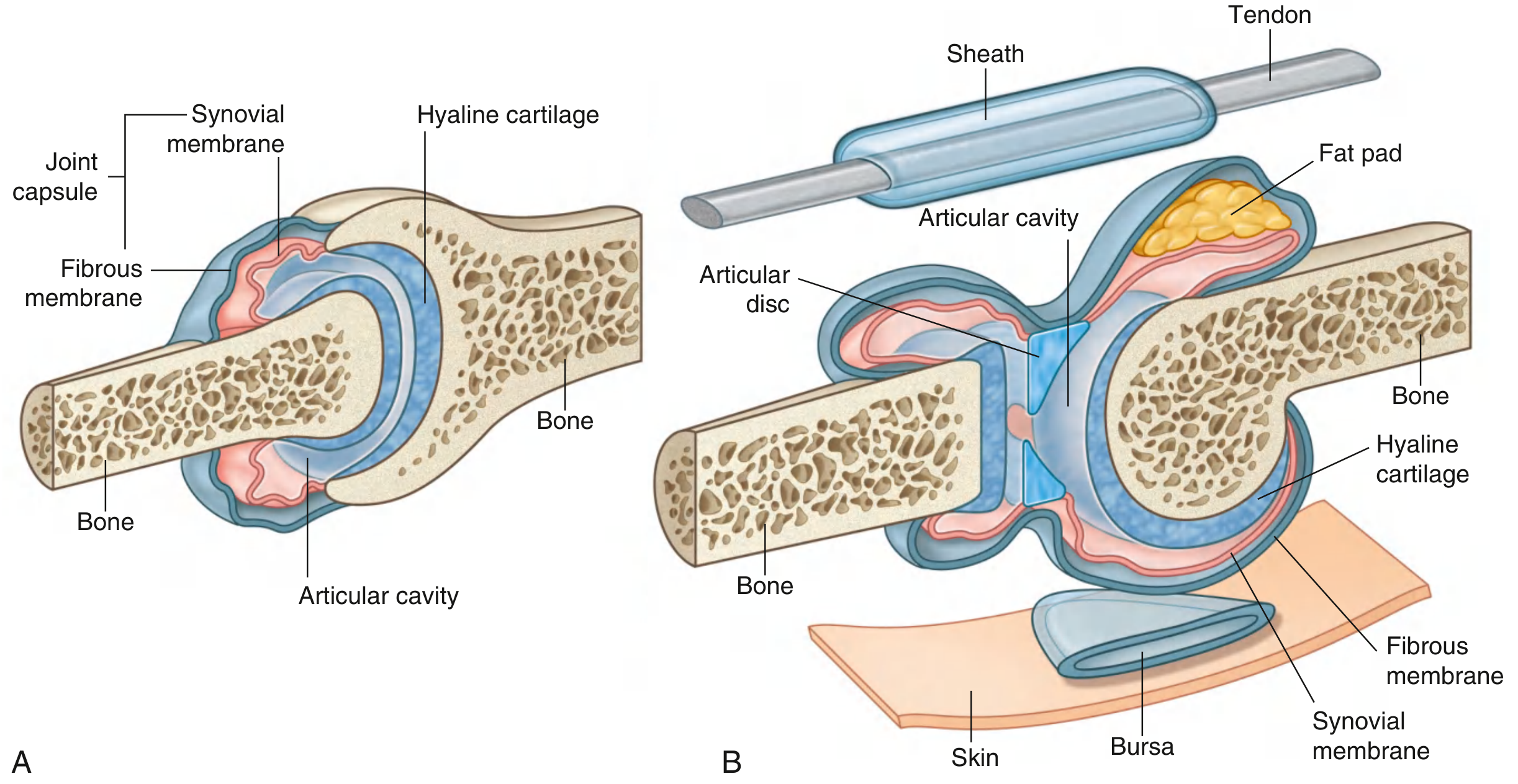
Synovial joints are connections between skeletal components where the elements are separated by a narrow articular cavity.
Characteristic Features
-
Articular cartilage - a layer of hyaline cartilage covers the articulating surfaces (bony surfaces do not contact each other directly). This is why a gap appears on X-ray - cartilage is more radiolucent than bone.
-
Joint capsule - composed of:
- Inner synovial membrane - highly vascular, attaches to margins of joint surfaces, produces synovial fluid that lubricates articulating surfaces. Closed sacs of synovial membrane also form bursae and tendon sheaths outside joints, reducing friction.
- Outer fibrous membrane - dense connective tissue that surrounds and stabilizes the joint. Parts may thicken to form intrinsic ligaments; extrinsic ligaments outside the capsule provide additional reinforcement.
-
Accessory structures (not universal) within or enclosed by the capsule:
- Articular discs (fibrocartilage) - absorb compression forces, adjust to contour changes during movement, and increase the range of movement
- Fat pads - between synovial membrane and capsule; move in and out of regions as joint contours change
- Redundant folds of synovial and fibrous membrane allow for large movements
Types of Synovial Joints
Synovial joints are classified by shape and movement:
By movement:
- Uniaxial - movement in one plane
- Biaxial - movement in two planes
- Multiaxial - movement in three planes
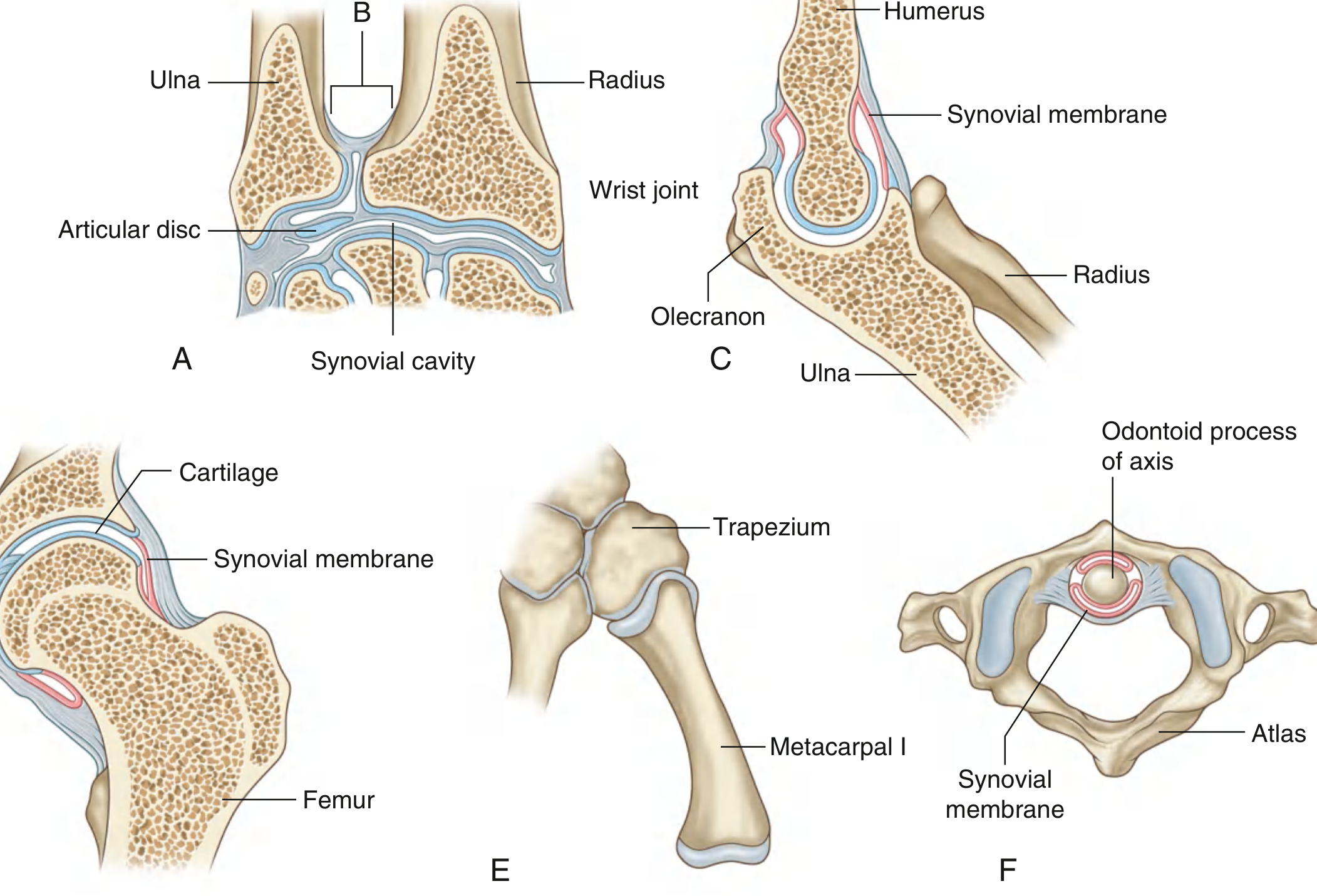
By shape (Fig. 1.22):
| Type | Movement | Example |
|---|---|---|
| Plane (flat) | Sliding/gliding in one bone across another | Acromioclavicular joint |
| Hinge | Uniaxial; flexion and extension around a transverse axis | Elbow (humero-ulnar) joint |
| Pivot | Uniaxial; rotation around a longitudinal axis along the bone shaft | Atlanto-axial joint |
| Bicondylar | Mainly uniaxial with limited rotation around a second axis; two convex condyles articulating with concave/flat surfaces | Knee joint |
| Condylar (ellipsoid) | Biaxial; flexion, extension, abduction, adduction, circumduction (limited) | Wrist joint |
| Saddle | Biaxial; saddle-shaped articular surfaces; flexion, extension, abduction, adduction, circumduction | Carpometacarpal joint of the thumb |
| Ball-and-socket | Multiaxial; flexion, extension, abduction, adduction, circumduction, and rotation | Hip joint |
Hinge joints are uniaxial; ball-and-socket joints are multiaxial.
II. SOLID JOINTS
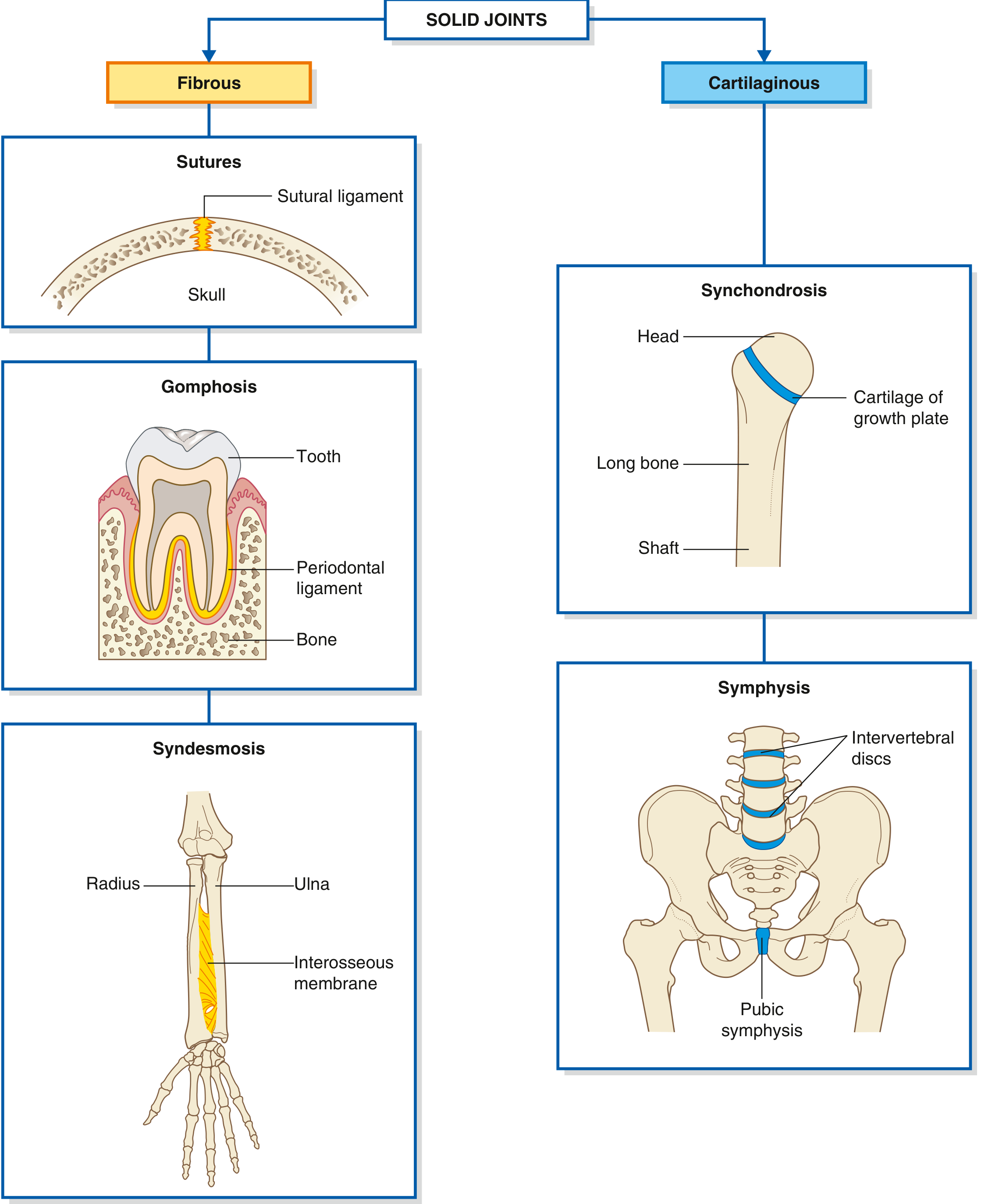
Solid joints are connections where adjacent surfaces are linked by fibrous connective tissue or cartilage (usually fibrocartilage). Movements are more restricted than at synovial joints.
A. Fibrous Joints
Linked by fibrous connective tissue. Three subtypes:
| Type | Description | Example |
|---|---|---|
| Sutures | Adjacent skull bones linked by a thin sutural ligament; occur only in the skull | Coronal suture, sagittal suture |
| Gomphoses | Tooth root anchored in bony socket by short collagen fibers of the periodontal ligament | Tooth-in-socket |
| Syndesmoses | Two adjacent bones linked by a ligament | Ligamentum flavum (vertebral laminae); interosseous membrane (radius-ulna) |
B. Cartilaginous Joints
Linked by cartilage. Two subtypes:
| Type | Description | Example |
|---|---|---|
| Synchondroses | Two ossification centers in a developing bone separated by a cartilage layer (growth plate); allow bone growth, eventually become fully ossified | Epiphyseal growth plate of long bones |
| Symphyses | Two separate bones interconnected by cartilage; occur mostly in the midline | Pubic symphysis; intervertebral discs |
Summary Table
JOINTS
├── SYNOVIAL (cavity present)
│ ├── Plane — gliding (acromioclavicular)
│ ├── Hinge — uniaxial flexion/extension (elbow)
│ ├── Pivot — uniaxial rotation (atlanto-axial)
│ ├── Bicondylar — mainly uniaxial + limited rotation (knee)
│ ├── Condylar/Ellipsoid — biaxial (wrist)
│ ├── Saddle — biaxial (1st carpometacarpal)
│ └── Ball-and-socket — multiaxial (hip, shoulder)
│
└── SOLID (no cavity)
├── FIBROUS
│ ├── Sutures (skull only)
│ ├── Gomphoses (teeth only)
│ └── Syndesmoses (ligament-linked bones)
└── CARTILAGINOUS
├── Synchondroses (growth plates)
└── Symphyses (pubic symphysis, IVDs)
Source: Gray's Anatomy for Students, Chapter 1 - The Body (pp. 33-37), Figs. 1.20-1.23.
Joints its classsification, types and function from general anatomy
Finding Sources
Finding Sources
Finding Sources
Finding Sources
Finding Sources
Finding Sources
Found the key section. Let me read the joints classification content from block1:
Reading File
Reading File
Reading File
Reading File
Reading File
Reading File
Reading File
Reading File
Now let me fetch the key diagrams:
Loading Image
Loading Image
I now have all the content needed. Let me compile the comprehensive answer from the THIEME General Anatomy and Musculoskeletal System atlas.
Joints - Classification, Types, and Functions
General Anatomy and Musculoskeletal System (THIEME Atlas of Anatomy)
Overview: The Two Major Categories
The THIEME atlas uses a distinct terminology that divides joints into False Joints (Synarthroses) and True Joints (Diarthroses/Amphiarthroses):
| False Joints (Synarthroses) | True Joints | |
|---|---|---|
| Connection | Continuously connected by connective tissue, cartilage, or bone | Separated by a joint space |
| Mobility | Low to moderate | Variable, depending on attached ligaments |
| Subdivisions | Syndesmoses, Synchondroses, Synostoses | Diarthroses, Amphiarthroses |
I. FALSE JOINTS (SYNARTHROSES)
These joints have no joint cavity - the bones are continuously connected.
1. Syndesmoses (Fibrous Joints)
Two bones connected by fibrous connective tissue. Examples:
- Interosseous membrane (radius-ulna; tibia-fibula)
- Tibiofibular syndesmosis
- Fontanelles (newborn skull)
- Gomphosis - immovable articulation of a tooth in its bony socket via the periodontal ligament
2. Synchondroses (Cartilaginous Joints)
Bones connected by cartilage. Examples:
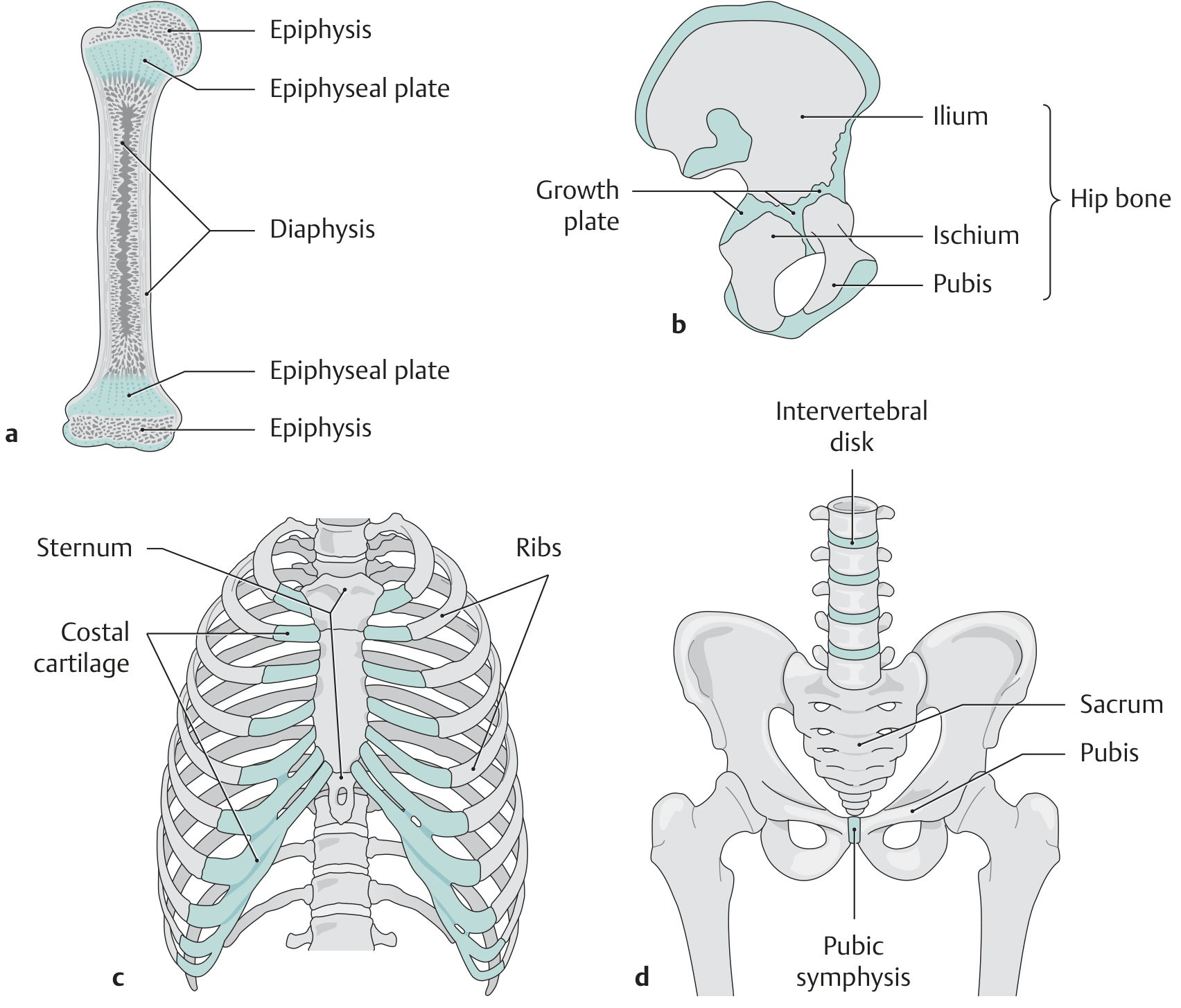
- Epiphyseal growth plates - allow bone growth; eventually ossify
- Hip bone - growth plates between ilium, ischium, and pubis (prior to closure)
- Costal cartilage - connecting ribs to sternum
- Pubic symphysis and intervertebral discs (if the intervening tissue is mostly fibrocartilaginous, the joint is called a symphysis)
3. Synostoses (Sites of Bony Fusion)
The cartilage or fibrous tissue is replaced by bone, resulting in complete stiffness. Examples:
- Sacrum - fused sacral vertebrae
- Hip bone - fusion of ilium, ischium, and pubis
- Closed and ossified epiphyseal plates in adults
II. TRUE JOINTS (DIARTHROSES / SYNOVIAL JOINTS)
True joints (also called synovial joints or diarthroses) have articulating surfaces separated by a narrow joint cavity (a few millimeters wide). The joint capsule produces synovial fluid.
Structure of a True Joint
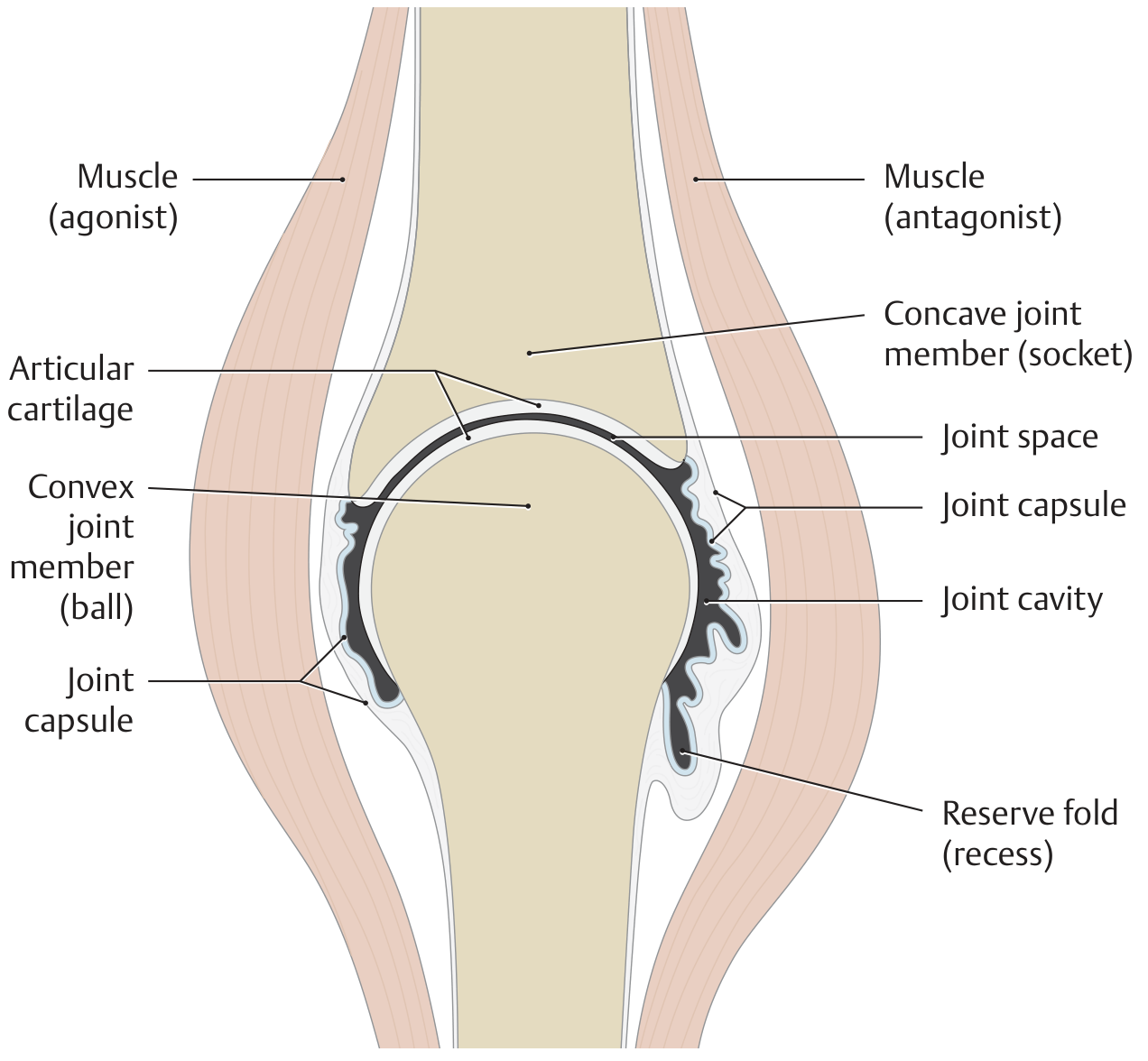
A true joint has these characteristic components:
- Articular surfaces - variably shaped, covered by hyaline cartilage (1-2 mm thick in phalanges; 5-7 mm in femoropatellar joint). Exceptions: jaw and sternoclavicular joint are covered by fibrous cartilage.
- Joint cavity - with articular recesses; width varies
- Joint capsule - a closed capsule with alar folds, synovial folds, and synovial villi; the inner layer (synovial membrane) is highly vascular and produces synovial fluid
- Synovial fluid - highly viscous; lubricates and nourishes the avascular cartilage (by diffusion and convection)
- Intra-articular structures (to improve congruency and increase force-absorbing surface):
- Menisci - crescent-shaped, wedge-shaped in cross-section; found regularly only in the knee; made of collagen, connective tissue, and fibrocartilage
- Articular discs - divide the joint into two separate chambers; found in jaw, sternoclavicular joint, and proximal wrist joint
- Articular labra - wedge-shaped fibrocartilage at outer margins of hip and shoulder sockets (acetabular and glenoid labra); enlarge the articulating surfaces
- Ligaments - intra- and extracapsular; primary joint stabilizers
- Muscles - agonist and antagonist pairs crossing the joint to move it in opposite directions
- Synovial bursae - often near the joint, may communicate with the joint cavity
Note: While the synovial membrane can regenerate through adjoining connective tissue, hyaline cartilage cannot regenerate - it is avascular, lacks perichondrium, and must be nourished exclusively by synovial fluid.
Types of True Joints - Classified by Shape and Movement
Joints are classified by the shape and arrangement of articular surfaces, number of joint axes, and number of degrees of freedom:
| Type | Axes of Motion | Degrees of Freedom | Primary Movements | Example |
|---|---|---|---|---|
| Femoropatellar (plane) joint | 1 translational | 1 | Slide up/down in femoral groove | Patella in femoral groove |
| Vertebral (plane) joint | 1-2 translational | 2-4 | Gliding in multiple directions | Facet joints of spine |
| Ellipsoidal joint | 2 rotational | 4 | Flexion, extension, abduction, adduction | Radiocarpal (wrist) joint |
| Saddle joint | 2 rotational | 4 | Flexion, extension, abduction, adduction | Carpometacarpal joint of thumb |
| Hinge joint | 1 rotational | 2 | Flexion, extension | Elbow, knee |
| Pivot joint | 1 rotational | 2 | Rotation (axial) | Atlanto-axial joint, proximal radioulnar |
| Spheroidal joint (deep socket) | 3 rotational | 6 | Flexion, extension, abduction, adduction, internal/external rotation | Hip joint |
| Spheroidal joint (shallow socket) | 3 rotational | 6 | All 6 movements + greater range | Shoulder (glenohumeral) joint |
Key principle: The more congruent the articular surfaces (similar radius of curvature, e.g., shoulder), the more they slide onto each other. The less congruent, the more they roll off each other (e.g., knee). Most joints use a combination - roll-slide.
Amphiarthroses
A special subcategory of true joints - stiff joints with very limited movement due to tight ligamentous constraints. Example: the iliosacral (sacroiliac) joint.
III. JOINT MECHANICS: Stability and Function
Constraints on Joint Motion (4 types)
- Bony constraint - shape of articular surfaces
- Muscular constraint - muscles crossing the joint
- Ligamentous constraint - ligaments limiting range
- Soft-tissue constraint - joint capsule and surrounding tissue
Key Muscles for Erect Posture
- Triceps surae + tibialis anterior - stabilize the ankle in the sagittal plane
- Quadriceps femoris - stabilizes the knee
- Gluteal muscles - stabilize the hip (sagittal plane)
- Gluteus medius and minimus - stabilize the hip (frontal plane)
- Intrinsic back muscles - stabilize the spinal column
Summary Classification Tree
JOINTS
├── FALSE JOINTS (Synarthroses) — no joint cavity
│ ├── Syndesmoses (fibrous)
│ │ ├── Interosseous membranes
│ │ ├── Tibiofibular syndesmosis
│ │ ├── Fontanelles
│ │ └── Gomphosis (teeth)
│ ├── Synchondroses (cartilaginous)
│ │ ├── Epiphyseal growth plates
│ │ ├── Costal cartilage
│ │ └── Symphyses (pubic, intervertebral discs)
│ └── Synostoses (bony fusion)
│ ├── Sacrum
│ ├── Hip bone
│ └── Ossified epiphyseal plates
│
└── TRUE JOINTS (Diarthroses) — joint cavity present
├── Diarthroses (variable degrees of freedom)
│ ├── Translational: Plane joints (femoropatellar, vertebral)
│ └── Rotational:
│ ├── 1 axis: Hinge, Pivot
│ ├── 2 axes: Ellipsoidal, Saddle
│ └── 3 axes: Spheroidal (hip, shoulder)
└── Amphiarthroses (stiff, e.g., sacroiliac joint)
Source: General Anatomy and Musculoskeletal System, THIEME Atlas of Anatomy (ISBN 9781626237186), Sections 4.2 - 4.7, pp. 60-71.
This is a shared conversation. Sign in to Orris to start your own chat.