
Carbuncle
Reading File
A carbuncle is a deep, painful skin infection involving a cluster of hair follicles that forms a coalescing abscess with multiple draining sinuses, usually caused by Staphylococcus aureus. It is essentially a coalescence of multiple furuncles extending into the subcutaneous tissue.
Searching sources...
Finding Sources
Finding Sources
Good sources found. Let me read the most detailed sections in parallel.
Reading File
Reading File
Reading File
Now let me get treatment details and fetch the clinical image of the carbuncle.
Reading File
Loading Image
Loading Image
I now have comprehensive information from multiple authoritative textbooks. Here is the full clinical overview:
Carbuncle
Definition
A carbuncle is a more extensive, deeper, communicating, infiltrated, and serious inflammatory lesion that develops when suppuration occurs in thick, inelastic skin and multiple closely set furuncles coalesce. It represents the progression of folliculitis → furuncle → carbuncle, with extension into the deeper subcutaneous tissue and the formation of multiple draining sinus tracts.
- Fitzpatrick's Dermatology, p. 2754
- Medical Microbiology 9e, p. 216
Etiology
The causative organism is almost exclusively Staphylococcus aureus, including community-acquired MRSA (CA-MRSA) strains, which are now the most common cause of skin and soft-tissue infections presenting to emergency departments.
Pathogenesis
The progression is:
- Folliculitis - pyogenic infection confined to the hair follicle
- Furuncle (boil) - extension beyond the follicle base; large, painful nodule with necrotic tissue
- Carbuncle - coalescence of multiple furuncles extending into the subcutaneous tissue, forming multiple communicating sinus tracts
The infection preferentially involves areas of thick, inelastic skin where the skin cannot accommodate the spreading purulent process easily.
Clinical Features
Classic presentation:
- Extremely painful lesion at the nape of the neck, back, or thighs (characteristic sites)
- The involved area is red and indurated
- Multiple pustules appear on the surface, draining around multiple hair follicles simultaneously
- Develops a yellow-gray irregular crater at the center
- Heals slowly by granulation, with a prolonged violaceous discoloration
- Results in a dense, permanent scar
Systemic features (distinguish from uncomplicated furuncle):
-
Fever and malaise are often present
-
The patient may appear quite ill
-
Chills indicating systemic spread via bacteremia
-
Fitzpatrick's Dermatology, p. 2754
Clinical Images
Figure 1 - Carbuncle at the nape of the neck: multiple confluent furuncles draining pus from multiple openings, with surrounding erythema and induration.
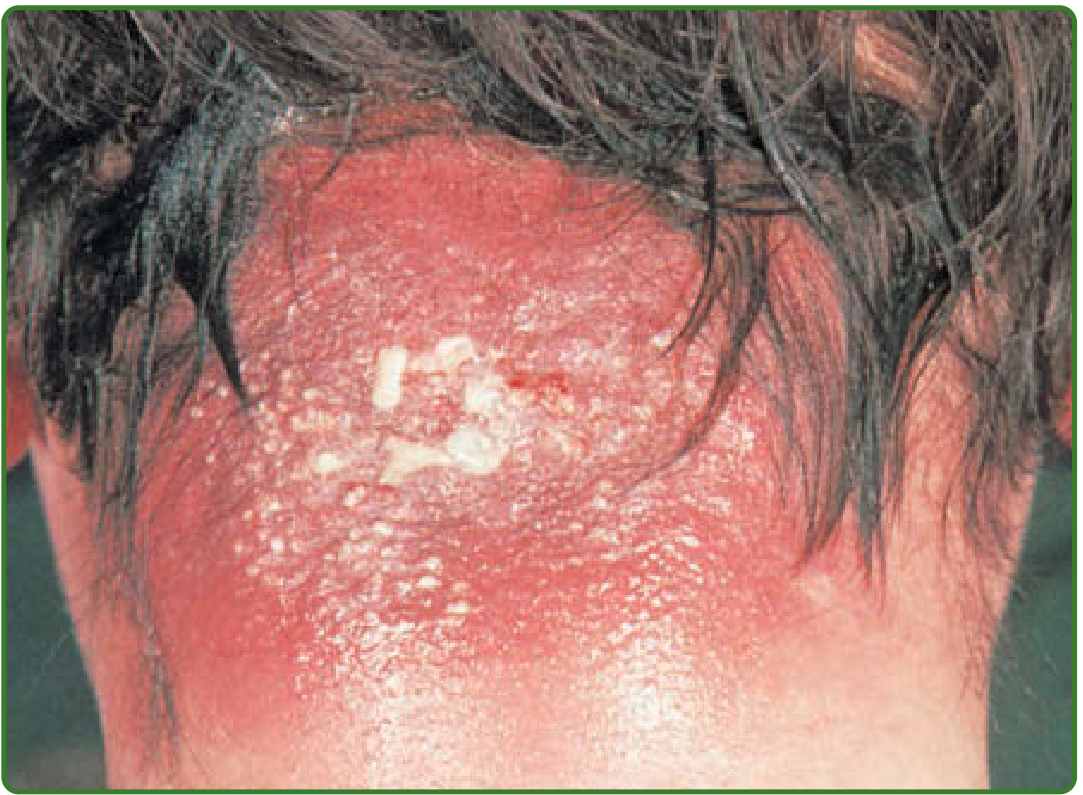
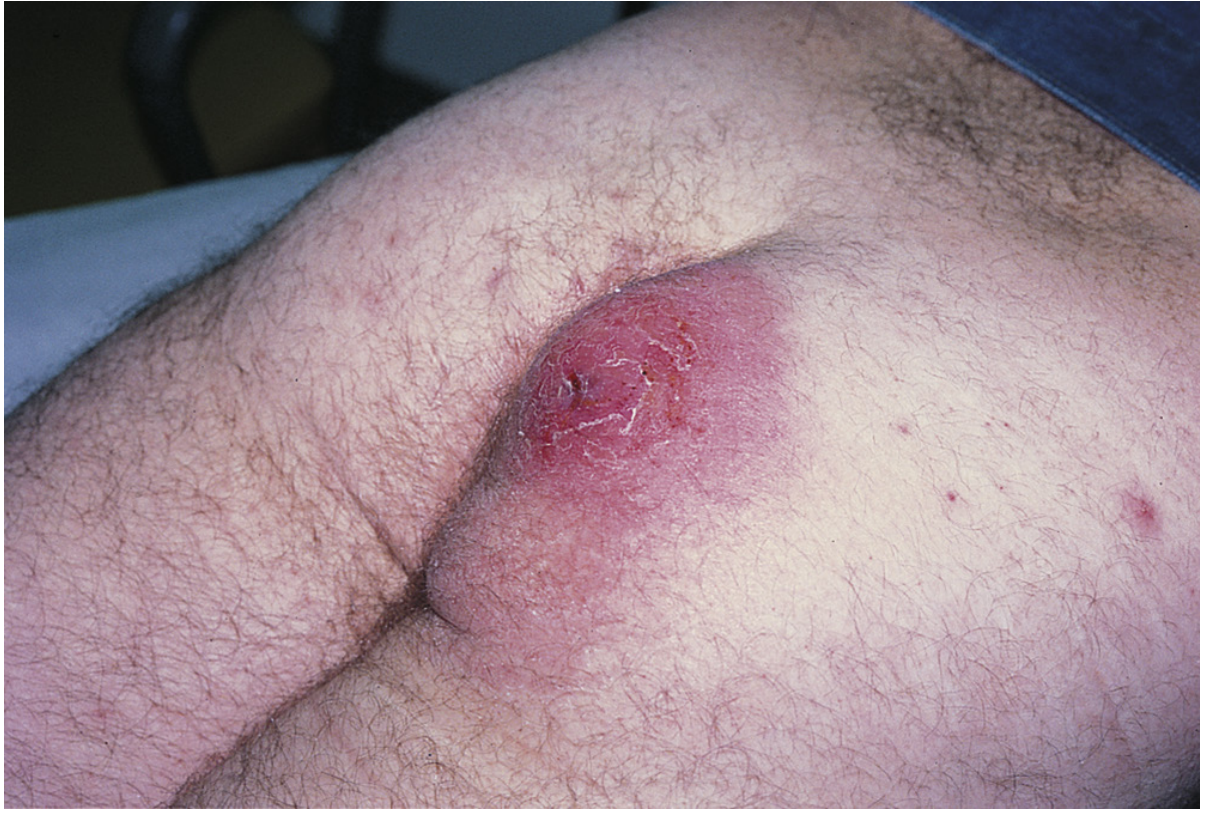
Figure 2 - S. aureus carbuncle on the buttock: developed over 7-10 days, required surgical drainage plus antibiotic therapy.
Predisposing Factors
| Factor | Notes |
|---|---|
| Diabetes mellitus | Process is often more extensive |
| Obesity | Increases friction and sweat |
| Blood dyscrasias | Impaired immune response |
| Neutrophil function defects | Inability to clear infection |
| Immunosuppression | Systemic glucocorticoids, chemotherapy |
| Immunoglobulin deficiency | Hypogammaglobulinemia |
| HIV / chronic alcoholism | Additional risk factors |
The majority of patients with recurrent furunculosis/carbuncles are otherwise healthy, however.
Complications
- Bacteremia and sepsis - patients with carbuncles have chills and fever due to systemic spread of staphylococci
- Staphylococcal scarlet fever - 16/20 cases in one study arose from furuncles/carbuncles; all strains expressed Staphylococcal Enterotoxin B (SEB)
- Distant seeding (endocarditis, osteomyelitis) if bacteremia occurs
- Dense permanent scarring
Treatment
1. Incision and Drainage (I&D)
- The primary treatment; drainage must be established
- Surgical drainage required for large or deep lesions (as in the buttock example above developing over 7-10 days)
2. Antibiotics
- Indicated when systemic signs (fever, malaise, bacteremia) are present
- Must cover S. aureus; suspect CA-MRSA in community-acquired cases
- Preferred agents for MRSA: trimethoprim-sulfamethoxazole, doxycycline, or clindamycin (community)
- For MSSA: dicloxacillin, cephalexin, or nafcillin
- If systemic or hospitalized: vancomycin for MRSA coverage
3. For hand carbuncles (Pye's Surgical)
- Conservative management: antibiotics to encourage localization
- After a few days, a core of slough separates, leaving a surprisingly large hole that heals rapidly
- Pye's Surgical Handicraft 22nd Ed., p. 395
Key Distinguishing Features vs. Furuncle
| Feature | Furuncle | Carbuncle |
|---|---|---|
| Depth | Single follicle, dermis | Multiple follicles, subcutaneous |
| Sinus tracts | None | Multiple communicating tracts |
| Systemic symptoms | Rare | Common (fever, chills, malaise) |
| Bacteremia | Uncommon | Present - systemic spread |
| Scarring | Minimal | Dense, permanent scar |
| Typical site | Any hair-bearing skin | Nape of neck, back, thighs |
This is a shared conversation. Sign in to Orris to start your own chat.