
24 year old newly diagnosed with migrane what to do medicine precautions and what can help to reduce symptoms
migraine management treatment guidelines
migraine treatment 2025 guidelines acute preventive lifestyle triggers
PMID: 40277321
migraine triggers lifestyle management diagram
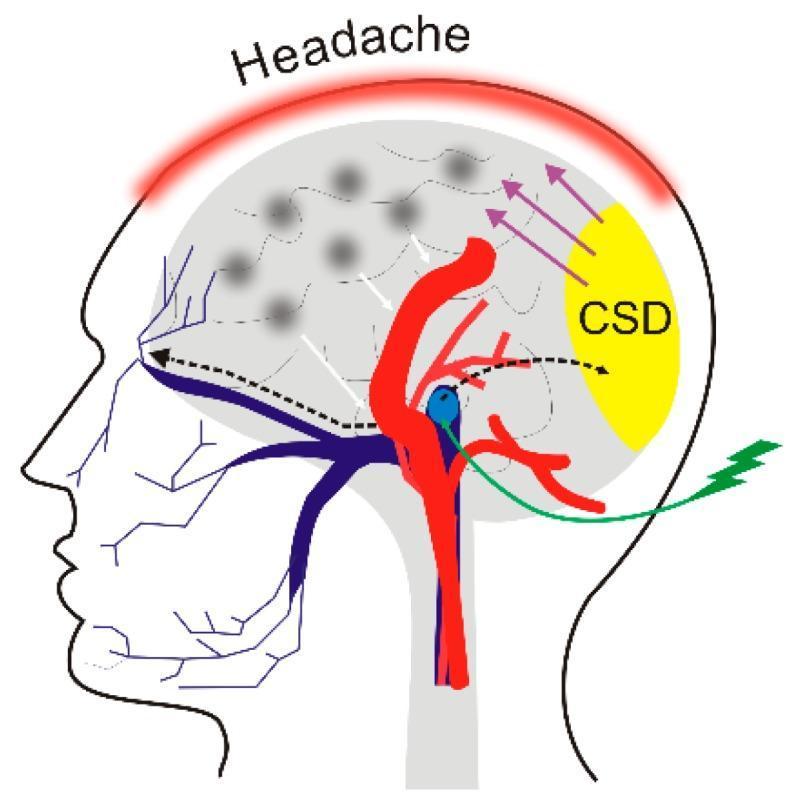
This pathophysiology diagram illustrates the hypothetical mechanism of a migraine attack in a profile view of the human head. The process begins with an external trigger (represented by a green lightning bolt) that activates the trigeminal nerve (dark blue), specifically targeting the trigeminal nucleus (light blue oval). Waves of depolarization (black dashed arrows) propagate along the nerve pathways, reaching the cerebral cortex and initiating Cortical Spreading Depression (CSD), visualized as a yellow posterior region. This activity triggers neurogenic inflammation, represented by gray 'cloud' shapes across the cortex. The subsequent release of inflammatory neurotransmitters (white arrows) leads to the vasodilation of intracranial blood vessels (bright red). The culmination of these vascular and neurological events results in the clinical manifestation of pain, indicated by a red 'Headache' arc over the superior aspect of the skull. This anatomical illustration integrates concepts of neurology and pain management, highlighting the interaction between the trigeminal vascular system and cortical activity in migraine pathogenesis.
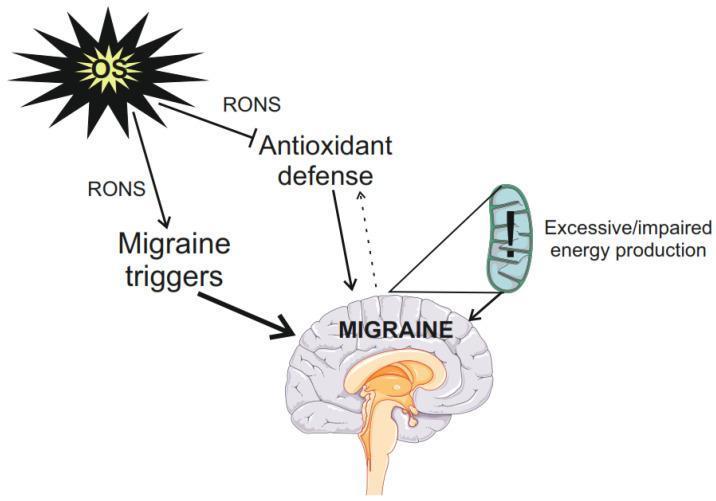
A pathophysiology diagram illustrating the relationship between oxidative stress (OS) and migraine pathogenesis. The visual map identifies OS as a central source of Reactive Oxygen and Nitrogen Species (RONS). These RONS follow two main pathways: first, acting upon 'Migraine triggers' (modulating their threshold), and second, inhibiting the 'Antioxidant defense' system (denoted by a T-bar arrow). A cross-section of a human brain labeled 'MIGRAINE' receives direct input from 'Migraine triggers', 'Antioxidant defense', and 'Excessive/impaired energy production' associated with a mitochondrion containing an exclamation mark (representing ETC impairment). A bidirectional feedback loop is shown between the brain and the antioxidant system, where migraine episodes may stimulate antioxidant defenses (dashed arrow). The diagram emphasizes the 'mitochondrial vicious cycle' and biochemical factors contributing to a migraine-susceptible brain, specifically highlighting metabolic dysfunction and the imbalance between pro-oxidants and cellular defenses as key mechanisms of disease progression.
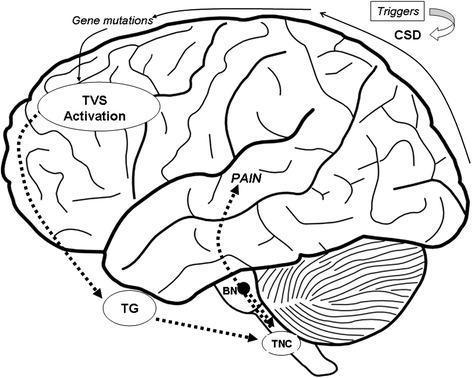
This pathophysiology diagram illustrates the neurological pathways involved in migraine pain generation within a schematic human brain. The process begins externally with 'Triggers' leading to Cortical Spreading Depression (CSD), depicted as a curved arrow over the cerebral cortex. An oval labeled 'TVS Activation' (Trigemino-Vascular System) is situated in the frontal lobe, influenced by 'Gene mutations.' A dotted signaling pathway descends from the TVS to the 'TG' (Trigeminal Ganglion) and subsequently to the 'TNC' (Trigeminal Nucleus Caudalis) located in the brainstem. The TNC receives modulatory input from 'BN' (brainstem nuclei), such as the periaqueductal gray or locus coeruleus. Finally, a dotted arrow ascends from the brainstem toward the somatosensory areas of the cortex, labeled 'PAIN,' representing the perception of a migraine attack. This diagram serves as an educational tool for understanding the trigeminovascular system's role and the transition from cortical excitation to sensory pain perception in pediatric and adult migraine pathology.
Migraine: Complete Guide for a Newly Diagnosed Young Adult
What Is Happening in Your Brain?
- Premonitory (prodrome): mood changes, food cravings, yawning, neck stiffness (hours before pain)
- Aura (not everyone): visual zigzag lines, numbness, speech changes - lasts 20-60 min
- Headache phase: throbbing, often one-sided, moderate-to-severe pain with nausea/vomiting, light & sound sensitivity - lasts 4-72 hours
- Postdrome: fatigue, "brain fog" after the attack resolves
Part 1: Medicines - Acute (Abortive) Treatment
Step 1 - Mild to Moderate Attacks (First Line)
| Drug | Dose | Notes |
|---|---|---|
| Ibuprofen (NSAID) | 400-600 mg at onset | Take with food; avoid if stomach issues |
| Naproxen sodium | 500-550 mg | Longer acting than ibuprofen |
| Aspirin + Caffeine + Paracetamol (Excedrin) | Combination | Caffeine enhances absorption |
| Paracetamol (Acetaminophen) | 1000 mg | Weaker but safer on the stomach |
Add an anti-nausea drug (metoclopramide 10 mg or domperidone) alongside the painkiller - it also speeds absorption and relieves nausea.
Step 2 - Moderate to Severe Attacks (Migraine-Specific, First Choice)
| Triptan | Route | Notes |
|---|---|---|
| Sumatriptan | Oral 50-100 mg, nasal spray, injection | Most studied; injection works fastest |
| Rizatriptan | Oral 10 mg (wafer dissolves on tongue) | Fast onset, good for nausea |
| Eletriptan | Oral 40-80 mg | High efficacy |
| Naratriptan / Frovatriptan | Oral | Slower onset but longer action - good for menstrual migraine |
- How they work: Activate 5-HT1B/D receptors - constrict dilated vessels, block pain signal transmission
- Key rule: Take AS EARLY AS POSSIBLE after onset - waiting makes them less effective
- Contraindications: Avoid if you have heart disease, uncontrolled high BP, or stroke history (they cause mild vasoconstriction)
Newer Options (if triptans not tolerated)
- Lasmiditan (ditan): 5-HT1F agonist - no vasoconstriction, safe if heart disease; but causes dizziness - do NOT drive for 8 hours after
- Rimegepant / Ubrogepant (gepants - CGRP antagonists): No vasoconstriction, no rebound risk - excellent for frequent users or those with cardiovascular concerns
Critical Warning - Medication Overuse Headache (MOH)
Part 2: Preventive (Prophylactic) Treatment
- 4 or more migraine days per month
- Attacks that severely impair function
- Poor response to acute treatments
| Drug Class | Examples | Notes |
|---|---|---|
| Beta-blockers (1st choice) | Propranolol 40-240 mg/day, Metoprolol | Avoid if asthma or low heart rate |
| Anticonvulsants | Topiramate 25-100 mg/day, Valproate | Topiramate causes weight loss; avoid valproate in pregnancy |
| Antidepressants | Amitriptyline 10-75 mg at night | Also helps sleep and stress |
| CGRP monoclonal antibodies | Erenumab, Fremanezumab (monthly/quarterly injection) | Newer, very effective, minimal side effects |
| Rimegepant / Atogepant (oral gepants) | Daily or every-other-day oral | Newest class - also works as preventive |
Part 3: Triggers - Know and Avoid Yours
Common Triggers
| Category | Examples |
|---|---|
| Diet | Alcohol (especially red wine/beer), aged cheese, chocolate, processed meats (nitrates), artificial sweeteners, MSG, skipping meals |
| Hormonal | Menstrual cycle (estrogen drop), oral contraceptives - discuss with your doctor |
| Sleep | Too little OR too much sleep, irregular sleep schedule |
| Stress | Both stress itself and the "let-down" after stress (weekend migraines) |
| Sensory | Bright/flickering lights, strong odors, loud noise |
| Environmental | Weather/barometric pressure changes, high altitude |
| Lifestyle | Dehydration, caffeine withdrawal, excessive screen time |
Part 4: Lifestyle Changes That Reduce Attack Frequency
- S - Sleep: Fixed sleep/wake time every day including weekends. Aim for 7-8 hours. Irregular sleep is a major trigger.
- E - Exercise: Regular aerobic exercise (walking, swimming, cycling) 30 min, 3-5 times/week reduces attack frequency. Start gently - intense sudden exercise can trigger attacks.
- E - Eat: Regular meals - never skip. Balanced diet, limit processed foods and triggers. Stay well hydrated (8-10 glasses of water daily).
- D - Diary: Track headaches (date, time, duration, severity, possible triggers, medications used). This is a game-changer for finding patterns and adjusting treatment.
Additional Non-Drug Strategies
- Stress management: Cognitive behavioral therapy (CBT), mindfulness, breathing exercises - evidence shows these reduce migraine frequency
- Biofeedback: Training to control physiological responses - AAN-endorsed for migraine prevention
- Magnesium supplementation: 400-600 mg/day (magnesium glycinate or citrate) - widely supported for prevention, especially if deficiency suspected
- Riboflavin (Vitamin B2): 400 mg/day - shown to reduce attack frequency
- Coenzyme Q10: 300 mg/day - evidence for modest reduction in attacks
- Acupuncture: Evidence-supported as a preventive option
Part 5: During an Attack - What Helps
- Take your medicine early - don't try to wait it out
- Go to a dark, quiet room - light and sound make it worse
- Cold or warm compress on forehead/neck (whichever feels better for you)
- Hydrate - drink water slowly
- Ginger tea - has antiemetic (anti-nausea) properties with mild evidence
- Rest - don't push through; lying down can shorten the attack
- Eye mask + earplugs - reduce sensory input
Part 6: Precautions and Red Flags
General Precautions
- Tell all doctors about your migraine - some medications (nitrates, vasodilators) can trigger attacks
- If female: Discuss migraine and oral contraceptive use with your doctor - combined OCPs with aura significantly increase stroke risk
- Avoid overusing acute medications - the 10-day rule above
- Do not drive or operate machinery during an attack (or after lasmiditan use)
- Avoid alcohol during attacks and limit generally
Seek Emergency Care Immediately For ("Red Flags"):
- Sudden "thunderclap" worst headache of your life (subarachnoid hemorrhage until proven otherwise)
- Headache with fever + stiff neck (meningitis)
- New neurological symptoms - confusion, vision loss, limb weakness, speech problems
- Headache after head injury
- Headache that is completely different from your usual migraine pattern
- Progressive worsening over days/weeks
Quick Reference Summary
| Goal | Action |
|---|---|
| Stop an attack (mild) | Ibuprofen/naproxen + anti-nausea drug, taken early |
| Stop an attack (severe) | Triptan (sumatriptan/rizatriptan) as early as possible |
| Prevent attacks | Lifestyle (SEED), consider propranolol/topiramate/CGRP antibody if frequent |
| Reduce triggers | Diary, regular sleep/meals/exercise, hydration, stress management |
| Supplements | Magnesium + B2 (riboflavin) - safe and evidence-based |
| Avoid | Medication overuse (>10-15 days/month), known food triggers, irregular sleep |
- Bradley and Daroff's Neurology in Clinical Practice (migraine classification, treatment, lifestyle)
- Lippincott Illustrated Reviews: Pharmacology (triptans, ergots, gepants, ditans)
- Goodman & Gilman's Pharmacological Basis of Therapeutics (triptan mechanisms)
- Textbook of Family Medicine 9e (acute management)
- 2025 Evidence-based guidelines for pharmacological treatment of migraine (Ornello et al., Cephalalgia 2025) - PMID 40277321
- International Headache Society 2024 global practice recommendations - PMID 39133176
Note: This is educational information. Work with your doctor to choose the right medication for YOU based on your frequency, other health conditions, and what you can access. A neurologist or headache specialist can create a personalized plan.