
Ascites
Reading File
Finding Sources
Searching PubMed
ascites management
The best sources are Sleisenger & Fordtran (GI/Liver) and Goldman-Cecil Medicine. Let me pull those comprehensive sections in parallel.
Reading File
Reading File
Reading File
Now let me pull the main Sleisenger & Fordtran dedicated ascites chapter and Goldman-Cecil block 18 for pathophysiology and diagnosis.
Reading File
Reading File
Finding Sources
Excellent. Now let me get the detailed Sleisenger & Fordtran ascites chapter (the main one) and Harrison's section for pathophysiology and SBP.
Reading File
Reading File
Let me get the SBP section and more of the Sleisenger pathophysiology/treatment:
Reading File
Finding Sources
Reading File
Reading File
I have rich data from multiple authoritative sources. Let me fetch the SAAG diagnostic flowchart image and the SBP section from Harrison's, then compile the full answer.
Loading Image
Reading File
I now have comprehensive information from multiple authoritative sources. Let me compile a thorough, well-structured answer.
Ascites
Ascites is the pathological accumulation of free fluid within the peritoneal cavity. It is the most common major complication of cirrhosis, and its development marks the transition from compensated to decompensated liver disease.
Epidemiology & Etiology
- Cirrhosis accounts for ~80% of cases in the Western world
- Peritoneal malignancy (colon, gastric, pancreatic, ovarian, breast, endometrial) — ~10%
- Cardiac ascites (heart failure, constrictive pericarditis, tricuspid regurgitation) — ~5%
- Peritoneal tuberculosis — important cause in endemic regions
- Others: nephrotic syndrome, Budd-Chiari syndrome, pancreatic ascites, sinusoidal obstruction syndrome
Prognosis: Median survival is ~2 years for non-malignant ascites and only ~4 months for malignant ascites. If the underlying malignancy is chemotherapy-responsive, survival may be prolonged. (Sleisenger & Fordtran's GI and Liver Disease)
Pathophysiology (Cirrhotic Ascites)
The central mechanism is portal hypertension leading to splanchnic vasodilatation:
- Portal hypertension → splanchnic vasodilation (nitric oxide-mediated) → decreased effective arterial blood volume
- Activation of the renin-angiotensin-aldosterone system (RAAS) and sympathetic nervous system (SNS) → renal sodium and water retention
- Hypoalbuminemia → reduced oncotic pressure → fluid shifts into the peritoneum
- Impaired hepatic lymph flow — hepatic lymph production exceeds the capacity of the thoracic duct
- Systemic inflammation in decompensated cirrhosis — bacterial translocation from an edematous gut wall produces pathogen-associated molecular patterns (PAMPs), activating innate immune cells and releasing pro-inflammatory cytokines (IL-6, IL-8, TNF-α), further worsening circulatory dysfunction
Clinical Features
Symptoms: Abdominal distension, early satiety, dyspnea (from diaphragm elevation), abdominal discomfort, ankle swelling
Signs:
- Shifting dullness (detectable with ≥1,500 mL fluid)
- Fluid thrill (large-volume ascites)
- Caput medusae, spider angiomata, palmar erythema, jaundice (in cirrhosis)
- Elevated JVP, Kussmaul's sign, pericardial knock (in cardiac causes)
- Virchow's node — suggests metastatic malignancy
Imaging: Ultrasound can detect as little as 100 mL of fluid and is the first-line, most cost-effective test. CT better delineates associated findings (nodular liver, splenomegaly — see below) and retroperitoneal lymphadenopathy.
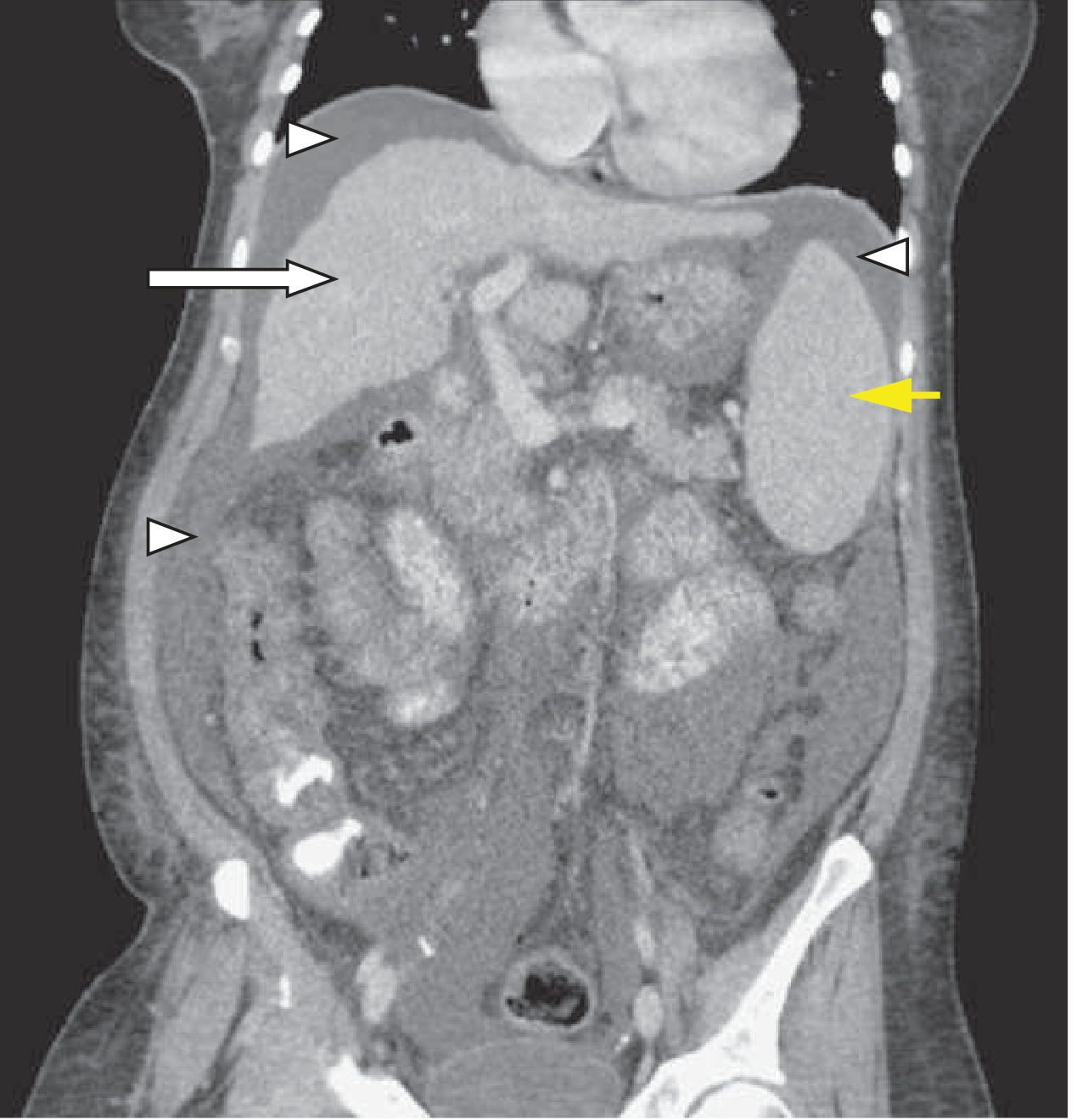
Grading (International Club of Ascites)
| Grade | Description |
|---|---|
| 1 | Mild — detectable only by ultrasound |
| 2 | Moderate — detectable on physical examination |
| 3 | Tense — marked abdominal distension |
Recurrent ascites: Recurs ≥3 times within a 1-year period despite appropriate treatment.
Diagnostic Paracentesis
Diagnostic paracentesis is safe and should be performed in every patient with new-onset ascites, even in the presence of coagulopathy. Ultrasound guidance is used when fluid is difficult to locate clinically.
Ascitic Fluid Analysis
| Test | Purpose |
|---|---|
| Albumin + serum albumin (simultaneous) | Calculate SAAG |
| Total protein | Differentiate cause |
| PMN count | Exclude SBP (≥250/μL is diagnostic) |
| Gram stain & culture (inoculate blood culture bottles at bedside) | Identify organism |
| Cytology | Peritoneal carcinomatosis |
| Amylase | Pancreatic ascites (typically >1000 U/L) |
| Glucose + LDH | Secondary peritonitis (glucose <50 mg/dL, LDH > serum LDH) |
| AFB smear/culture | TB peritonitis |
Gross Appearance
- Turbid → infection or tumor
- Milky/white (triglycerides >200 mg/dL) → chylous ascites (trauma, cirrhosis, tumor, TB, lymphatic anomalies)
- Dark brown → biliary perforation
- Black → pancreatic necrosis or metastatic melanoma
Serum-Ascites Albumin Gradient (SAAG)
SAAG = Serum albumin − Ascites albumin (specimens drawn on the same day)
SAAG reflects sinusoidal pressure and correlates with the hepatic venous pressure gradient. Accuracy is reduced if samples are not taken simultaneously, serum albumin is very low, or ascites is chylous (falsely high SAAG).
| SAAG | Meaning | Common Causes |
|---|---|---|
| ≥1.1 g/dL | Portal hypertension | Cirrhosis, cardiac ascites, Budd-Chiari, sinusoidal obstruction syndrome, massive liver metastases |
| <1.1 g/dL | Non-portal hypertension | Peritoneal carcinomatosis, TB peritonitis, pancreatic ascites, nephrotic syndrome |
Ascitic protein refines the diagnosis in high-SAAG ascites:
- High SAAG + protein ≥2.5 g/dL → Normal sinusoids (cardiac ascites, early Budd-Chiari, sinusoidal obstruction syndrome)
- High SAAG + protein <2.5 g/dL → Scarred/capillarized sinusoids (cirrhosis, late Budd-Chiari, massive metastases)
- Low SAAG + high protein → Malignant or TB peritonitis
A high serum BNP has high diagnostic accuracy for cardiac ascites in high-SAAG cases. (Goldman-Cecil Medicine)
Management
1. Uncomplicated Ascites
Grade 1: No treatment required beyond observation.
Grade 2 (moderate):
- Sodium restriction: 2 g/day (88 mEq/day) — more restrictive diets compromise nutritional status
- Spironolactone (aldosterone antagonist): Start at 100 mg/day, titrate every 3–4 days up to 400 mg/day
- Furosemide: 40–160 mg/day — add concurrently if ascites is tense, or if weight loss is inadequate, or hyperkalemia develops with spironolactone alone
- Target weight loss: 1 kg/week (first week); 2 kg/week thereafter — do not exceed 0.5 kg/day without peripheral edema or 1 kg/day with edema
- Avoid: ACE inhibitors, ARBs, NSAIDs (worsen renal function)
- Spironolactone side effects: Gynecomastia, hyperkalemia; furosemide side effects: hypovolemic hyponatremia, renal dysfunction, encephalopathy
Albumin infusion (long-term): Albumin 40 g twice weekly × 2 weeks, then 40 g weekly added to spironolactone and furosemide can significantly reduce recurrent ascites and improve 18-month survival. Albumin infusion alone (without diuretics) is of no benefit and may increase pulmonary edema risk. (Goldman-Cecil Medicine)
2. Refractory Ascites (10–20% of patients)
Defined by failure to respond to or early recurrence despite maximum diuretic therapy (spironolactone 400 mg/day + furosemide 160 mg/day for ≥1 week with sodium restriction):
Large-Volume Paracentesis (LVP):
- Remove all or most fluid in one session
- Albumin replacement: 6–8 g IV per liter removed, especially when >5 L is drained — prevents paracentesis-induced circulatory dysfunction (PICD)
- Frequency dictated by rate of re-accumulation
TIPS (Transjugular Intrahepatic Portosystemic Shunt):
- Connects intrahepatic portal branch to hepatic vein — decompresses portal system
- Covered stents (PTFE) preferred over uncovered (lower occlusion rates, lower encephalopathy rates)
- More effective than LVP for controlling recurrent ascites; improves survival in recurrent ascites (not demonstrated in refractory ascites)
- Main complication: hepatic encephalopathy (up to 50% with uncovered stents, reduced with covered stents)
- Contraindications: severe hepatic encephalopathy, advanced liver failure, heart failure
Peritoneovenous shunt: Subcutaneously placed silicone tube transfers ascites to systemic circulation — used when TIPS and liver transplantation are not options.
Automated flow pumps (alfapump): Move ascitic fluid to the bladder, reducing need for LVP; improve quality of life but require surgical placement and carry infection risk.
Liver transplantation: Definitive treatment — patients with refractory ascites should be evaluated. MELD score (using creatinine, bilirubin, INR, and serum sodium) guides transplant priority.
Complications
Spontaneous Bacterial Peritonitis (SBP)
The most common and potentially lethal infectious complication of cirrhotic ascites.
Clinical features: Increased abdominal girth, fever, nausea/vomiting; abdominal tenderness in only 40%; rebound tenderness uncommon; new or worsening hepatic encephalopathy.
Diagnosis: Ascitic fluid PMN count ≥250/μL (diagnostic, even before culture results). Cultures typically reveal a single pathogen; multiple pathogens suggest secondary peritonitis (ruptured viscus).
Common pathogens: E. coli, Klebsiella (gram-negative rods); streptococci, enterococci. Increasingly, nosocomial/healthcare-acquired SBP is caused by multidrug-resistant bacteria.
Treatment:
- IV cefotaxime 2 g every 12 hours × 5 days (3rd-generation cephalosporin) — effective for gram-negative and gram-positive aerobes
- Repeat paracentesis at 48 hours to confirm PMN count decreased by ≥25%
- Nosocomial SBP or critically ill patients: consider carbapenem empirically
- IV albumin (1.5 g/kg at diagnosis, 1 g/kg at day 3) reduces risk of HRS and improves survival
Prophylaxis (for high-risk patients):
- Prior SBP
- Ascitic fluid total protein <1 g/dL
- Active GI bleeding
- Agents: oral ciprofloxacin or norfloxacin daily; IV ceftriaxone for hospitalized patients
Paracentesis within 12 hours of hospital admission in patients with ascites reduces mortality through early SBP detection. (Harrison's Principles of Internal Medicine, 22e)
Hepatic Hydrothorax
- Ascitic fluid migrates via diaphragmatic fenestrae into the pleural space (usually right-sided)
- Defined by the absence of primary cardiopulmonary or pleural disease
- Serum-to-pleural fluid albumin gradient ≥1.1 g/dL is suggestive
- Can cause respiratory failure, hypoxia, and spontaneous bacterial empyema (same diagnostic criteria as SBP)
- Treatment: sodium restriction, diuretics, thoracentesis as needed, TIPS
- Avoid chest tube placement
- Median survival ~1 year — list for liver transplantation
Hepatorenal Syndrome (HRS)
- Type 1 (HRS-AKI): Rapid doubling of creatinine to >2.5 mg/dL in <2 weeks; median survival 2 weeks
- Type 2: Moderate renal failure (creatinine 1.25–2.5 mg/dL), slowly progressive; presents with refractory ascites; median survival 4–6 months
Abdominal Wall Hernias
- Umbilical and inguinal hernias in up to 20% of patients with cirrhosis and ascites
- Risk: incarceration, perforation; elective repair after ascites control or at time of liver transplantation
Summary: Key Numbers to Remember
| Parameter | Value |
|---|---|
| SAAG cutoff for portal hypertension | ≥1.1 g/dL |
| Ascitic PMN cutoff for SBP | ≥250/μL |
| Ascitic protein low vs. high threshold | 2.5 g/dL |
| Albumin for LVP >5 L | 6–8 g/L removed |
| Spironolactone max dose | 400 mg/day |
| Furosemide max dose | 160 mg/day |
| Minimum fluid detectable by US | 100 mL |
| Minimum fluid detectable clinically | ~1,500 mL |
| Sodium restriction target | ≤2 g/day (88 mEq/day) |
Sources: Sleisenger and Fordtran's Gastrointestinal and Liver Disease; Harrison's Principles of Internal Medicine, 22e; Goldman-Cecil Medicine; Rosen's Emergency Medicine
This is a shared conversation. Sign in to Orris to start your own chat.