
Montelukast
I'll start with a quick overview, then pull detailed information from the medical library.
Montelukast is a leukotriene receptor antagonist (LTRA) used primarily for asthma prophylaxis and allergic rhinitis. It blocks cysteinyl leukotriene receptors (CysLT1), reducing bronchoconstriction, mucus secretion, and inflammation. It's taken orally once daily and is generally well tolerated, though it carries an FDA black-box warning for neuropsychiatric effects.
Searching sources...
Reading File
Now I'll search the medical library for detailed montelukast content in parallel:
Finding Sources
Searching PubMed
montelukast neuropsychiatric effects safety
Good - I found relevant sources. Let me now read the key pharmacology sections in parallel:
Reading File
Reading File
Finding Sources
Excellent. Now let me read the core pharmacology sections from Katzung and Harrison's:
Reading File
Reading File
Finding Sources
I now have rich data from multiple authoritative textbooks. Let me get the full pharmacology details from Katzung and Lippincott, and also check the Goodman & Gilman section:
Reading File
Reading File
Finding Sources
Excellent. Let me now read the Harriet Lane dosing section and fetch the pathway diagram:
Reading File
Reading File
Loading Image
I now have comprehensive information from multiple authoritative textbooks. Let me now get the pediatric dosing details:
Finding Sources
I now have all the information needed for a comprehensive answer. Let me compile the full montelukast summary:
Montelukast (Singulair)
Drug Class
Leukotriene receptor antagonist (LTRA) - specifically a selective CysLT1 receptor antagonist
Mechanism of Action
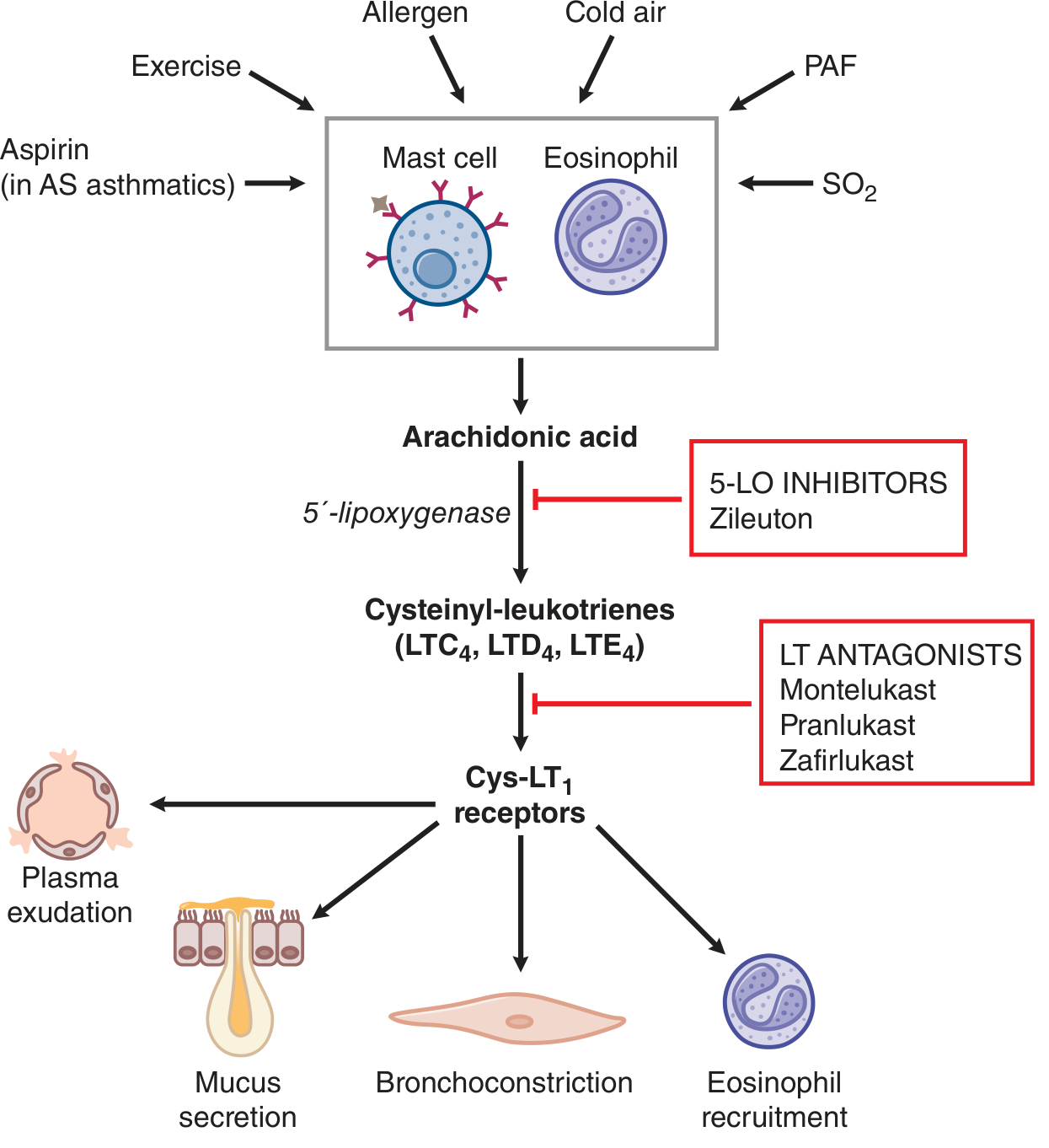
Leukotrienes (LTC4, LTD4, LTE4) are produced via the 5-lipoxygenase pathway of arachidonic acid metabolism in mast cells, basophils, eosinophils, and neutrophils. These cysteinyl leukotrienes bind to CysLT1 receptors and cause:
- Bronchoconstriction
- Mucus hypersecretion
- Plasma exudation
- Eosinophil recruitment and airway inflammation
Montelukast blocks the CysLT1 receptor, preventing all of these downstream effects.
Indications
| Indication | Notes |
|---|---|
| Asthma prophylaxis (chronic) | Alternative to low-dose ICS; NOT for acute attacks |
| Exercise-induced bronchoconstriction | Give at least 2 hrs before exercise; no additional dose within 24 hrs |
| Aspirin-exacerbated respiratory disease (AERD) | Particularly effective due to high leukotriene overproduction |
| Seasonal & perennial allergic rhinitis | Adults and children; approved but NOT recommended as first-line monotherapy (inferior to intranasal corticosteroids) |
| Pediatric mild persistent asthma | Widely used in children when ICS-related growth suppression is a concern |
Pharmacokinetics
| Parameter | Detail |
|---|---|
| Route | Oral only |
| Dosing frequency | Once daily (at night) |
| Protein binding | Highly protein-bound |
| Absorption | Food does NOT impair absorption (unlike zafirlukast) |
| Metabolism | Extensive hepatic metabolism via CYP 3A4 and CYP 2C9 |
| Excretion | Biliary (feces); primarily not renal |
| Onset of effect | Rapid (hours); full chronic benefit within ~1 month |
Drug interactions: Phenobarbital and rifampin induce hepatic metabolism and increase montelukast clearance (reduced efficacy). - The Harriet Lane Handbook, 23rd ed.
Dosing
| Age Group | Indication | Dose |
|---|---|---|
| Adults & ≥15 yr | Asthma / Allergic rhinitis | 10 mg PO once daily at bedtime |
| Children 6-14 yr | Asthma / Allergic rhinitis | 5 mg (chewable tablet) PO once daily |
| Children 2-5 yr | Asthma / Allergic rhinitis | 4 mg (chewable tablet or granules) PO once daily |
| 6-23 months | Asthma only | 4 mg (oral granules) PO once daily |
| Adults ≥15 yr | Exercise-induced bronchoconstriction | 10 mg at least 2 hrs before exercise |
| Children 6-14 yr | Exercise-induced bronchoconstriction | 5 mg at least 2 hrs before exercise |
Phenylketonuria (PKU) warning: Chewable tablet contains phenylalanine - contraindicated in PKU patients. - Fishman's Pulmonary Diseases
Adverse Effects
Common
- Headache
- Abdominal pain, dyspepsia, nausea
- Diarrhea
- Fatigue, dizziness
- Elevated liver enzymes (mild; less than with zileuton)
Serious - FDA Black Box Warning
Montelukast carries an FDA black-box warning for neuropsychiatric events, including:
- Agitation, aggression
- Anxiety, dream abnormalities, insomnia
- Hallucinations
- Depression, suicidal ideation and behavior
- Obsessive-compulsive symptoms
This warning applies to both children and adults. A completed-suicide signal exists, though more recent data suggest a potentially lower risk of depression vs. inhaled corticosteroids (data remains mixed). - Goodman & Gilman's; The Maudsley Prescribing Guidelines
Rare but Serious
- Eosinophilic Granulomatosis with Polyangiitis (EGPA / Churg-Strauss syndrome): Characterized by eosinophilia, vasculitis, rash, arthralgia, worsening respiratory symptoms, and neuropathy. Often unmasked when oral corticosteroids are tapered. - Lippincott Pharmacology; Brenner & Rector's Kidney
- Stevens-Johnson syndrome / TEN (very rare, reported in children)
- Thrombocytopenia, epistaxis
Comparison with Other LTRAs
| Drug | Mechanism | Dosing | Key Concern |
|---|---|---|---|
| Montelukast | CysLT1 receptor antagonist | Once daily | Neuropsychiatric black-box warning |
| Zafirlukast | CysLT1 receptor antagonist | Twice daily (empty stomach) | Hepatotoxicity; CYP2C8/2C9/3A4 inhibitor |
| Zileuton | 5-Lipoxygenase inhibitor | Twice daily (sustained-release) | LFT monitoring required; CYP1A2 inhibitor; slightly more effective |
Zileuton inhibits both LTB4 and cysteinyl leukotrienes, making it slightly broader in spectrum but at the cost of hepatotoxicity risk. Montelukast only blocks downstream cysteinyl leukotriene effects.
Place in Therapy
- Asthma: Less effective than ICS for control; alternative for mild persistent asthma, especially in children or those unable/unwilling to use inhalers. Add-on to ICS provides modest benefit; less effective than LABA as add-on. - Katzung's; Goodman & Gilman's
- Allergic rhinitis: Equal to antihistamines in efficacy for symptom control; inferior to intranasal corticosteroids (INCS). Current AAO-HNS guidelines and 2018 International Consensus Statement recommend against routine use as monotherapy for AR. - Cummings Otolaryngology
- AERD: Particularly effective because aspirin-sensitive asthma is driven largely by leukotriene overproduction.
- Exercise-induced bronchoconstriction: Effective and avoids the tachyphylaxis seen with regular LABA use. - Harrison's 22E
- In pregnancy: LTRAs have reassuring animal data; montelukast is preferred over zileuton. - Creasy & Resnik's
- COPD: No role - cys-LTs are not elevated in exhaled breath condensate in COPD. - Goodman & Gilman's
Key Clinical Pearls
- Montelukast is not a bronchodilator - it must never be used for acute bronchospasm.
- The black-box neuropsychiatric warning (added 2020) is the most important safety caveat in current practice; counsel patients and caregivers at initiation.
- It is the only major asthma drug delivered as once-daily oral granules - useful in infants and young children who cannot use inhalers.
- No liver function test monitoring is required (unlike zileuton or zafirlukast at higher doses).
- EGPA risk may be unmasked (not directly caused) by montelukast when steroid-dependent patients are weaned off corticosteroids.
Sources: Katzung's Basic and Clinical Pharmacology 16e; Harrison's Principles of Internal Medicine 22e; Goodman & Gilman's Pharmacological Basis of Therapeutics; Lippincott Illustrated Reviews Pharmacology; The Harriet Lane Handbook 23e; Cummings Otolaryngology; Fishman's Pulmonary Diseases; Maudsley Prescribing Guidelines 15e; Creasy & Resnik's Maternal-Fetal Medicine
This is a shared conversation. Sign in to Orris to start your own chat.