
Latest 2025 guidelines of DAS and AIDAA for difficult airway management
difficult airway management guidelines
DAS AIDAA difficult airway management guidelines 2025
PMID: 41203471
PMID: 41293142
https://pmc.ncbi.nlm.nih.gov/articles/PMC12643155
difficult airway management algorithm flowchart intubation
DAS 2025 and AIDAA 2025 Guidelines for Difficult Airway Management
DAS 2025 Guidelines (Difficult Airway Society, UK)
Development Process
- 12 guideline group members met over 65 meetings across 3 years
- Systematic review of 1,241 papers
- Three-round Delphi process
- 20 external emergency front-of-neck airway (eFONA) experts consulted
- 16 international airway experts provided feedback
- 65 total recommendations produced
Core Philosophy Shift
Algorithm Structure (Plans A-D) - Retained and Refined
| Plan | Device/Action | Key 2025 Update |
|---|---|---|
| A | Tracheal intubation | VL as primary; limit to 3 attempts; physiologic optimization before attempt |
| B | Supraglottic airway (SGA) device | Reframed as strategic oxygenation pause, not just rescue |
| C | Face-mask ventilation | "Buying time" - continuous oxygen, not a sign of failure |
| D | Emergency front-of-neck airway (eFONA) | Act early; delay is the main predictor of poor outcome |
Key New Recommendations
AIDAA 2025 Guidelines (All India Difficult Airway Association)
Development Process
- AHA Class of Recommendation + Level of Evidence grading system
- Delphi process for areas with absent or weak evidence
- Multiple research questions addressed with structured evidence review
Core Philosophy Shift vs. 2016 AIDAA Guidelines
Key New Recommendations
- Pre-oxygenation is emphasized
- Apnoeic oxygenation: nasal oxygen at 10-15 L/min extends safe apnoea time
- HFNO is an option and further extends safe apnoea time
- Trigger for cricothyroidotomy: "Complete ventilation failure" = tracheal tube, SGA, AND face mask have all failed (even if oxygenation is momentarily maintained)
- In 2016, needle or surgical cricothyroidotomy was acceptable based on familiarity
- In 2025, surgical cricothyroidotomy is the preferred technique (expert consensus)
- Rationale: universal availability of stab knife, bougie, and size 6 tracheal tube
- Team debriefing and team support
- Patient and family counselling
- Detailed documentation are all explicitly stated as paramount
Side-by-Side Comparison: DAS 2025 vs. AIDAA 2025
| Feature | DAS 2025 | AIDAA 2025 |
|---|---|---|
| Algorithm structure | Linear Plans A-B-C-D (retained) | Circular/non-hierarchical rescue (new) |
| Scope | Unanticipated difficult tracheal intubation | Unanticipated difficult airway (any primary plan failure) |
| Emergency code | Not specified | "Code D" (new, formal) |
| Physiologically difficult airway | Formally addressed for first time | Formally addressed for first time |
| Preoxygenation/apnoeic O2 | HFNO standard; continuous O2 central principle | Nasal O2 10-15 L/min or HFNO |
| VL recommendation | Primary device | Primary device (Class I, Level A) |
| eFONA trigger | True CICO (cannot intubate, cannot oxygenate) | Complete ventilation failure (TT + SGA + FM all failed) |
| Preferred cricothyroidotomy | Surgical | Surgical (expert consensus) |
| Waveform capnography | Mandatory | Mandatory (both operator + assistant verbalize) |
| Max attempts | Limit attempts; no fixed number per plan | Up to 3 failed attempts per device if SpO2 ≥95% |
| Human factors | Central to entire document | Debriefing and team support post-event |
| Institutional duty | Simulation, airway governance, registries | Documentation, counselling |
Key Shared Themes Across Both 2025 Guidelines
- Optimize for first-attempt success rather than planning reactively for failure
- Physiologically difficult airway is now a distinct, formally recognized entity
- VL is the primary intubation tool in adults
- Waveform capnography is non-negotiable for tube confirmation
- Surgical cricothyroidotomy is preferred over needle technique for eFONA
- Continuous/peri-intubation oxygenation (apnoeic O2, HFNO) is standard
- Early escalation - act before oxygenation failure occurs, not after
- Post-event responsibilities (debriefing, documentation, patient communication) are formalized
Image of both
DAS 2025 difficult airway algorithm image Plan A B C D flowchart
AIDAA 2025 difficult airway algorithm image Code D circular flowchart India
DAS 2025 - Main Algorithm: Management of Unanticipated Difficult Tracheal Intubation

The linear Plans A-D framework is retained. Note the "OXYGENATE" sidebar running vertically - continuous oxygenation is the central principle throughout all plans. "Stop, Think and Communicate" boxes appear at Plan B and C transition points.
DAS 2025 - Preparation and Planning for Tracheal Intubation
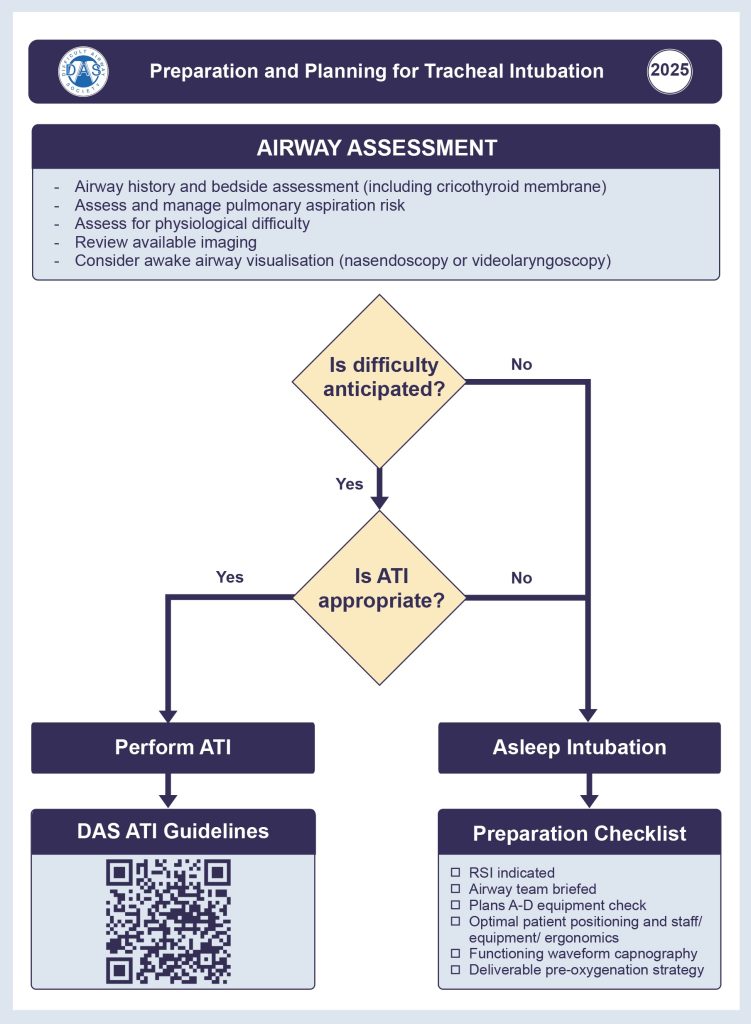
This is the pre-intubation planning figure: airway assessment leads to a decision on whether AWI (Awake Tracheal Intubation) is appropriate, or whether to proceed to asleep intubation with a full preparation checklist (Plans A-D equipment, waveform capnography, preoxygenation strategy).
AIDAA 2025 - Management of Unanticipated Difficult Airway in Obstetrics

This shows the AIDAA circular design - the three devices (tracheal tube, SGA, face mask) form a non-hierarchical loop. "Code D" call for help runs along the left side. Complete Ventilation Failure triggers Emergency Surgical Cricothyroidotomy at the bottom.
AIDAA 2025 - Extubation of the "At-Risk" Airway

Bonus: AIDAA 2025 also published companion guidelines for extubation of the at-risk airway, shown here - covering the 3 Ds (Difficulty, Delayed recovery, Difficult FMV/intubation) and 3 Ss (Suspected collapse, oedema, surgical cause), with pathways to awake extubation, staged sequential extubation, or delayed extubation in HDU/ICU.
Aidaa and das 2016 difficult airway image
DAS 2015 difficult airway algorithm image Plan A B C D unanticipated difficult intubation
AIDAA 2016 difficult airway algorithm image unanticipated difficult intubation India
AIDAA 2016 adult unanticipated difficult tracheal intubation algorithm figure 1 PMC5168891
DAS 2015 - Difficult Intubation Guidelines Overview

The classic linear Plans A-D: Plan A = Facemask ventilation + laryngoscopy → tracheal intubation. Plan B = SAD insertion (with "Stop and Think" options: wake up / intubate via SAD / proceed / tracheostomy). Plan C = Final facemask attempt → wake up if successful. Plan D = CICO → Cricothyroidotomy.
AIDAA 2016 - Unanticipated Difficult Tracheal Intubation in Adults (Linear Stepwise Algorithm)

AIDAA 2016 Adult Algorithm Steps:
- Step 1: Laryngoscopy and tracheal intubation (nasal O2 15 L/min; max 2 attempts if SpO2 ≥95%; confirm with capnography)
- Step 2: Insert SAD to maintain oxygenation (2nd gen preferred; max 2 attempts if SpO2 ≥95%)
- Step 3: Rescue face-mask ventilation (ensure NMB; optimal technique + adjuncts)
- Step 4 (Complete Ventilation Failure): Emergency cricothyroidotomy (surgical / wide-bore cannula / needle - based on familiarity)
- Running left sidebar: "CALL FOR HELP" at every step
- Nasal O2 insufflation at 15 L/min throughout all steps
Quick Side-by-Side: 2015/2016 vs 2025
| Feature | DAS 2015 | AIDAA 2016 | DAS 2025 | AIDAA 2025 |
|---|---|---|---|---|
| Structure | Linear A-D | Linear 4 steps | Linear A-D (retained) | Circular (no hierarchy) |
| Scope | Failed intubation | Failed intubation | Failed intubation | Any failed primary plan |
| Emergency code | None | None | None | "Code D" |
| Preferred eFONA | Any cricothyroidotomy | Any technique | Surgical | Surgical |
| VL | Optional | Optional | Primary device | Primary device |
| Physiologic DA | Not addressed | Not addressed | Formally addressed | Formally addressed |
| HFNO/apnoeic O2 | Not standard | 15 L/min nasal O2 | HFNO standard | 10-15 L/min or HFNO |