
Hemoglobin estimation methods How does the path lab coulter estimate the amount of hemoglobin Most common method used in blood camps for hb estimation And most common methods used in blood bank for hb estimation
Reading File
Now let me search the medical library and web in parallel for comprehensive coverage.
Finding Sources
Finding Sources
Searching the Web
hemoglobin estimation methods coulter counter blood camp blood bank
Let me search for more specific content in the library and extract the relevant web article.
Finding Sources
Finding Sources
Reading Web Page
https://pmc.ncbi.nlm.nih.gov/articles/PMC5503668
Now let me read the specific textbook sections for more detail.
Reading File
Reading File
Reading File
Excellent - I now have comprehensive information from multiple authoritative sources. Let me also fetch the absorption spectra image and search for the Sahli and Taliquist methods for completeness.
Finding Sources
Finding Sources
I now have all the information needed for a thorough answer. Let me also fetch the absorption spectra image for visual clarity.
Loading Image
Now I have everything needed for a complete, well-structured answer. Here it is:
Hemoglobin Estimation Methods
Overview of All Methods
| Method | Setting | Sample | Accuracy |
|---|---|---|---|
| Cyanmethemoglobin (HiCN) | Reference/Lab | Venous blood | Gold standard |
| Automated hematology analyzer (Coulter) | Path lab | Venous blood | Highest precision |
| Copper sulfate gravimetric | Blood bank/camps | Venous blood | Qualitative/screening |
| HemoCue/Photometer | Blood camps/field | Capillary/venous | Good POC accuracy |
| Sahli's acid hematin | Older/field | Capillary | Obsolete, inaccurate |
| Talquist scale | Camps (historical) | Capillary smear | Very inaccurate |
| Non-invasive (SpHb) | POC | Transcutaneous | Screening only |
1. Cyanmethemoglobin (HiCN) Method - The Reference Standard
This is the WHO-recommended reference method and the gold standard for laboratory Hb estimation.
Principle: Blood is mixed with Drabkin's reagent (potassium ferricyanide + potassium cyanide). Potassium ferricyanide oxidizes hemoglobin to methemoglobin (Hi), which is then converted by potassium cyanide (KCN) to the stable cyanmethemoglobin (HiCN). The absorbance of HiCN is read at 540 nm in a photoelectric colorimeter against a certified HiCN standard.
Procedure (standard dilution):
- 20 µL of blood added to 5.0 mL of Drabkin's reagent (1:251 dilution)
- Allowed to stand for at least 3 minutes for complete conversion
- Absorbance measured at 540 nm
- Hb (g/dL) = [A₅₄₀ test / A₅₄₀ standard] × [Concentration of standard (mg/dL) / 100 mg/g] × 251
Key advantages:
- Measures almost all forms of Hb (oxyhemoglobin, deoxyhemoglobin, methemoglobin, HbCO) - but NOT sulfhemoglobin
- Stable diluted samples that can be read at any convenient time
- Certified international standard available
Limitations:
- Requires toxic cyanide reagent (HCN gas hazard on acidification)
- Time-consuming and not suitable for high-throughput or field use
- Turbidity from hyperlipemia, abnormal proteins, or very high WBC (>30 × 10⁹/L) causes falsely elevated readings
Here is the absorption spectra showing why 540 nm is ideal for HiCN (green line - flat, stable plateau):
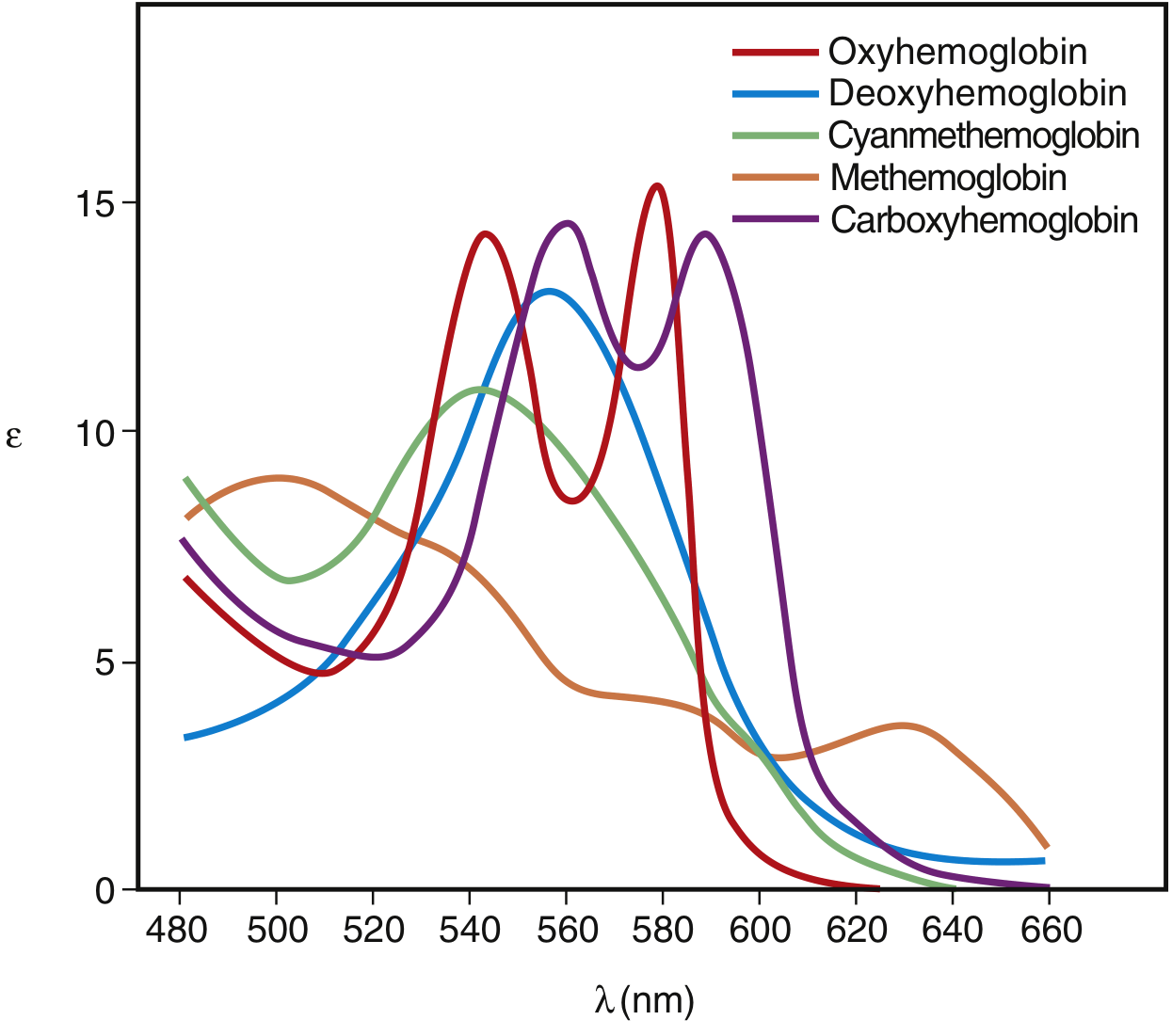
Figure: Absorption spectra of oxyhemoglobin, deoxyhemoglobin, cyanmethemoglobin, methemoglobin, and carboxyhemoglobin - Henry's Clinical Diagnosis and Management by Laboratory Methods, Fig. 31.2
2. How the Path Lab Coulter Counter Estimates Hemoglobin
The Coulter (automated hematology analyzer) uses a photometric method, not the Coulter impedance principle, specifically for Hb measurement.
Step-by-step mechanism:
-
Cell lysis: A measured aliquot of whole blood is mixed with a lysing reagent. This reagent breaks open (lyses) all red blood cells, releasing hemoglobin into solution.
-
Hemoglobin conversion: Most Coulter instruments use a modified cyanmethemoglobin method - the released Hb is converted to a stable chromogen (HiCN or a cyanide-free derivative like sodium lauryl sulfate-methemoglobin, depending on the platform). Some modern Coulter analyzers use sodium lauryl sulfate (SLS) to convert Hb to SLS-methemoglobin to avoid toxic cyanide reagents.
-
Photometric measurement: The lysate is passed through a Hgb cuvette. A beam of light at 525 nm (or 540 nm depending on the instrument) is directed through the solution. The transmittance of light through the lysed sample is compared to transmittance through a reagent blank.
-
Calculation: The system converts the transmittance ratio to a Hb concentration value using a built-in calibration factor:Hb = (Transmittance of blank / Transmittance of sample) × Calibration factor
Important points about the Coulter:
- Hb is one of the directly measured parameters (along with RBC count and WBC count). HCT, MCH, MCHC are calculated from these direct measurements.
- The Coulter Principle (electrical impedance) is used for counting and sizing RBCs and WBCs - NOT for Hb measurement. Hb has its own dedicated photometric channel.
- Instruments are calibrated using certified reference materials and must pass stringent QC checks.
Source: Tietz Textbook of Laboratory Medicine, 7th ed. - "For the determination of Hb, most automated instruments use modifications of the cyanmethemoglobin assay. Another method involves the use of sodium lauryl sulfate to convert hemoglobin to sodium lauryl sulfate-methemoglobin."
Source: CDC/NHANES CBC Method Manual - "Hgb: Photometric Measurement - Transmittance of light at 525 nm through a lysed WBC solution in the Hgb cuvette, compared to the transmittance of the same light through a reagent blank."
3. Most Common Method at Blood Donation Camps
Copper Sulfate Gravimetric Method (Qualitative)
This is the most widely used screening method at blood donation camps globally, including in India.
Principle: Based on specific gravity. A drop of blood is gently released from a height of 1 cm into a copper sulfate solution of specific gravity 1.053 (equivalent to approximately 12.5 g/dL Hb).
- If the drop sinks within 15 seconds → Hb ≥ 12.5 g/dL → donor is acceptable
- If the drop floats or remains suspended → Hb < 12.5 g/dL → donor is deferred
Advantages: Extremely fast (<15 seconds), no equipment needed, very cheap, no electricity required, portable.
Limitations:
- Only qualitative (pass/fail), gives no actual Hb value
- Cannot be used for double red cell apheresis donation (FDA/AABB require a quantitative method for apheresis donors)
- Affected by lipemia, posture changes, and source of blood sample
- Higher false-positive deferral rate (falsely low in some cases)
HemoCue (Quantitative POC) - Increasingly Preferred
The HemoCue (and similar photometric microcuvette systems) are increasingly used at camps where a quantitative reading is needed. A drop of blood fills a disposable microcuvette pre-loaded with dry reagent (azide methemoglobin chemistry). The device reads Hb in ~15-45 seconds and displays a numeric g/dL value. It performs well even at temperatures >35°C, making it suitable for outdoor tropical camps.
4. Most Common Method at the Blood Bank
For Routine Donor Screening: Copper Sulfate Method
As above - quick, qualitative screening test for whole blood donors is the copper sulfate method. It is the most common method used in blood banks for routine donor Hb screening pre-donation.
For Quantitative/Confirmatory Measurement: Automated Analyzer or HiCN
- Blood banks use automated hematology analyzers (modified HiCN or SLS-methemoglobin photometry) when a quantitative Hb is required.
- Per AABB Standards and FDA requirements, apheresis (double red cell) donors must have Hb measured by a quantitative method - copper sulfate is explicitly NOT acceptable for this purpose.
- The cyanmethemoglobin method is used as the reference/calibration standard.
Summary table for blood bank context:
| Purpose | Method |
|---|---|
| Whole blood donor screening | Copper sulfate (qualitative) |
| Apheresis donor pre-donation | Quantitative (automated analyzer) |
| Product QC / reference testing | HiCN or automated analyzer |
| Field/mobile collection units | HemoCue or copper sulfate |
Sources:
- Henry's Clinical Diagnosis and Management by Laboratory Methods (Hemiglobincyanide Method section)
- Tietz Textbook of Laboratory Medicine, 7th ed. (Methods for RBC Analytical Parameters)
- Henry's (Erythrocytapheresis Donor Selection section) - copper sulfate limitation for apheresis
- Techniques for Hb screening in blood donors - PMC5503668
- CDC/NHANES Coulter DxH 800 CBC Method Manual
This is a shared conversation. Sign in to Orris to start your own chat.