
Renal pharmacology, Diuretics but focus more on loop and thiazide and use katzung and all othrr books
Reading File
Finding Sources
Finding Sources
Now let me find Katzung specifically and search for loop and thiazide diuretics sections:
Finding Sources
Finding Sources
Now let me read the Katzung diuretics chapter and Goodman & Gilman diuretics sections in parallel:
Finding Sources
Finding Sources
Now let me read the key Katzung, Goodman & Gilman, and Lippincott diuretics sections in parallel:
Reading File
Reading File
Reading File
I need to find the correct Katzung diuretics sections. Let me search for them more precisely:
Finding Sources
Finding Sources
Now I have the exact locations. Let me read the key Katzung and Goodman & Gilman loop diuretics and thiazide sections in parallel:
Reading File
Reading File
Reading File
Let me now read the core diuretics content from Katzung (block3) and Goodman & Gilman (block8) which contain the main loop diuretics sections:
Reading File
Reading File
Excellent data coming in. Now let me read the continuation of the Katzung loop diuretics section and the Goodman & Gilman loop/thiazide sections:
Reading File
Reading File
Let me now read the critical loop and thiazide sections - the core pharmacology content from Katzung (block3 around line 2970) and Goodman & Gilman (block8 around line 1755 to 2200):
Reading File
Reading File
Excellent! Now let me read the Katzung thiazides section and the Goodman & Gilman thiazides section, plus get the Lippincott diuretics content:
Reading File
Reading File
Now let me read the Goodman & Gilman core thiazide section (block8 around line 2000-2200) and the Katzung detailed loop section continuation:
Reading File
Reading File
Now I have enough content for a comprehensive answer. Let me also get the Goodman & Gilman thiazide mechanism section and read the Katzung thiazide section:
Reading File
Reading File
Searching Images
loop diuretics mechanism NKCC2 thick ascending limb nephron
Now let me get the Goodman & Gilman thiazide mechanism and the Katzung thiazide pharmacodynamics content, plus search for a thiazide mechanism image:
Reading File
Reading File
Searching Images
thiazide diuretics mechanism distal convoluted tubule NCC sodium chloride cotransporter
I now have comprehensive content from multiple textbooks. Let me also read the Goodman & Gilman thiazide mechanism section:
Reading File
Now I have all the material needed. Let me synthesize a comprehensive, well-structured answer.
Renal Pharmacology: Diuretics
Overview
Diuretics increase the rate of urine flow and — clinically — raise Na⁺ excretion (natriuresis) to reduce extracellular fluid (ECF) volume by decreasing total-body NaCl. Continued diuretic use causes a finite natriuresis because of diuretic braking: compensatory activation of the SNS, RAAS, reduced arterial pressure, renal epithelial hypertrophy, increased transporter expression, and alterations in ANP.
— Goodman & Gilman's, p. 581
Sites of action along the nephron (proximal → distal):
| Diuretic Class | Primary Site | Transporter Blocked | Max. Fractional Na⁺ Excretion |
|---|---|---|---|
| Carbonic anhydrase inhibitors | PCT | H⁺ secretion / NaHCO₃ reabsorption | ~5% |
| Osmotic | PCT + descending loop | Passive (osmotic force) | variable |
| Loop diuretics | Thick Ascending Limb (TAL) | NKCC2 (Na⁺-K⁺-2Cl⁻) | ~25% |
| Thiazides | DCT | NCC (Na⁺-Cl⁻ cotransporter) | ~5% |
| K⁺-sparing | Collecting tubule | ENaC (amiloride/triamterene) or MR (spironolactone) | <3% |
I. LOOP DIURETICS (High-Ceiling Diuretics)
Prototype Drugs
- Furosemide (sulfonamide)
- Bumetanide (sulfonamide — ~40× more potent than furosemide)
- Torsemide (sulfonylurea)
- Ethacrynic acid (phenoxyacetic acid — the only non-sulfonamide; for sulfa-allergic patients)
— Katzung 16th ed., p. 406; Goodman & Gilman's, p. 584
Mechanism of Action
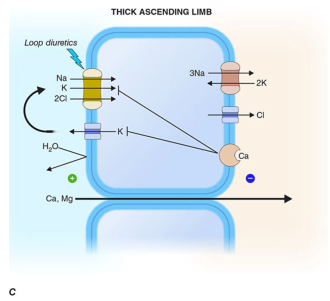
Loop diuretics act on the luminal side of the TAL, where the Na⁺-K⁺-2Cl⁻ cotransporter (NKCC2) normally reabsorbs ~25% of the filtered Na⁺ load. They bind to the Cl⁻ binding site on NKCC2, blocking it almost completely.
Consequences of NKCC2 inhibition:
- Massive ↑ NaCl delivery to distal segments → powerful natriuresis
- Loss of the lumen-positive electrochemical potential in the TAL → ↑ Mg²⁺ and Ca²⁺ excretion (normally driven by this potential)
- Abolition of the corticomedullary osmotic gradient → impairs urinary concentrating ability → useful in SIADH
Loop diuretics also induce COX-2 expression in the TAL → ↑ prostaglandin E₂ synthesis → PGE₂ inhibits further salt transport in the TAL (participates in the diuretic effect). This is why NSAIDs blunt loop diuretic response (especially in nephrotic syndrome, cirrhosis).
Furosemide increases renal blood flow via prostaglandin-mediated vasodilation, and both furosemide and ethacrynic acid reduce pulmonary congestion and LV filling pressures before any urine output — a clinically important vascular effect.
— Katzung 16th ed., pp. 406–408; Goodman & Gilman's, pp. 583–585
Pharmacokinetics
| Drug | Oral Bioavailability | t½ | Elimination | Duration |
|---|---|---|---|---|
| Furosemide | ~60% (variable) | ~1.5 h | ~65% renal, ~35% metabolism | 2–3 h |
| Bumetanide | ~80% | ~0.8 h | ~62% renal, ~38% metabolism | 4–6 h |
| Torsemide | ~80% (rapid, ~1 h) | ~3.5 h | ~80% hepatic metabolism | 4–6 h |
| Ethacrynic acid | ~100% | ~1 h | ~67% renal, ~33% metabolism | 2–4 h |
Key PK points:
- All loop diuretics act from the luminal side → must be secreted by the organic acid (OAT) transporter in the proximal tubule to reach the TAL
- Competing anions (uremic toxins, NSAIDs, probenecid) reduce tubular secretion → blunted response in renal failure or nephrotic syndrome (hypoalbuminemia reduces delivery)
- Furosemide oral absorption is highly variable (10–100%); torsemide has nearly complete oral bioavailability
- Torsemide and bumetanide are largely hepatically cleared → preferred when renal function is impaired
- Half-life increases in renal failure (except torsemide)
— Katzung 16th ed., p. 407; Goodman & Gilman's, p. 584
Pharmacodynamics & Electrolyte Effects
| Effect | Mechanism |
|---|---|
| ↑ Na⁺, Cl⁻ excretion | NKCC2 block |
| ↑ K⁺ excretion (hypokalemia) | Increased distal Na⁺ delivery → ↑ aldosterone-mediated K⁺ secretion in cortical collecting duct |
| Metabolic alkalosis | ↑ H⁺ secretion in distal tubule, volume contraction alkalosis |
| ↑ Mg²⁺ excretion (hypomagnesemia) | Loss of lumen-positive potential in TAL |
| ↑ Ca²⁺ excretion | Loss of lumen-positive potential; hypercalciuria (opposite of thiazides) |
| Hyperuricemia | Compete with uric acid for proximal tubule secretion; volume depletion → ↑ uric acid reabsorption |
| ↑ Glucose (mild) | Inhibit insulin secretion (less than thiazides) |
— Katzung 16th ed., p. 408; Goodman & Gilman's, p. 585
Clinical Indications
- Pulmonary edema / acute decompensated heart failure — first-line; IV furosemide provides immediate preload reduction even before diuresis
- Peripheral edema — from heart failure, cirrhosis, nephrotic syndrome, renal failure
- Hypertension — especially with impaired renal function (eGFR <30); thiazides lose efficacy here, loop diuretics do not
- Acute hypercalcemia — combined with IV saline, loop diuretics force calciuresis
- Hyperkalemia — enhance urinary K⁺ excretion (with saline to maintain volume)
- Acute renal failure — can increase urine flow and K⁺ excretion but do NOT prevent or shorten acute renal failure
- Anion overdose (bromide, fluoride, iodide) — enhance excretion of these TAL-reabsorbed anions
- SIADH — loop diuretics destroy the medullary gradient, forcing free water excretion
- Forced diuresis in drug intoxication (combined with IV saline)
— Katzung 16th ed., pp. 408–412; Goodman & Gilman's, pp. 585–587
Adverse Effects
| Adverse Effect | Details |
|---|---|
| Hypokalemia | Most common electrolyte problem; risk of arrhythmias especially with digoxin |
| Hypomagnesemia | Can precipitate refractory hypokalemia and arrhythmias |
| Metabolic alkalosis | Hypochloremic alkalosis |
| Volume depletion / hypotension | Overzealous use; particularly dangerous in cirrhosis (hepatic encephalopathy), renal failure |
| Hyperuricemia / gout | Competition for OAT secretion |
| Ototoxicity ⚠️ | Tinnitus, hearing loss, vertigo — usually reversible; most with rapid IV infusion; ethacrynic acid > others; furosemide infusion rate should not exceed 4 mg/min; synergistic with aminoglycosides, cisplatin, carboplatin |
| Hyperglycemia | Mild; less than thiazides |
| Hypocalcemia (rare) | From prolonged hypercalciuria |
| Hyponatremia | Especially in elderly |
| Skin rash, photosensitivity | Sulfonamide-based agents |
| Increased LDL, triglycerides | Lipid effects |
Sulfonamide cross-reactivity: Furosemide, bumetanide, torsemide → caution in sulfa allergy. Ethacrynic acid is the safe alternative (not a sulfonamide).
— Goodman & Gilman's, pp. 585–586; Katzung 16th ed., pp. 412–413
Drug Interactions
| Interacting Drug | Effect |
|---|---|
| Aminoglycosides, cisplatin | ↑ Ototoxicity |
| Digoxin | Hypokalemia → ↑ digoxin toxicity, arrhythmias |
| NSAIDs, COX-2 inhibitors | ↓ Loop diuretic response (↓ prostaglandin synthesis) |
| Probenecid | Blocks OAT → ↓ tubular secretion of loop diuretics → ↓ response |
| Lithium | ↑ Lithium levels |
| Thiazides | Synergistic diuresis (sequential nephron blockade) |
| Amphotericin B | ↑ Nephrotoxicity, electrolyte loss |
Typical Doses (Oral)
| Drug | Oral Daily Dose |
|---|---|
| Furosemide | 20–80 mg |
| Bumetanide | 0.5–2 mg |
| Torsemide | 5–20 mg |
| Ethacrynic acid | 50–200 mg |
— Katzung 16th ed., Table 15-4
II. THIAZIDE DIURETICS
Discovered in 1957 as an outgrowth of efforts to improve carbonic anhydrase inhibitors. The prototypical agent is hydrochlorothiazide (HCTZ).
Drugs in This Class
Thiazide-type (benzothiadiazine derivatives):
- Hydrochlorothiazide (HCTZ)
- Chlorothiazide (the only IV-available thiazide)
- Bendroflumethiazide
- Methyclothiazide
Thiazide-like (structurally different but pharmacologically similar):
- Chlorthalidone — t½ ~47 h (binds extensively to RBCs); preferred over HCTZ for cardiovascular outcomes
- Metolazone — retains efficacy even at GFR <30; used for sequential nephron blockade with loop diuretics
- Indapamide — primarily biliary excretion; additional vasodilator properties
— Goodman & Gilman's, pp. 586–588; Katzung 16th ed., p. 411
Mechanism of Action
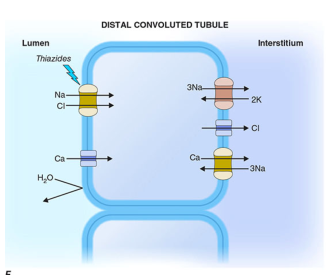
Thiazides inhibit the Na⁺-Cl⁻ cotransporter (NCC/TSC/ENCC1) on the luminal membrane of DCT epithelial cells. The Na⁺-K⁺-ATPase on the basolateral side maintains a low intracellular Na⁺ concentration, providing the driving force for NCC. Thiazides bind to the Cl⁻ site on NCC.
- Maximum efficacy is modest (~5% of filtered Na⁺) because 90% of filtered Na⁺ is reabsorbed before reaching the DCT
- Some thiazides (chlorthalidone) retain weak carbonic anhydrase inhibitory activity → minor proximal tubular effects
- NCC expression is regulated by aldosterone
- Mutations in NCC cause Gitelman syndrome (inherited hypokalemic alkalosis with hypomagnesemia and hypocalciuria) — a "pharmacological mimic" of chronic thiazide use
— Goodman & Gilman's, p. 587; Katzung 16th ed., p. 413
Pharmacokinetics
| Drug | Oral Bioavailability | t½ | Elimination |
|---|---|---|---|
| Hydrochlorothiazide | ~70% | ~2.5 h | Renal (intact) |
| Chlorothiazide | 9–56% (dose-dependent) | ~1.5 h | Renal |
| Bendroflumethiazide | ~100% | ~3.9 h | ~70% hepatic |
| Chlorthalidone | ~65% | ~47 h | ~65% renal |
| Indapamide | — | ~14–18 h | Biliary (mostly) |
| Metolazone | — | variable | Mixed |
All thiazides are secreted by the organic acid transporter in the proximal tubule → compete with uric acid secretion (a contributor to hyperuricemia).
Chlorthalidone's very long half-life results from extensive binding to carbonic anhydrase in red blood cells — this provides sustained 24-hour action and better BP control compared to HCTZ.
— Goodman & Gilman's, Table 29-5; Katzung 16th ed., p. 414
Pharmacodynamics & Electrolyte Effects
| Effect | Mechanism |
|---|---|
| ↑ Na⁺, Cl⁻ excretion | NCC block |
| ↑ K⁺ excretion (hypokalemia) | Same as loop: ↑ distal Na⁺ → ↑ aldosterone-driven K⁺ secretion |
| Metabolic alkalosis | ↑ Distal H⁺ secretion + volume contraction |
| ↑ Uric acid retention (chronic) | Proximal OAT competition; volume depletion → ↑ uric acid reabsorption |
| ↓ Ca²⁺ excretion (hypercalciuria prevention) ⭐ | Volume depletion → ↑ proximal reabsorption; enhanced DCT Ca²⁺-Na⁺ exchange (opposite of loop diuretics) |
| ↑ Mg²⁺ excretion (hypomagnesemia) | More profound than loop diuretics with chronic use |
| Hyperglycemia | ↓ Insulin secretion via K⁺-channel hyperpolarization of β-cells (exacerbated by hypokalemia); ↓ glucose utilization |
Critical distinction — Ca²⁺ handling:
- Loop diuretics → hypercalciuria (loss of lumen-positive potential)
- Thiazides → hypocalciuria (enhanced proximal + DCT Ca²⁺ reabsorption)
This makes thiazides the choice for nephrolithiasis (calcium oxalate stones, hypercalciuria) and for preventing osteoporosis-related fractures.
— Katzung 16th ed., pp. 413–415; Goodman & Gilman's, p. 588
Clinical Indications
- Hypertension — first-line therapy (ALLHAT trial showed thiazide-type diuretics equivalent or superior to ACEi and CCB for most hypertensive patients); mechanism: initial ↓ intravascular volume → later ↓ peripheral vascular resistance
- Mild heart failure — adjunct
- Nephrolithiasis (calcium stones, hypercalciuria) — exploit Ca²⁺-retaining effect
- Nephrogenic diabetes insipidus (NDI) — paradoxical antidiuresis: by ↓ ECF volume, ↑ proximal reabsorption → less fluid reaches collecting duct; used for Li⁺-induced NDI
- Osteoporosis — ↓ urinary Ca²⁺ loss; fracture risk reduction shown
- Hypercalciuria — for kidney stone prevention
Important limitation: Thiazides (except metolazone) lose diuretic efficacy when eGFR <30 mL/min. Loop diuretics are required in moderate-severe CKD.
— Katzung 16th ed., pp. 414–415; Lippincott Pharmacology, pp. 295–296
Adverse Effects
| Adverse Effect | Notes |
|---|---|
| Hypokalemia | Most common electrolyte problem; risk of arrhythmias; worse with K⁺ wasting + QT-prolonging drugs (quinidine, dofetilide, arsenic) → potentially fatal ventricular arrhythmia |
| Hyponatremia ⚠️ | More dangerous than with loop diuretics; fatal or near-fatal cases reported; mechanism: ↑ ADH + ↓ diluting capacity + ↑ thirst; elderly women most at risk |
| Hyperglycemia | At higher doses (HCTZ >50 mg/d); less at 12.5 mg/d; corrected by restoring K⁺ |
| Hyperuricemia / gout | OAT competition + volume depletion |
| Hypercalcemia | Due to enhanced Ca²⁺ reabsorption (especially in primary hyperparathyroidism) |
| Hypomagnesemia | More profound than loop diuretics with chronic use (>1 year) |
| Hyperlipidemia | ↑ LDL, total cholesterol, triglycerides 5–15% (may normalize with prolonged use) |
| Metabolic alkalosis | Hypochloremic alkalosis |
| Erectile dysfunction | Volume depletion |
| Photosensitivity, skin rashes | Sulfonamide-related |
| Acute angle-closure glaucoma | Due to hyponatremia |
| Hemolytic anemia, thrombocytopenia, acute pancreatitis | Rare allergic reactions |
| Skin cancer ⚠️ | Meta-analysis (>10 million patients): OR for melanoma ×1.10, SCC ×1.35, BCC ×1.05 — thought to be photosensitivity-related |
— Katzung 16th ed., pp. 415–416; Goodman & Gilman's, pp. 588–589
Drug Interactions
| Interacting Drug | Effect |
|---|---|
| Loop diuretics | Synergistic natriuresis ("sequential nephron blockade") — used deliberately in resistant edema |
| Digoxin | Hypokalemia → ↑ digitalis toxicity |
| QT-prolonging drugs | Hypokalemia → fatal ventricular arrhythmias |
| Lithium | ↑ Lithium levels (↑ reabsorption in volume-depleted state) |
| NSAIDs, COX-2 inhibitors | ↓ Antihypertensive and diuretic effects |
| Amphotericin B, corticosteroids | ↑ Hypokalemia |
| Bile acid sequestrants | ↓ Thiazide absorption |
| Sulfonylureas, insulin | Thiazide-induced hyperglycemia antagonizes effect |
| Allopurinol | Combination needed if hyperuricemia develops |
III. POTASSIUM-SPARING DIURETICS
Two mechanistic subclasses:
A. ENaC Blockers: Amiloride & Triamterene
Act in the late DCT, connecting tubule, and cortical collecting duct (CCD), blocking epithelial Na⁺ channels (ENaC) on the luminal membrane. Both are organic bases secreted by the proximal tubule.
- Weak diuretics (1–3% fractional Na⁺ excretion) — used primarily to prevent K⁺ loss from loop/thiazide therapy
- Amiloride also blocks Li⁺ entry via ENaC → useful for lithium-induced NDI; treats Liddle syndrome (constitutively active ENaC)
- Triamterene is partially metabolized in the liver; can form kidney stones (triamterene crystals)
B. Mineralocorticoid Receptor (MR) Antagonists: Spironolactone, Eplerenone, Finerenone
Block aldosterone's genomic effects in collecting ducts → prevent upregulation of ENaC and Na⁺-K⁺-ATPase.
- Spironolactone: Steroidal MR antagonist; also weakly anti-androgenic → gynecomastia, menstrual irregularity — a distinguishing adverse effect
- Eplerenone: More selective MR antagonist → fewer sex hormone side effects; shorter t½; preferred post-MI
- Finerenone: Nonsteroidal MR antagonist; may cause less hyperkalemia; approved for CKD in type 2 diabetes (reduces albuminuria and cardiovascular events)
- Efficacy is proportional to endogenous aldosterone levels (unlike ENaC blockers)
- Slow onset and offset (24–48 h) — due to genomic mechanism
- KEY USE: Added to standard therapy in HFrEF → reduces mortality (RALES trial: spironolactone; EPHESUS: eplerenone)
- Aldosterone promotes myocardial fibrosis, vascular fibrosis, baroreceptor dysfunction — additional non-renal effects beyond diuresis
Main toxicity of all K⁺-sparing diuretics: HYPERKALEMIA — particularly dangerous in CKD, diabetes, with ACEi/ARBs, NSAIDs
— Katzung 16th ed., pp. 417–424; Goodman & Gilman's, pp. 589–593
IV. CARBONIC ANHYDRASE INHIBITORS
Prototype: Acetazolamide; also dichlorphenamide, methazolamide
- Act in the PCT: inhibit luminal and cytoplasmic carbonic anhydrase → ↓ H⁺ secretion → ↓ NaHCO₃ reabsorption → alkaline urine, metabolic acidosis
- Self-limiting diuresis because the resulting acidosis limits further HCO₃⁻ excretion
- Main uses: Glaucoma (↓ aqueous humor formation), altitude sickness (prophylaxis/treatment), metabolic alkalosis, epilepsy (minor)
- Adverse effects: Hypokalemia, metabolic acidosis, phosphate wasting, paresthesias/drowsiness (high doses), hypersensitivity (DRESS syndrome), contraindicated in cirrhosis (↓ NH₄⁺ excretion → hyperammonemia)
V. OSMOTIC DIURETICS
Prototype: Mannitol (IV only); also urea, glycerin, isosorbide
- Freely filtered, poorly reabsorbed → osmotically retain water in tubule lumen
- Main uses: Cerebral edema, ↓ IOP (glaucoma), dialysis disequilibrium syndrome, oliguric states, cystic fibrosis (mannitol inhaler)
- Contraindicated in: Pulmonary edema, anuric states, active intracranial bleeding (mannitol, urea)
- Adverse effects: Transient volume expansion (dangerous in CHF, pulmonary edema), hyponatremia, dehydration/hypernatremia if water loss exceeds electrolyte loss
VI. SGLT2 INHIBITORS (Emerging Renal Diuretics)
Examples: Dapagliflozin, canagliflozin, empagliflozin, ertugliflozin
- Inhibit SGLT2 in the PCT → ↓ glucose and Na⁺ reabsorption (90% of glucose reabsorption normally occurs here)
- Result in glucosuria, osmotic diuresis, modest natriuresis
- Primary indication: T2DM, but now first-line for HFrEF and CKD due to cardiorenal protection (EMPA-REG, CREDENCE trials)
- t½ of dapagliflozin: 10–12 h
- Not effective in advanced CKD (eGFR <30, some <45)
— Katzung 16th ed., pp. 403–405
VII. DIURETIC RESISTANCE
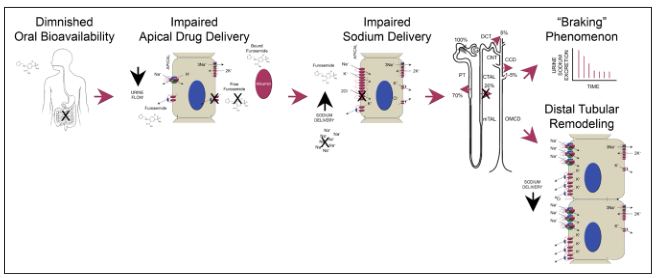
Mechanisms of loop diuretic resistance:
- Diminished oral bioavailability (furosemide)
- Impaired tubular secretion — OAT competition from uremic toxins, hypoalbuminemia (drug bound to albumin → less free drug secreted)
- "Braking phenomenon" — compensatory ↑ Na⁺ reabsorption post-diuretic dose by RAAS/SNS activation
- Distal tubular hypertrophy and remodeling — ↑ DCT and CD transporters compensate for chronic loop blockade
Strategies to overcome resistance:
- Switch to IV (continuous infusion)
- Add a thiazide or metolazone (sequential nephron blockade — profound synergistic diuresis)
- Add an MR antagonist
- Correct hypoalbuminemia
- Restrict dietary Na⁺
Summary Comparison: Loop vs. Thiazide
| Feature | Loop Diuretics | Thiazide Diuretics |
|---|---|---|
| Site | TAL (loop of Henle) | DCT |
| Transporter | NKCC2 | NCC |
| Max efficacy | ~25% (high-ceiling) | ~5% (moderate) |
| Ca²⁺ handling | ↑ Excretion (hypercalciuria) | ↓ Excretion (hypocalciuria) |
| Mg²⁺ | ↑ Excretion | ↑ Excretion (more with chronic use) |
| Use in CKD (eGFR <30) | Yes | No (except metolazone) |
| Hypertension | Second-line | First-line |
| Pulmonary edema | Yes | No |
| Nephrolithiasis (Ca²⁺) | No | Yes |
| Nephrogenic DI | No | Yes (paradoxical) |
| Ototoxicity | Yes ⚠️ (ethacrynic > others) | No |
| Hyperglycemia | Mild | More prominent |
| Hyponatremia | Less dangerous | More dangerous |
Sources:
- Katzung's Basic and Clinical Pharmacology, 16th Ed., Ch. 15, pp. 401–429
- Goodman & Gilman's The Pharmacological Basis of Therapeutics, Ch. 29, pp. 580–600
- Lippincott Illustrated Reviews: Pharmacology, Ch. 8 & 9, pp. 293–297
- Braunwald's Heart Disease, Ch. on diuretics in HF
- Harrison's Principles of Internal Medicine, 21st Ed. (images)Your credits are exhausted. Your daily credits reset tomorrow, or you can purchase a top-up for more.
This is a shared conversation. Sign in to Orris to start your own chat.