
Maternal mortality 25 marks question PG Obgy exam
Reading File
Now let me search the medical library for comprehensive content on maternal mortality.
Finding Sources
Searching PubMed
"maternal mortality" AND "causes" AND "prevention"
Excellent results. Now let me read the most relevant textbook sections - particularly from the OB/GYN-focused and preventive medicine sources.
Reading File
Reading File
Finding Sources
Reading File
Reading File
Finding Sources
Reading File
Reading File
Finding Sources
Reading File
Reading File
Finding Sources
Finding Sources
Finding Sources
Reading File
Reading File
Reading File
I now have comprehensive material from both sources. Let me compile the complete 25-mark PG OBGyn exam answer.
Loading Image
I now have all the information needed for a comprehensive 25-mark PG answer. Here it is:
MATERNAL MORTALITY
PG Obstetrics & Gynaecology - 25 Marks
1. DEFINITIONS (WHO)
Maternal Death: "The death of a woman while pregnant or within 42 days of termination of pregnancy, irrespective of the duration and site of pregnancy, from any cause related to or aggravated by the pregnancy or its management, but not from unintentional or incidental causes."
- Park's Textbook of Preventive and Social Medicine
Late Maternal Death: Death of a woman from direct or indirect obstetric causes, after more than 42 days but less than one year after termination of pregnancy.
Pregnancy-Related Death: Death of a woman while pregnant or within 42 days of termination of pregnancy, irrespective of the cause (including accidental/incidental causes). Useful in settings where reliable cause-of-death certification is unavailable.
Comprehensive Maternal Deaths (ICD-11): Combines maternal deaths and late maternal deaths into a single grouping.
2. MEASUREMENTS
Maternal Mortality Ratio (MMR)
$$\text{MMR} = \frac{\text{Total maternal deaths in an area in a year}}{\text{Total live births in the same area and year}} \times 100{,}000$$
MMR quantifies the risk of maternal death relative to the number of live births. It is the most commonly used indicator.
Maternal Mortality Rate (MMRate)
$$\text{MMRate} = \frac{\text{No. of maternal deaths}}{\text{Person-years lived by women aged 15-49}} $$
Captures both risk per pregnancy AND fertility level in the population.
Adult Lifetime Risk of Maternal Death
The probability that a 15-year-old girl will eventually die from a maternal cause. Takes competing causes of death into account.
Proportion of Maternal Deaths (PM)
Number of maternal deaths ÷ total deaths among women aged 15-49 years.
MMR Categories (WHO):
| Category | MMR (per 100,000 live births) |
|---|---|
| High | 300-499 |
| Very high | 500-999 |
| Extremely high | ≥ 1000 |
3. CLASSIFICATION OF MATERNAL DEATHS
Direct Obstetric Deaths
Result from obstetric complications of the pregnant state (pregnancy, labour, puerperium), from interventions, omissions, incorrect treatment, or a chain of events resulting from any of the above.
- Examples: obstetric haemorrhage, hypertensive disorders, complications of anaesthesia/caesarean section
Indirect Obstetric Deaths
Result from pre-existing disease or disease that developed during pregnancy, not due to direct obstetric causes, but aggravated by the physiological effects of pregnancy.
- Examples: cardiac disease, renal disease, malaria aggravated by pregnancy
4. GLOBAL AND INDIAN EPIDEMIOLOGY
- Global (2017): ~295,000 maternal deaths; overall MMR = 211 per 100,000 live births
- Global lifetime risk: ~1 in 190 for a 15-year-old girl (2017)
- Sub-Saharan Africa: Only WHO region with "very high" MMR - estimated at 542; lifetime risk 1 in 37
- Extremely high MMR countries: South Sudan (1150), Chad (1140), Sierra Leone (1120)
- India (2016-18): MMR = 113 per 100,000 live births (lifetime risk 1 in 290)
- Nigeria and India together account for ~35% of global maternal deaths
- South Asia achieved the greatest % reduction in MMR between 2000-2017: from 384 to 157 (59% reduction)
Timing of maternal deaths:
- 50-70% occur in the postpartum period
- 45% of postpartum deaths occur in the first 24 hours after delivery
-
2/3 occur in the first week postpartum
- 11-17% occur during childbirth itself
5. CAUSES OF MATERNAL MORTALITY
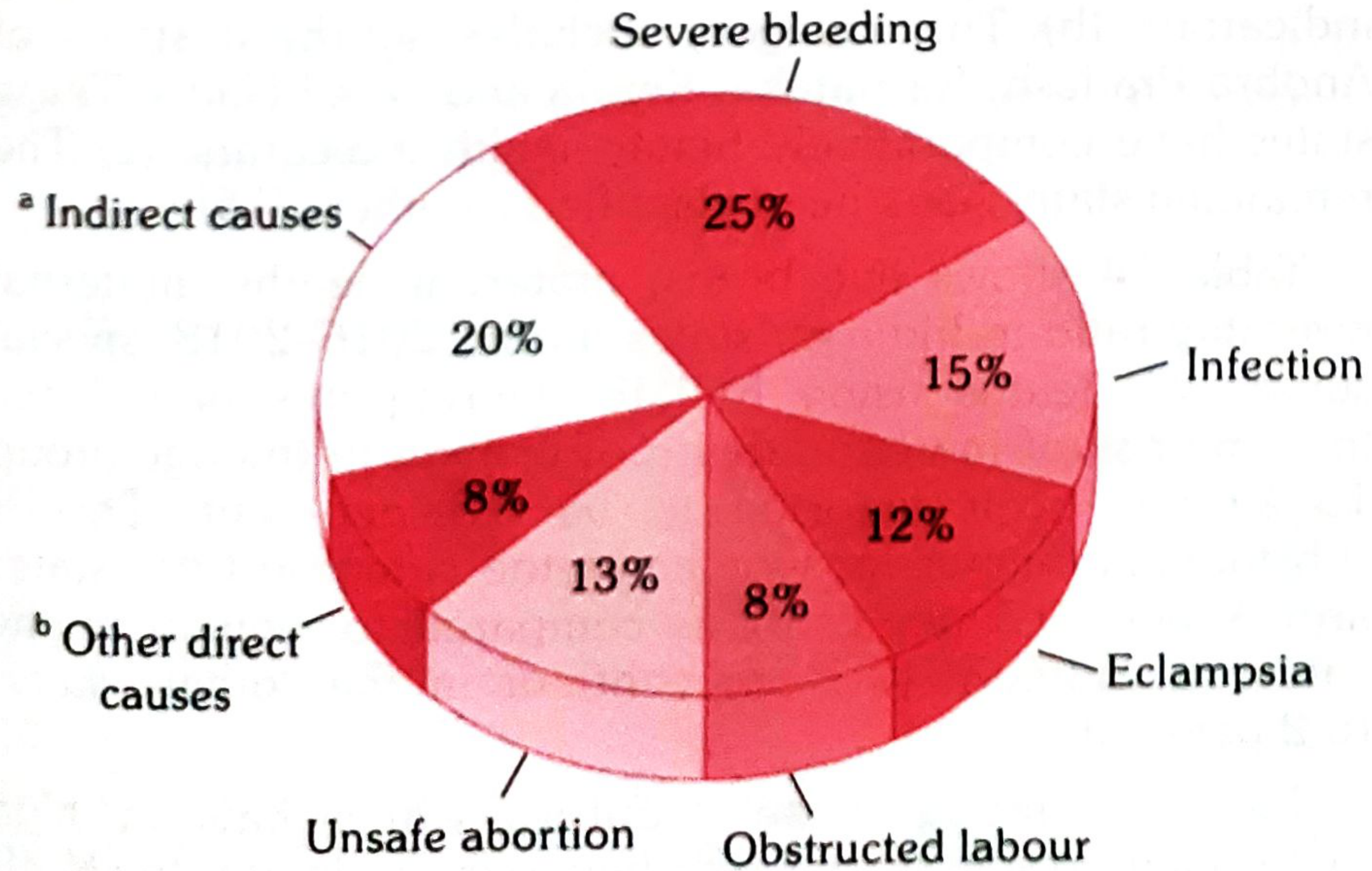
DIRECT CAUSES (~80% of maternal deaths)
| Cause | % of Maternal Deaths |
|---|---|
| Obstetric haemorrhage (mainly PPH) | 25% - single commonest cause |
| Unsafe abortion | 13% |
| Eclampsia/hypertensive disorders | 12% |
| Infections/puerperal sepsis | 15% |
| Obstructed labour | 8% |
| Other direct (embolism, ectopic, anaesthesia) | 8% |
INDIRECT CAUSES (~20%)
- Anaemia (most important in developing countries - affects ~50% of pregnant women)
- Cardiac disease
- Malaria (~10,000 maternal deaths/year globally)
- Tuberculosis
- HIV/AIDS
- Hepatitis
- Renal disease
- Endocrine/metabolic disorders
In Resource-Rich Settings (USA/UK) - Shifting Pattern
- Cardiomyopathy + cardiovascular disease is now the leading cause in the US (peripartum cardiomyopathy predominant)
- Preeclampsia: 17.4%
- Haemorrhage: 9.7%
- VTE: 9.7%
- Amniotic fluid embolism (AFE): 8.7%
(Source: Creasy & Resnik's Maternal-Fetal Medicine)
6. SOCIAL CORRELATES / RISK FACTORS
A number of social factors precede the medical causes and make pregnancy dangerous:
- Age: Optimal childbearing age is 20-30 years. Both adolescents and older women (>35 years) are at increased risk
- Parity: High parity (grand multiparity) increases risk
- Birth interval: Short intervals increase maternal mortality risk
- Literacy/Education: Low literacy prevents women from seeking antenatal care
- Socioeconomic status: Poverty limits access to skilled care
- Access to skilled birth attendant: Inverse relationship between lifetime risk and availability of trained health worker
- Place of delivery: Home deliveries without skilled personnel carry higher risk
- Nutrition: Poor nutritional status, especially anaemia
- Cultural practices and beliefs
- Gender inequality and low status of women in society
7. THE THREE DELAYS MODEL (Thaddeus & Maine)
This framework explains why women in low-resource settings die from preventable causes:
| Delay | Description | Example |
|---|---|---|
| Delay 1 | Delay in deciding to seek care | Lack of awareness, cultural barriers, financial constraints |
| Delay 2 | Delay in reaching care | Poor roads, transport unavailability, distance to facility |
| Delay 3 | Delay in receiving adequate care | Shortage of staff, drugs, blood, equipment at facility |
Addressing all three delays is the cornerstone of reducing maternal mortality in developing nations.
8. APPROACHES TO MEASURING MATERNAL MORTALITY
In the absence of complete civil registration, MMR estimates use:
- Civil registration systems - ideal but unavailable in most LMICs
- Household surveys - alternative where registration data are absent
- Sisterhood methods - interviewing a sample about survival of adult sisters
- RAMOS (Reproductive Age Mortality Studies) - identifies and investigates all causes of death in women of reproductive age using multiple data sources
- Verbal autopsy - assigns cause of death through community/family interview
- Census - eliminates sampling errors; allows geographic/temporal breakdown
9. PREVENTABILITY
A major proportion of maternal deaths are preventable with timely, quality care:
| Cause | Preventability |
|---|---|
| Haemorrhage | 69-93% |
| Preeclampsia | 50-60% |
| Sepsis | 43-50% |
| VTE | 17-53% |
| Cardiomyopathy | 22-25% |
| Amniotic fluid embolism | 0% (largely unpreventable) |
(Data from North Carolina, California, and UK Confidential Enquiry - Creasy & Resnik)
10. REDUCTION STRATEGIES
Specific Management Bundles (cause-by-cause):
For Haemorrhage:
- Risk-assess ALL delivering women for PPH
- Active management of third stage of labour (AMTSL) with oxytocin
- Availability of uterotonics, intrauterine balloon tamponade, compression sutures (B-Lynch)
- Tranexamic acid - RCT demonstrated reduction in maternal death from PPH vs placebo (WOMAN Trial, 2017)
- Massive transfusion protocol with early FFP/platelet replacement
- Screen for placenta accreta spectrum (PAS) in women with prior CS + placenta previa; deliver at tertiary centre
- Hemorrhage safety bundle: Readiness, Recognition, Response, Reporting (NPMS)
For Hypertensive Disorders/Eclampsia:
- Regular blood pressure monitoring at ANC visits
- Antihypertensive therapy for severe hypertension
- Magnesium sulphate for eclampsia and severe pre-eclampsia (anticonvulsant of choice)
- Timely delivery for severe features
For Sepsis:
- Aseptic delivery technique
- Early recognition and broad-spectrum antibiotics
- Avoid unnecessary interventions
For VTE:
- Risk assessment for all women
- Sequential compression devices after all caesarean deliveries
- Pharmacologic prophylaxis (LMWH) in high-risk women
- Maintain index of suspicion for PE in new-onset dyspnoea/tachycardia
For AFE:
- Recognition in differential of sudden cardiovascular collapse in labour/postpartum
- Aggressive cardiopulmonary support, massive transfusion, early echocardiography
- VA-ECMO for refractory ventricular dysfunction
Health System Level:
- Skilled birth attendant at all deliveries
- Access to Emergency Obstetric Care (EmOC) - Basic EmOC and Comprehensive EmOC
- 24/7 availability of blood transfusion services
- Functioning referral systems
- Maternal Death Review (MDR) - mandatory in India; identifies avoidable factors
Maternal Death Review (MDR):
A qualitative, in-depth investigation of causes and circumstances of each maternal death. Follows the WHO surveillance-and-response cycle:
Case Review → Identify avoidable factors → Make recommendations → Implement changes → Evaluate impact
11. SDG TARGETS AND GLOBAL STRATEGY
SDG Target 3.1 (by 2030): Reduce global MMR to less than 70 per 100,000 live births
Global Strategy for Women's, Children's and Adolescent Health 2016-2030 (SURVIVE, THRIVE, TRANSFORM):
- SURVIVE: End preventable deaths - MMR <70 globally; each country must reduce its MMR by at least 2/3 by 2030
- THRIVE: Universal access to sexual and reproductive health services; end malnutrition; universal health coverage
- TRANSFORM: End poverty, gender discrimination, harmful practices; ensure education and clean water
India-specific initiatives:
- Janani Suraksha Yojana (JSY): Cash incentive for institutional delivery
- Pradhan Mantri Matru Vandana Yojana (PMMVY): Maternity benefit scheme
- LaQshya Programme: Labour Room Quality Improvement Initiative
- National Iron + Initiative - for anaemia reduction
- ASHA workers - community-level mobilization for ANC and institutional delivery
12. CONFIDENTIAL ENQUIRIES INTO MATERNAL DEATHS
The UK Confidential Enquiry into Maternal Deaths (CEMD) - now known as MBRRACE-UK - is the gold standard for surveillance:
- Reviews all maternal deaths using a multidisciplinary team
- Identifies substandard care and systemic failures
- Issues triennial reports with national recommendations
- Has driven significant improvements: e.g., 50% reduction in VTE deaths after national protocols were adopted
In India, the Maternal Death Review (MDR) is mandated under the National Health Mission (NHM) at facility and community levels.
SUMMARY TABLE
| Parameter | Key Fact |
|---|---|
| WHO definition | Death within 42 days of termination of pregnancy |
| MMR formula | Maternal deaths / Live births × 100,000 |
| Global MMR (2017) | 211 per 100,000 live births |
| India MMR (2016-18) | 113 per 100,000 live births |
| SDG 2030 target | < 70 per 100,000 live births |
| Commonest direct cause | Obstetric haemorrhage (PPH) - 25% |
| Commonest indirect cause (India) | Anaemia |
| Most preventable cause | Haemorrhage (93%) |
| Least preventable | AFE (0%) |
| Most dangerous period | First 24 hours postpartum |
| Anticonvulsant of choice | Magnesium sulphate |
| Key measurement tool | Maternal Mortality Ratio (MMR) |
Sources:
- Park's Textbook of Preventive and Social Medicine - Maternal Mortality Ratio chapter
- Creasy & Resnik's Maternal-Fetal Medicine: Principles and Practice - Chapter 47
- Recent meta-analysis on ICD-MM causes (PMID: 38017449) confirms haemorrhage and hypertensive disorders as leading causes globally
This is a shared conversation. Sign in to Orris to start your own chat.