
Brachial plexus
Reading File
Finding Sources
Searching Images
labeled anatomical diagram of brachial plexus roots trunks divisions cords branches
Searching PubMed
"Brachial Plexus"[MeSH Terms]
Searching the Web
brachial plexus anatomy roots trunks divisions cords branches reputable medical source
Reading File
Finding Sources
Finding Sources
Brachial plexus
The brachial plexus is a network of nerves supplying the shoulder and upper limb. It is formed mainly by the anterior rami of C5-T1 spinal nerves and travels from the neck, over the first rib, into the axilla. [Gray's Anatomy for Students, p. 728]
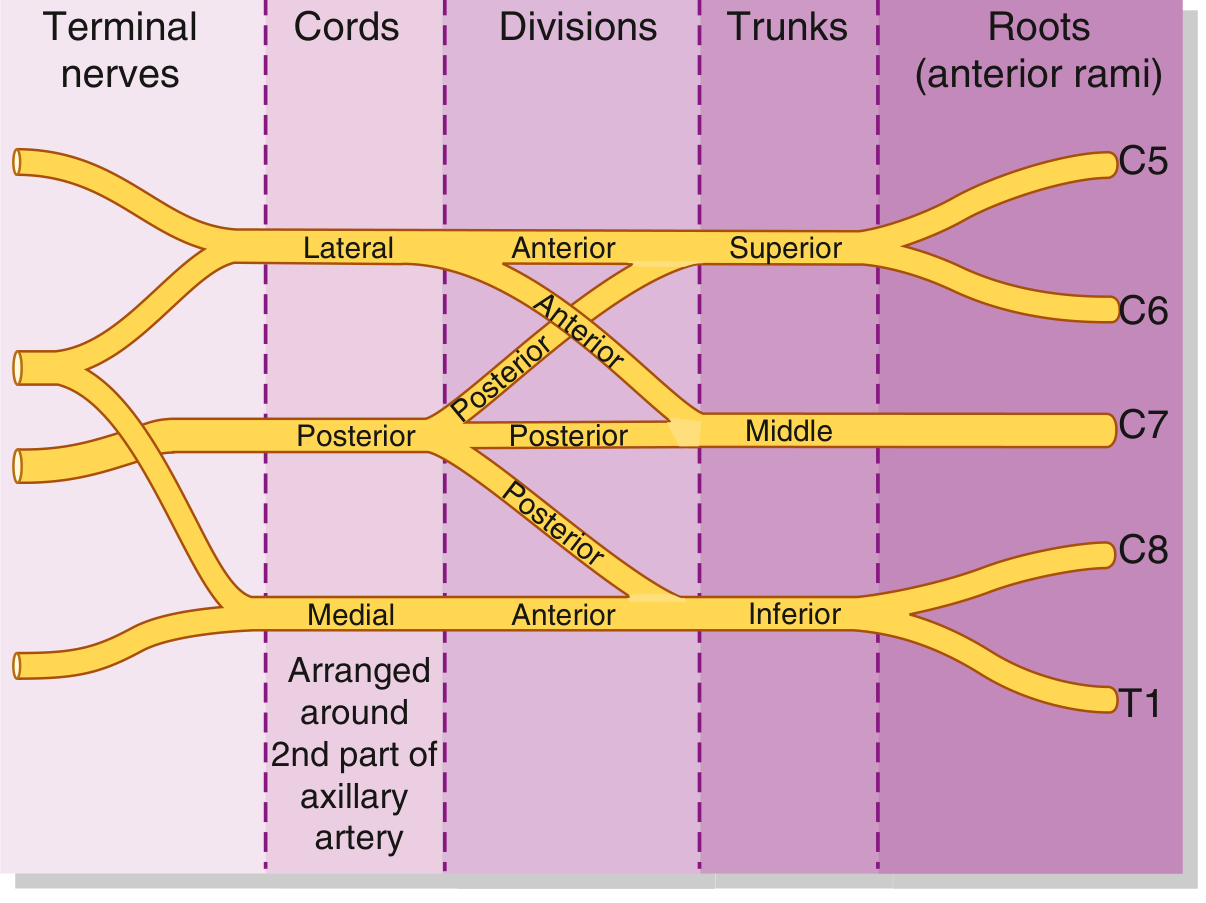
Organization
Use: Read That Damn Cadaver Book
Roots → Trunks → Divisions → Cords → Branches
Roots → Trunks → Divisions → Cords → Branches
| Component | Formation / relation |
|---|---|
| Roots | Anterior rami of C5, C6, C7, C8, T1 |
| Trunks | Upper: C5-C6; Middle: C7; Lower: C8-T1 |
| Divisions | Each trunk divides into an anterior and posterior division |
| Cords | Named by their relation to the 2nd part of the axillary artery |
| Terminal branches | Musculocutaneous, axillary, median, radial, ulnar |
Cords and their formation
- Lateral cord: anterior divisions of upper and middle trunks, C5-C7
- Medial cord: anterior division of lower trunk, C8-T1
- Posterior cord: all three posterior divisions, C5-T1
Anterior divisions mainly contribute to nerves of the flexor/anterior compartments; posterior divisions contribute to nerves of the extensor/posterior compartments. [Gray's Anatomy for Students, pp. 728-729]
Major branches
From roots
- Dorsal scapular nerve: C5, to rhomboids
- Long thoracic nerve: C5-C7, to serratus anterior
From upper trunk
- Suprascapular nerve: supraspinatus and infraspinatus
- Nerve to subclavius
From cords
- Lateral cord: lateral pectoral nerve, musculocutaneous nerve, lateral root of median nerve
- Medial cord: medial pectoral nerve, medial cutaneous nerves of arm and forearm, ulnar nerve, medial root of median nerve
- Posterior cord: upper and lower subscapular nerves, thoracodorsal nerve, axillary nerve, radial nerve
Terminal branches and key functions
| Nerve | Main action / important deficit |
|---|---|
| Musculocutaneous | Flexion at elbow, sensation over lateral forearm |
| Axillary | Deltoid and teres minor; shoulder abduction 15-90 degrees |
| Median | Most forearm flexors, thenar muscles; thumb opposition |
| Radial | Extension at elbow, wrist, and fingers |
| Ulnar | Most intrinsic hand muscles; finger abduction/adduction |
Common clinical correlations
-
Upper trunk injury, C5-C6: Erb palsy
Often traction between neck and shoulder. Arm tends to be adducted, medially rotated, with extended elbow and pronated forearm: the "waiter's tip" posture. -
Lower trunk injury, C8-T1: Klumpke palsy
May follow excessive upward traction of the arm. Causes intrinsic hand weakness and may cause a clawed hand. Associated sympathetic involvement can cause Horner syndrome. -
Long thoracic nerve injury
Weak serratus anterior causes winging of the scapula, especially when pushing against a wall. -
Axillary nerve injury
May occur with surgical-neck humeral fracture or anterior shoulder dislocation. Causes deltoid weakness and sensory loss over the lateral shoulder.
A recent systematic review on clinical assessment in brachial-plexus injury surgery is indexed as PMID 40272565; it concerns injury assessment rather than basic anatomy.
This is a shared conversation. Sign in to Orris to start your own chat.