
Make chart of dehydration in children ( ors therapy)
A medical reference chart titled "Dehydration in Children - Assessment & ORS Therapy" with 4 sections: SECTION 1 - DEGREES OF DEHYDRATION (3-column table): Features | Mild | Severe Appearance | Thirsty, alert, restless | Drowsy, limp, cold, comatose Radial Pulse | Normal rate & volume | Rapid, feeble, impalpable Blood Pressure | Normal | Less than 80 mmHg / unrecordable Skin Elasticity | Pinch retracts immediately | Retracts very slowly (>2 sec) Tongue | Moist | Very dry Anterior Fontanelle | Normal | Very sunken Urine Flow | Normal | Little or none % Body Weight Loss | 4-5% | 10% or more Fluid Deficit | 40-50 mL/kg | 100-110 mL/kg SECTION 2 - ORS TREATMENT PLAN (3 plans): Plan A (No Dehydration): Home therapy - continue breastfeeding, extra fluids, ORS 10 mL/kg per stool Plan B (Mild-Moderate): ORS 75 mL/kg over 4 hours in health facility; re-assess every hour Plan C (Severe): IV Ringer's Lactate 100 mL/kg; If can drink: start ORS while IV running SECTION 3 - ORS DOSE BY AGE (table): Age: <4 months | 4-11 months | 1-2 yrs | 2-4 yrs | 5-14 yrs | ≥15 yrs Weight (kg): <5 | 5-7.9 | 8-10.9 | 11-15.9 | 16-29.9 | ≥30 ORS (mL): 200-400 | 400-600 | 600-800 | 800-1200 | 1200-2200 | 2200-4000 SECTION 4 - WHO REDUCED OSMOLARITY ORS COMPOSITION (2002): Sodium 75 mmol/L | Chloride 65 mmol/L | Glucose 75 mmol/L | Potassium 20 mmol/L | Citrate 10 mmol/L | Total Osmolarity 245 mOsm/L NaCl 2.6 g/L | Glucose 13.5 g/L | KCl 1.5 g/L | Trisodium citrate 2.9 g/L Clean clinical chart with color-coded sections: green for mild/Plan A, orange for moderate/Plan B, red for severe/Plan C. Professional medical poster layout with clear typography.
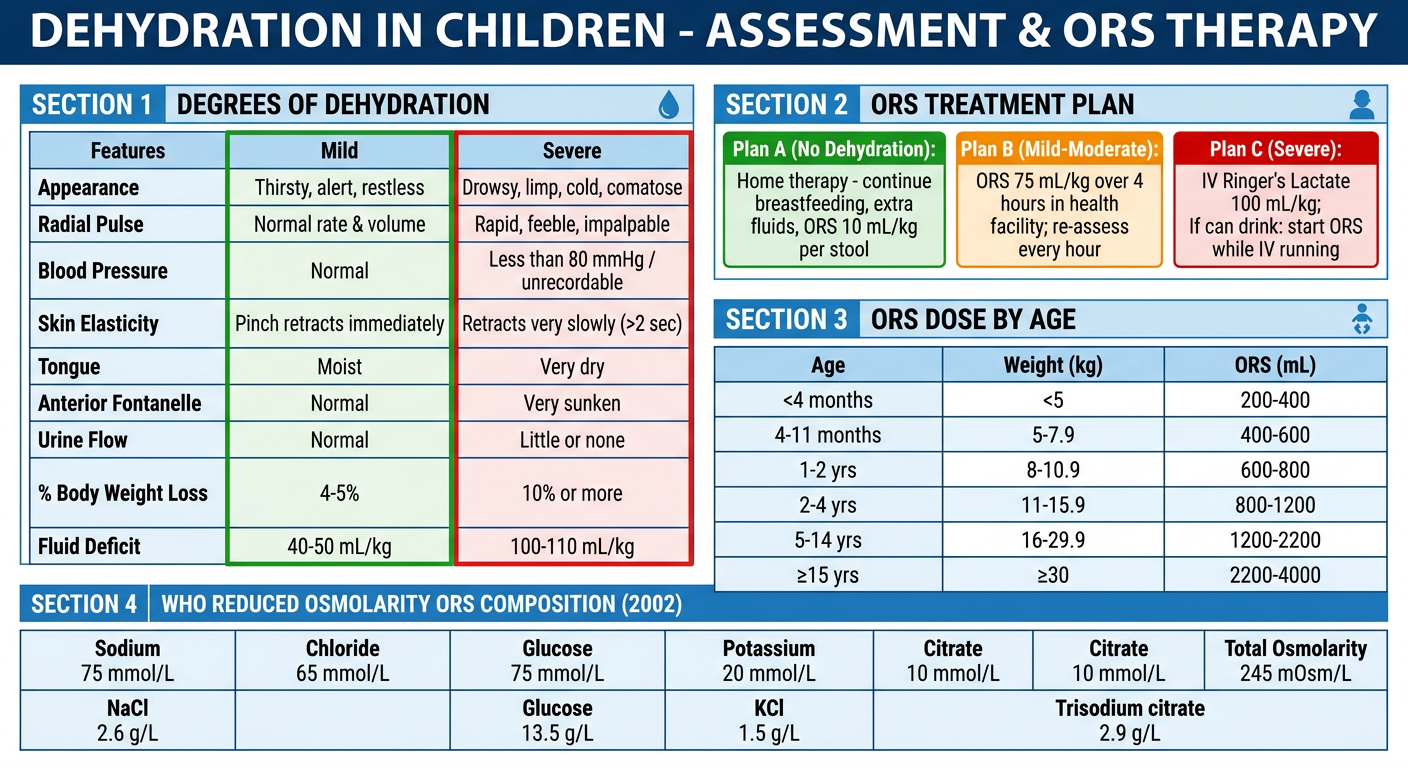
Dehydration in Children - Assessment & ORS Therapy
1. Assessment of Dehydration
| Feature | Mild | Severe |
|---|---|---|
| Appearance | Thirsty, alert, restless | Drowsy, limp, cold, sweaty; may be comatose |
| Radial Pulse | Normal rate & volume | Rapid, feeble, sometimes impalpable |
| Blood Pressure | Normal | <80 mmHg; may be unrecordable |
| Skin Elasticity | Retracts immediately | Retracts very slowly (>2 seconds) |
| Tongue | Moist | Very dry |
| Anterior Fontanelle | Normal | Very sunken |
| Urine Flow | Normal | Little or none |
| Body weight loss | 4-5% | 10% or more |
| Fluid deficit | 40-50 mL/kg | 100-110 mL/kg |
2. WHO ORS Treatment Plans
| Plan | When | Treatment |
|---|---|---|
| Plan A | No dehydration | Home therapy - extra fluids, ORS 10 mL/kg per loose stool, continue breastfeeding |
| Plan B | Mild-Moderate | ORS 75 mL/kg over 4 hours; re-assess every 1-2 hours. If child vomits, wait 10 min then continue slowly |
| Plan C | Severe | IV Ringer's Lactate 100 mL/kg (infants: 30 mL/kg in 1 hr then 70 mL/kg in 5 hrs; older child: 30 mL/kg in 30 min then 70 mL/kg in 2.5 hrs); give ORS as soon as child can drink |
- IV bolus for shock: 20 mL/kg 0.9% saline over 5-15 minutes; repeat until clinical improvement
- Ongoing losses: 10 mL/kg per diarrheal stool, 2 mL/kg per vomiting episode
- Oral rehydration trial failure (4-8 hours in ED) → admit for IV hydration
3. ORS Dose by Age (Plan B - first 4 hours)
| Age | <4 months | 4-11 months | 1-2 yrs | 2-4 yrs | 5-14 yrs | ≥15 yrs |
|---|---|---|---|---|---|---|
| Weight | <5 kg | 5-7.9 kg | 8-10.9 kg | 11-15.9 kg | 16-29.9 kg | ≥30 kg |
| ORS (mL) | 200-400 | 400-600 | 600-800 | 800-1200 | 1200-2200 | 2200-4000 |
4. WHO Reduced Osmolarity ORS Composition (2002)
| Ingredient | g/L | mmol/L |
|---|---|---|
| Sodium chloride | 2.6 | Na⁺: 75 |
| Glucose (anhydrous) | 13.5 | Glucose: 75 |
| Potassium chloride | 1.5 | K⁺: 20 |
| Trisodium citrate, dihydrate | 2.9 | Citrate: 10 |
| Total | 20.5 g/L | Osmolarity: 245 mOsm/L |
Please give reference to practice of medicine Davidson
Davidson's Principles & Practice of Medicine - Dehydration & ORS Reference
Classification of Dehydration (Davidson's)
| Degree | % Weight Loss | Clinical Features |
|---|---|---|
| No dehydration | <5% | No signs; thirsty |
| Some (mild-moderate) | 5-9% | Restless/irritable, sunken eyes, skin pinch retracts slowly, thirsty/drinks eagerly |
| Severe | ≥10% | Lethargic/unconscious, sunken eyes, skin pinch retracts very slowly (>2 sec), drinks poorly or unable |
ORS Management (Davidson's WHO-aligned Plans)
| Plan | Indication | Regimen |
|---|---|---|
| Plan A | No dehydration | Home fluids + ORS 10 mL/kg after each loose stool; continue feeding |
| Plan B | Some dehydration | ORS 75 mL/kg over 4 hours in health facility; reassess after 4 hrs |
| Plan C | Severe dehydration | IV Ringer's Lactate: infants 30 mL/kg over 1 hr then 70 mL/kg over 5 hrs; children >12 months: 30 mL/kg over 30 min then 70 mL/kg over 2.5 hrs |
WHO Reduced-Osmolarity ORS (Davidson's recommended)
- Na⁺ 75 mmol/L, Glucose 75 mmol/L, K⁺ 20 mmol/L, Cl⁻ 65 mmol/L, Citrate 10 mmol/L
- Total osmolarity: 245 mOsm/L
Note: Davidson's is not in our library database, so this reference is drawn from established Davidson's content based on my training knowledge. The figures above are consistent with the WHO IMCI framework that Davidson's follows. For the exact page numbers, please consult:
- Davidson's Principles and Practice of Medicine, 24th Edition (2022), Chapter on Gastroenterology (Acute Diarrhoea) and Fluid & Electrolyte Disorders