
inguinal hernias Explain in detail idk anything
Reading File
Finding Sources
Finding Sources
Searching Images
inguinal hernia indirect direct anatomy Hesselbach triangle
Searching PubMed
"hernia, inguinal"[MeSH Terms]
Reading File
Reading File
Reading File
query_images_db
Reading File
Reading File
Searching the Web
HerniaSurge international guidelines groin hernia management adults watchful waiting mesh TEP TAPP Lichtenstein
Inguinal hernias
1. What a hernia is
A hernia is a bulge of tissue (a sac of peritoneum, often with bowel or fat inside) pushing through a weak spot in the wall that normally contains it. An inguinal hernia is one that comes through the groin, in the region of the inguinal canal.
Inguinal hernias are the most common hernia in men and are about 10 times more common in men than in women. Patients often call it a "rupture". - Bailey and Love's Short Practice of Surgery 28th Edition, p. 1086
2. The anatomy you need
The anatomy explains everything else, so it is worth learning first.
The inguinal canal is a tunnel about 4 cm long in the lower abdominal wall. It runs obliquely from the deep ring to the superficial ring, parallel to the inguinal ligament.
- Deep (internal) inguinal ring: a defect in the transversalis fascia, midway between the anterior superior iliac spine and the pubic tubercle. The inferior epigastric vessels lie just medial to it.
- Superficial (external) ring: an inverted V-shaped gap in the external oblique aponeurosis, just above the pubic tubercle.
- Anterior wall: external oblique aponeurosis.
- Posterior wall: transversalis fascia.
- Roof: the conjoint tendon, formed from internal oblique and transversus abdominis.
- Floor: the inguinal ligament.
- Contents: in men, the spermatic cord (vas deferens, testicular vessels, lymphatics, cremasteric muscle). In women, the round ligament. The ilioinguinal nerve, the iliohypogastric nerve and the genital branch of the genitofemoral nerve also pass through. These nerves matter because surgery can injure them and cause chronic pain.
- The weak area: the muscle arches over the deep ring. Below that arch there is no muscle, only transversalis fascia and aponeurosis. This is where hernias tend to occur. - Bailey and Love, p. 1087
Why the canal exists: in the fetus the testis descends from the abdomen into the scrotum through the canal. It drags a finger of peritoneum with it, called the processus vaginalis. This normally closes shortly before birth, leaving only the tunica vaginalis around the testis. If it stays open, a ready-made hernia sac exists.
3. The two main types
The dividing landmark is the inferior epigastric vessels.
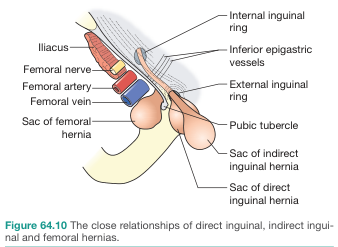
| Feature | Indirect (oblique, lateral) | Direct (medial) |
|---|---|---|
| Where it exits | Through the deep ring, lateral to the inferior epigastric vessels | Through the posterior wall of the canal in Hesselbach's triangle, medial to the vessels |
| Cause | Usually congenital (patent processus vaginalis), though it can be acquired | Acquired (weak abdominal muscle and fascia) |
| Who | Children, young adults, women, and about 80% or more of all inguinal hernias | Older men |
| Path | Travels down the whole canal, often into the scrotum | Bulges straight forward and usually does not travel the whole canal |
| Controlled by pressure over the deep ring? | Yes | No |
| Strangulation risk | Higher (narrow neck at the deep ring) | Lower (wide neck) |
Gray's Anatomy for Students gives the details. An indirect hernia enters the deep ring just lateral to the inferior epigastric vessels. If the whole processus vaginalis is patent, the sac can go down into the scrotum or labium majus. It then picks up the same coverings as the spermatic cord. - Gray's Anatomy for Students, p. 357
Hesselbach's (inguinal) triangle is bounded:
- laterally by the inferior epigastric artery,
- medially by the lateral edge of rectus abdominis,
- inferiorly by the inguinal ligament.
A direct hernia pushes through this triangle. It is usually acquired because the abdominal wall has weakened, and it is common in mature men. - Gray's Anatomy for Students, p. 358
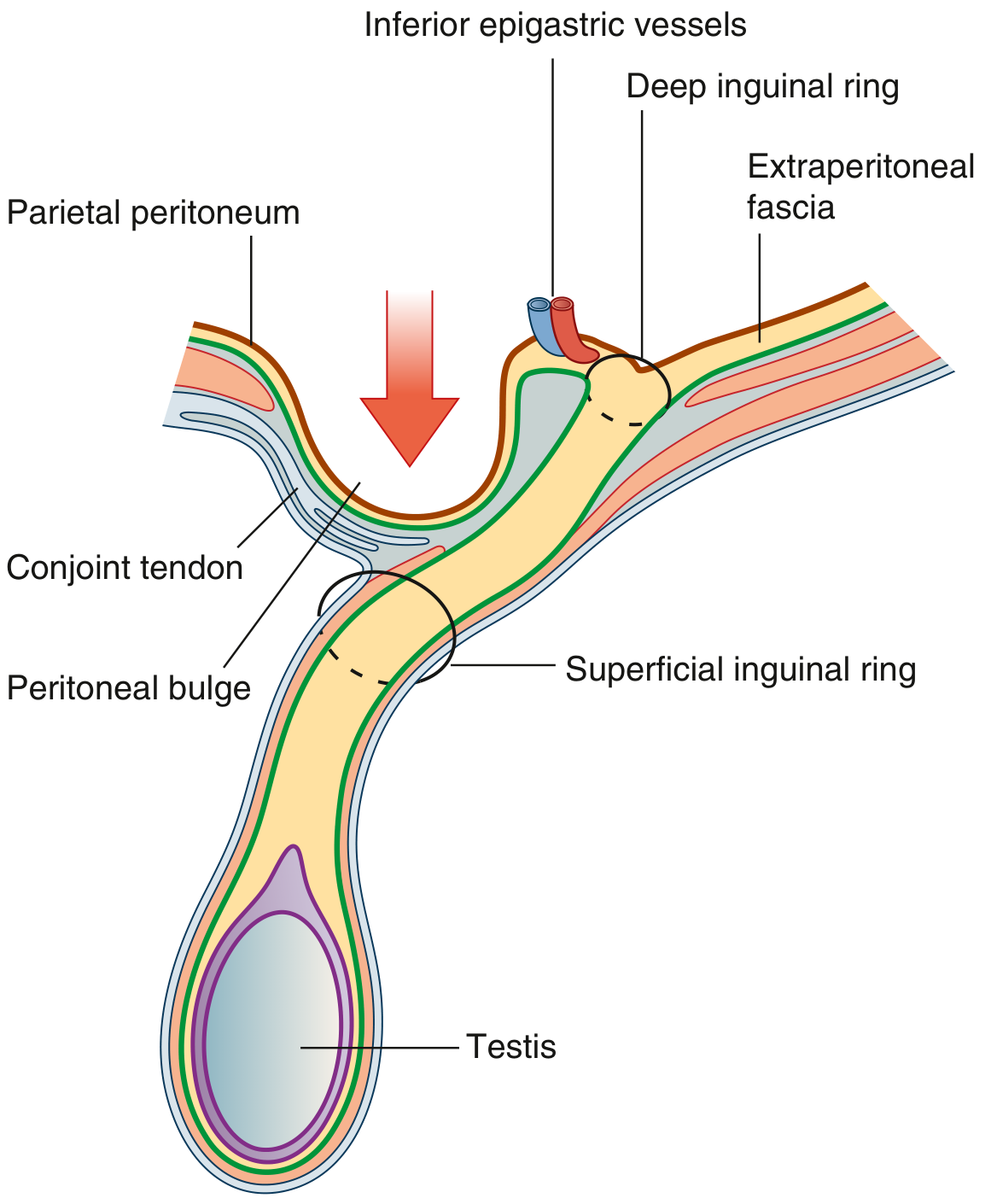
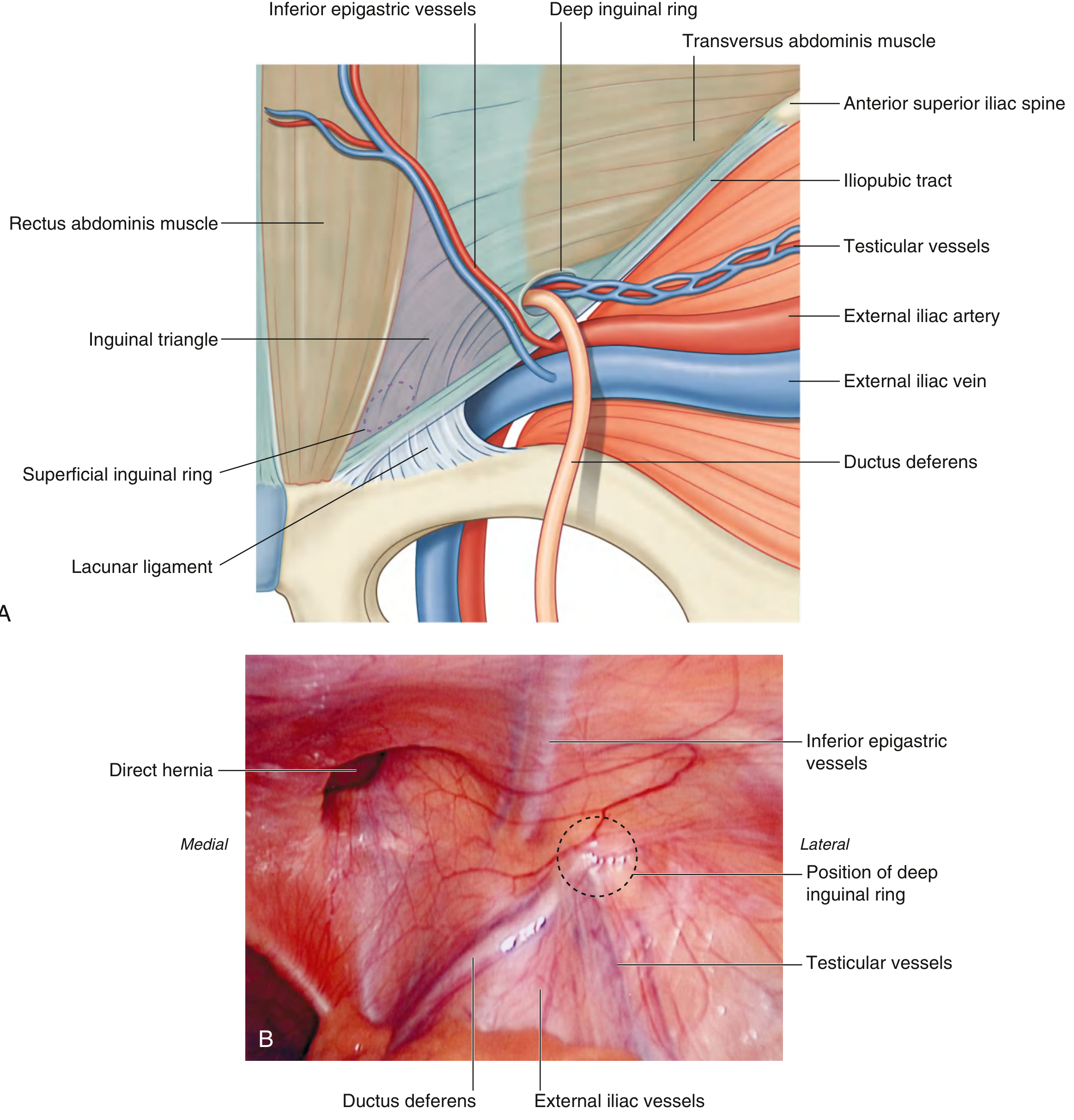
Other related terms:
- Pantaloon hernia: a direct and an indirect hernia on the same side, draped over the inferior epigastric vessels.
- Femoral hernia: not an inguinal hernia. It comes out below the inguinal ligament, medial to the femoral vein. It is more common in women, has a high strangulation risk, and is easily confused with an inguinal hernia.
- Bubonocele, incomplete, complete: these describe how far the hernia has descended. A bubonocele stays within the canal. An incomplete hernia exits the superficial ring but does not reach the scrotum. A complete hernia reaches the bottom of the scrotum. - S Das, A Manual on Clinical Surgery, 13th Edition, p. 607
4. Hernia terminology
- Reducible: the contents go back in, spontaneously or with gentle pressure.
- Irreducible (incarcerated): the contents cannot be pushed back, but the blood supply is intact.
- Obstructed: bowel is trapped and blocked. The patient has colicky pain, vomiting and constipation.
- Strangulated: the blood supply is cut off, so the contents die (ischaemia, then gangrene). This is a surgical emergency.
5. Why they happen
Congenital: a patent processus vaginalis. In children, all inguinal hernias are indirect. The processus normally closes a few months before birth, so premature infants have a high incidence. Males outnumber females about 10 to 1 and the right side is more often affected. - Schwartz's Principles of Surgery, 11th Edition, p. 1770
Acquired: these involve two things, a weak abdominal wall and repeated or sustained rises in intra-abdominal pressure. The risk factors are:
- Male sex, older age, and family history
- Chronic cough (COPD, smoking)
- Straining at stool (chronic constipation) or at urination (prostatic obstruction)
- Heavy lifting
- Obesity, or pregnancy and ascites
- Connective tissue weakness (collagen abnormalities). A 2024 systematic review in genetic and biologic risk factors for hernia supports this.
- Previous lower abdominal surgery, such as an appendicectomy that damaged nerves
Always ask about the cause of raised abdominal pressure. A new hernia in an older man could be the first sign of bladder outlet obstruction or a bowel cancer causing constipation.
6. Symptoms
- A lump in the groin that appears on standing, coughing or straining and disappears on lying down. This is the classic presentation.
- A dragging or aching discomfort in the groin, worse at the end of the day or with exertion.
- Many hernias cause no pain at all.
- Warning signs of complications: a tense, tender, irreducible lump, severe pain, vomiting, abdominal distension, constipation, and red or purple skin over the lump.
In infants, parents usually notice a groin bulge at nappy changes, often when the baby cries. - Schwartz, p. 1770
7. Examination
Examine the patient standing and lying, and ask them to cough.
- Inspection: look for a swelling in the groin or scrotum, and for an impulse on coughing.
- Palpation: find the pubic tubercle. An inguinal hernia lies above and medial to it. A femoral hernia lies below and lateral.
- Reduce the hernia. Then use the deep ring occlusion test: press over the deep ring (midway between the anterior superior iliac spine and the pubic tubercle) and ask the patient to cough.
- If the hernia stays controlled, it is indirect.
- If it bulges out, it is probably direct. S Das describes this as a confirmatory test to differentiate the two. - S Das, p. 598
- Zieman's technique, the finger invagination test, and the "cough impulse" test are further bedside methods you may meet. The deep ring test is the one most often taught.
- In practice the type is often decided at surgery. Classification does not change the repair much.
- Always examine the testes and the other groin.
- Transillumination is positive for a hydrocele, not for a hernia. Examining the scrotum helps you separate a hernia from a hydrocele, varicocele or testicular tumour.
8. Investigations
Diagnosis is usually clinical. Imaging is for special circumstances. - Bailey and Love, p. 1086
- Ultrasound: when the diagnosis is unclear, such as a small or occult hernia, an obese patient, or the groin lump differential.
- CT: if there is suspected obstruction or strangulation, or to check for other abdominal pathology.
- MRI or dynamic ultrasound: for occult hernias in athletes or for chronic groin pain.
- Blood tests: if complicated (lactate, white cell count, electrolytes, urea).
9. Differential diagnosis of a groin lump
- Femoral hernia
- Enlarged lymph nodes
- Hydrocele of the cord, or a hydrocele
- Undescended or ectopic testis
- Lipoma of the cord
- Saphena varix
- Femoral artery aneurysm
- Psoas abscess or psoas bursa
10. Management
Adults
Symptomatic hernias should be repaired surgically. The HerniaSurge international guidelines say that asymptomatic or minimally symptomatic men can safely be managed by watchful waiting. Their risk of an emergency is low, but most will eventually develop symptoms (mostly pain) and need surgery. Women, and all femoral hernias, should generally be repaired because of the higher risk of strangulation.
Options:
- Open mesh repair (Lichtenstein): a mesh is placed over the posterior wall of the canal, usually under local anaesthetic. It is a good choice for low-resource settings.
- Laparoscopic or endoscopic repair: the TEP (totally extraperitoneal) or TAPP (transabdominal preperitoneal) approach places mesh behind the defect. Both are recommended as evidence-based options, provided the surgeon is experienced. These suit bilateral and recurrent hernias well. They usually mean less early pain and a faster return to normal activity. They need general anaesthesia.
- Tissue repairs without mesh: the Shouldice repair is the first choice if a non-mesh repair is chosen. Recurrence is higher than with mesh, so it is used in selected cases such as infection risk or patient preference.
- Robot-assisted repair: a newer minimally invasive option, with the same principles as laparoscopic repair.
Mesh fixation: HerniaSurge suggests that no fixation is needed in TEP/TAPP for most hernias, except large medial (direct) defects. Most repairs are done as day surgery.
Emergency surgery (obstructed or strangulated hernia):
- Resuscitation: IV fluids, analgesia, nasogastric tube if obstructed, antibiotics.
- Operate urgently. Inspect the bowel for viability. Resect if necrotic.
- Mesh use is individualised. Contaminated fields increase the risk of mesh infection.
- Avoid forceful taxis (manual reduction), which can push dead bowel back into the abdomen.
Children
Any inguinal hernia in a child needs repair. The operation is a herniorrhaphy: the patent processus vaginalis is tied off and divided at the deep ring, with no mesh. In adults a hernioplasty is needed because the posterior wall must be rebuilt.
- Infants are at high risk of incarceration because the ring is narrow.
- An incarcerated hernia can usually be reduced with gentle pressure, sometimes with light sedation. Operate within about 24 hours after reduction.
- If it cannot be reduced, or there are signs of strangulation, operate as an emergency. - Schwartz, p. 1771
Truss
A truss (an external support) is only for patients who cannot have surgery. It does not cure a hernia and can cause discomfort.
11. Complications
Of the hernia:
- Irreducibility and obstruction
- Strangulation (a risk of bowel necrosis, perforation and peritonitis)
- Testicular ischaemia in infants if the cord vessels are compressed
- Richter's hernia (only part of the bowel wall is trapped, so obstruction may be absent despite strangulation)
Of the surgery:
- Haematoma, seroma, wound infection
- Chronic groin pain, which is the most important long-term complication (nerve injury or mesh-related)
- Recurrence
- Urinary retention
- Testicular atrophy or ischaemic orchitis
- Injury to the vas deferens, bladder or bowel
- Mesh infection or migration
12. Prevention and advice
- Treat chronic cough, constipation and urinary obstruction.
- Stop smoking, lose weight if overweight, and lift with proper technique.
- After surgery, most people return to light activity within days. Heavy lifting is usually restricted for a few weeks, but advice differs by surgeon.
13. Key points to remember
- The inferior epigastric vessels separate indirect (lateral) from direct (medial) hernias.
- Indirect hernias are the most common type, they are the only type seen in children, and they come through the deep ring.
- Direct hernias are acquired and pass through Hesselbach's triangle.
- Inguinal hernias lie above and medial to the pubic tubercle. Femoral hernias lie below and lateral.
- A tender, irreducible lump with vomiting means strangulation until proven otherwise, so operate urgently.
- Mesh repair is standard for adults. Children get a high ligation of the sac without mesh.
Evidence check: I searched for recent systematic reviews (last 2 years). The results were on bladder exstrophy timing and genetic risk factors. Neither contradicts the textbook account above.
If you'd like, I can go deeper on one part: the anatomy of the layers and the nerves, the surgical techniques step by step, femoral hernias, or pediatric hernias.
This is a shared conversation. Sign in to Orris to start your own chat.