
Status epilepticus defination
Reading File
Now let me search the medical library and PubMed in parallel.
Finding Sources
Searching PubMed
"status epilepticus" definition classification
Now let me read the most relevant sections in parallel - neurology, emergency medicine, and Goldman-Cecil:
Reading File
Reading File
Reading File
Let me also get the ILAE definition from the Miller's Anesthesia and Rosen's text:
Reading File
Reading File
I now have sufficient information to provide a comprehensive answer. Let me also fetch the treatment flowchart image from Tintinalli's.
Loading Image
Here is a thorough, textbook-sourced answer on the definition of status epilepticus.
Status Epilepticus (SE) - Definition
Core Definition
Status epilepticus is a single seizure lasting ≥5 minutes, OR two or more seizures without recovery of consciousness between them.
This operational definition reflects a key physiological threshold: after 5 minutes, seizures become:
-
Less likely to terminate spontaneously
-
Less responsive to antiepileptic drugs
-
More likely to cause permanent neuronal damage
-
Tintinalli's Emergency Medicine, A Comprehensive Study
The ILAE Two-Timepoint Definition
The modern (ILAE 2015) definition incorporates two critical time points (t1 and t2):
| Time Point | Meaning |
|---|---|
| t1 | Time at which abnormal seizure prolongation begins (when to treat) |
| t2 | Time at which long-term neuronal injury/death begins |
These differ by seizure type:
| Seizure Type | t1 (treat at) | t2 (neuronal injury by) |
|---|---|---|
| Generalized tonic-clonic | 5 minutes | 30 minutes |
| Focal impaired awareness | 10 minutes | 60 minutes |
| Absence SE | 10-15 minutes | Unknown |
- Goldman-Cecil Medicine, International Edition
Operational Definition (Clinical Use)
"Status epilepticus is a medical emergency in which seizures occur continuously or repeatedly without intervening resumption of consciousness."
- Goldman-Cecil Medicine
"A single seizure ≥5 minutes in length or two or more seizures without recovery of consciousness between seizures."
- Tintinalli's Emergency Medicine
Classification of SE
SE is broadly classified into two main types:
1. Convulsive SE (Generalized Tonic-Clonic SE)
- Most recognized and most dangerous form
- Overt motor manifestations (rhythmic jerking, tonic posturing)
- Clear diagnosis
2. Non-Convulsive SE (NCSE)
- Patient is comatose, or has fluctuating/altered mental status or confusion
- No overt seizure activity visible clinically
- Diagnosis requires EEG (often missed)
- Clues: prolonged postictal period, subtle twitching/blinking/eye deviation, unexplained stupor
- Tintinalli's Emergency Medicine
Phases / Subtypes by Refractoriness
| Phase | Definition |
|---|---|
| Early SE | First 5-10 min; responds to benzodiazepines (~70%) |
| Established SE | 10-30 min; requires second-line agents (fosphenytoin, valproate, levetiracetam) - success ~45% |
| Refractory SE | Persists after adequate benzodiazepine + one second-line agent (20-30% of cases); requires ICU + IV infusions |
| Super-refractory SE | Seizures persist or recur after 24h despite third-line therapy; highest mortality |
- Miller's Anesthesia, 10e; Goldman-Cecil Medicine
Why 5 Minutes Matters - Pathophysiology
At the 5-minute mark, critical cellular changes occur:
-
Downregulation and internalization of GABA-A receptors - reduces inhibitory tone
-
Upregulation of NMDA and glutamate receptors - increases excitatory drive
-
Blood-brain barrier compromise - allows entry of potassium and albumin (both hyperexcitatory)
-
After 20 minutes: hypotension, hypoxia, metabolic acidosis, hyperthermia, hypoglycemia, cardiac arrhythmias, and pulmonary edema develop
-
This milieu makes standard therapies progressively less effective
-
Tintinalli's Emergency Medicine
Common Causes
-
Subtherapeutic antiepileptic drug levels
-
Acute stroke / anoxia / hypoxia
-
CNS infection or prior structural brain lesion
-
Metabolic abnormalities
-
Alcohol/drug intoxication or withdrawal
-
Autoimmune encephalitis (reported as the most common single cause in one recent study, though 50% remain cryptogenic)
-
Goldman-Cecil Medicine
Treatment Protocol Overview
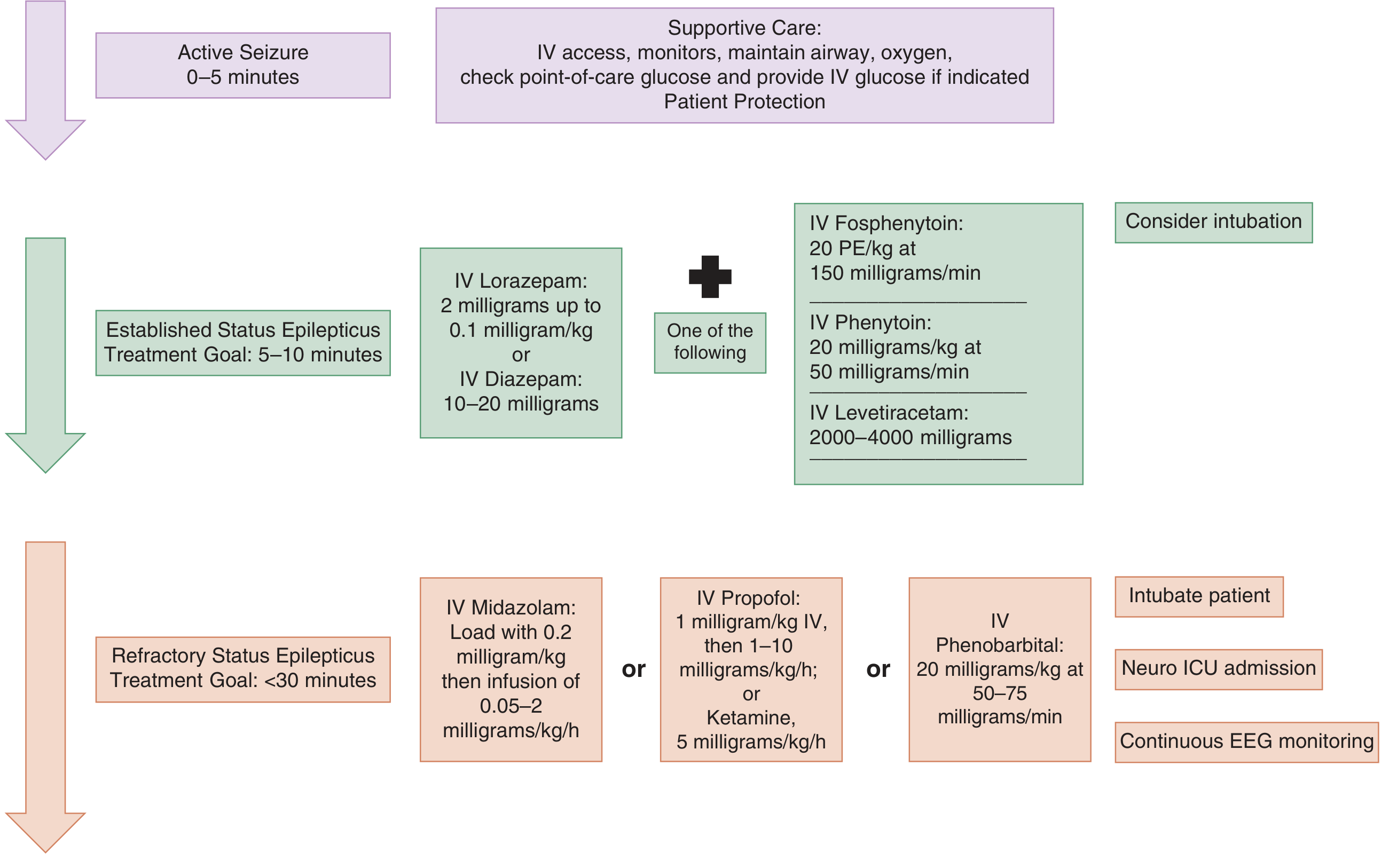
Treatment goal: seizure control within 30 minutes of presentation. First-line: benzodiazepines. Second-line: fosphenytoin/valproate/levetiracetam. Refractory: midazolam/propofol/phenobarbital infusion in ICU with continuous EEG monitoring.
Key takeaway: SE is defined by the 5-minute rule in clinical practice. The underlying reason is biological - beyond 5 minutes, seizures become self-sustaining due to receptor trafficking changes, making early treatment the single most important factor in outcome.
This is a shared conversation. Sign in to Orris to start your own chat.