
Hypertension
I'll start by reading the medical library skill, then search for comprehensive hypertension content.
Searching sources...
Reading File
Now I'll search for hypertension content in the medical library in parallel with a web search and image search.
Finding Sources
Searching Images
hypertension pathophysiology classification diagram blood pressure
Searching PubMed
"hypertension"[MeSH Terms] AND "management"[MeSH Terms]
Now let me read the most relevant hypertension sections from the textbooks in parallel.
Let me now get the core hypertension sections from the Family Medicine textbook and search for more specific content.
Finding Sources
Reading File
Let me get the main hypertension chapter content from the Family Medicine textbook.
Reading File
Finding Sources
Searching Images
antihypertensive drugs mechanism of action pharmacology
Let me get the core hypertension chapter from Harrison's and also search for specific hypertension paragraphs.
Finding Sources
Finding Sources
Now let me read the comprehensive Harrison's hypertension chapter sections.
Reading File
Reading File
I now have rich, detailed content from Harrison's 22E (2025). Let me read more of the core hypertension block for treatment details.
Reading File
I now have very rich content from Harrison's 22E. Let me fetch the hypertensive retinopathy image and compile the full answer.
Loading Image
I now have comprehensive content from Harrison's Principles of Internal Medicine 22E (2025) and the supporting image. Here is a thorough, well-organized overview of hypertension.
Hypertension
Definition and Classification
Hypertension is defined as a sustained elevation of blood pressure (BP) at or above 130/80 mmHg (2017 ACC/AHA guidelines) or 140/90 mmHg (2018 ESC/ESH guidelines). It is one of the most common and consequential modifiable risk factors for cardiovascular disease (CVD), stroke, kidney disease, and all-cause mortality worldwide.
| BP Category (ACC/AHA 2017) | Systolic (mmHg) | Diastolic (mmHg) |
|---|---|---|
| Normal | < 120 | < 80 |
| Elevated | 120-129 | < 80 |
| Stage 1 Hypertension | 130-139 | 80-89 |
| Stage 2 Hypertension | ≥ 140 | ≥ 90 |
| Hypertensive Crisis | > 180 | > 120 |
Epidemiology
- Affects approximately 1.3 billion adults worldwide, with prevalence rising with age - up to 70% of older adults in the United States have hypertension.
- Non-Hispanic Black adults have disproportionately high prevalence, earlier onset, and higher rates of CVD and kidney disease from hypertension, compared to white or other race/ethnicity groups.
- BP control rates remain suboptimal: in the 2017-2020 NHANES survey, only 52% of White and 37% of Black adults with hypertension were controlled to <140/90 mmHg.
Types: Primary vs. Secondary
Primary (Essential) Hypertension (~95% of cases)
Most adults with hypertension have primary hypertension - no identifiable anatomic cause. It is polygenic and environmental in origin.
Key contributing factors (per Harrison's 22E):
- Dietary: excess sodium intake, insufficient potassium intake, poor diet quality
- Lifestyle: physical inactivity, obesity (BMI ≥30), excess alcohol
- Environmental: heavy metal exposure (lead, cadmium, arsenic), air pollution (PM2.5 raises SBP by ~3-5 mmHg), seasonal cold temperature, high altitude
- Psychosocial: chronic stress
Secondary Hypertension (~5% of cases)
Consider when there is:
- Treatment-resistant hypertension
- Abrupt worsening of previously controlled hypertension
- Disproportionate target organ damage
- Lab findings: unprovoked hypokalemia, proteinuria, left ventricular hypertrophy
| Cause | Key Features | Screening Test |
|---|---|---|
| Primary aldosteronism | Hypokalemia, sodium retention | Aldosterone-to-renin ratio |
| Renal artery stenosis | Bruits, flash pulmonary edema | Renal Doppler ultrasound |
| Obstructive sleep apnea | Snoring, daytime fatigue | Polysomnography |
| Chronic kidney disease | Proteinuria, elevated creatinine | eGFR, urinalysis |
| Pheochromocytoma | Episodic headache, sweating, palpitations | Plasma/urine metanephrines |
| Cushing's syndrome | Central obesity, striae, easy bruising | 24-hr urine cortisol |
| Thyroid disorders | Hypo- or hyperthyroidism | TSH |
Pathophysiology
The main mechanisms driving BP elevation include:
- Renin-Angiotensin-Aldosterone System (RAAS) activation: Increased angiotensin II causes vasoconstriction and aldosterone-mediated sodium/water retention, raising both vascular resistance and volume.
- Sympathetic nervous system overactivity: Increases heart rate, cardiac output, and vasoconstriction.
- Impaired endothelium-dependent vasorelaxation: Reduced nitric oxide (NO) bioavailability decreases vasodilation.
- Sodium retention: Abnormal renal sodium handling raises intravascular volume.
- Vascular remodeling: Structural changes in vessel walls increase peripheral vascular resistance chronically.
Target Organ Damage
Chronic hypertension damages multiple organ systems:
| Organ | Damage |
|---|---|
| Heart | Left ventricular hypertrophy, coronary artery disease, heart failure |
| Brain | Stroke (ischemic and hemorrhagic), white matter changes, cognitive decline, dementia |
| Kidneys | Nephrosclerosis, proteinuria, progressive CKD, ESKD |
| Eyes | Hypertensive retinopathy (see image below) |
| Vasculature | Aortic aneurysm, peripheral arterial disease, accelerated atherosclerosis |
Hypertensive Retinopathy (Target Organ Damage - Eye)
The image below shows the progression of hypertensive retinopathy compared to coronary plaque changes:
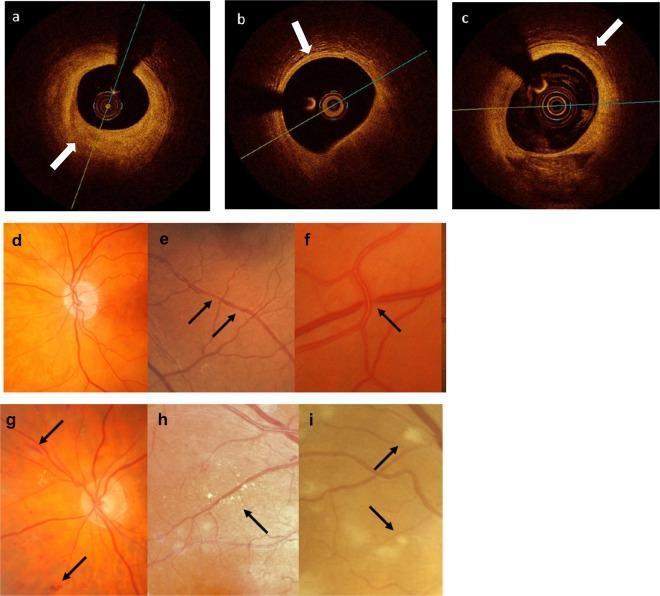
- Mild: Generalized/focal arteriolar narrowing, AV nicking (compressed veins at arteriovenous crossings)
- Moderate: Retinal hemorrhages, hard exudates (lipid deposits), cotton wool spots (nerve fiber infarcts)
- Severe: Papilledema (hypertensive emergency)
Measurement
Accurate BP measurement is essential:
- Use appropriate cuff size; arm at heart level; patient seated and rested ≥5 minutes
- Measure in both arms initially; use the higher reading
- White coat hypertension: BP elevated in office only - confirmed with ambulatory BP monitoring (ABPM) or home BP monitoring
- Masked hypertension: Normal in office, elevated at home - higher CVD risk than white coat
- ABPM is the gold standard for diagnosis and is recommended when office readings are uncertain
Non-Pharmacologic Management (Lifestyle Modifications)
These can lower SBP by 4-11 mmHg each:
| Intervention | Expected SBP Reduction |
|---|---|
| DASH diet | 8-11 mmHg |
| Sodium restriction (<1.5 g/day) | 5-6 mmHg |
| Weight loss (per 10 kg) | 5-20 mmHg |
| Physical activity (aerobic, 150 min/week) | 4-9 mmHg |
| Limit alcohol (<2 drinks/day men, <1 women) | 2-4 mmHg |
| Stop smoking | BP + CVD risk reduction |
Pharmacologic Management
When to Start
- Stage 1 (130-139/80-89): Start if ASCVD risk ≥10% or existing CVD/diabetes/CKD; otherwise lifestyle first
- Stage 2 (≥140/90): Start medication along with lifestyle changes
- Most patients require 2 or more agents
First-Line Drug Classes
| Class | Examples | Key Indications / Notes |
|---|---|---|
| Thiazide diuretics | Chlorthalidone, hydrochlorothiazide | First-line; especially effective in Black patients |
| ACE Inhibitors (ACEI) | Lisinopril, enalapril | CKD, diabetes, heart failure; avoid in pregnancy |
| Angiotensin Receptor Blockers (ARB) | Losartan, valsartan | Same as ACEi; use if ACEi-intolerant (cough) |
| Calcium Channel Blockers (CCB) | Amlodipine (dihydropyridine) | Effective in elderly and Black patients |
| Beta-blockers | Metoprolol, carvedilol | Compelling indication: heart failure, post-MI, angina |
Compelling Indications Guide Drug Selection
| Comorbidity | Preferred Agent(s) |
|---|---|
| Heart failure (reduced EF) | ACEI/ARB + beta-blocker + diuretic + spironolactone |
| Post-MI | ACEI + beta-blocker |
| Diabetic nephropathy | ACEI or ARB (reduces proteinuria) |
| CKD with proteinuria | ACEI or ARB |
| Isolated systolic HTN (elderly) | Thiazide or CCB |
| Marfan syndrome / TAA | Beta-blockers; ARBs |
BP Targets
- General: < 130/80 mmHg (ACC/AHA) or < 140/90 mmHg (ESC/ESH)
- Elderly (≥80 years): Target SBP < 150 mmHg per ACP; < 140 mmHg if tolerated (ESC/ESH recommends treatment at SBP ≥160 mmHg in this age group)
- Older patients with low comorbidity/fall risk: Target SBP < 130 mmHg is appropriate
- Diabetes or heart failure: Higher targets (e.g., < 150 mmHg) if postural hypotension present
Hypertensive Emergencies and Urgencies
| Urgency | Emergency | |
|---|---|---|
| Definition | Severe HTN (>180/120) without end-organ damage | Severe HTN with acute end-organ damage |
| Symptoms | Headache, anxiety | Chest pain, dyspnea, altered consciousness, vision loss |
| Management | Oral agents, gradual reduction over 24-48h | IV agents (nicardipine, labetalol, nitroprusside); reduce BP by no more than 25% in first hour |
Special Populations
Older Adults (per Harrison's 22E)
- 70% of older U.S. adults have hypertension
- HYVET trial: treating hypertension in patients ≥80 years to a target ≤150 mmHg significantly reduced stroke, heart failure, and mortality
- SPRINT trial: targeting SBP <120 mmHg reduced composite CVD events and may reduce dementia/MCI risk; excluded patients with diabetes, prior stroke, and heart failure
- Risk of orthostatic hypotension, falls, and syncope must be weighed against CVD benefit
- Use lower initial doses; for dual therapy, prefer ACEI/ARB + diuretic (rather than CCB) if heart failure risk is high
Pregnancy
- Hypertension in ADPKD increases risk of fetal and maternal complications; normotensive women with ADPKD usually have uncomplicated pregnancies
- Gestational hypertension and preeclampsia are distinct entities requiring specific management
- Avoid ACEI and ARBs in pregnancy (teratogenic)
- Preferred agents: labetalol, nifedipine, methyldopa
CKD / Renal Disease
- Hypertension accelerates CKD progression via glomerular hypertension and RAAS activation
- Target BP < 130/80 mmHg with ACEI or ARB as first-line
- In ADPKD: hypertension affects ~50% of young patients with normal renal function and nearly 100% with ESKD
Black Patients
- Higher prevalence, earlier onset, more CVD/renal complications
- Thiazide diuretics and CCBs are especially effective in this population
- Many require triple therapy; RAAS-based therapy should still be included
Key Clinical Trials
| Trial | Key Finding |
|---|---|
| ALLHAT | Thiazides as effective as ACEI/CCB; linear BP-stroke relationship |
| SPRINT | SBP target <120 mmHg reduces CVD events vs. <140 mmHg; reduces MCI/dementia |
| HYVET | Treatment in ≥80-year-olds to ≤150 mmHg reduces stroke, HF, mortality |
| HOPE / EUROPA | ACEi (ramipril) reduces CVD events beyond BP lowering alone, though generalizability debated |
| HIPARCO | CPAP reduces BP in resistant hypertension with OSA |
Resistant Hypertension
Defined as BP above goal despite three or more antihypertensive agents including a diuretic at optimal doses. Consider:
- Secondary cause (especially primary aldosteronism, OSA, renal artery stenosis)
- Poor adherence or white coat effect
- Add spironolactone (4th agent), doxazosin, or other agents
- Refer to hypertension specialist
Sources: Harrison's Principles of Internal Medicine 22E (2025, McGraw Hill Medical), Textbook of Family Medicine 9e, Brenner and Rector's The Kidney 2-Volume Set
This is a shared conversation. Sign in to Orris to start your own chat.