
Hemolytic shock
Reading File
Now let me search the medical library and PubMed in parallel for hemolytic shock content.
Finding Sources
Finding Sources
Finding Sources
Searching PubMed
"hemolytic transfusion reaction" AND "shock"
Good results found. Let me now read the most relevant sections - the hemolytic transfusion reaction sections from Tintinalli's, Miller's Anesthesia, and Roberts & Hedges, as well as a broader hemolytic anemia section.
Reading File
Reading File
Reading File
Reading File
Let me also read more of the Miller's Anesthesia section and the Tintinalli section on management, and fetch the relevant image from Miller's.
Reading File
Reading File
Loading Image
Let me also read the treatment box from Miller's and fetch the hemoglobin-haptoglobin pathway image:
Reading File
Loading Image
I now have comprehensive information to provide a thorough, well-cited answer on hemolytic shock. Let me compile it.
Hemolytic Shock
Hemolytic shock is a life-threatening circulatory collapse triggered by massive intravascular destruction of red blood cells (RBCs). The most common and clinically important context is an acute hemolytic transfusion reaction (AHTR), particularly from ABO-incompatible blood transfusion.
Pathophysiology
When incompatible blood is transfused, naturally occurring ABO alloantibodies (typically IgM class) fix complement and cause rapid, massive intravascular hemolysis of donor RBCs. The cascade of events that leads to shock includes:
-
Free hemoglobin release - As RBCs lyse, hemoglobin floods the plasma. Haptoglobin (which can bind ~100 mg Hb/100 mL plasma) is quickly saturated. Free Hb then circulates unbound and is filtered by the kidney. When plasma Hb exceeds 150 mg/dL, hemoglobinuria occurs.
-
Complement and vasoactive amine release - Complement activation releases histamines, vasoactive amines, and activates the kallikrein system, causing profound vasodilation and hypotension.
-
DIC (Disseminated Intravascular Coagulation) - RBC stroma released during hemolysis contains erythrocytin, which activates the intrinsic coagulation pathway, consuming platelets and factors I, II, V, and VII, leading to a bleeding diathesis.
-
Acute Renal Failure - Free hemoglobin precipitates as acid hematin in the distal tubules, causing mechanical blockage. Shock compounds this by reducing renal perfusion. The net result is acute tubular necrosis.
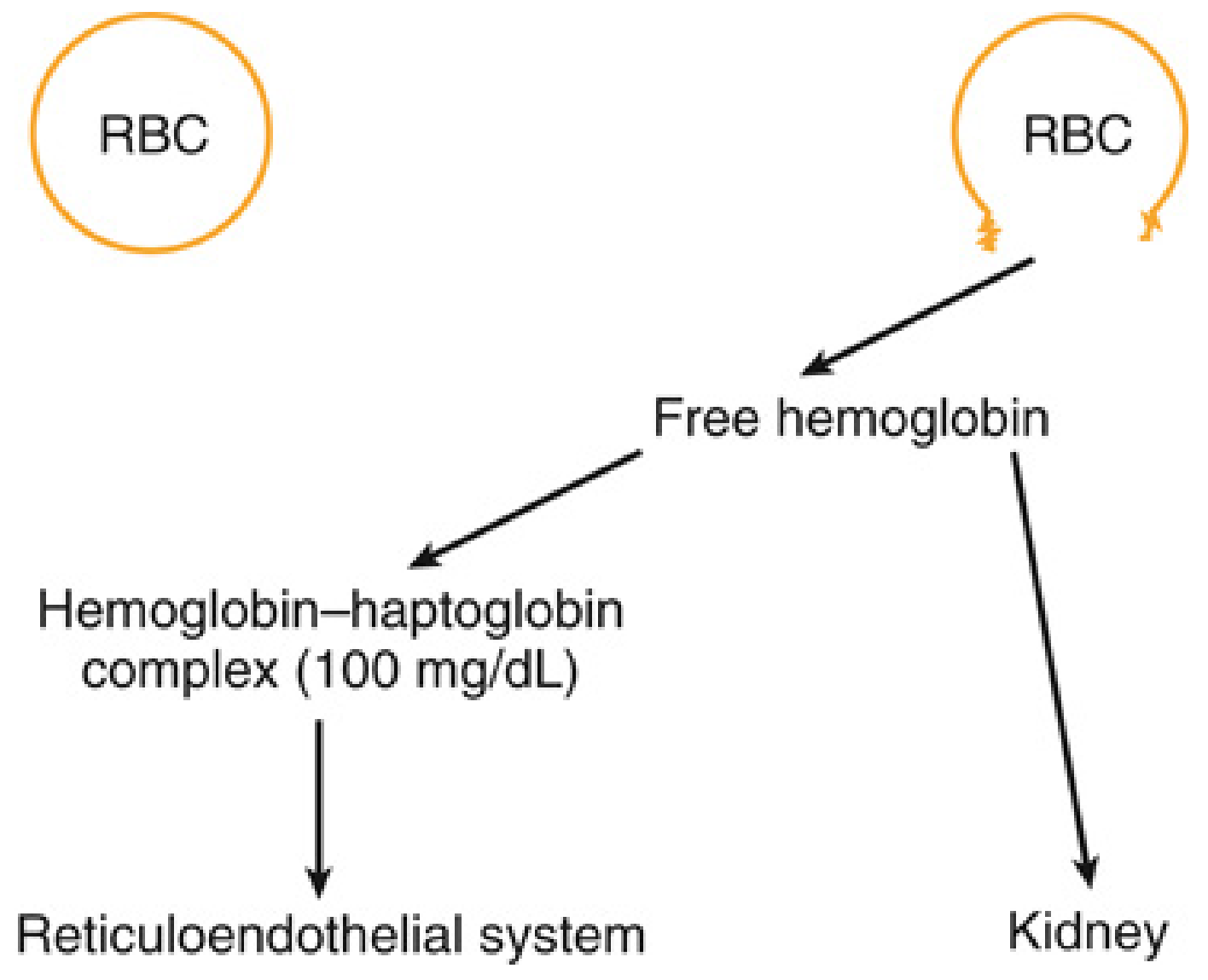
The most common cause of AHTR causing death is ABO incompatibility from clerical error - errors made after the blood leaves the blood bank (in the OR, ED, ICU, or ward). The incidence of fatal AHTR from ABO incompatibility is approximately 1:1,200 to 1:190,000 transfusions.
Types of Hemolytic Transfusion Reactions
| Type | Timing | Mechanism | Severity |
|---|---|---|---|
| Acute intravascular | During or within hours of transfusion | ABO antibodies (IgM) + complement | Severe - can be fatal |
| Delayed extravascular | 3-10 days post-transfusion | Non-ABO antibodies (IgG) in Rh, Kidd system | Usually mild, rarely fatal |
| Delayed serologic | Days to weeks | Anamnestic antibody rise | Often asymptomatic |
Clinical Features
Acute Hemolytic Reaction (the shock-producing form)
Presenting signs and symptoms include:
- Fever and chills (most common - fever in ~87% of cases per Miller's series of 40 patients)
- Back/flank pain and chest pain
- Hypotension and tachycardia
- Dyspnea and bronchospasm
- Hemoglobinuria (red/brown urine - a key early sign)
- Bleeding from DIC
- Sensation of "impending doom"
- Oliguria progressing to renal failure
Under general anesthesia, the classic symptoms are masked. The only clues may be hemoglobinuria, unexplained hypotension, or a bleeding diathesis. - Miller's Anesthesia, 10e
As little as 50 mL of incompatible blood can trigger a clinically significant reaction. The amount of free Hb in plasma roughly correlates with the volume of incompatible blood transfused.
Laboratory Workup
Stop the transfusion immediately and send the following:
| Test | What it shows |
|---|---|
| Serum haptoglobin | Decreased (consumed binding free Hb) |
| Plasma free hemoglobin | Elevated (pink/red plasma) |
| Serum LDH | Elevated |
| Indirect bilirubin | Elevated |
| Direct antiglobulin (Coombs) test | Positive (antibody on donor RBCs) |
| Urine hemoglobin | Positive (hemoglobinuria) |
| CBC, creatinine, PT/aPTT | Assess DIC and renal function |
| Repeat blood type + crossmatch | Confirm incompatibility |
Management
Most morbidity and mortality stem from hypotension/shock and the subsequent renal and coagulation complications. Treatment is immediate and aggressive.
Step-by-Step Treatment Protocol (from Miller's Anesthesia, Box 45.6):
- Stop the transfusion immediately
- Maintain urine output at minimum 75-100 mL/hr:
- IV crystalloid (aggressive fluid resuscitation)
- Mannitol (osmotic diuretic)
- Furosemide if mannitol is ineffective
- Alkalinize the urine - IV sodium bicarbonate prevents precipitation of acid hematin in the distal tubules
- Treat circulatory shock - IV infusions + vasopressors (e.g., norepinephrine) to maintain blood pressure and renal perfusion
- Prevent and treat DIC - platelet count, PT, aPTT, fibrinogen; administer fresh frozen plasma, platelets, or cryoprecipitate as needed
- Return unused blood to blood bank for repeat crossmatch
- Treat bronchospasm - inhaled or subcutaneous beta-agonists
- Symptomatic care - acetaminophen, warming blanket, antihistamines
- Monitor renal, coagulation, respiratory, and cardiac function continuously
After shock is controlled, assess for acute tubular necrosis (which may complicate fluid management) and persistent DIC.
Delayed Hemolytic Transfusion Reaction (DHTR)
A DHTR typically occurs 3-21 days after transfusion. It is caused by low-level alloantibodies (Rh, Kidd system) that were undetectable at pretransfusion testing but rise through an anamnestic response. Features include:
- Falling hemoglobin (below expected post-transfusion level)
- Jaundice, indirect hyperbilirubinemia
- Positive Coombs test
- Usually self-limited and rarely fatal
In a postoperative patient, an unexplained drop in Hb 2-21 days after transfusion should raise suspicion for DHTR - Miller's Anesthesia, 10e
Prevention
- Two patient identifiers and confirmation of the correct blood product are mandatory before transfusion (Joint Commission requirement)
- Barcode scanning of blood products before administration
- Careful pretransfusion testing and blood bank protocols
- Patients with prior hemolytic reactions should wear medical ID bracelets alerting personnel to previous reactions
Sources:
- Tintinalli's Emergency Medicine, Table 238-7 (Transfusion Reactions)
- Miller's Anesthesia, 10e, Chapter 45 (Signs/Symptoms, Treatment Box 45.6, Table 45.16)
- Roberts and Hedges' Clinical Procedures in Emergency Medicine, Chapter 28
- Frameworks for Internal Medicine (Hemolytic anemia - ABO mechanism and shock)
Lanka premier league
The Lanka Premier League (LPL) is Sri Lanka's premier T20 franchise cricket tournament, launched in 2020. It features five franchises representing cities across Sri Lanka, and is sanctioned by Sri Lanka Cricket (SLC). Past winners include Jaffna Kings (multiple titles) and Galle Gladiators.
Searching sources...
Searching the Web
Lanka Premier League 2025 2026 latest news results
Reading Web Page
https://www.sportingnews.com/in/cricket/news/2026-lanka-prem…
Searching the Web
Lanka Premier League 2026 points table results fixtures teams
Here's everything you need to know about the Lanka Premier League (LPL) 2026, which is currently underway!
Lanka Premier League (LPL) 2026
6th edition | Sanctioned by Sri Lanka Cricket (SLC) | Sponsored by Dafabet
Duration: 17 July - 8 August 2026
Format: Double round-robin (20 league matches) + 4-team playoffs
Broadcast: Peo TV (SLTMobitel) - exclusive media partner
The 5 Teams
| Team | Captain |
|---|---|
| Galle Gallants | Dasun Shanaka |
| Jaffna Kings | - |
| Colombo Kaps | - |
| Kandy Royals | - |
| Dambulla Sixers | - |
Jaffna Kings began as tournament favourites, having won 4 of the previous 5 editions.
Points Table (as of 22 July 2026)
| Pos | Team | M | W | L | Pts | NRR |
|---|---|---|---|---|---|---|
| 1 | Galle Gallants | 2 | 2 | 0 | 4 | +1.121 |
| 2 | Kandy Royals | 3 | 1 | 2 | 2 | +0.317 |
| 3 | Colombo Kaps | 2 | 1 | 1 | 2 | -0.054 |
| 4 | Dambulla Sixers | 3 | 1 | 2 | 2 | -0.612 |
| 5 | Jaffna Kings | 2 | 1 | 1 | 2 | -0.626 |
Galle Gallants lead comfortably with a perfect 2/2 record and a strong NRR.
Results So Far
| Date | Match | Result |
|---|---|---|
| 17 Jul | Galle Gallants vs Jaffna Kings | Gallants won by 36 runs (213/6 vs 177) |
| 18 Jul | Dambulla Sixers vs Kandy Royals | Sixers won by 18 runs |
| 18 Jul | Colombo Kaps vs Galle Gallants | Gallants won by 5 wickets |
| 19 Jul | Dambulla Sixers vs Jaffna Kings | Jaffna won by 5 wickets |
| 19 Jul | Kandy Royals vs Colombo Kaps | Kaps won by 6 wickets |
| 21 Jul | Kandy Royals vs Dambulla Sixers | Royals won by 43 runs |
Today's Matches (22 July - Dambulla)
- Match 7: Colombo Kaps vs Jaffna Kings - 3:00 PM local
- Match 8: Dambulla Sixers vs Galle Gallants - 7:30 PM local
Upcoming Schedule
| Date | Match | Venue |
|---|---|---|
| 23 Jul | Colombo Kaps vs Kandy Royals | Dambulla |
| 23 Jul | Galle Gallants vs Jaffna Kings | Dambulla |
| 25 Jul | Galle Gallants vs Kandy Royals | Dambulla |
| 25 Jul | Dambulla Sixers vs Colombo Kaps | Dambulla |
| 26 Jul | Jaffna Kings vs Kandy Royals | Dambulla |
| 28 Jul | Colombo Kaps vs Jaffna Kings | Pallekele |
| 29-30 Jul | Various matches | Pallekele |
| 1-2 Aug | Final league matches | Pallekele |
| 5 Aug | Qualifier 1 + Eliminator | Colombo (RPS) |
| 7 Aug | Qualifier 2 | Colombo (RPS) |
| 8 Aug | FINAL | Colombo (R. Premadasa Stadium) |
Top Performers (After 6 Matches)
Most Wickets:
- Akif Javed (Galle Gallants) - 6 wkts, BBI 4/40
- Lizaad Williams (Jaffna Kings) - 5 wkts, BBI 3/14
- Eshan Malinga (Galle Gallants) - 5 wkts, BBI 4/26
LPL History
| Season | Champions |
|---|---|
| 2020 | Jaffna Stallions |
| 2021 | Jaffna Kings |
| 2022 | Jaffna Kings |
| 2023 | Colombo Strikers |
| 2024 | Jaffna Kings |
| 2026 | Ongoing |
The 2025 edition was not held - the tournament returned in 2026 after a two-year absence following the 2024 edition.
Full live coverage and scorecard details are available at ESPN Cricinfo.
Live score
Searching the Web
LPL 2026 live score Colombo Kaps vs Jaffna Kings today
Unfortunately, I can't pull real-time ball-by-ball scores directly - my web search isn't returning a live scorecard for the match in progress. The current time is 4:48 PM IST, and today's first match (Match 7: Colombo Kaps vs Jaffna Kings) was scheduled for 3:00 PM local Sri Lanka time (SLT = IST), so it should be live right now.
For the live score, head directly to one of these:
Today's matches at a glance:
| # | Match | Time (SLT/IST) | Venue |
|---|---|---|---|
| Match 7 | 🏏 Colombo Kaps vs Jaffna Kings | 3:00 PM - Live now | Dambulla |
| Match 8 | 🏏 Dambulla Sixers vs Galle Gallants | 7:30 PM - Later tonight | Dambulla |
This is a shared conversation. Sign in to Orris to start your own chat.