
Capd procedure steps
CAPD continuous ambulatory peritoneal dialysis procedure steps exchange technique
https://nz.mykidneyjourney.com/en-nz/peritoneal-dialysis-hom…
CAPD - Continuous Ambulatory Peritoneal Dialysis
What is CAPD?
Prerequisites / Setup
- A flexible silicone rubber catheter with side holes at the distal end is surgically placed through the abdominal wall into the peritoneal cavity
- The catheter has two Dacron cuffs that anchor it, seal against bacterial tracking, and prevent external fluid leakage
- One cuff is placed in the preperitoneal plane; the other sits ~2 cm below the skin surface
- Harrison's Principles of Internal Medicine, 22E
- Dwell volume: typically 2-3 L per exchange
- Dwell time: usually 2-4 hours per exchange
- Number of exchanges: 3-5 per day (commonly 4)
- Dextrose concentration of dialysis solution
- Washington Manual of Medical Therapeutics; Harrison's 22E
The 3 Core Steps of Each CAPD Exchange
Step 1: DRAIN (Outflow)
- The used, waste-saturated dialysate (called "effluent") already sitting in the peritoneal cavity from the previous dwell is drained out through the catheter
- The drain bag is placed below the level of the abdomen - gravity assists drainage
- This fluid carries away metabolic waste products and excess water
Step 2: FILL (Inflow)
- Once the abdomen is fully drained, fresh dialysis solution is infused through the same catheter
- The fresh solution bag is elevated above the abdomen - gravity drives it inward
- Typical fill volume: 1.5-3 L per exchange
Step 3: DWELL
- The fresh dialysate remains inside the peritoneal cavity for the prescribed dwell period (typically 2-4 hours during the day)
- During this time, diffusion and osmosis occur:
- Waste products (urea, creatinine) move from blood across the peritoneal membrane into the dialysate down a concentration gradient
- Excess water is removed via ultrafiltration driven by the osmotic gradient of the dextrose solution
- Rate of diffusion gradually slows and eventually stops as equilibration is reached
- After the dwell period, the patient drains again (Step 1) and repeats the cycle
Daily CAPD Schedule
| Exchange | Time | Dwell |
|---|---|---|
| Exchange 1 | Morning | ~4 hours |
| Exchange 2 | Midday | ~4 hours |
| Exchange 3 | Afternoon/Evening | ~4 hours |
| Exchange 4 (overnight) | Bedtime | Remains overnight (~8-10 hours) |
- Typically 3-5 exchanges per day, with the last bag left in overnight
- Between exchanges, the patient disconnects and is free to go about normal activities
- Harrison's 22E; Washington Manual; National Kidney Foundation Primer
Dialysis Solution Details
| Dextrose Concentration | Color Code | Osmotic Effect |
|---|---|---|
| 1.5% | Yellow | Low ultrafiltration |
| 2.5% | Green | Moderate ultrafiltration |
| 4.25% | Red | High ultrafiltration |
- Higher dextrose = more fluid removal but also more glucose absorption and risk of hyperglycemia
- Icodextrin (glucose polymer) is used for the long overnight dwell - it is minimally absorbed and maintains osmotic gradient for up to 18 hours
- Common additives: Heparin (prevents fibrin clot obstruction of catheter), insulin (in diabetic patients), antibiotics (during peritonitis episodes)
- Harrison's 22E; Washington Manual
Strict Aseptic Technique
- Thorough handwashing before every exchange
- Wearing a mask during connection/disconnection
- Inspecting the bag and tubing for damage, cloudiness, or leaks
- Using a clean, flat surface for the procedure
Key Differences: CAPD vs CCPD
| Feature | CAPD | CCPD (Automated PD) |
|---|---|---|
| Machine required | No | Yes (cycler) |
| Timing | Daytime, manual | Overnight, automated |
| Exchanges | 3-5 per day by patient | Machine runs 4-8 cycles overnight |
| Flexibility | Can be done anywhere | Requires machine at bedside |
Complications to Monitor
- Peritonitis - most common serious complication; signs: cloudy effluent, abdominal pain, fever. Diagnosed when dialysate WBC >100 cells/μL with >50% neutrophils - Washington Manual
- Exit-site/tunnel infection - erythema, tenderness, or purulent drainage at catheter exit
- Outflow failure - failure of fluid to drain; may be due to catheter kink, constipation, or fibrin plugging
- Hernias - increased intraabdominal pressure from dialysate predisposes to hernias
- Hydrothorax - usually right-sided pleural effusion from dialysate leak
- Sclerosing encapsulating peritonitis - rare, long-term complication with peritoneal thickening
In diagram
A clear medical educational diagram showing the CAPD (Continuous Ambulatory Peritoneal Dialysis) procedure steps. Show three main steps in sequence: 1. DRAIN - A person with a catheter in the abdomen, drain bag placed below at ground level, arrow showing old dialysate (waste fluid, shown in yellow/dark) flowing down out of the peritoneal cavity into the drain bag via gravity. 2. FILL - Same person, a fresh dialysis solution bag elevated on a pole above the abdomen, arrow showing clear fresh solution flowing down into the peritoneal cavity through the catheter. 3. DWELL - Person disconnected and going about daily activities (walking), with dialysate sitting inside the abdomen (shown as a shaded region), small arrows indicating diffusion of waste products (urea, creatinine) moving from blood vessels across the peritoneal membrane into the dialysate. Dwell time label: 2-4 hours daytime, 8-10 hours overnight. Include a circular flow arrow at the bottom showing the cycle repeats 3-5 times per day. Label each step clearly with large bold text. Include a small inset showing the catheter placement through the abdominal wall with the two Dacron cuffs. Use clean medical illustration style with blue, yellow, and green color coding for the solution bags.
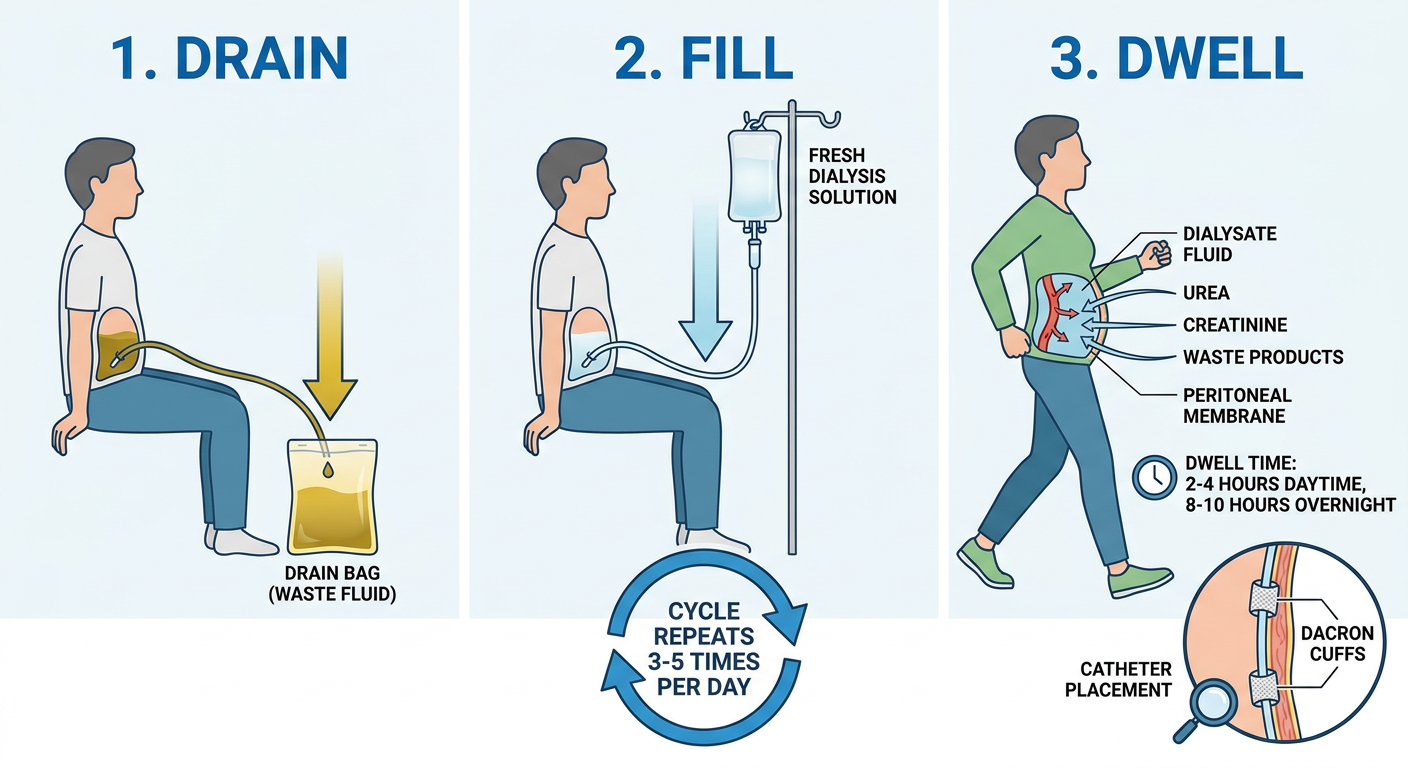
- DRAIN - Old waste-laden dialysate flows out by gravity into a drain bag placed below the abdomen
- FILL - Fresh dialysis solution flows in from an elevated bag through the same catheter
- DWELL - Fluid sits in the peritoneal cavity for 2-4 hours (or overnight), allowing diffusion of waste across the peritoneal membrane