
Volume of distribution
The volume of distribution (Vd) is a pharmacokinetic parameter that describes how widely a drug distributes throughout the body relative to plasma. Let me pull up the full textbook content on this.
Searching sources...
Reading File
Finding Sources
Finding Sources
Good sources found. Let me now read the most comprehensive ones - Katzung's Pharmacology and Goldman-Cecil Medicine, plus Miller's Anesthesia.
Reading File
Reading File
Reading File
Now let me also read the Katzung content on the apparent Vd equation and the Goldman-Cecil content on loading dose and half-life relationship, and fetch the pharmacokinetics diagram:
Reading File
Reading File
Loading Image
Excellent - I now have all the material needed for a thorough answer. Here is a complete explanation of Volume of Distribution:
Volume of Distribution (Vd)
Definition
The volume of distribution (Vd) relates the total amount of drug in the body to the concentration of drug measured in plasma (or blood):
Vd = Amount of drug in body / Plasma concentration (Cp₀)
It is always described as an apparent volume because it does not correspond to any real anatomical compartment. It is simply the hypothetical volume that would be needed to contain the entire drug load, assuming uniform distribution at the same concentration as measured in plasma. - Katzung's Basic and Clinical Pharmacology, 16th Edition
The Formula in Practice
If 10 mg of a drug is administered and the initial plasma concentration is 2 mg/L:
Vd = 10 mg ÷ 2 mg/L = 5 L
If instead the concentration were 4 mg/L (drug stays more in plasma), the Vd would be only 2.5 L.
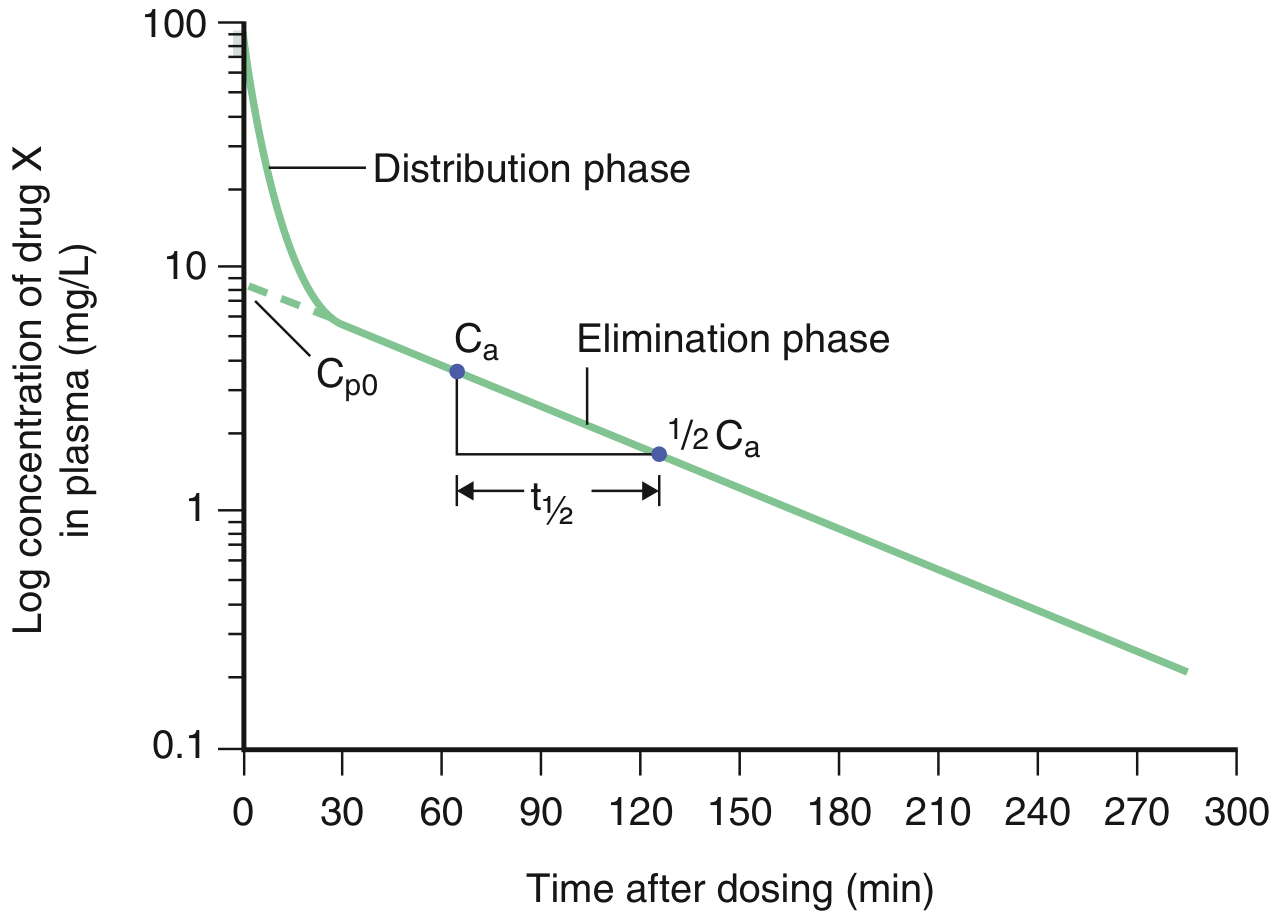
The Cp₀ is found by extrapolating the elimination phase of the log-concentration vs. time curve back to time zero:
Why It Is "Apparent"
Because Vd can exceed the total body volume. Drugs like digoxin or chloroquine have Vd values of hundreds of liters - far larger than any physical space in the body. This simply means that most of the drug has left the plasma and concentrated in tissues. The plasma is "seeing" very little of the total drug load, so you mathematically need an enormous volume to explain the low plasma concentration. - Goldman-Cecil Medicine
Body Compartments and Typical Vd Values
| Compartment | Volume (L/kg) | Drug Examples |
|---|---|---|
| Plasma | 0.04 L/kg (~2.8 L) | Large proteins, antibodies |
| Extracellular water | 0.2 L/kg | Gentamicin (water-soluble) |
| Total body water | 0.6 L/kg | Ethanol, small water-soluble molecules |
| Fat + tissues | 0.2-0.35 L/kg | Diazepam (lipid-soluble) |
| Bone | 0.07 L/kg | Lead, fluoride |
- Katzung's Basic and Clinical Pharmacology, Table 3-2
Determinants of Vd
Vd reflects a balance between two competing forces:
- Tissue binding - pulls drug out of plasma → lowers plasma concentration → increases Vd
- Plasma protein binding - keeps drug in plasma → raises plasma concentration → decreases Vd
In general:
- Lipophilic drugs = large Vd (partition into fat and tissues)
- Hydrophilic drugs = small Vd (stay in plasma/extracellular water)
- Highly plasma-protein-bound drugs = small Vd
Clinical Factors That Alter Vd
| Condition | Drug Affected | Effect on Vd |
|---|---|---|
| Old age (↓ muscle mass) | Digoxin | Decreased |
| Obesity | Digoxin | Overestimated if dosed by weight |
| Obesity | Theophylline | Proportional (fat has similar water content) |
| Edema / ascites | Gentamicin | Increased |
Clinical Applications
1. Loading Dose Calculation
Loading Dose = Vd × Target Plasma Concentration
Example: Phenytoin has a Vd of ~0.6 L/kg. For a 70 kg patient targeting 10 mg/L:
- Loading dose = 0.6 × 70 × 10 = 420 mg
- An IV bolus of this carries cardiac arrest risk, so it is given orally (using bioavailability ~0.8) as ~500 mg. - Goldman-Cecil Medicine
2. Relationship to Half-Life
t½ = 0.693 × Vd / Clearance
This equation has important implications:
- A larger Vd → longer half-life (at the same clearance)
- A higher clearance → shorter half-life (at the same Vd)
- A disease can change Vd and clearance independently, so half-life may increase, decrease, or stay the same
Example: Diazepam half-life increases with age - not because clearance changes, but because Vd increases as body fat increases with aging. - Katzung's Basic and Clinical Pharmacology
3. Extracorporeal Removal (Dialysis)
Drugs with a large Vd (e.g., most beta-blockers) are poorly removed by hemodialysis. Most of the drug is sequestered in tissues, not in the plasma compartment that dialysis can access. - Tintinalli's Emergency Medicine
Summary Table
| Vd Range | Interpretation | Drug Examples |
|---|---|---|
| ~0.04 L/kg (2-3 L) | Confined to plasma | Warfarin (heavy protein binding) |
| ~0.2 L/kg (14 L) | Extracellular fluid only | Gentamicin |
| ~0.6 L/kg (42 L) | Total body water | Ethanol, theophylline |
| >1 L/kg (>70 L) | Extensive tissue sequestration | Digoxin (~7 L/kg), chloroquine, amiodarone |
Key takeaway: Vd is a mathematical construct - not a real volume. It tells you how extensively a drug distributes beyond the plasma. A large Vd means a large loading dose is needed to achieve a target concentration, and the drug will be hard to remove by dialysis. A small Vd means the drug is relatively confined to plasma and easier to manage clinically.
Please give me a simple des- definition of volume of distribution.
Volume of distribution (Vd) is a number that tells you how widely a drug spreads throughout the body compared to its concentration in the blood.
Think of it this way: if most of a drug stays in the blood, the Vd is small. If the drug escapes into tissues and organs, the plasma concentration drops - making the Vd large.
Vd = Total amount of drug in the body ÷ Drug concentration in plasma
A Vd of ~3 L means the drug is mostly in the plasma. A Vd of 500 L means the drug has buried itself deep in tissues - there is almost none left in the blood.
This is a shared conversation. Sign in to Orris to start your own chat.