
contribution of H O thomas in orthopaedics
Hugh Owen Thomas was a pioneering Welsh orthopaedic surgeon (1834-1891) whose work fundamentally shaped modern orthopaedics. Key contributions include the Thomas splint, Thomas test for hip flexion contracture, and principles of rest in treating bone and joint disease.
Searching sources...
Reading File
Searching the Web
Hugh Owen Thomas orthopaedics contributions history
Finding Sources
Reading File
Reading File
Reading File
Loading Image
Loading Image
Reading File
Here is a detailed account of Hugh Owen Thomas (1834-1891) and his contributions to orthopaedics.
Hugh Owen Thomas - Father of British Orthopaedics
Hugh Owen Thomas was a Welsh orthopaedic surgeon born on 23 August 1834, descended from three generations of Welsh meddygon esgyrin (bone-setters). He and his nephew Sir Robert Jones are jointly called "the Fathers of Orthopaedic Surgery." He practiced in Liverpool, famously treating the poor for free on Sundays, and died overworked at age 57 on 6 January 1891.
Core Philosophy
Thomas stressed one overarching principle: rest must be "enforced, uninterrupted and prolonged." He believed no overdose of rest was possible in treating diseased or fractured bone and joint. This was a radical departure from the prevailing practice of early mobilization, and it formed the intellectual backbone of all his inventions.
Major Contributions
1. Thomas Splint (1865)
The most famous contribution. Originally designed in 1865 to treat tuberculosis of the knee by prolonged immobilization, it was later adapted for fractures of the lower limb - particularly femoral shaft fractures.
The splint uses a padded proximal ring that sits against the ischial tuberosity, providing counter-traction, with two lateral metal bars extending to a distal ring. Skin or skeletal traction is applied distally.
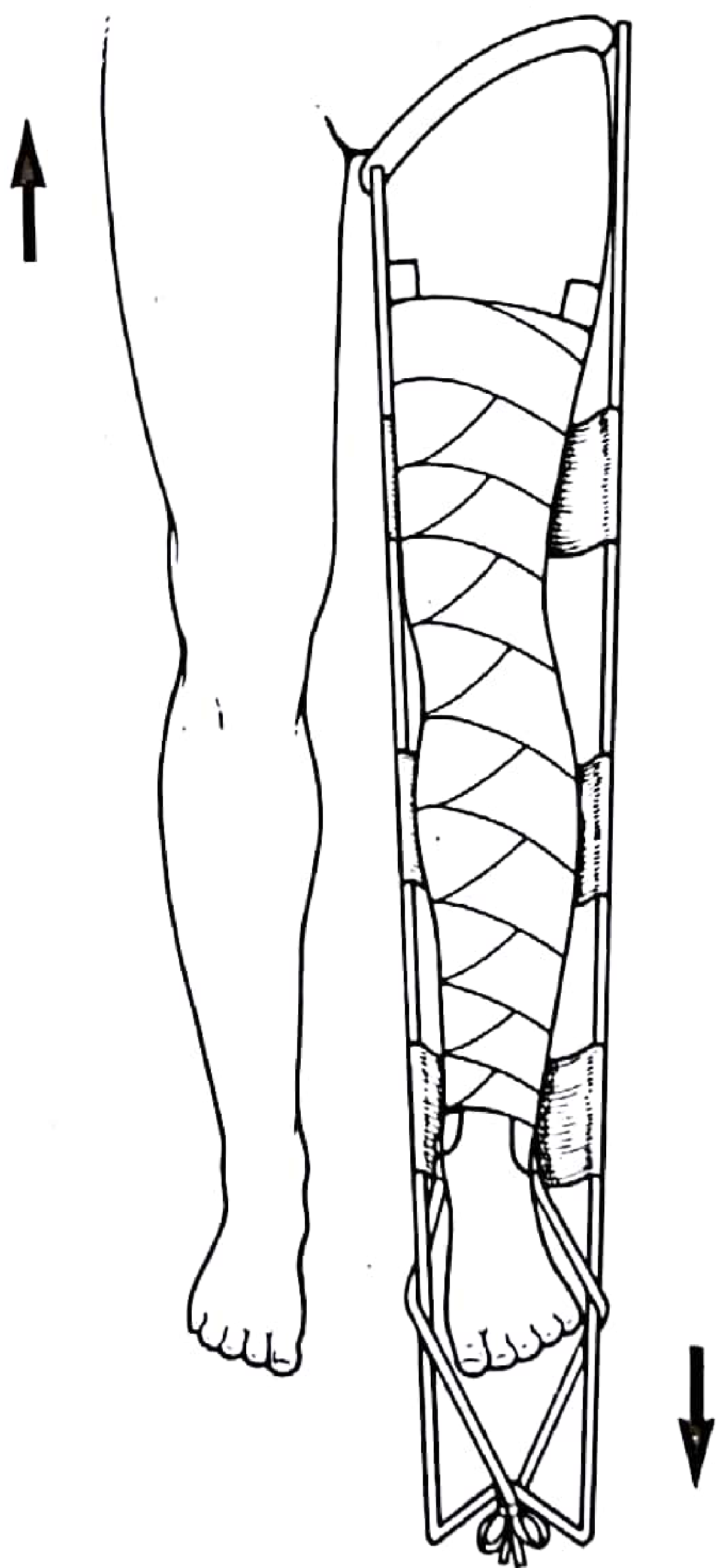
Thomas splint applied with skin traction - Pye's Surgical Handicraft, 22nd Ed.
Impact in World War I: When Sir Robert Jones popularized the Thomas splint during WWI for battlefield femur fractures, mortality from compound femoral fractures dropped from approximately 80% to just 8% by the end of the war. In skilled hands, the Thomas splint with a Pearson knee attachment continues to be used for femoral traction today, as described in Rockwood and Green's Fractures in Adults (2025).
2. Thomas Test (1875)
A clinical bedside test to detect and quantify fixed flexion contracture of the hip joint.
Technique:
- Patient lies supine
- The contralateral (sound) hip is fully flexed onto the abdomen until the lumbar lordosis is completely obliterated (the examiner's hand cannot be insinuated between the lumbar spine and the bed)
- This stabilizes the pelvis and eliminates compensatory hyperlordosis
- The examined hip is then allowed to extend; failure to lie flat reveals the degree of fixed flexion deformity - the angle between the thigh and the bed equals the angle of fixed flexion contracture
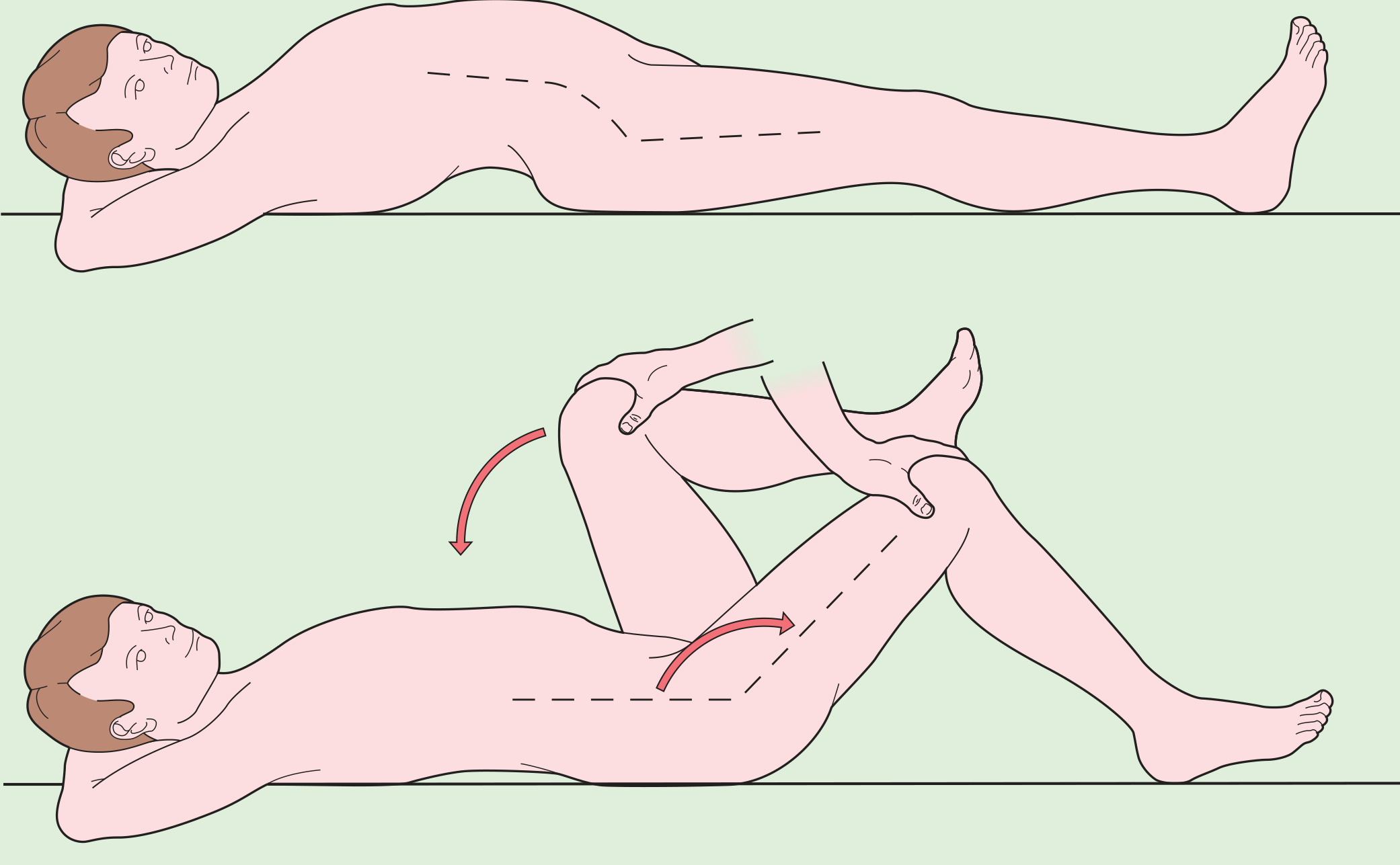
Top: flexion deformity masked by lumbar hyperlordosis. Bottom: Thomas test flattens the lordosis and unmasks the true deformity. - Rheumatology, 2-Volume Set (2022, Elsevier)
As noted in S. Das's Manual of Clinical Surgery (13th Ed.), the test is important because without it, a fixed flexion deformity of the hip is easily concealed by compensatory lordosis of the lumbar spine.
3. Thomas Collar
A neck collar designed to treat tuberculosis of the cervical vertebrae by enforced rest and immobilization - consistent with his central principle.
4. Thomas Wrench
An instrument used for fracture reduction (manipulation to bring bone ends back into alignment), reflecting his interest in non-operative management of fractures.
5. Thomas Heel
A modification of the heel of a shoe (elevated and extended medially) used to prevent depression of the talus and manage flat foot/pes planus. Still used today in pediatric and adult foot orthoses.
6. Thomas Calliper (Walking Splint)
A weight-relieving caliper splint for the lower limb, which offloads the hip and knee joints during ambulation in patients with bone and joint tuberculosis or other arthropathies. Per the Dictionary of Welsh Biography, "the Thomas calliper saved thousands of limbs and is now in daily use in most hospitals throughout the world."
7. Principles in Skeletal Tuberculosis
His influence on the treatment of skeletal TB was so profound that it is specifically cited in Campbell's Operative Orthopaedics (15th Ed., 2026): "The influence of Hugh Owen Thomas on the evolution of treatment of skeletal tuberculosis." He advocated conservative management with strict rest over the prevailing surgical approach.
8. Key Publication
In 1875, he published Diseases of the Hip, Knee, and Ankle Joints - his landmark text in which the Thomas splint and Thomas test were first formally described. A series of Contributions to Medicine and Surgery followed throughout the rest of his life.
Legacy
Despite his enormous contributions, Thomas went largely unrecognized during his lifetime - partly because his books were poorly produced and he refused to present at medical meetings, working in isolation in Liverpool. It was his nephew Sir Robert Jones who brought his teachings and splints before the medical world, particularly through their application in WWI.
As stated in the Dictionary of Welsh Biography: "No other pioneer contributed so much in establishing the fundamental principles of orthopaedic surgery."
Summary Table
| Contribution | Purpose |
|---|---|
| Thomas Splint | Femur fractures, knee TB - immobilization & traction |
| Thomas Test | Detect & measure hip fixed flexion contracture |
| Thomas Collar | Cervical TB immobilization |
| Thomas Wrench | Fracture reduction instrument |
| Thomas Heel | Orthotic correction of pes planus / talus depression |
| Thomas Calliper | Weight-relieving ambulatory splint for hip/knee disease |
| Principle of Rest | "Enforced, uninterrupted, prolonged" rest for bone/joint disease |
| Diseases of Hip, Knee, Ankle (1875) | Foundational orthopaedic text |
This is a shared conversation. Sign in to Orris to start your own chat.