
ABGs
Reading File
ABGs (Arterial Blood Gases) is a broad clinical topic. Let me search the library for comprehensive coverage.
Finding Sources
Finding Sources
Reading File
Reading File
Reading File
Now let me get the acid-base disorders section from the nephrology and physiology textbooks for the stepwise approach:
Finding Sources
Reading File
Reading File
Finding Sources
Reading File
Finding Sources
Reading File
Finding Sources
Reading File
Reading File
I now have comprehensive textbook content. Let me also fetch that flowchart image and get the anion gap MUDPILES content:
Loading Image
Finding Sources
I now have everything needed for a thorough, well-cited ABG reference. Here is the complete guide:
Arterial Blood Gas (ABG) Interpretation
What an ABG Measures
An ABG directly measures pH, PaCO₂, and PaO₂, and calculates HCO₃⁻ from those values using the Henderson-Hasselbalch equation. Modern analyzers also often include lactate, hemoglobin, and electrolytes. It is the gold standard for assessing oxygenation, ventilation, and acid-base status.
- Murray & Nadel's Textbook of Respiratory Medicine
Normal Values
| Parameter | Normal Value | Range |
|---|---|---|
| pH | 7.40 | 7.35 - 7.45 |
| PaCO₂ | 40 mmHg | 38 - 42 mmHg |
| PaO₂ | 100 mmHg | 75 - 100 mmHg |
| HCO₃⁻ | 24 mEq/L | 22 - 26 mEq/L |
- Current Surgical Therapy, 14e
Stepwise Interpretation
Step 1 - Determine the Primary Process (pH)
- pH < 7.35 = Acidemia
- pH > 7.45 = Alkalemia
Step 2 - Identify Respiratory vs. Metabolic
| pH | PaCO₂ | Primary Disorder |
|---|---|---|
| ↓ | ↑ | Respiratory acidosis |
| ↓ | ↓ | Metabolic acidosis |
| ↑ | ↓ | Respiratory alkalosis |
| ↑ | ↑ | Metabolic alkalosis |
Step 3 - Assess Compensation
The body always compensates in the same direction as the primary disorder (i.e., respiratory compensation for metabolic and vice versa), but never over-compensates.
| Primary Disorder | Expected Compensation |
|---|---|
| Metabolic acidosis | PaCO₂ = 1.5 × [HCO₃⁻] + 8 ± 2 (Winter's formula) |
| Metabolic alkalosis | PaCO₂ = 0.7 × [HCO₃⁻] + 20 ± 5 |
| Acute respiratory acidosis | ↑ HCO₃⁻ by 1 mEq/L per 10 mmHg ↑ PaCO₂ |
| Chronic respiratory acidosis | ↑ HCO₃⁻ by 3.5-5 mEq/L per 10 mmHg ↑ PaCO₂ |
| Acute respiratory alkalosis | ↓ HCO₃⁻ by 2 mEq/L per 10 mmHg ↓ PaCO₂ |
| Chronic respiratory alkalosis | ↓ HCO₃⁻ by 4 mEq/L per 10 mmHg ↓ PaCO₂ |
If PaCO₂ is higher than expected in metabolic acidosis → concurrent respiratory acidosis. If lower → concurrent respiratory alkalosis.
- Barash Clinical Anesthesia 9e; Current Surgical Therapy 14e
Step 4 - Calculate the Anion Gap (AG)
AG = Na⁺ - (Cl⁻ + HCO₃⁻)
Normal AG < 12-13 mEq/L. Always correct for albumin:
Corrected AG = measured AG + 2.5 × (4 - albumin g/dL)
High-AG (MUDPILES):
- M - Methanol
- U - Uremia
- D - Diabetic ketoacidosis (also alcoholic / starvation ketoacidosis)
- P - Propylene glycol / Paracetamol (acetaminophen)
- I - Isoniazid / Iron
- L - Lactic acidosis (most common cause overall)
- E - Ethylene glycol
- S - Salicylates
An alternative modern mnemonic is GOLD MARK (Glycols, Oxoproline, L-lactate, D-lactate, Methanol, Aspirin, Renal failure, Ketoacidosis).
Normal-AG (hyperchloremic) acidosis - think GI bicarbonate loss (diarrhea) vs. renal loss (RTA).
Step 5 - Urine Anion Gap (if non-AG acidosis identified)
Urine AG = Urine (Na⁺ + K⁺ - Cl⁻)
- Negative urine AG → kidneys excreting NH₄⁺ appropriately → GI loss (diarrhea)
- Positive urine AG → impaired NH₄⁺ excretion → renal tubular acidosis (RTA)
Step 6 - Delta-Delta Ratio (ΔΔ) if AG elevated
ΔΔ = ΔAG / ΔHCO₃⁻ = (measured AG - 12) / (24 - measured HCO₃⁻)
| ΔΔ | Interpretation |
|---|---|
| < 1.0 | Mixed AG + non-AG metabolic acidosis |
| 1.0 - 2.0 | Pure AG metabolic acidosis |
| > 2.0 | AG metabolic acidosis + concurrent metabolic alkalosis (or chronic compensated respiratory acidosis) |
Step 7 - Evaluate PaO₂ / Oxygenation
Never overlook oxygenation. Calculate the A-a gradient:
- A-a gradient = PAO₂ - PaO₂
- PAO₂ = (FiO₂ × 713) - (PaCO₂ / 0.8)
- Normal ~10 mmHg (increases with age)
- Normal A-a gradient → pure hypoventilation (CNS, neuromuscular)
- Elevated A-a gradient → V/Q mismatch, diffusion impairment, shunt
Base Deficit
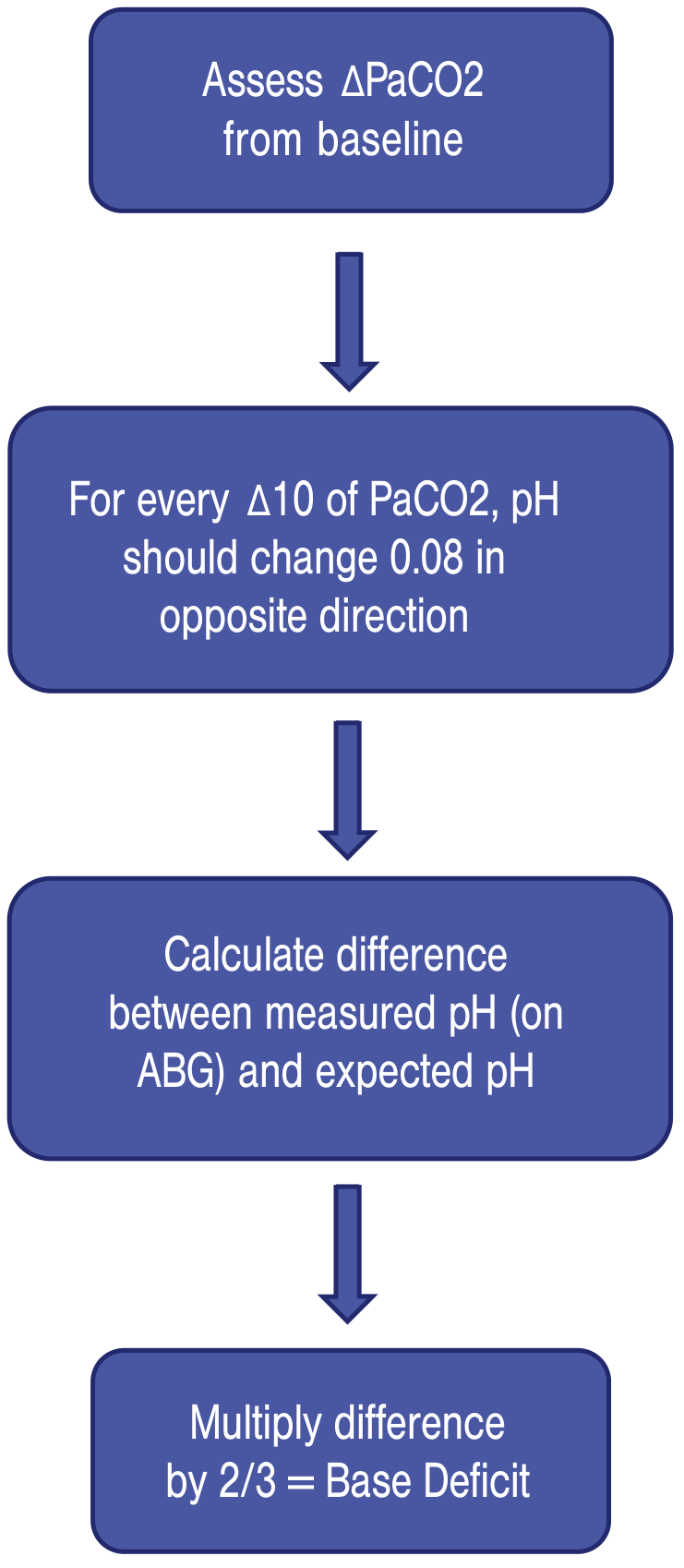
Base deficit is a derived value: for every Δ10 mmHg in PaCO₂, pH should change by 0.08 in the opposite direction. The difference between measured and expected pH, multiplied by 2/3, gives the base deficit. A practical shortcut: in metabolic acidosis, the expected PaCO₂ roughly equals the last two decimal digits of the pH (e.g., pH 7.23 → expected PaCO₂ ≈ 23 mmHg).
- Roberts and Hedges' Clinical Procedures in Emergency Medicine; Current Surgical Therapy 14e
Acute vs. Chronic Hypercapnia
| PaCO₂ | pH | HCO₃⁻ | |
|---|---|---|---|
| Acute respiratory acidosis | > 45 | < 7.35 | ↑ ~1 per 10 mmHg ↑CO₂ |
| Chronic respiratory acidosis | > 45 | Normal or near-normal | ↑ 3.5-5 per 10 mmHg ↑CO₂ |
Renal compensation takes 3-5 days to reach steady state, so acute-on-chronic hypercapnia shows intermediate values.
- Murray & Nadel's Textbook of Respiratory Medicine
Venous vs. Arterial
Arterial blood is the reference standard. However, in clinical practice:
- Venous pH correlates closely with arterial (difference ±0.05) - useful for pH trending
- Venous PaCO₂ trends with arterial but can vary ±20 mmHg
- Venous PO₂ cannot substitute for arterial PO₂ - the values do not correlate
A normal venous PaCO₂ is predictive of a normal arterial PaCO₂ (useful to rule out hypercapnia). Mildly elevated venous lactate should be confirmed with an arterial sample when clinically important.
- Tintinalli's Emergency Medicine
Quick Summary Mnemonics
- ROME: Respiratory Opposite, Metabolic Equal (pH and the primary parameter move in the same direction in metabolic disorders, opposite in respiratory)
- Winter's formula: PaCO₂ = 1.5 × HCO₃⁻ + 8 ± 2 (expected respiratory compensation for metabolic acidosis)
- MUDPILES / GOLD MARK: causes of high-anion-gap metabolic acidosis
This is a shared conversation. Sign in to Orris to start your own chat.