
Flexion of hip and flexion of knee simultaneously occurs due to what
Reading File
Finding Sources
Finding Sources
Finding Sources
Finding Sources
Reading File
Finding Sources
Reading File
Finding Sources
Finding Sources
Finding Sources
Reading File
The textbook data is clear. Here is a comprehensive answer:
Simultaneous Hip Flexion + Knee Flexion
The muscle responsible for simultaneous flexion of the hip and flexion of the knee is the Sartorius.
Why the Sartorius?
The sartorius is a biarticular muscle — it crosses both the hip joint and the knee joint — allowing it to act on both simultaneously.
| Feature | Detail |
|---|---|
| Origin | Anterior superior iliac spine (ASIS) |
| Insertion | Medial to the tibial tuberosity (pes anserinus, along with gracilis and semitendinosus) |
| Action at hip | Flexion, abduction, external rotation |
| Action at knee | Flexion and internal rotation |
| Innervation | Femoral nerve (L1–L4) |
Because it runs from the ASIS (above the hip) all the way down to the medial tibia (below the knee), contraction of the sartorius produces hip flexion and knee flexion simultaneously — bringing the lower limb into the classic "tailor's position" (cross-legged sitting), which is why it is called the "tailor's muscle" (sartor = Latin for tailor).
Other muscles to note
| Muscle | Hip | Knee |
|---|---|---|
| Sartorius | Flexion ✓ | Flexion ✓ |
| Rectus femoris | Flexion ✓ | Extension (not flexion) |
| Iliopsoas | Flexion ✓ | Does not cross knee |
| Hamstrings (biceps femoris, semitendinosus, semimembranosus) | Extension | Flexion ✓ |
Rectus femoris is also biarticular but does the opposite at the knee (extension), so it does not produce simultaneous hip + knee flexion.
Key answer: Sartorius — the longest muscle in the body — is the only muscle that simultaneously flexes both the hip and the knee.
— General Anatomy and Musculoskeletal System, THIEME Atlas of Anatomy; Neuroanatomy through Clinical Cases, 3rd Edition
Anterior drawer test vs lachman test
Finding Sources
Finding Sources
Reading File
Reading File
Reading File
Finding Sources
Searching Images
Lachman test anterior drawer test ACL knee examination
Loading Image
Finding Sources
Here is a detailed comparison of both tests:
Anterior Drawer Test vs Lachman Test
Both tests assess ACL (Anterior Cruciate Ligament) integrity by checking for abnormal anterior translation of the tibia on the femur.
Side-by-Side Comparison
| Feature | Anterior Drawer Test | Lachman Test |
|---|---|---|
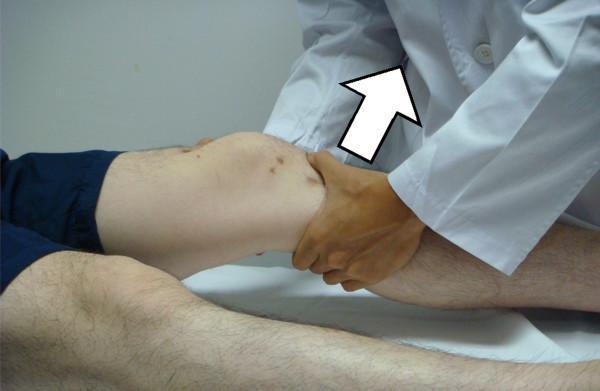
| Knee position | 90° flexion | 20–30° flexion |
| Hip position | 45° flexion | Neutral/slight flexion |
| Patient position | Supine, foot flat on table | Supine |
| Examiner stabilizes | Foot (sits on it) | Distal femur with one hand |
| Force applied | Pulls tibia anteriorly with both hands | Pulls proximal tibia anteriorly with other hand |
| End point assessed | Tibial translation vs contralateral side | Firmness of end point (firm vs soft) |
| Sensitivity | Lower (poor — hamstrings at 90° act as secondary stabilizers, masking instability) | Higher — most sensitive test for ACL |
| Specificity | Fairly specific | High specificity |
| False negatives | More common (hamstring guarding, acute hemarthrosis, posterior horn meniscal block) | Fewer |
| Clinical preference | Less preferred | Gold standard clinical test for ACL |
How Each Test is Performed
Anterior Drawer Test
- Patient supine, hip at 45°, knee at 90°
- Examiner sits on the patient's foot to stabilize it
- Thumbs placed over the joint line
- Tibia pulled anteriorly
- Positive = greater anterior tibial translation vs normal side
Lachman Test
- Patient supine, knee at 20–30° flexion
- One hand stabilizes the distal femur
- Other hand grasps the proximal tibia and pulls it anteriorly
- Assess end point quality and amount of translation
- Positive = increased translation + soft/absent end point
Grading (Lachman):
- 1+ = 0–5 mm excess translation
- 2+ = 5–10 mm excess translation
- 3+ = >10 mm excess translation
Why is Lachman Superior?
At 90° flexion (anterior drawer position), the hamstrings are optimally positioned to act as secondary restraints to anterior tibial translation — they can mask an ACL tear, giving a false-negative result. This is especially problematic in:
- Acute injuries with pain/spasm
- Patients with large thighs (technically difficult)
- Hemarthrosis causing guarded muscle contraction
At 20–30° flexion (Lachman position), hamstring tension is minimal, the secondary stabilizers are relaxed, and the ACL is under its maximum in-situ force — making tibial translation much more apparent.
"The Lachman test is the most sensitive approach to assess anterior cruciate ligament function... The anterior drawer test is also used but is less sensitive. The most specific test is the pivot shift." — Textbook of Family Medicine, 9th Edition
The Most Specific Test
The pivot shift test is the most specific for ACL tears (though less sensitive and harder to perform on a guarded patient) — it demonstrates anterolateral rotatory instability.
Quick Memory Aid
| Test | Angle | Sensitivity | Mnemonic |
|---|---|---|---|
| Anterior Drawer | 90° | Lower | "90 degrees = drawer opens less" |
| Lachman | 20–30° | Highest | "Lachman = Lucid — best at catching ACL tears" |
— Rosen's Emergency Medicine; Textbook of Family Medicine, 9th Edition; Miller's Review of Orthopaedics, 9th Edition
Anterior drawer test vs lachman test
The answer to this is already in our conversation above. Here's a quick summary:
Anterior Drawer Test vs Lachman Test
Both test ACL integrity via anterior tibial translation.
| Feature | Anterior Drawer | Lachman |
|---|---|---|
| Knee angle | 90° | 20–30° |
| Sensitivity | Lower | Higher (gold standard) |
| Specificity | Fairly specific | High |
| Why less accurate | Hamstrings act as secondary stabilizers at 90°, masking tears | Hamstrings relaxed at 20–30° → true laxity detected |
| End point grading | Translation vs contralateral side | 1+ (0–5 mm), 2+ (5–10 mm), 3+ (>10 mm) + soft end point |
| False negatives | More common (pain, spasm, hemarthrosis) | Fewer |
Key Points
- Lachman = most sensitive clinical test for ACL rupture
- Pivot shift = most specific (but hardest to perform on a guarded patient)
- A soft or absent end point on Lachman is the hallmark of a complete ACL tear
- PCL must be intact for Lachman to be valid (rule out posterior sag first)
Doorstopper effect in knee
Finding Sources
Finding Sources
Finding Sources
Searching the Web
doorstopper effect knee anatomy mechanism
Finding Sources
Finding Sources
Finding Sources
Finding Sources
Searching PubMed
doorstopper effect knee meniscus ACL
Searching PubMed
posterior horn medial meniscus "door stop" OR "doorstop" anterior drawer ACL
Finding Sources
Reading File
Reading File
The term "doorstopper effect" is not a standard textbook term found in the literature by that name, but it is a well-known conceptual phenomenon in knee biomechanics. Here is a full explanation:
The "Doorstopper Effect" in the Knee
What It Is
The doorstopper effect (also called the wedge effect or doorstop mechanism) refers to the role of the posterior horn of the medial meniscus (PHMM) as a physical block to anterior tibial translation — acting like a doorstop preventing a door (the tibia) from sliding forward under the femur.
The Mechanism
In a normal knee, the ACL is the primary restraint against anterior tibial translation. When the ACL is torn or absent:
- The tibia tends to sublux anteriorly on the femur
- As it does so, the posterior horn of the medial meniscus gets wedged between the medial tibial plateau and the medial femoral condyle
- This wedging action physically blocks further forward translation — like a doorstop under a door
- The PHMM thus becomes the major secondary stabilizer against anterior tibial translation in an ACL-deficient knee
"The posterior horn of the medial meniscus is a major secondary stabilizer against anterior tibial translation in an ACL-deficient knee." — Miller's Review of Orthopaedics, 9th Edition
Clinical Relevance
| Scenario | Consequence of Doorstopper Effect |
|---|---|
| ACL tear + intact medial meniscus | PHMM compensates, knee may feel relatively stable initially |
| ACL tear + medial meniscal tear | No doorstopper → gross instability, much worse prognosis |
| Chronic ACL deficiency | Repetitive wedging causes abnormal strain → accelerated medial meniscal degeneration and tear |
| Anterior Drawer Test | An intact PHMM can act as a doorstop → false-negative result despite ACL rupture |
Why the Anterior Drawer Test Can Be False-Negative
This is a direct consequence of the doorstopper effect. At 90° of knee flexion (the position of the anterior drawer test), the posterior horn of the medial meniscus is under the femoral condyle and can mechanically block anterior tibial translation even when the ACL is completely torn — producing a false-negative anterior drawer test.
This is one of the major reasons why the Lachman test (at 20–30° flexion) is more sensitive — at that angle, the PHMM is less engaged as a block, and true ACL laxity is unmasked.
Key Takeaway
ACL rupture → tibia slides forward → PHMM wedges under femoral condyle
             → acts as "doorstop" → limits translation
             → protects the knee short-term
             → but causes accelerated meniscal wear long-term
This is why ACL reconstruction is recommended early in active patients — to prevent progressive medial meniscal damage from chronic reliance on the doorstopper mechanism.
— Miller's Review of Orthopaedics, 9th Edition
Can we take rosuvastatin 24 hours before surgery
Finding Sources
Finding Sources
Finding Sources
Searching PubMed
statin perioperative continuation surgery guidelines
Searching PubMed
statin perioperative withdrawal cardiovascular outcomes surgery
Finding Sources
Finding Sources
Searching PubMed
"statin" AND "perioperative" AND "noncardiac surgery"
Finding Sources
Reading Article
PMID: 22074437
Reading File
Yes — rosuvastatin should be continued, including the day before (and on the day of) surgery. Stopping it is actively harmful. Here is the full reasoning:
Rosuvastatin Before Surgery: Continue It
The Recommendation
Statins should NOT be withheld perioperatively. Current consensus across anesthesia, cardiology, and surgical guidelines is to continue statins through the perioperative period, including the dose the evening before or morning of surgery (with a small sip of water).
Why Statins Must Be Continued Perioperatively
1. Statin Withdrawal Syndrome
Abrupt discontinuation — even for 24–48 hours — triggers a rebound pro-inflammatory, pro-thrombotic state due to loss of pleiotropic (non-lipid) effects:
- Increased oxidative stress
- Upregulation of Rho-kinase pathway
- Endothelial dysfunction
- Increased platelet aggregation and CRP
- Risk of myocardial infarction, stroke, and death increases
A systematic review (Gomez Sandoval et al., Current Pharmaceutical Design, 2011) found that perioperative statin discontinuation was associated with detrimental cardiovascular and cerebrovascular outcomes — in some studies, discontinuation was worse than never having been on a statin at all. [PMID: 22074437]
2. Pleiotropic Perioperative Benefits
Statins offer surgery-specific protective effects independent of cholesterol:
- Reduced perioperative myocardial ischemia
- Anti-inflammatory effect (attenuates surgical stress response)
- Reduced atrial fibrillation post-cardiac surgery
- Improved endothelial function under anesthesia-induced stress
Rosuvastatin-Specific Pharmacokinetics
| Property | Rosuvastatin |
|---|---|
| Half-life | ~19 hours (longest among statins) |
| Peak effect | Within 3–5 hours of dose |
| Metabolism | Minimal CYP2C9 (unlike atorvastatin/simvastatin) — less drug interaction risk |
| Renal excretion | ~10% |
The 19-hour half-life of rosuvastatin means a dose taken the evening before surgery will still be fully active during the procedure — providing optimal perioperative protection.
Practical Guidance
| Timing | Recommendation |
|---|---|
| Evening before surgery | ✅ Take the regular dose |
| Morning of surgery | ✅ Take with a small sip of water (if on morning dosing) |
| NPO (nil by mouth) status | Statins are not affected by NPO rules — they are not restricted |
| Postoperatively | Resume as soon as oral intake is allowed |
The Only Caution
If the patient cannot take anything orally for an extended postoperative period (e.g., prolonged ileus, major GI surgery), an IV statin equivalent is not available — in such cases, resume at the earliest opportunity. There is no IV formulation of rosuvastatin.
Bottom Line
Yes — take rosuvastatin the night before surgery as usual. Do not stop it. Perioperative withdrawal of statins is associated with increased cardiovascular events and mortality. The benefit of continuation far outweighs any theoretical risk.
— Lippincott Illustrated Reviews: Pharmacology; Gomez Sandoval et al. [PMID: 22074437]; Chopra et al. Meta-Analysis [PMID: 22351917]
This is a shared conversation. Sign in to Orris to start your own chat.