
Dengue psm
Reading File
Searching sources...
Finding Sources
Finding Sources
The query is about "Dengue PSM" - this refers to Preventive and Social Medicine (Community Medicine), which is a specific exam subject. Let me get comprehensive content from Park's textbook (the standard PSM reference) and Harrison's.
Finding Sources
Reading File
Now let me read the comprehensive Park's PSM content on Dengue:
Reading File
Reading File
Reading File
Reading File
Reading File
Reading File
Reading File
I now have comprehensive content. Let me fetch the key diagram image and also read the vector/control section:
Reading File
Loading Image
I now have all the key information needed for a comprehensive PSM-oriented dengue answer. Let me compile the complete response:
Dengue - Preventive & Social Medicine (PSM)
Source: Park's Textbook of Preventive and Social Medicine
The Dengue Syndrome
Dengue virus infection can manifest in four ways, as shown in the classification diagram:
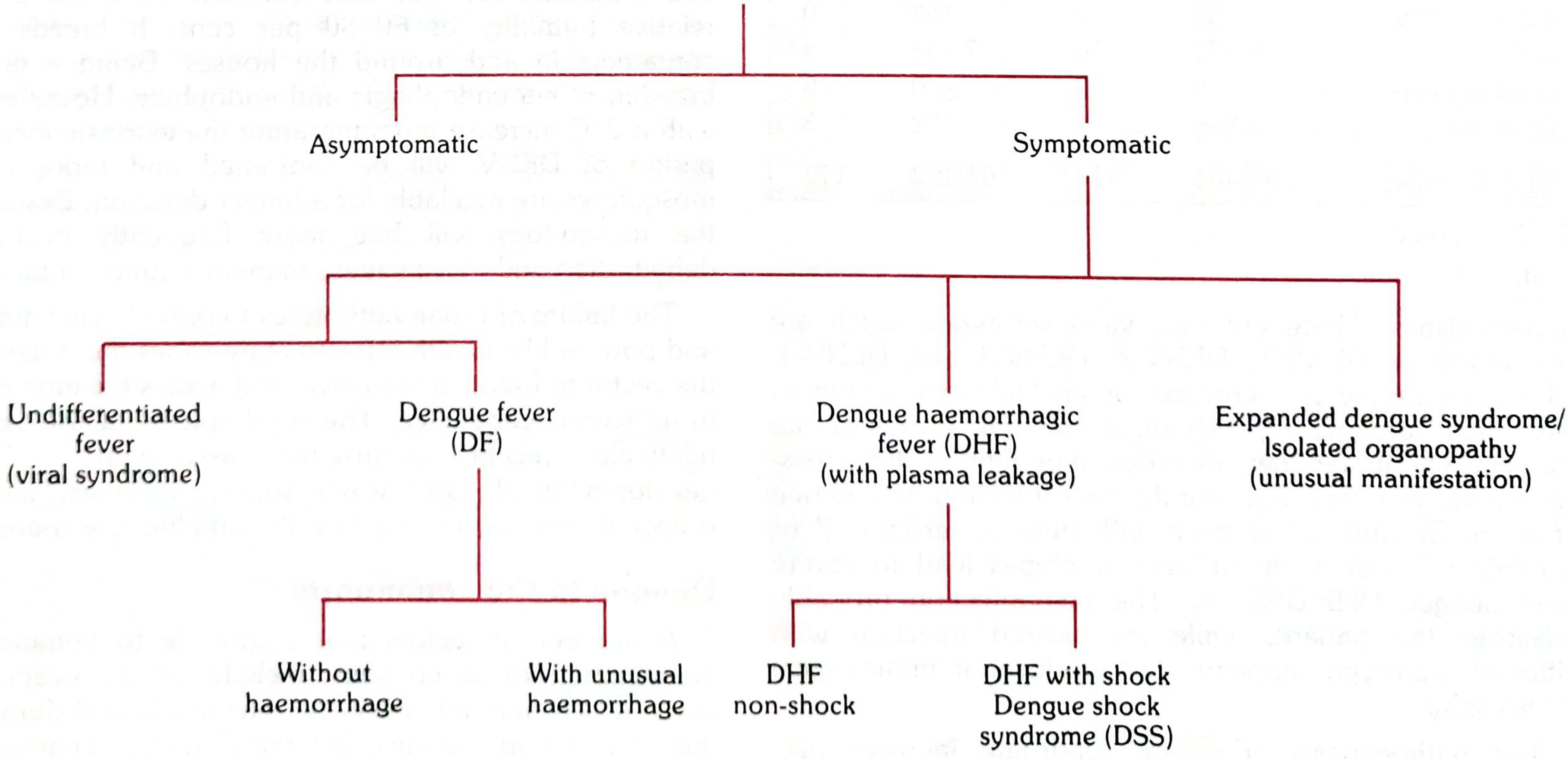
- Asymptomatic (silent infection)
- Undifferentiated fever (viral syndrome)
- Classical Dengue Fever (DF) - with or without unusual haemorrhage
- Dengue Haemorrhagic Fever (DHF) - with plasma leakage; subdivides into DHF non-shock and DHF with shock (Dengue Shock Syndrome - DSS)
- Expanded dengue syndrome / Isolated organopathy (unusual manifestations)
DF/DHF follows an "iceberg/pyramid" phenomenon - most cases at the base are asymptomatic, with DF, DHF, and DSS forming progressively narrower tiers above.
Problem Statement / Global Burden
- ~3.9 billion people in 128 countries are at risk of dengue infection
- 390 million infections per year; 96 million manifest clinically
- Reported cases rose from <0.5 million (2010) to 4.2 million (2019)
- ~500,000 DHF hospitalizations per year worldwide; ~90% are children <5 years
- CFR: ~2.5% during epidemics
- Attack rate during outbreaks in non-immune populations: 40-50%, can reach 80-90%
- Regions most affected: South-East Asia and Western Pacific
India
- Endemic in 35 states/UTs
- ~157,996 cases with 253 deaths in 2019; CFR 0.1%
- Seasonal pattern: cases peak after monsoon; southern states and Gujarat have perennial transmission
- All four serotypes isolated; DENV-1 and DENV-2 are currently widespread
- SEAR countries classified into 3 categories:
- Category A (India, Indonesia, Thailand, Myanmar, etc.) - Major public health problem, hyperendemic with all 4 serotypes
- Category B (Bhutan, Nepal) - Endemicity uncertain, first outbreaks 2004
- Category C (DPR Korea) - No evidence of endemicity
Epidemiological Determinants
A. Agent Factors
| Feature | Detail |
|---|---|
| Causative agent | Dengue virus - Flavivirus (RNA virus) |
| Serotypes | 4 serotypes: DENV-1, 2, 3, 4 |
| Cross-immunity | Homologous (same serotype) - lifelong; Heterologous (different serotype) - partial, transient |
| Pathogenesis of DHF | Secondary infection with a different serotype triggers "antibody-dependent enhancement" - leads to plasma leakage |
B. Host Factors
- Age: In hyperendemic areas, DHF primarily affects children; in primary epidemic areas, all age groups affected
- Immunity: No cross-protection between serotypes; secondary infection increases risk of DHF/DSS (only 2-4% develop severe disease in sequential infections)
- Severity: Depends on serotype sequence of secondary infection; DENV-2 secondary infections associated with greater severity
C. Vector Factors
| Feature | Aedes aegypti | Aedes albopictus |
|---|---|---|
| Primary/secondary vector | Primary | Secondary |
| Biting habit | Day-biting (peak activity: 2 hrs after sunrise, late afternoon) | Day-biting |
| Habitat | Domestic/peridomestic | Peridomestic/semi-wild |
| Behaviour | Endophagic, endophilic | Less endophilic |
| Breeding sites | Man-made containers (stored water, flower pots, tyres, coolers) | Natural + artificial containers |
| Extrinsic incubation period | 8-10 days at 30°C | - |
D. Environmental Factors
- Temperature: Optimum 16-30°C; humidity 60-80%
- Aedes population fluctuates with rainfall and water storage
- Even a 2°C rise in temperature shortens the extrinsic incubation period and increases biting frequency
- Rapid urbanization, poor water management, and deficient sanitation amplify transmission
Clinical Features
1. Classical Dengue Fever
- Incubation period: 3-14 days (commonly 4-7 days)
- Sudden onset high fever (39-40°C)
- Severe headache, retro-orbital pain (pain on eye movement and pressure), photophobia
- Myalgia and arthralgia ("break-bone fever")
- Biphasic fever curve - remission for a few hours to 2 days
- Rash in 80% cases - appears during remission or 2nd febrile phase
- Early: diffuse flushing/mottling on face, neck, chest
- Later: maculopapular or scarlatiniform rash on chest/trunk (3rd-4th day), may spread to extremities; may itch and be followed by desquamation
- Fever lasts ~5 days (rarely >7 days); full recovery usual; CFR exceedingly low
2. Dengue Haemorrhagic Fever (DHF) - Three Phases
Phase 1 - Febrile Phase:
- Abrupt onset high fever, facial flushing, headache
- Anorexia, vomiting, epigastric discomfort, right costal tenderness
- Maculopapular (rubelliform) rash less common than in DF
- Positive Tourniquet Test (Rumple-Leede test)
Phase 2 - Critical Phase (day 3-7):
- Fever defervescence
- Plasma leakage - leads to pleural effusion, ascites
- Platelet count drops sharply (≤100,000/mm³)
- Haematocrit rises ≥20% (haemoconcentration) - hallmark of plasma leakage
- Risk of shock if plasma leakage is severe
Phase 3 - Recovery Phase:
- Plasma reabsorption
- Risk of fluid overload (pulmonary oedema) if IV fluids given excessively
DHF Grading (WHO)
| Grade | Features |
|---|---|
| I | Fever + constitutional symptoms + positive tourniquet test |
| II | Grade I + spontaneous bleeding (skin, mucosa, or GI) |
| III | Circulatory failure - rapid/weak pulse, narrowing pulse pressure (≤20 mmHg), hypotension, cold/clammy skin, restlessness |
| IV | Profound shock - undetectable pulse and BP (DSS) |
Diagnostic Criteria (WHO)
Classical Dengue Fever (Probable Case)
Acute febrile illness (2-7 days) with two or more of:
- Headache
- Retro-orbital pain
- Myalgia/arthralgia
- Rash
- Haemorrhagic manifestation
- Low WBC
- Confirmed by serology/virus isolation
DHF Criteria (All 4 must be present):
- Acute fever of 2-7 days
- Haemorrhagic manifestations (positive tourniquet test, petechiae/ecchymoses, or bleeding from mucosa/GI/injection sites)
- Platelet count ≤ 100,000/mm³
- Evidence of plasma leakage: rising haematocrit ≥20%, pleural effusion, ascites, or hypoproteinaemia
Dengue Shock Syndrome (DSS)
DHF criteria + signs of shock:
- Tachycardia, cool extremities, delayed capillary refill, weak pulse, lethargy/restlessness
- Pulse pressure ≤ 20 mmHg (e.g., 100/80 mmHg)
- Hypotension: systolic <80 mmHg (age <5 yrs) or 80-90 mmHg (older children/adults)
Confirmed Case
Probable case + any one of:
- Virus isolation from serum, CSF, or autopsy sample
- Fourfold or greater rise in IgG (by HI test) or rise in IgM
- Detection of virus/antigen by immunohistochemistry, immunofluorescence, or ELISA
- Detection of viral genome by RT-PCR
Laboratory Diagnosis
| Test | Best Window | Details |
|---|---|---|
| Virus isolation | Days 1-6 of illness | Serum, plasma, buffy coat, autopsy tissue (liver, spleen, lymph nodes) or mosquitoes |
| RT-PCR | Days 1-6 (acute phase) | Detects viral RNA; serotype identification possible |
| NS1 Antigen ELISA | Day 1 onwards | Early diagnosis - detects from Day 1 of infection |
| IgM ELISA (MAC-ELISA) | After day 5 | IgM rises from day 3-5, peaks at 2 weeks, lasts 2-3 months |
| IgG (HI test) | Fourfold rise in paired sera | Primary infection: IgM > IgG; Secondary infection: IgG rises earlier and higher than IgM |
| Haemagglutination inhibition (HI) | Paired sera | Reference serological test |
- IgM ELISA detects cases after Day 5 of infection
- NS1 ELISA kits can detect cases from Day 1
Treatment
Dengue Fever (DF)
- Supportive: adequate rest, fluids, paracetamol for fever
- Avoid aspirin/NSAIDs (risk of bleeding/Reye's syndrome)
- Oral rehydration if tolerating orally
DHF (Grades I & II) - Volume Replacement Algorithm
- Oral fluids first
- If not tolerated: IV crystalloids (Normal Saline, Ringer Lactate)
- Monitor haematocrit every 3-4 hours
- If Hct continues to rise: switch to colloids (Dextran 40/haemaccel)
- If Hct falls and patient improving: reduce IV fluids
DSS (DHF Grades III & IV)
- Immediate IV fluid resuscitation - crystalloid or colloid
- If Hct rising: colloid (Dextran 40/polygeline) at 10-20 ml/kg/hour
- If Hct declining: internal bleeding suspected → fresh whole blood 10 ml/kg/hour
- Oxygen to all patients in shock
- Monitor ABCS: Acidosis, Bleeding, Calcium (Na⁺, K⁺), Sugar
Indications for Red Cell Transfusion
- Overt blood loss ≥10% total blood volume
- Refractory shock despite fluids + declining haematocrit/Hb
- Replacement: 10 ml/kg at a time + coagulogram
- If fluid overload: give packed cells
Prevention and Control
1. Vector Control (Primary Strategy)
Source Reduction (most effective):
- Eliminate mosquito breeding places
- Weekly Dry Day - empty/scrub/clean all water containers weekly
- Proper covering of stored water
- Filling/sealing permanent water bodies
- Manage roof tops, porticos, sunshades
Chemical Control:
- Larviciding: Temephos (Abate) - for stored water
- Adult mosquito control: Malathion fogging/spraying (outbreak measure)
- Pyrethroid-based insecticides for indoor residual spraying
Biological Control:
- Larvivorous fish (Gambusia, Poecilia) in ornamental tanks, ponds
- Bacillus thuringiensis israelensis (Bti) - biological larvicide
Personal Protection:
- Full-sleeved clothing
- Mosquito repellents (creams, liquids, coils, mats)
- Bed nets (especially for sleeping infants/children during daytime)
- Screens on windows and doors
2. Vaccine - CYD-TDV (Dengvaxia - Sanofi Pasteur)
- World's first licensed dengue vaccine (licensed in Mexico, December 2015)
- Live attenuated tetravalent (all 4 serotypes) - chimeric yellow fever-dengue vaccine
- Schedule: 3 doses × 0.5 ml; 6-month intervals
- Route: Subcutaneous
- Age indication: 9-45 years (or 9-60 years depending on license) in endemic areas
- Contraindicated in:
- Severe allergic reaction to components
- Congenital/acquired immune deficiency
- Symptomatic HIV or asymptomatic HIV with immune impairment
- Pregnant/breastfeeding women
- Note: lower age limit is 9 years (safety concern in children aged 2-5 years in Phase 3 trials)
- Storage: 2-8°C; shelf life 36 months; discard reconstituted vaccine within 6 hours
3. Other Measures
- Isolation of patient under bed nets during first few days of illness (prevents further mosquito bites and transmission)
- Health education on Do's and Don'ts
- Sentinel surveillance hospitals (521 identified by GOI) with lab support
- 14 Apex Referral Laboratories for advanced diagnosis
- IgM capture ELISA kits supplied free by National Institute of Virology, Pune
WHO Global Strategy for Dengue Prevention and Control (2012-2020)
Five key elements:
- Diagnosis and case management
- Integrated surveillance and outbreak preparedness
- Sustainable vector control
- Implementation of future vaccine tools
- Basic operational and implementation research
India's National Programme / GOI Steps
- Monitoring through reports from state health authorities
- Mid-term plan (2011) with components:
- (a) Surveillance (disease + entomological)
- (b) Case management (lab diagnosis + clinical management)
- (c) Vector management (environmental + chemical + personal protection + legislation)
- (d) Outbreak response (epidemic preparedness + media management)
- (e) Capacity building (training + HR strengthening)
- (f) Operational research
- Contingency plan for dengue outbreaks sent to all states since 1996 Delhi outbreak
High-Yield PSM Points (Exam Focus)
| Point | Answer |
|---|---|
| Causative agent | Dengue virus - Flavivirus, RNA virus, 4 serotypes |
| Vector | Aedes aegypti (primary); Aedes albopictus (secondary) |
| Biting time | Daytime (2 hrs post-sunrise + late afternoon) |
| Incubation period | 3-14 days (commonly 4-7 days) |
| Extrinsic incubation period | 8-10 days |
| "Break bone fever" | Dengue fever (due to severe myalgia/arthralgia) |
| Iceberg phenomenon | DF/DHF - majority are asymptomatic |
| Tourniquet test | Positive in DHF (≥10-20 petechiae per inch²) |
| Platelet cut-off for DHF | ≤ 100,000/mm³ |
| Haemoconcentration in DHF | Hct rise ≥ 20% from baseline |
| Pulse pressure in DSS | ≤ 20 mmHg |
| NS1 detects from | Day 1 of illness |
| IgM detects from | Day 5 of illness |
| Vaccine | CYD-TDV (Dengvaxia); 3 doses SC; 6-monthly; age 9-45 yrs |
| Avoid in treatment | Aspirin / NSAIDs |
| Weekly Dry Day | Empty + scrub water containers every week |
| Larvivorous fish | Gambusia, Poecilia |
| Larvicide for stored water | Temephos (Abate) |
| Adult mosquito control | Malathion fogging |
| CFR (India 2019) | 0.1% |
| Global at-risk population | 3.9 billion in 128 countries |
| Annual infections | 390 million; 96 million manifest clinically |
Sources: Park's Textbook of Preventive and Social Medicine; Harrison's Principles of Internal Medicine 22E (2025)
This is a shared conversation. Sign in to Orris to start your own chat.