
Eplain sodium potassium pump
Reading File
Now let me search the medical library for sodium-potassium pump content in parallel:
Finding Sources
Finding Sources
Excellent! I have two great sources. Let me read the primary sections from Guyton & Hall (the gold standard physiology textbook) and Neuroscience: Exploring the Brain in parallel:
Reading File
Reading File
Reading File
Let me fetch the key diagram images and read the remaining Guyton content:
Loading Image
Loading Image
Reading File
I now have everything needed for a thorough, well-illustrated answer. Here it is:
The Sodium-Potassium Pump (Na⁺-K⁺ ATPase)
What It Is
The sodium-potassium pump is a primary active transport protein embedded in the plasma membrane of virtually every cell in the body. It belongs to the P-type ATPase family and uses the energy of ATP hydrolysis to move ions against their concentration gradients - work that cannot happen passively.
Its formal name, Na⁺-K⁺-ATPase, reflects all three roles: it handles sodium, potassium, and has enzymatic ATPase activity.
Structure
The pump is a complex of two protein subunits:
| Subunit | Molecular Weight | Role |
|---|---|---|
| Alpha (α) | ~100,000 Da | Catalytic unit; contains ion-binding sites and ATPase activity |
| Beta (β) | ~55,000 Da | Anchors the complex in the lipid membrane |
The α subunit has three critical features:
- 3 Na⁺ binding sites on the intracellular face
- 2 K⁺ binding sites on the extracellular face
- ATPase activity near the sodium-binding sites (cleaves ATP → ADP + Pi)
Mechanism - Step by Step
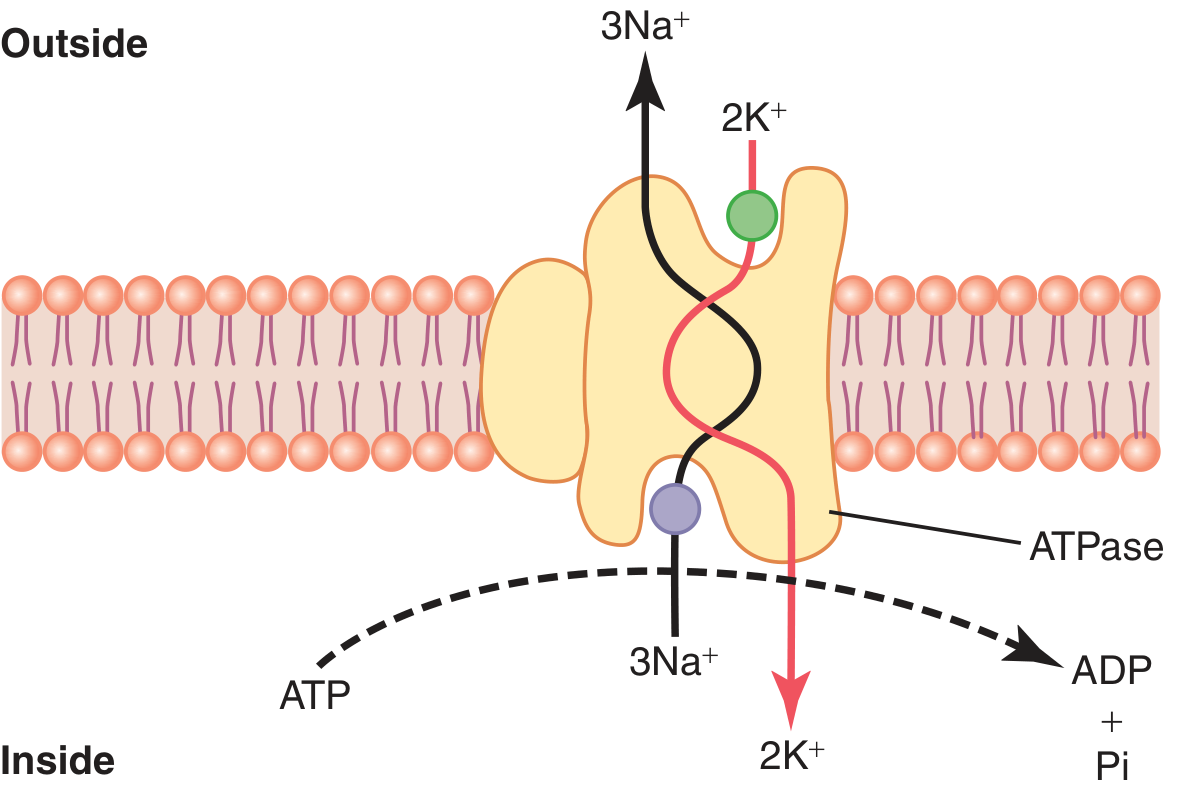
Figure: Postulated mechanism of the Na⁺-K⁺ pump. ADP = adenosine diphosphate; ATP = adenosine triphosphate; Pi = phosphate ion. (Guyton and Hall Textbook of Medical Physiology)
- 3 Na⁺ bind inside the cell to the intracellular binding sites of the α subunit
- 2 K⁺ bind outside the cell to the extracellular sites
- Binding activates ATPase → ATP is cleaved to ADP + Pi
- The released energy drives a conformational change in the protein
- 3 Na⁺ are expelled to the extracellular fluid; 2 K⁺ are taken in
- The cycle repeats
Net result per cycle: 3 Na⁺ out, 2 K⁺ in, 1 ATP consumed
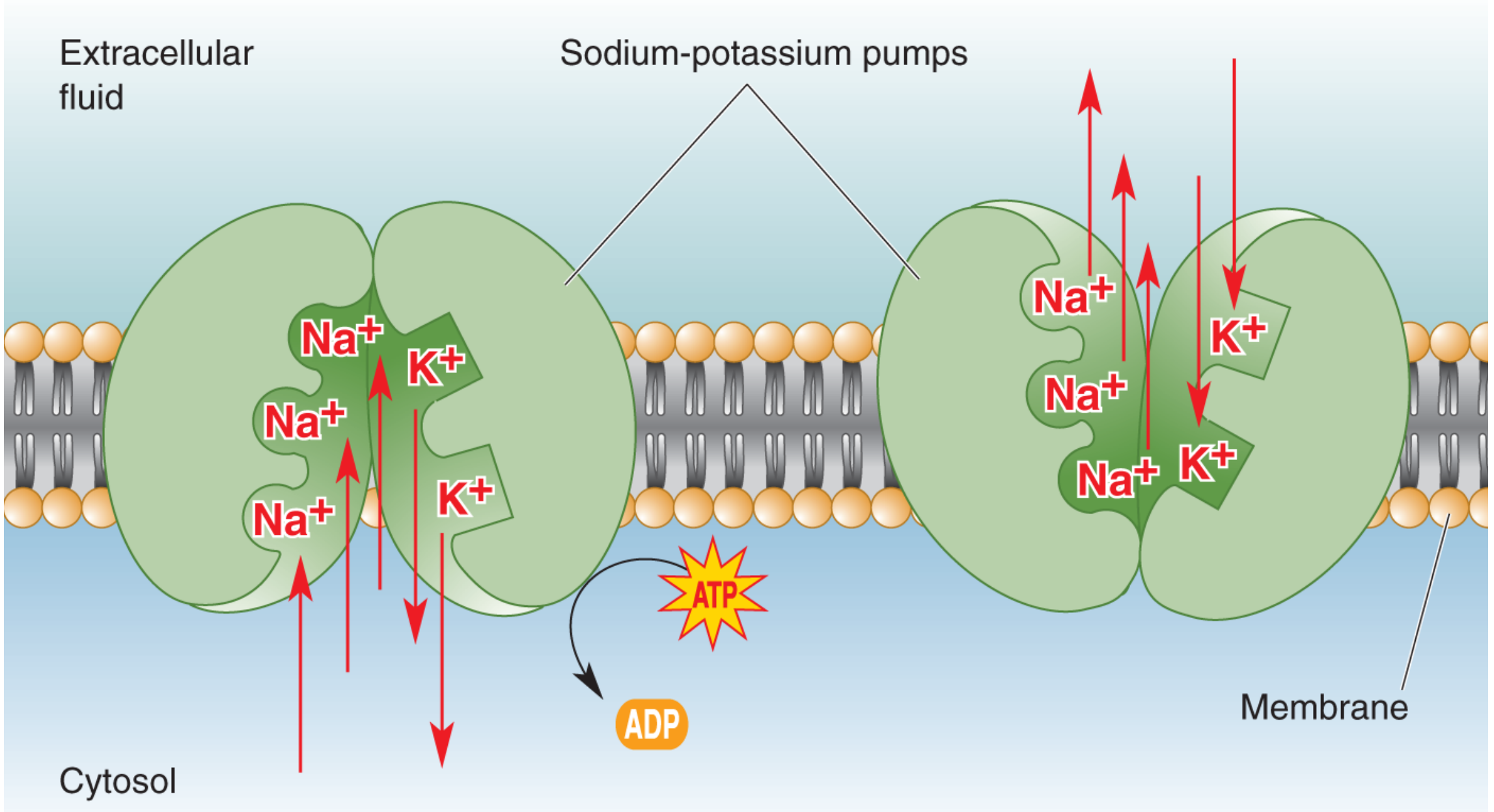
Figure: The sodium-potassium pump transports ions across the membrane against their concentration gradients at the expense of ATP. (Neuroscience: Exploring the Brain, 5th ed.)
It's Electrogenic
Because 3 positive charges leave but only 2 return, there is a net export of one positive charge per cycle. This creates:
- Positivity outside the cell
- Negativity inside the cell
This electrogenic property contributes directly to the resting membrane potential (approximately -70 mV in neurons), which is the foundation for all nerve and muscle signaling.
Physiological Functions
1. Maintaining Ion Concentration Gradients
- Keeps Na⁺ high outside (~142 mEq/L extracellular vs. ~14 mEq/L intracellular)
- Keeps K⁺ high inside (~140 mEq/L intracellular vs. ~4 mEq/L extracellular)
- These gradients are the energy source for secondary active transport and action potentials
2. Generating the Resting Membrane Potential
- The electrogenic nature of the pump, combined with K⁺ leak channels, produces the negative resting membrane potential
- In neurons, active depolarization and repolarization rely on this baseline
3. Cell Volume Regulation
- Intracellular proteins and organic molecules attract cations by electrostatic force, tending to draw water in by osmosis
- The pump counters this by continuously expelling more Na⁺ than it imports K⁺, creating a net loss of solutes and pulling water out
- If a cell begins to swell, pump activity automatically increases to correct it
4. Supporting Secondary Active Transport
- The low intracellular Na⁺ created by the pump serves as the driving force for cotransporters and antiporters (e.g., glucose-Na⁺ symporter in the gut and kidney tubules)
5. Driving Neurotransmitter Reuptake
- In neurons, the Na⁺ gradient generated by the pump powers monoamine transporters (e.g., serotonin, dopamine, norepinephrine reuptake transporters) - these are targets of SSRIs and many other drugs
Energy Demand
The pump is metabolically expensive:
- In nerve cells: 60-70% of the cell's total ATP may go toward running this pump
- In the brain overall: it consumes at least 50% of the brain's total ATP
This explains why neurons are so sensitive to hypoxia and ischemia - even brief ATP depletion causes the pump to fail, leading to ion imbalance, cellular swelling, and cell death.
Reversibility
The pump can theoretically run in reverse. If the electrochemical gradients for Na⁺ and K⁺ are experimentally made large enough that the energy stored in those gradients exceeds the energy of ATP hydrolysis, the pump runs backward and synthesizes ATP from ADP + Pi. Under normal physiological conditions, however, it always runs forward.
Clinical Relevance
| Context | Mechanism |
|---|---|
| Cardiac glycosides (Digoxin) | Inhibit Na⁺-K⁺-ATPase → intracellular Na⁺ rises → Na⁺/Ca²⁺ exchanger brings in more Ca²⁺ → increased cardiac contractility |
| Hypokalemia | Reduced extracellular K⁺ slows pump activity; alters membrane potential |
| Ischemia / Hypoxia | ATP depletion stops the pump → Na⁺ floods in, cell swells, K⁺ leaks out |
| Aldosterone | Upregulates Na⁺-K⁺-ATPase in renal tubular cells → increases Na⁺ reabsorption and K⁺ secretion |
| Fluoride toxicity | Free fluoride inhibits Na⁺-K⁺-ATPase, disrupting cellular ion homeostasis |
Sources:
- Guyton and Hall Textbook of Medical Physiology - Sodium-Potassium Pump section (pp. 71-72)
- Neuroscience: Exploring the Brain, 5th ed. - Ion Distribution Across the Membrane (p. 299)
- Morgan and Mikhail's Clinical Anesthesiology, 7e - Mechanisms of Local Anesthetic Action (p. 481)
This is a shared conversation. Sign in to Orris to start your own chat.