
Aminoacyl trna
Reading File
Now let me search the medical library for aminoacyl tRNA content.
Finding Sources
Finding Sources
Good. Let me read the most comprehensive sections from Lippincott and Basic Medical Biochemistry.
Reading File
Reading File
Reading File
Now let me fetch the key diagram images and read more about the binding at the A site.
Loading Image
Loading Image
Reading File
I now have comprehensive information from multiple authoritative biochemistry textbooks. Let me compile the full answer.
Aminoacyl-tRNA
What is Aminoacyl-tRNA?
An aminoacyl-tRNA (also called "charged tRNA") is a tRNA molecule that has an amino acid covalently attached to its 3'-end. It serves as the adapter molecule in translation - carrying the correct amino acid to the ribosome, guided by its anticodon matching the mRNA codon.
Naming convention: the tRNA is named for both its amino acid and the tRNA it carries. For example, tRNA^Ala carrying alanine becomes alanyl-tRNA^Ala.
Formation of Aminoacyl-tRNA ("Charging")
The process is catalyzed by aminoacyl-tRNA synthetases and occurs in two steps, requiring ATP:
Step 1 - Amino Acid Activation
The amino acid's carboxyl group reacts with ATP, forming a high-energy aminoacyl-AMP-enzyme complex (activated amino acid), releasing pyrophosphate (PPi):
Amino acid + ATP + Enzyme → Enzyme•AMP~Amino acid + PPi
The released PPi is immediately cleaved by pyrophosphatase (PPase) → 2 Pi, which drives the reaction forward thermodynamically.
Step 2 - Transfer to tRNA
The activated amino acid is transferred from the enzyme-AMP complex to the 3'-OH of the terminal adenosine (in the -CCA sequence) of the cognate tRNA, releasing AMP and the free enzyme:
Enzyme•AMP~Amino acid + tRNA → Aminoacyl-tRNA + AMP + Enzyme
The amino acid is linked via a high-energy ester bond to the 3'-OH of the CCA terminus.
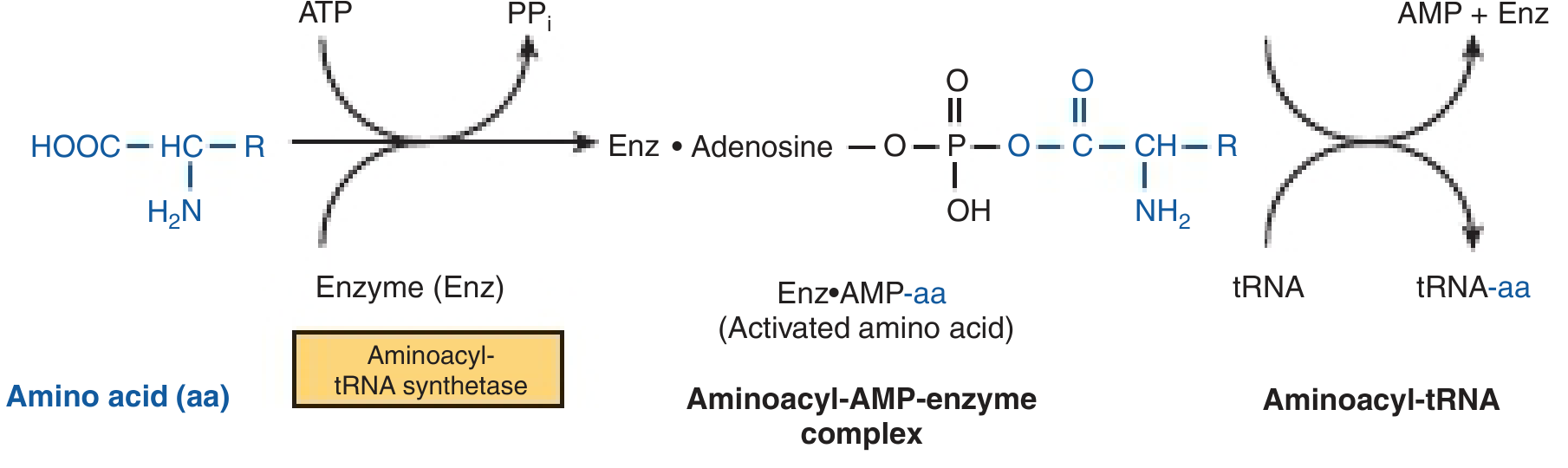
Formation of aminoacyl-tRNA (Harper's Illustrated Biochemistry, 32nd Ed.)
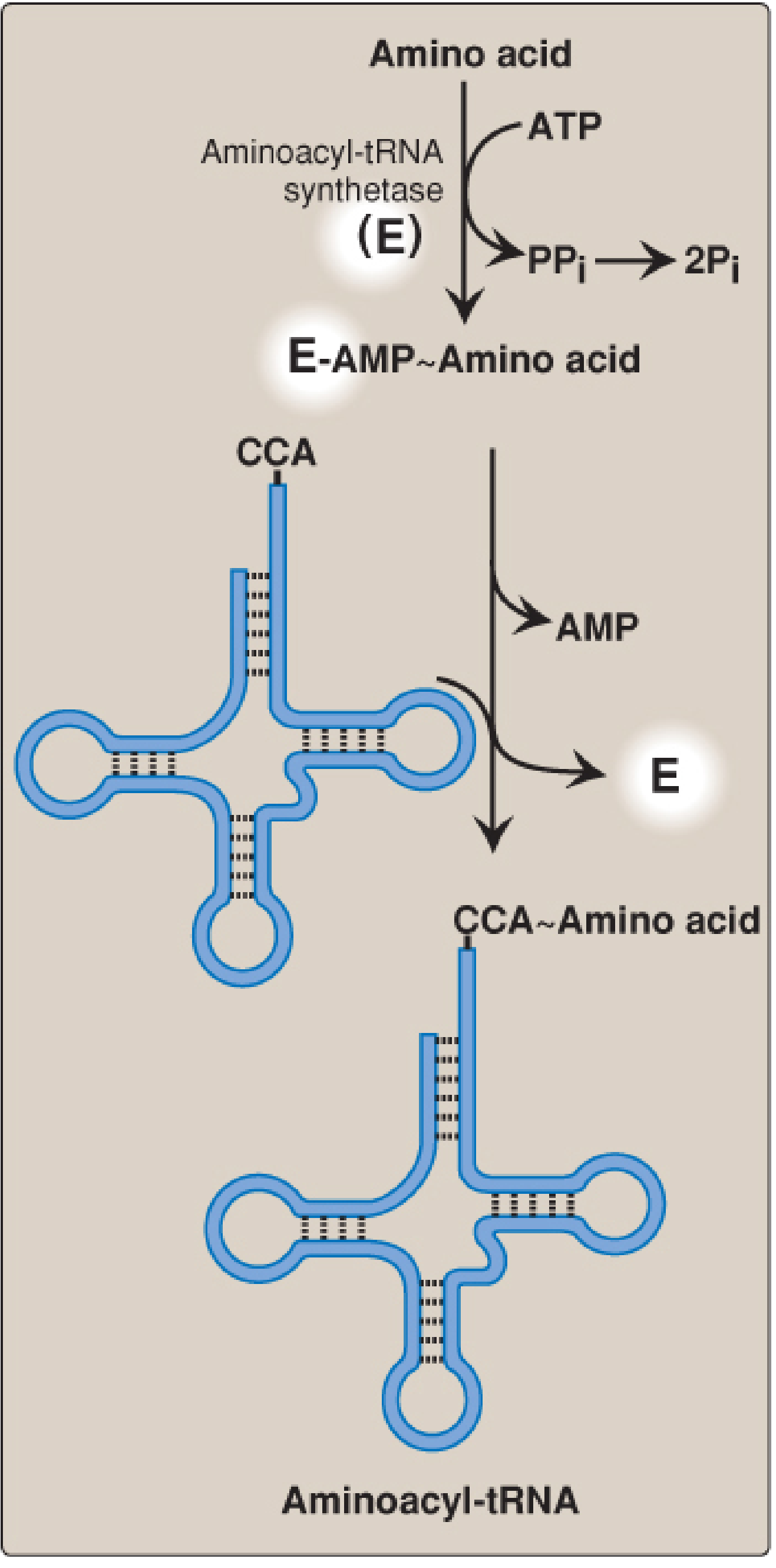
Overall charging reaction showing CCA terminus of tRNA (Lippincott's Biochemistry, 8th Ed.)
Aminoacyl-tRNA Synthetases
| Feature | Detail |
|---|---|
| Number | 20 (one per amino acid) |
| Substrate specificity | Each recognizes one specific amino acid AND all its cognate tRNAs ("isoaccepting tRNAs," up to 5 per amino acid) |
| Energy requirement | 1 ATP consumed (→ AMP + PPi, equivalent to 2 high-energy bonds) |
| Error rate | < 1 in 10^4 to 10^6 mischarging events |
| Additional activity | Proofreading (editing) - can remove an incorrectly attached amino acid from the enzyme or the tRNA |
Recognition of tRNA
Synthetases recognize their cognate tRNA through specific nucleotide sequences called recognition sites. The location varies by enzyme:
- Some use the anticodon loop as the primary recognition site
- Others recognize bases elsewhere in the tRNA (e.g., the D arm, acceptor stem)
Regardless of how the synthetase recognizes the tRNA, the anticodon is what determines which mRNA codon the amino acid is incorporated at.
The D arm (dihydrouridine arm) is a key site for recognition by aminoacyl-tRNA synthetases. The TψC arm is involved in binding the aminoacyl-tRNA to the ribosomal surface during protein synthesis. - Harper's Illustrated Biochemistry, 32nd Ed.
Key tRNA Structural Regions Relevant to Charging
| tRNA Region | Role |
|---|---|
| Acceptor arm (3'-CCA-OH) | Site of amino acid attachment (ester bond to 3'-OH of terminal adenosine) |
| Anticodon loop | Codon recognition on mRNA; sometimes a synthetase recognition site |
| D arm (dihydrouridine arm) | Recognition site for aminoacyl-tRNA synthetase |
| TψC arm | Binding to ribosome surface during translation |
The Initiator tRNA - A Special Case
The initiator methionyl-tRNA (written Met-tRNA^Met_i) is unique:
- It recognizes only the AUG start codon that initiates translation
- It does NOT decode internal AUG codons (which specify methionine insertion within a chain - a different tRNA does that)
- In eukaryotes, the methionine on the initiator tRNA is not formylated (unlike in prokaryotes, where it is formyl-methionine)
Role in Translation (Elongation - A Site Binding)
During elongation, the charged aminoacyl-tRNA enters the A site of the ribosome:
- An elongation factor (EF-Tu in prokaryotes; EF1A in eukaryotes) forms a ternary complex with GTP and the incoming aminoacyl-tRNA
- The ternary complex brings the aminoacyl-tRNA to the A site
- Correct codon-anticodon base pairing triggers GTP hydrolysis, which releases EF-Tu/EF1A-GDP
- The aminoacyl-tRNA is then fully accommodated in the A site
- Peptide bond formation follows: the α-amino group of the A-site aminoacyl-tRNA attacks the ester bond of the peptidyl-tRNA at the P site (nucleophilic attack), catalyzed by peptidyl transferase (a ribozyme activity of the large subunit rRNA)
Clinical Relevance - Anti-Aminoacyl-tRNA Synthetase Syndrome
Autoantibodies against aminoacyl-tRNA synthetases are associated with the antisynthetase syndrome, characterized by:
- Inflammatory myopathy (myositis)
- Nonerosive arthritis
- Interstitial lung disease (ILD)
- Raynaud's phenomenon
- "Mechanic's hands"
- Fever
The most common is anti-Jo-1 (anti-histidyl-tRNA synthetase). - Harrison's Principles of Internal Medicine, 22nd Ed.
Summary Box
| Feature | Detail |
|---|---|
| Function | Carries amino acid to ribosome for translation |
| Attachment site | 3'-OH of terminal adenosine (-CCA) |
| Bond type | Ester bond (high-energy) |
| Enzyme | Aminoacyl-tRNA synthetase (20 types) |
| Energy cost | 1 ATP → AMP + PPi (= 2 phosphoanhydride bonds) |
| Fidelity mechanism | Synthetase proofreading/editing activity |
| A site delivery | Via EF-Tu (prokaryotes) or EF1A (eukaryotes) + GTP |
Sources: Lippincott Illustrated Reviews: Biochemistry 8th Ed. | Basic Medical Biochemistry 6th Ed. | Harper's Illustrated Biochemistry 32nd Ed.
This is a shared conversation. Sign in to Orris to start your own chat.