
Perioperative acute kidney injury for 10 marks dnb exam
Reading File
Now let me search the library for perioperative AKI content in parallel:
Finding Sources
Finding Sources
Searching PubMed
"perioperative acute kidney injury" AND prevention
Excellent - found dedicated sections in Miller's and Barash's. Let me read all three key sources in parallel:
Reading File
Reading File
Reading File
Good content so far. Let me now read the dedicated Miller's AKI mechanisms section and the Bailey & Love table, plus search for more on definition, staging, and pathophysiology:
Reading File
Reading File
Finding Sources
Let me now read the KDIGO staging table and the Miller's full mechanisms/pathophysiology section:
Reading File
Reading File
Excellent - rich content. Let me read a bit more of the Miller's pathophysiology section and risk factors:
Reading File
I now have comprehensive material. Let me fetch the key AKI diagram and compile the full answer:
Loading Image
I now have comprehensive, textbook-backed content to write a thorough 10-mark DNB answer. Here it is:
Perioperative Acute Kidney Injury (10 Marks - DNB)
Definition and Incidence
Acute kidney injury (AKI) - previously termed acute renal failure - is characterized by a rapid decline in glomerular filtration rate (GFR) with accumulation of nitrogenous waste products (BUN and creatinine). AKI occurs in approximately 5-25% of all hospitalized patients and in 1-7% of patients after cardiac or major vascular surgery. Mortality ranges from 10-35% for mild AKI and 50-80% in the ICU setting.
- Miller's Anesthesia, 10e
Diagnostic Criteria / Staging (KDIGO 2012)
The three widely used systems - RIFLE, AKIN, and KDIGO - share the same urine output criteria:
| Stage | Serum Creatinine Criteria | Urine Output |
|---|---|---|
| Stage 1 | Rise ≥0.3 mg/dL in <48 h, OR ≥50% rise in <7 days | <0.5 mL/kg/h for >6 hours |
| Stage 2 | Rise ≥100% (2x baseline) | <0.5 mL/kg/h for >12 hours |
| Stage 3 | Rise ≥200% (3x baseline) or need for RRT | <0.3 mL/kg/h for >24 h or anuria >12 h |
RIFLE additionally includes Loss (RRT >4 weeks) and End-stage (RRT >3 months).
The KDIGO definition requires either criterion to be met: an absolute rise of >0.3 mg/dL within 48 hours OR a relative rise of >50% within 7 days.
- Brenner and Rector's The Kidney, p. 1244-1245
Risk Factors
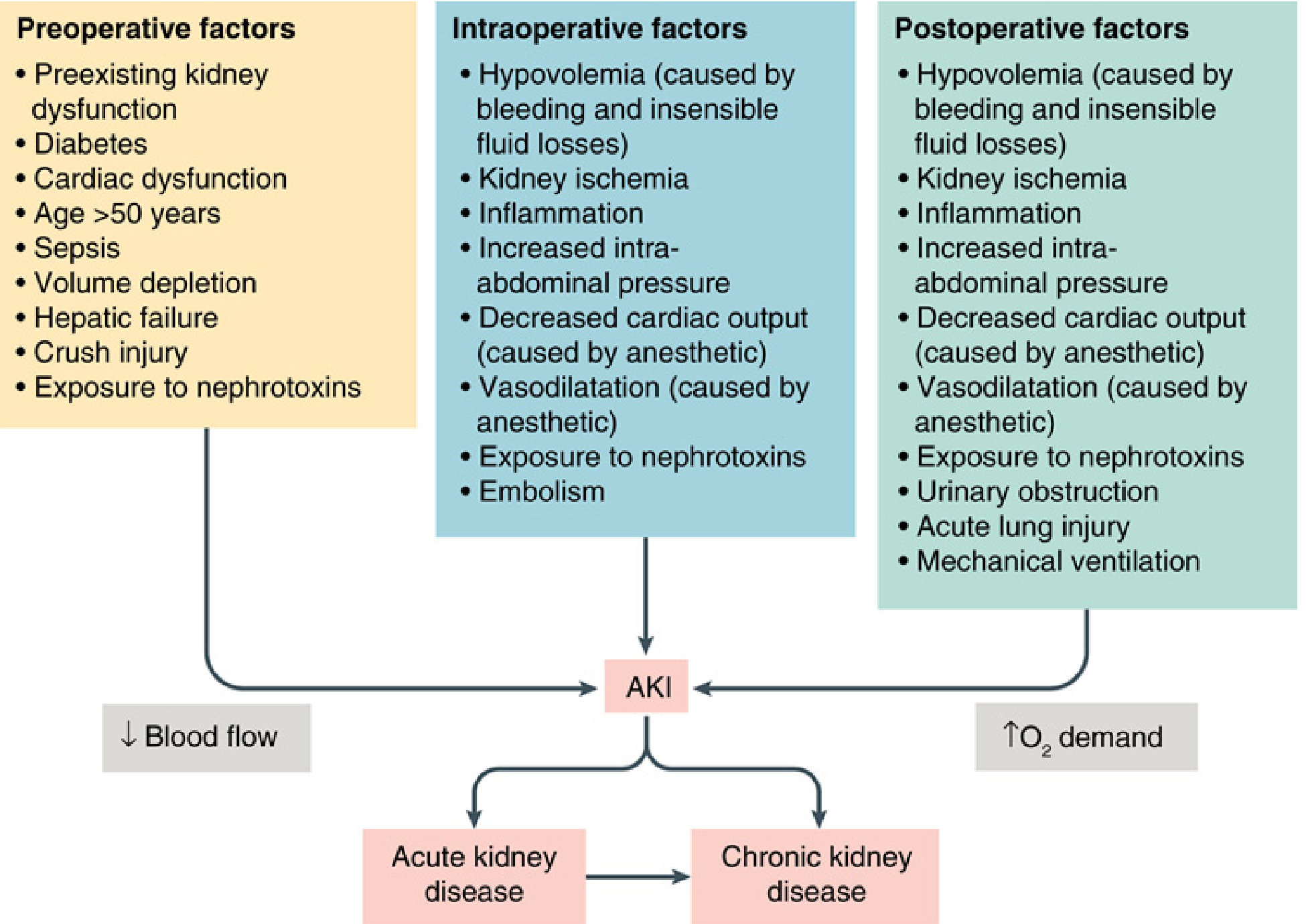
Preoperative:
- Pre-existing kidney dysfunction / CKD
- Diabetes mellitus, age >50 years
- Cardiac dysfunction, hepatic failure
- Sepsis, volume depletion
- Crush injury, prior nephrotoxin exposure
Intraoperative:
- Hypovolemia (bleeding, insensible losses)
- Kidney ischemia, intraoperative hypotension
- Inflammation (surgical stress)
- Increased intra-abdominal pressure
- Decreased cardiac output (anesthetic effect)
- Vasodilatation (anesthetic effect)
- Embolism (atheroemboli, air embolism)
- Nephrotoxin exposure
Postoperative:
-
Continued hypovolemia and ischemia
-
Urinary obstruction
-
Acute lung injury / mechanical ventilation
-
Ongoing inflammation
-
Miller's Anesthesia, 10e, Fig. 38.1
Pathophysiology
The primary cause of perioperative AKI is acute tubular necrosis (ATN). The mechanisms are multifactorial and commonly involve:
1. Ischemia-Reperfusion Injury
- The kidney's outer medulla is susceptible to ischemia due to its high metabolic demand and marginal oxygen supply (medullary pO2 ~10-20 mmHg at baseline).
- Anesthetic agents cause vasodilation and negative inotropy, reducing renal blood flow (RBF).
- Intraoperative hypotension with mean arterial pressure (MAP) below the autoregulatory threshold leads to a fall in GFR. The renal cortex is primarily supplied by the peritubular capillary network, and ischemia-reperfusion injury damages the S3 segment of the proximal tubule.
- Reperfusion generates reactive oxygen species (ROS) causing further cellular damage.
2. Inflammation
- Surgery activates the systemic inflammatory response (SIRS) via complement, cytokines (TNF-α, IL-1, IL-6), and neutrophil-endothelial adhesion.
- Inflammatory mediators cause afferent arteriolar vasoconstriction and tubular epithelial injury.
3. Nephrotoxin-Mediated Injury
- Nephrotoxins disturb either renal O2 delivery or utilization and promote ischemia.
- Key culprits: aminoglycoside antibiotics, amphotericin B, radiocontrast agents, NSAIDs, cyclosporine/tacrolimus, ACE inhibitors/ARBs, myoglobin (rhabdomyolysis), free hemoglobin.
- Barash Clinical Anesthesia, 9e
4. Hemodynamic Prerenal Mechanism
- Prerenal azotemia is the commonest precursor. The kidney maximizes solute/water retention, but if hypoperfusion persists, ATN supervenes.
- ACE inhibitors and ARBs impair glomerular efferent arteriolar tone, reducing GFR during low-flow states.
5. Atheroembolism
- Especially relevant in vascular surgery (aortic cross-clamping) - cholesterol crystal emboli occlude small renal vessels.
Causes - Classification
| Category | Examples |
|---|---|
| Prerenal | Hypovolemia (bleeding, third-space), sepsis, cardiac failure, low CO from CPB, hepatorenal syndrome, aortic cross-clamping, increased IAP |
| Renal (Intrinsic) | Inflammation/sepsis, CKD + comorbidities, endogenous toxins (myoglobin), exogenous toxins (contrast dyes), blood transfusions, chloride-rich/HES solutions |
| Postrenal | Ureteric/bladder/urethral obstruction, BPH, neurogenic bladder, surgical injury |
- Bailey & Love's Short Practice of Surgery, 28e, Table 24.4
Effects of Anesthetic Techniques
Regional Anesthesia
- Neuraxial blocks reduce sympathetic tone (T4-L1) innervating the renal vasculature. If hypotension results, RBF falls. Meta-analysis data suggest a 30% reduction in odds of postoperative mortality with neuraxial blockade (Rodgers et al.), with some reduction in renal failure, though confidence intervals were wide.
Inhaled Anesthetics
- Methoxyflurane and enflurane (historical) caused fluoride-induced polyuric renal insufficiency. Sevoflurane generates inorganic fluoride and compound A but is NOT associated with clinically significant AKI - likely due to shorter duration of fluoride elevation and lower intrarenal metabolism compared to methoxyflurane.
Intravenous Anesthetics
-
Propofol increases bone morphogenetic protein-7 (BMP-7), which suppresses TNF-α-induced inflammatory cascade in sepsis-induced AKI and reduces ischemia-reperfusion injury.
-
Dexmedetomidine (α2-adrenoceptor agonist) - meta-analysis data suggest a reduction in postoperative AKI; may stimulate BMP-7 in sepsis/ischemia-reperfusion models.
-
Miller's Anesthesia, 10e
Biomarkers
| Marker | Basis |
|---|---|
| Serum creatinine | Standard; lags 24-48 h behind injury |
| Cystatin C | More sensitive for mild CKD; inconsistent for perioperative AKI |
| NGAL (Neutrophil gelatinase-associated lipocalin) | Early tubular damage marker; rises within hours of injury |
| KIM-1 (Kidney injury molecule-1) | Proximal tubule damage |
| IGFBP7 × TIMP-2 (NephroCheck) | Cell cycle arrest markers; predict AKI 12 h before SCr rise |
| L-FABP, α-GST, π-GST | Tubular enzymuria |
| penKid (proenkephalin A 119-159) | Correlated with GFR; associated with adverse outcomes in critical illness |
Nephrotoxic Drug Considerations (Key Perioperative Points)
- ACE inhibitors/ARBs: Should be withheld 48 hours before elective cardiac surgery - meta-analysis of >50,000 procedures links continuation to higher mortality (20%) and AKI rates (17%).
- NSAIDs: Impair prostaglandin-mediated renal autoregulation; risk magnified in volume depletion.
- Loop diuretics: Chronic therapy and high-dose furosemide independently associated with postoperative AKI.
- Radiocontrast: AKI risk 24-48 h after exposure, peaks at 3-5 days. Mitigation: pre-hydration, minimize contrast dose, withhold NSAIDs/nephrotoxins.
- Statins (protective): Pre-CABG statin use associated with lower dialysis and mortality rates (meta-analysis of 17 studies, >47,000 patients).
- Aminoglycosides/Amphotericin B: Avoid concomitant hypovolemia, fever, other nephrotoxins; monitor electrolytes (hypomagnesemia, hypokalemia worsen toxicity).
- Barash Clinical Anesthesia, 9e
Prevention / Management
General Principles
- Hemodynamic optimization: Maintain MAP above autoregulatory threshold; avoid intraoperative hypotension. Goal-directed therapy (GDT) is beneficial, but overly restrictive fluid protocols have recently been associated with increased AKI risk - balance is key.
- Fluid choice: Balanced salt solutions preferred over normal saline - avoids hyperchloremic metabolic acidosis; may modestly reduce AKI rates.
- Avoid volume overload: Volume overload is an independent risk factor for adverse AKI outcomes.
- Minimize nephrotoxin exposure: Hold ACE inhibitors/ARBs perioperatively; avoid NSAIDs; use ISO-osmolar/low-osmolarity contrast; monitor aminoglycoside levels.
- Urine output monitoring: Carefully monitor intraoperative urine output, though it is not validated as a sole predictor of postoperative renal dysfunction.
Pharmacological Interventions with Evidence
| Agent | Status |
|---|---|
| Mannitol (before aortic clamping) | Clinical trials FAILED to show benefit |
| Dopamine (renal-dose) | NOT associated with improved mortality |
| Atrial natriuretic peptide | NOT associated with improved mortality |
| Fenoldopam (selective DA1 agonist) | May reduce postoperative AKI incidence, but NO reduction in need for RRT or hospital mortality |
| Dexmedetomidine | Meta-analysis suggests potential AKI reduction |
| N-acetylcysteine | No benefit in cardiac surgery RCTs |
- Miller's Anesthesia, 10e
Renal Replacement Therapy (RRT)
- Indicated for severe AKI with refractory hyperkalemia, acidosis, uremia, or volume overload.
- Does not prevent AKI, but treats its metabolic consequences.
- Current evidence does not support early initiation of dialysis or one modality (CRRT vs. IHD) over another.
- Up to 75% of survivors of AKI after major vascular surgery regain kidney function and become dialysis-independent.
- Miller's Anesthesia, 10e
Outcomes and Long-term Consequences
- AKI increases risk of acute kidney disease (AKD) and progression to CKD.
- Even minor elevation in serum creatinine postoperatively correlates with increased short-term mortality.
- After cardiac/major vascular surgery: AKI requiring dialysis is associated with 30-day mortality significantly higher than those without AKI.
- KDIGO defines AKD as AKI or reduction in GFR <60 mL/min/1.73m² or a 35% GFR decrease or >50% SCr increase, lasting <3 months - a bridging category between AKI and CKD.
Summary Points for Exam
- KDIGO defines AKI as SCr rise ≥0.3 mg/dL in 48h OR ≥50% in 7 days OR UO <0.5 mL/kg/h for >6h.
- Primary mechanism of perioperative AKI is ATN, via ischemia-reperfusion, inflammation, and nephrotoxins.
- Perioperative AKI is a mosaic of pure nephropathies; no single treatment reverses it.
- Sevoflurane is safe; avoid methoxyflurane/enflurane (historical).
- Withhold ACE inhibitors/ARBs 48h before cardiac surgery.
- Balanced crystalloids preferred over saline; avoid HES.
- No proven pharmacological renoprotection exists - hemodynamic optimization is the mainstay.
- Dopamine and ANP are NOT renoprotective.
Sources: Miller's Anesthesia, 10e (Ch. 38 & 55); Barash Clinical Anesthesia, 9e (Ch. 50); Bailey & Love's Surgery, 28e (Table 24.4); Brenner & Rector's The Kidney (Table 29.2)
This is a shared conversation. Sign in to Orris to start your own chat.