
Fibroendenoma of breast
Reading File
Now let me search the medical library for fibroadenoma of the breast.
Finding Sources
Searching PubMed
"fibroadenoma" AND "breast"
Finding Sources
Finding Sources
Now let me read the most comprehensive sections in parallel - Robbins pathology, Bailey & Love surgery, and S Das clinical surgery:
Reading File
Reading File
Reading File
Reading File
Reading File
Now let me fetch the key fibroadenoma histology image from Robbins:
Loading Image
Finding Sources
I now have comprehensive information from multiple authoritative textbooks. Let me compile the full answer.
Fibroadenoma of the Breast
Definition and Overview
A fibroadenoma is the most common benign stromal tumor of the female breast and the most frequent cause of a breast lump in women aged 15-25 years. It is a fibroepithelial tumor arising from hyperplasia of a single breast lobule, consisting of both epithelial and stromal (fibrous) components.
Etiopathogenesis
-
Arises from hyperplasia of intralobular stroma and ductal epithelium within a single breast lobule.
-
Two-thirds harbor driver mutations in MED12 - a gene encoding a subunit of the mediator complex that regulates RNA polymerase II-dependent transcription. This same mutation is found in uterine leiomyomas (both arising from hormone-responsive stromal cells).
-
~One-third have mutations in RARA (retinoic acid receptor alpha), an estrogen target gene.
-
The tumor is hormonally responsive - grows during pregnancy, may regress post-menopause.
-
Almost half of females on cyclosporin A after renal transplantation develop multiple bilateral fibroadenomas (likely reactive hyperplasia).
-
Robbins Pathologic Basis of Disease, p. 984
Types / Classification
By Histological Pattern
| Type | Description | Size | Age Group |
|---|---|---|---|
| Pericanalicular | Fibrous tissue surrounds small tubular (round) glands | Smaller, hard | 15-30 years |
| Intracanalicular | Glands are compressed into elongated slit-like clefts by fibrous tissue | Larger, soft | 35-50 years |
In practice, both patterns are often seen in the same tumor.
By Size / Special Subtypes
-
Simple fibroadenoma - typical, <5 cm, slight increase in cancer RR (1.5-1.7)
-
Giant fibroadenoma - >5 cm; descriptive term; excision recommended
-
Juvenile fibroadenoma - large, more cellular histologically; occurs in adolescents; excision if >5 cm or persists to adulthood
-
Complex fibroadenoma - contains cysts >0.3 cm, sclerosing adenosis, epithelial calcifications, or papillary apocrine change; cancer RR 3.4-3.7; especially high RR (3.0-4.0) with family history of breast cancer
-
Myxoid fibroadenoma - sporadic or associated with Carney complex (autosomal dominant; PRKAR1A mutations)
-
Bailey and Love's Short Practice of Surgery 28th ed., p. 408; Robbins, p. 984
Morphology / Pathology
Gross
- Well-circumscribed, rubbery, gray-white nodule that bulges above surrounding tissue
- Contains slit-like spaces lined by epithelium
- Usually 2-3 cm; surrounded by a well-defined capsule
- In older females: stroma is densely hyalinized, epithelium is atrophic
Microscopic
- Delicate, often myxoid stroma resembling normal intralobular stroma
- Pericanalicular pattern: stroma surrounds patent round/oval ducts
- Intracanalicular pattern: stroma compresses and distorts ducts into cleft-like spaces (the "interlocking antlers" appearance on H&E)
- Sharply delimited from surrounding tissue
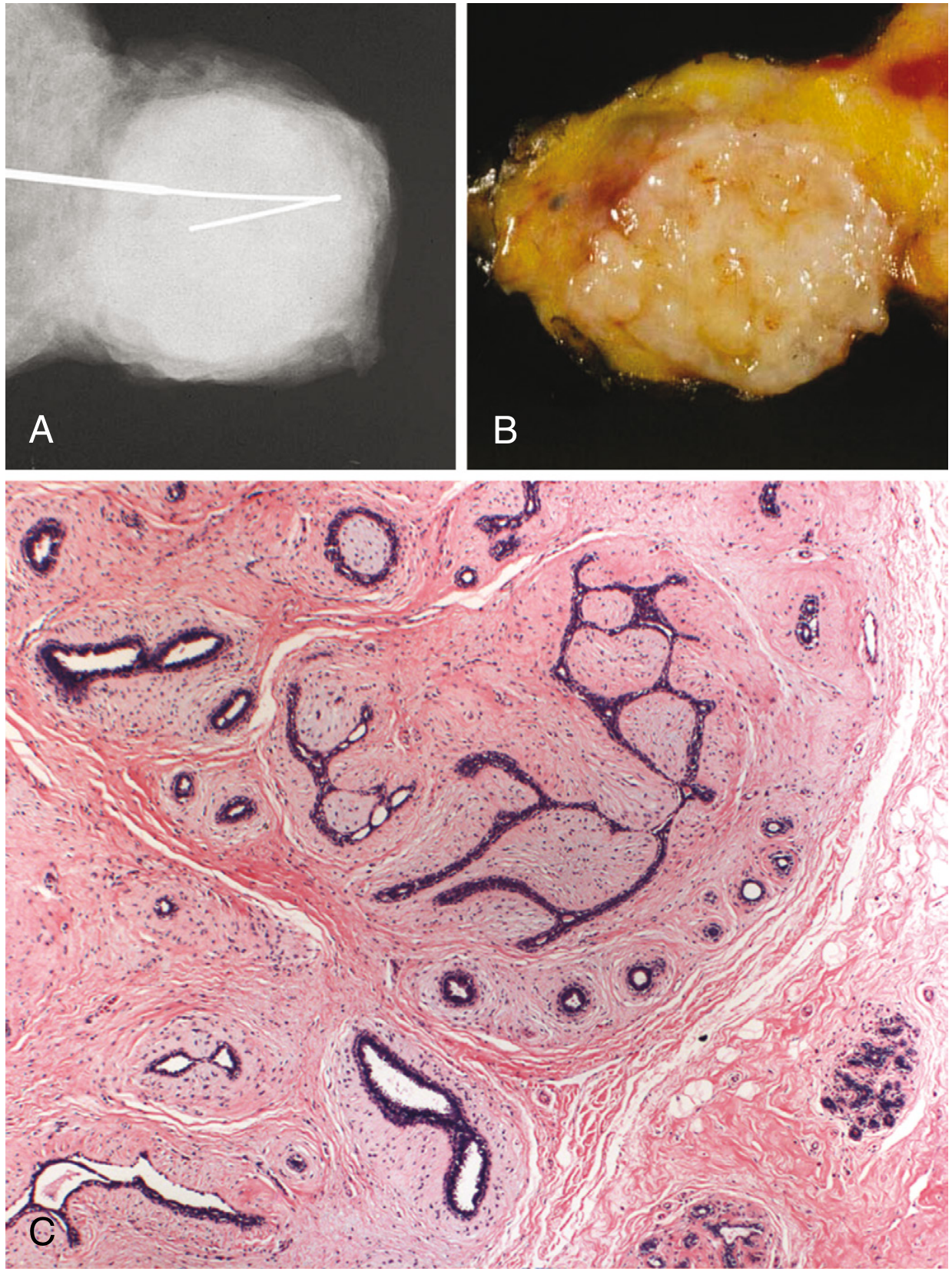
- Robbins Pathologic Basis of Disease, p. 984
Clinical Features
-
Age: most common in women in their 20s and 30s; pericanalicular type in 15-30 yr, intracanalicular in 35-50 yr
-
Presentation: painless, solitary lump (occasionally multiple/bilateral)
-
Examination findings:
- Smooth, firm, well-defined margin
- Not fixed to skin or deeper structures
- Highly mobile within breast - classically called "breast mouse" or "floating tumor"
- No axillary lymphadenopathy
- No skin changes, no nipple discharge
-
Multiple and bilateral fibroadenomas are not uncommon
-
Rapid growth during pregnancy (occasionally with infarction) can mimic carcinoma
-
Regresses after menopause
-
S Das Manual on Clinical Surgery 13th ed., p. 434
Investigations
Triple Assessment (standard approach)
- Clinical examination - characteristic "breast mouse" mobility
- Imaging
- Ultrasonography (preferred in young women <35 yr): well-circumscribed, oval, homogeneous hypoechoic mass with gentle lobulations; posterior acoustic enhancement
- Mammography: well-circumscribed density; may show "popcorn" calcifications in older/involuting lesions
- Tissue diagnosis (FNAC / core biopsy)
- FNAC: shows clusters of benign ductal epithelial cells with background stromal fragments ("antler-horn" stroma)
- Core biopsy: required if >25 years or atypical features
A clinically typical fibroadenoma confirmed on ultrasonography may be observed without biopsy (if the patient is under 25).
Differential Diagnosis
| Condition | Distinguishing Features |
|---|---|
| Breast cyst | Fluctuant, transilluminates, US shows anechoic |
| Phyllodes tumor | Larger, bosselated surface, older women (>30 yr), stromal overgrowth on histology |
| Breast carcinoma | Hard, irregular, fixed, skin changes, lymphadenopathy |
| Breast abscess | Tender, hot, fluctuant, fever |
| Lipoma | Soft, lobulated, fatty consistency |
Risk of Malignancy
| Lesion | Relative Risk (RR) |
|---|---|
| Simple fibroadenoma | 1.5-1.7 |
| Complex fibroadenoma | 3.4-3.7 |
| Complex fibroadenoma + family history | 3.0-4.0 |
Cancer arising within a fibroadenoma is rare. The surrounding breast parenchyma (e.g., atypical hyperplasia found nearby) is thought to be the true driver of elevated risk in complex fibroadenomas.
- Bailey and Love 28th ed., p. 414-415; Robbins, p. 984
Management
Conservative (Observation)
- Indicated in women under 25-30 years with typical clinical and US features
- Natural history: regression (~30%), stable, or slow growth
- Regression with tamoxifen or ormeloxifene (anti-oestrogen drugs) has been observed
Indications for Surgical Excision
- Age >30 years
- Suspicious features on imaging (e.g., microlobulation)
- Atypia on histology/cytology
- Size >5 cm (giant fibroadenoma)
- Family history of breast cancer
- Patient preference
- Excision in elderly should include a rim of normal tissue (to exclude malignancy or phyllodes tumor)
Surgical Technique
- Enucleation through a periareolar or submammary (Gaillard Thomas) incision
- Giant fibroadenomas are often enucleated through a submammary incision
Minimally Invasive Options (emerging)
Recent evidence supports non-surgical ablation:
-
Cryoablation - systematic reviews (2025) confirm safety and efficacy for benign fibroadenomas [PMID: 41061430]
-
High-Intensity Focused Ultrasound (HIFU) - a 2026 systematic review and meta-analysis showed comparable efficacy and safety to cryoablation [PMID: 42147239]
-
Bailey and Love 28th ed.; Sabiston Textbook of Surgery 21st ed.
Fibroadenoma vs. Phyllodes Tumor - Key Comparison
| Feature | Fibroadenoma | Phyllodes Tumor |
|---|---|---|
| Age | 15-35 yr | >30 yr |
| Size | Usually 2-3 cm | Often large (can be massive) |
| Growth | Slow | Rapid |
| Surface | Smooth | Bosselated |
| Stroma | Myxoid, loose | Cellular, mitotically active |
| Behavior | Benign | Benign/borderline/malignant |
| MED12 mutations | Yes (2/3) | Yes (majority) |
| TERT/TP53/RB mutations | Rare | More common (malignant types) |
| Treatment | Conservative/enucleation | Wide local excision |
Summary
Fibroadenoma is a benign, hormonally responsive, fibroepithelial tumor of the breast driven largely by MED12 mutations. It presents as a painless, mobile "breast mouse" in young women. Management is conservative in typical cases in young women; surgical excision (enucleation) is indicated for size >5 cm, atypical features, or patient preference. Minimally invasive ablation (cryoablation, HIFU) is increasingly supported by evidence as an alternative to surgery.
Sources: Robbins Pathologic Basis of Disease (p. 984) | Bailey and Love's Short Practice of Surgery 28th ed. | S Das Manual on Clinical Surgery 13th ed. (p. 434) | Sabiston Textbook of Surgery 21st ed. | Recent systematic reviews: PMID 41061430 (cryoablation, 2025), PMID 42147239 (HIFU vs cryoablation, 2026)
Fibroendenoma of breast
The previous response already covered fibroadenoma of the breast in full detail. Here is a clean, consolidated reference:
Fibroadenoma of the Breast
Definition
A fibroadenoma is the most common benign fibroepithelial tumor of the female breast, arising from hyperplasia of a single breast lobule. It contains both epithelial and stromal (fibrous) components.
Etiopathogenesis
- Arises from intralobular stroma of a breast lobule
- 2/3 harbor MED12 mutations (mediator complex subunit regulating RNA Pol II transcription) - same mutation seen in uterine leiomyomas
- ~1/3 have RARA mutations (retinoic acid receptor alpha, an estrogen target gene)
- Tumor is hormonally responsive: grows during pregnancy, regresses post-menopause
- Cyclosporin A after renal transplant can trigger multiple bilateral fibroadenomas
Classification
By Histological Pattern
| Type | Stroma-Duct Relationship | Size | Consistency | Age |
|---|---|---|---|---|
| Pericanalicular | Fibrous tissue surrounds round/oval patent ducts | Smaller | Hard | 15-30 yr |
| Intracanalicular | Fibrous tissue compresses ducts into elongated cleft-like spaces | Larger | Soft | 35-50 yr |
Both patterns often coexist in the same tumor.
By Size / Special Subtypes
| Subtype | Definition | Management |
|---|---|---|
| Simple | Typical, <5 cm | Observe / enucleate |
| Giant | >5 cm | Excision recommended |
| Juvenile | Large, cellular; adolescents | Observe if <5 cm; excise if >5 cm or persists |
| Complex | Cysts >0.3 cm + sclerosing adenosis / calcifications / apocrine change | Higher cancer RR; closer follow-up |
| Myxoid | Sporadic or Carney complex (PRKAR1A mutation) | Per size/symptoms |
Pathology / Morphology
Gross
- Well-circumscribed, rubbery, gray-white nodule with a defined capsule
- Bulges above surrounding tissue on cut section
- Contains slit-like spaces lined by epithelium
- In older women: densely hyalinized stroma, atrophic epithelium
Microscopic
- Delicate, myxoid stroma resembling normal intralobular stroma
- Pericanalicular: stroma surrounds patent ducts
- Intracanalicular: stroma distorts ducts into compressed clefts ("antler-horn" pattern)
- Sharp demarcation from surrounding breast tissue
Clinical Features
- Most common breast lump in women aged 15-25 years
- Presentation: painless, solitary lump (may be multiple/bilateral)
- Examination:
- Smooth, firm, well-defined margin
- Not fixed to skin or deeper structures
- Highly mobile - classically called "breast mouse" or "floating tumor"
- No skin tethering, no nipple discharge
- No axillary lymphadenopathy
Investigations (Triple Assessment)
- Clinical examination - characteristic mobility
- Imaging
- Ultrasonography (preferred <35 yr): oval, well-circumscribed, homogeneous hypoechoic mass; posterior acoustic enhancement
- Mammography: well-circumscribed density; "popcorn" calcifications in involuting lesions
- Tissue diagnosis
- FNAC: clusters of benign ductal epithelial cells + stromal fragments (antler-horn stroma)
- Core biopsy: if age >25 or atypical features on imaging
A clinically typical fibroadenoma confirmed on ultrasound in a woman under 25 may be observed without biopsy.
Differential Diagnosis
| Condition | Key Differentiator |
|---|---|
| Breast cyst | Fluctuant, transilluminates, anechoic on US |
| Phyllodes tumor | Larger, bosselated, rapid growth, age >30 yr |
| Breast carcinoma | Hard, irregular, fixed, skin changes, lymphadenopathy |
| Breast abscess | Tender, warm, fluctuant, fever |
| Lipoma | Soft, lobulated, fatty consistency |
Risk of Malignancy
| Lesion | Relative Risk (RR) for Breast Cancer |
|---|---|
| Simple fibroadenoma | 1.5-1.7 |
| Complex fibroadenoma | 3.4-3.7 |
| Complex fibroadenoma + family history | 3.0-4.0 |
Cancer arising directly within a fibroadenoma is rare. The elevated RR in complex fibroadenomas is largely attributed to co-existing atypical hyperplasia in surrounding breast tissue.
Management
Conservative (Observation)
- Women <25-30 yr with typical clinical + US features
- Natural history: regression, stability, or slow growth
- Anti-estrogen therapy: tamoxifen or ormeloxifene can induce regression
Indications for Surgical Excision
- Age >30 years
- Size >5 cm (giant fibroadenoma)
- Suspicious / atypical features on imaging
- Atypia on histology / cytology
- Family history of breast cancer
- Rapid growth or change in character
- Patient's preference
- In elderly: excise with a rim of normal tissue (to exclude phyllodes or malignancy)
Surgical Technique
- Enucleation through a periareolar or submammary (Gaillard Thomas) incision
- Giant fibroadenomas: submammary incision preferred
Minimally Invasive Ablation (emerging evidence)
- Cryoablation: systematic review (2025, PMID 41061430) confirms safety and efficacy
- HIFU (High-Intensity Focused Ultrasound): 2026 meta-analysis (PMID 42147239) shows comparable outcomes to cryoablation
Fibroadenoma vs. Phyllodes Tumor
| Feature | Fibroadenoma | Phyllodes Tumor |
|---|---|---|
| Age | 15-35 yr | >30 yr (typically) |
| Size | 2-3 cm typical | Often large or massive |
| Growth | Slow | Rapid |
| Surface | Smooth | Bosselated / irregular |
| Stroma | Myxoid, loose | Cellular, mitotically active |
| Behavior | Always benign | Benign / borderline / malignant |
| MED12 mutations | Yes (~2/3) | Yes (majority) |
| TERT / TP53 / RB mutations | Rare | Present in malignant types |
| Treatment | Conservative / enucleation | Wide local excision |
Phyllodes tumors are classified by mitotic rate: benign (<4/10 HPF), borderline (4-9/10 HPF), malignant (>10/10 HPF).
Sources: Robbins Pathologic Basis of Disease (p. 984) | Bailey and Love's Short Practice of Surgery 28th ed. | S Das Manual on Clinical Surgery 13th ed. | Sabiston Textbook of Surgery 21st ed. | PMID 41061430 | PMID 42147239
This is a shared conversation. Sign in to Orris to start your own chat.