
If a patient on ATT and pemphigus vulgaris presented with total HBcAb positive what does is signifies and how to approach HbsAg negative
Reading File
This is a complex clinical scenario involving:
- Interpretation of total HBcAb (anti-HBc total) positive with HBsAg negative
- Management in the context of ATT (anti-tuberculosis therapy) and pemphigus vulgaris (requiring immunosuppression)
Let me search the medical library and literature simultaneously.
Searching sources...
Finding Sources
Finding Sources
Searching PubMed
isolated anti-HBc immunosuppression reactivation
Searching PubMed
hepatitis B reactivation anti-tuberculosis therapy corticosteroids
Good results. Now let me read the key sections from Harrison's and Goldman-Cecil, and also search for pemphigus+HBV reactivation and HBV prophylaxis guidance.
Reading File
Reading File
Finding Sources
Searching PubMed
hepatitis B reactivation immunosuppression prophylaxis antiviral
Excellent - very strong sources found. Let me now read the key Sleisenger HBV reactivation section and get the AGA guideline abstract (PMID 39863345), plus the meta-analysis on HBsAg-negative/anti-HBc-positive prophylaxis (PMID 39206573).
Reading File
Reading Article
PMID: 39863345
Reading Article
PMID: 39206573
Now let me get the APASL guideline details and also read the HBV reactivation table from Sleisenger to understand risk stratification.
Reading Article
PMID: 34427860
Reading File
Now let me get the HBV reactivation risk table and read about ATT drug hepatotoxicity plus the specific scenario details.
Reading File
Finding Sources
I now have enough information to compose a comprehensive, well-sourced answer. Let me also fetch the hepatitis B serologic marker diagram from Harrison's for visual clarity.
Loading Image
I now have all the information needed to provide a comprehensive answer. Here it is:
Total Anti-HBc Positive + HBsAg Negative in a Patient on ATT and Pemphigus Vulgaris
What Does "Total HBcAb Positive, HBsAg Negative" Mean?
This serologic pattern is called isolated anti-HBc (or resolved hepatitis B). Total anti-HBc (IgG + IgM) appears within 1-2 weeks of initial HBV infection and persists for life - it is acquired only through natural infection, never from vaccination. HBsAg negativity with anti-HBc positivity can represent three distinct situations:
| Scenario | Interpretation |
|---|---|
| Most common (~95%) | Past resolved HBV infection - patient was infected years ago and cleared the virus naturally |
| Window period | Acute HBV - HBsAg has cleared but anti-HBs not yet detectable (check IgM anti-HBc - would be positive) |
| Occult HBV infection | HBsAg below assay detection threshold, but HBV DNA may still be present in liver (low-level replication) |
| False positive | Rare; cross-reacting immunologic specificity |
Anti-HBc is only acquired during infection and will not be present in vaccinated individuals. - Harrison's Principles of Internal Medicine 22E, p. 2689
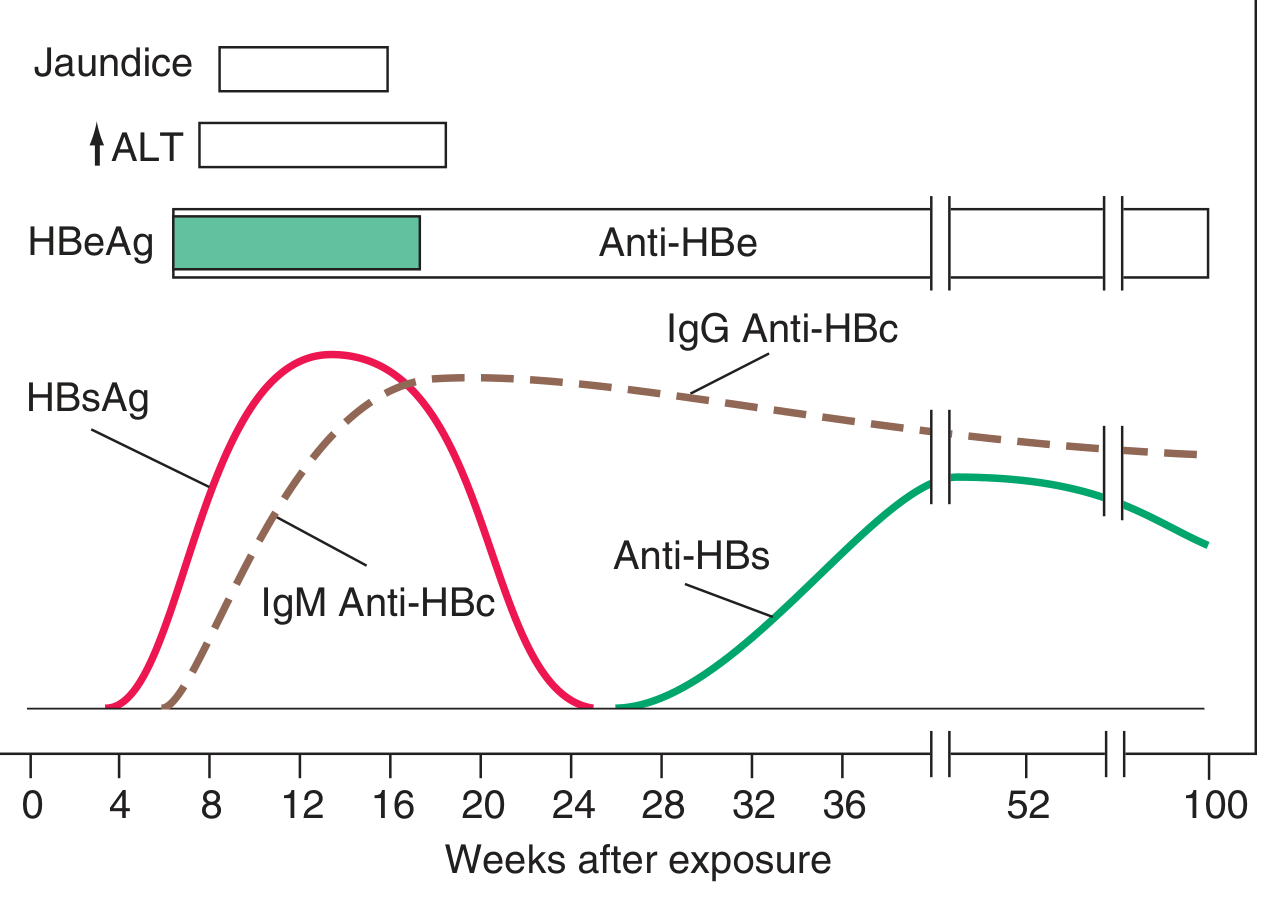
Scheme of typical serologic features of acute hepatitis B showing how IgG anti-HBc persists for life after HBsAg clears - Harrison's 22E
Why This Matters in Your Patient (ATT + Pemphigus Vulgaris)
This is a high-stakes triple problem:
- ATT - rifampicin, isoniazid, pyrazinamide are hepatotoxic on their own; HBV reactivation on ATT can cause fulminant hepatic failure
- Pemphigus vulgaris treatment - requires systemic immunosuppression (high-dose corticosteroids + azathioprine as first-line; or rituximab for refractory disease). Both drug classes are known to trigger HBV reactivation
- Occult HBV - even with HBsAg negative, residual HBV DNA in hepatocytes can re-emerge under immunosuppression
As noted in Goldman-Cecil Medicine, 2-Volume Set: "Some individuals who test positive for anti-HBc antibodies, but not for HBsAg or anti-HBs antibodies, may be viremic; in these cases, some viruses' amino acid substitutions in the HBsAg sequence make HBsAg undetectable... Other individuals may have such low-level HBV replication in their livers that HBV DNA is not detectable in blood ('occult' hepatitis B)."
Step-by-Step Clinical Approach
Step 1: Further Serologic Characterization
Order immediately:
| Test | Why |
|---|---|
| IgM anti-HBc | If positive = acute/recent infection (within 6 months); if negative = remote/resolved or occult |
| Anti-HBs (HBsAb) | If positive = fully resolved (immune); if negative with positive total anti-HBc = "isolated anti-HBc" pattern |
| HBV DNA (quantitative PCR) | The single most important test - determines if occult replication is present |
| HBeAg / Anti-HBe | For completeness |
| LFTs / ALT / AST | Baseline liver function, especially relevant with ATT hepatotoxicity risk |
Interpretation guide:
- HBsAg (-), Anti-HBs (+), Total anti-HBc (+) = Past resolved infection - lower but non-zero reactivation risk
- HBsAg (-), Anti-HBs (-), Total anti-HBc (+) = "Isolated anti-HBc" = highest risk group for occult HBV; requires HBV DNA testing urgently
- HBV DNA detectable = Occult HBV infection confirmed - treat as active infection from a prophylaxis standpoint
Step 2: Risk Stratification for HBV Reactivation
The risk depends on the immunosuppressive agents being used or planned:
| Agent | Reactivation risk (HBsAg-neg, anti-HBc-pos) |
|---|---|
| High-dose corticosteroids (>20 mg/day prednisone for >4 weeks) | Moderate |
| Rituximab (used in refractory pemphigus) | HIGH - highest risk of all agents |
| Azathioprine / mycophenolate | Low-moderate |
| Corticosteroids + azathioprine combined | Moderate |
| Corticosteroids + rituximab | Very high |
The 2025 AGA Clinical Practice Guideline (PMID: 39863345) stratifies management:
- High risk: Strong recommendation for antiviral prophylaxis
- Moderate risk: Conditional recommendation for antiviral prophylaxis
- Low risk: Monitoring alone acceptable
The 2024 meta-analysis (PMID: 39206573) of 8,034 HBsAg-neg/anti-HBc-pos patients found an overall HBV reactivation rate of 4% under immunosuppression - and prophylaxis was "strongly recommended" for rituximab-based regimens and "appropriate" for immune-mediated diseases like pemphigus.
Step 3: Management Algorithm
Total Anti-HBc (+), HBsAg (-)
        ↓
Check: HBV DNA + Anti-HBs + IgM anti-HBc + LFTs
        ↓
┌─────────────────────────────┐
│ HBV DNA detectable          │ → Treat as occult HBV
│ (occult HBV confirmed)      │ → Antiviral prophylaxis MANDATORY
└─────────────────────────────┘
        ↓
┌─────────────────────────────┐
│ HBV DNA undetectable        │ → Risk stratify by
│                             │   immunosuppressive regimen
└─────────────────────────────┘
        ↓
    If rituximab planned:       → Antiviral prophylaxis MANDATORY
    If high-dose steroids only: → Consider prophylaxis (conditional)
    If steroids + azathioprine: → Consider prophylaxis
Step 4: Antiviral Prophylaxis - Choice and Duration
If prophylaxis is indicated:
- Entecavir 0.5 mg/day - preferred (high barrier to resistance, potent)
- Tenofovir disoproxil fumarate (TDF) 245 mg/day or Tenofovir alafenamide (TAF) 25 mg/day - equally valid, TAF preferred if renal concerns
Goldman-Cecil Medicine: "HBV-infected patients who require corticosteroids, rituximab, or other chemotherapy for other conditions should receive entecavir 0.5 mg/day, tenofovir disoproxil fumarate 245 mg/day, or tenofovir alafenamide..."
Duration: Start 1-2 weeks before immunosuppression and continue for 6-12 months after stopping (longer for rituximab given prolonged B-cell depletion - typically 12 months post-rituximab). - APASL 2021 Guideline, PMID: 34427860
Step 5: ATT-Specific Considerations
- ATT drugs (especially pyrazinamide, rifampicin, isoniazid) are directly hepatotoxic
- Concurrent occult HBV reactivation during ATT can be misattributed to drug-induced liver injury (DILI), delaying the correct diagnosis
- Baseline and monthly LFTs are essential
- If ALT rises >3x ULN (symptomatic) or >5x ULN (asymptomatic) during ATT: suspect both ATT-DILI and HBV reactivation
- Check HBV DNA if LFTs rise during ATT, even if HBsAg was initially negative
Summary of Key Actions
- Subclassify the anti-HBc positive result: order HBV DNA + anti-HBs + IgM anti-HBc immediately
- If HBV DNA detectable: start antiviral prophylaxis (entecavir preferred) before continuing or escalating immunosuppression
- If HBV DNA undetectable but anti-HBs negative (isolated anti-HBc): risk stratify by planned therapy - if rituximab is planned, give prophylaxis; if steroids + azathioprine, consider prophylaxis
- If rituximab is needed for refractory pemphigus: antiviral prophylaxis is non-negotiable regardless of HBV DNA result
- Monitor LFTs monthly while on ATT - a rising ALT should trigger HBV DNA re-check to distinguish DILI from HBV reactivation
- Continue antivirals for 12 months after stopping rituximab (6 months after other immunosuppressants)
Key references:
- Harrison's Principles of Internal Medicine 22E, Chapter 350 - HBV serologic markers
- Goldman-Cecil Medicine - isolated anti-HBc and management in immunosuppressed patients
- Sleisenger and Fordtran's GI and Liver Disease - immunosuppressive therapy-induced HBV flares
- AGA Clinical Practice Guideline 2025 on HBV reactivation (PMID: 39863345)
- Meta-analysis: HBsAg-neg/anti-HBc-pos prophylaxis, 2024 (PMID: 39206573)
- APASL 2021 Guideline on HBV reactivation with immunosuppression (PMID: 34427860)
This is a shared conversation. Sign in to Orris to start your own chat.