
Surfactant shirt notes easy language
Reading File
Searching sources...
Finding Sources
Reading File
Reading File
Reading File
Loading Image
Finding Sources
Reading File
Finding Sources
Here are your easy-language short notes on Surfactant:
🫁 Surfactant - Short Notes (Easy Language)
1. What is Surfactant?
Surfactant is a soapy-like substance that lines the inside of the alveoli (tiny air sacs in the lungs).
- It is a mixture of phospholipids + proteins
- The most important component is DPPC (Dipalmitoylphosphatidylcholine)
- Source: Type II alveolar (pneumocyte) cells
Think of it like the non-stick coating in a pan - it stops the alveoli from sticking together and collapsing.
2. Why is it Needed? - The Law of Laplace
The key formula: P = 2T / r
| Term | Meaning |
|---|---|
| P | Collapsing pressure (how much force tries to collapse the alveolus) |
| T | Surface tension |
| r | Radius of alveolus |
The problem without surfactant:
- Small alveoli have a small radius → HIGH collapsing pressure → they collapse (atelectasis)
- Big alveoli have a large radius → LOW collapsing pressure → they stay open
- This means small alveoli would always empty into bigger ones - very bad!
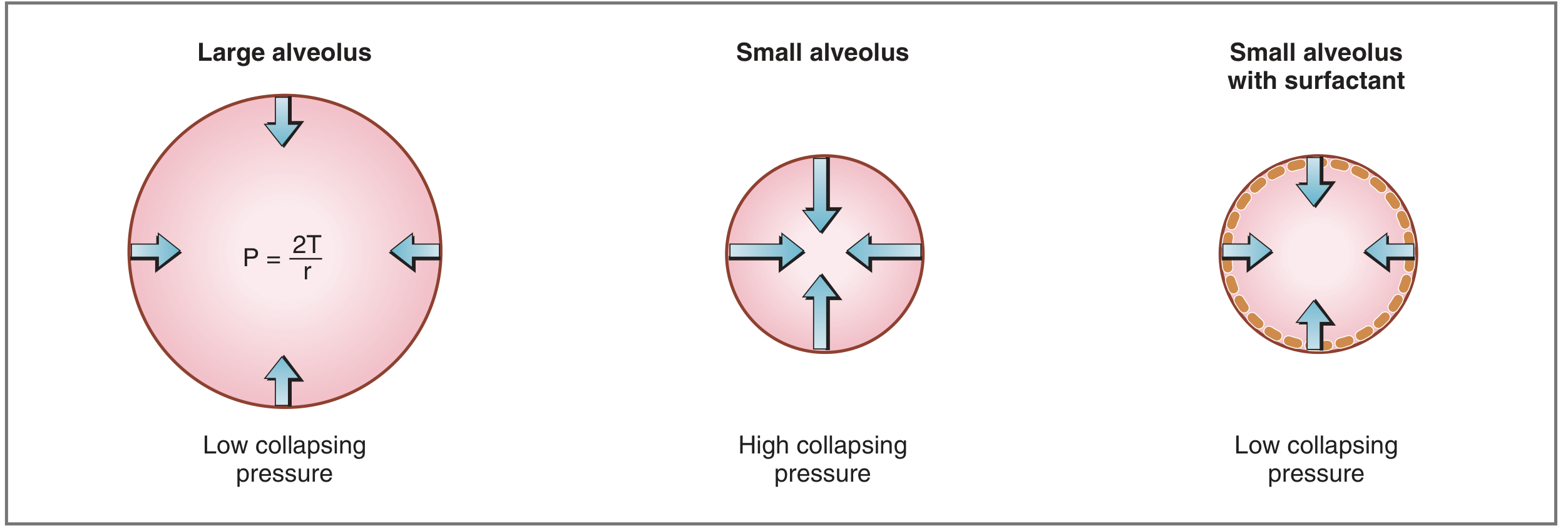
Surfactant fixes this by reducing surface tension (T), so collapsing pressure (P) drops even in small alveoli - keeping them open.
3. How Does DPPC Work?
DPPC is amphipathic (two-sided molecule):
- One end is hydrophilic (water-loving)
- Other end is hydrophobic (water-hating)
DPPC molecules line up on the alveolar surface. They break up the attractive forces between water molecules that cause high surface tension.
Result: Surface tension ↓ → Collapsing pressure ↓ → Alveoli stay open
4. Functions of Surfactant
| Function | Why It Matters |
|---|---|
| Reduces surface tension | Prevents alveolar collapse |
| Stabilises small alveoli | Makes them behave like large ones |
| Increases lung compliance | Makes breathing easier (less work) |
| Immune defence | Surfactant proteins fight bacteria/viruses |
5. Surfactant Proteins (SP-A, SP-B, SP-C, SP-D)
| Protein | Function |
|---|---|
| SP-A | Most abundant; regulates surfactant synthesis & secretion; immune defence |
| SP-B | Spreads surfactant onto alveolar surface (critical organizer) |
| SP-C | Works with SP-B to maintain the thin film layer |
| SP-D | Immune defence; binds bacteria and lymphocytes |
6. When Does Surfactant Develop?
- Synthesis starts around gestational week 24
- Fully functional by week 35
- Hormones that boost surfactant production: cortisol, insulin, prolactin, thyroxine
7. Clinical Importance
Neonatal Respiratory Distress Syndrome (RDS / Hyaline Membrane Disease)
- Occurs in premature babies (born before 28-35 weeks)
- Cause: Not enough surfactant → alveoli collapse → baby can't breathe
- Features: Low oxygenation, atelectasis, hyaline membrane formation
Treatment:
- Exogenous surfactant given at birth to premature babies
- Antenatal corticosteroids (given to the mother before preterm delivery) → stimulates fetal lung maturity and surfactant production
ARDS (Acute Respiratory Distress Syndrome)
- In adults, lung injury damages Type II cells → surfactant is inactivated
- This worsens lung collapse and oxygen failure
- Note: Exogenous surfactant therapy has not been as successful in adults as in neonates
Pulmonary Alveolar Proteinosis (PAP)
- Too much surfactant builds up in alveoli (not cleared properly)
- Causes: autoimmune (anti-GM-CSF antibodies), hereditary, or secondary
8. Quick Memory Trick
"Surfactant = Surface Tension Breaker" Made by Type II cells, mainly DPPC Keeps small alveoli open Absent in premature babies → RDS Treatment: Surfactant replacement + steroids
Sources: Costanzo Physiology 7th Ed., Histology: A Text & Atlas, Murray & Nadel's Respiratory Medicine, Robbins Basic Pathology, Ganong's Medical Physiology
This is a shared conversation. Sign in to Orris to start your own chat.