
functions of phrayngeal muscles during deglutition
I'll read the medical library skill first, then search for pharyngeal muscle functions during deglutition.
Reading File
Now I'll run parallel searches across the library and web.
Finding Sources
Finding Sources
Searching the Web
pharyngeal muscles functions during deglutition swallowing phases
Good - found relevant textbook sections. Let me read them in parallel.
Reading File
Reading File
Reading File
Excellent detail found. Let me now get the Cummings pharyngeal section and the anatomy atlas image, and also search for more specific pharyngeal muscle detail.
Reading File
Finding Sources
Loading Image
Found KJ Lee's Otolaryngology with pharyngeal walls section. Let me read it and get the Gray's constrictor diagram.
Reading File
Loading Image
I now have comprehensive textbook information. Let me also fetch the swallowing diagram from Ganong's.
Loading Image
I now have all the content needed for a thorough, well-illustrated answer. Here it is:
Functions of Pharyngeal Muscles During Deglutition (Swallowing)
Swallowing is a reflex response triggered by afferent impulses in the trigeminal (V), glossopharyngeal (IX), and vagus (X) nerves, integrated in the nucleus tractus solitarius and nucleus ambiguus. Efferent signals reach the pharyngeal musculature via V, VII, IX, X, and XII. The pharyngeal phase is entirely involuntary and occurs in under 1 second.
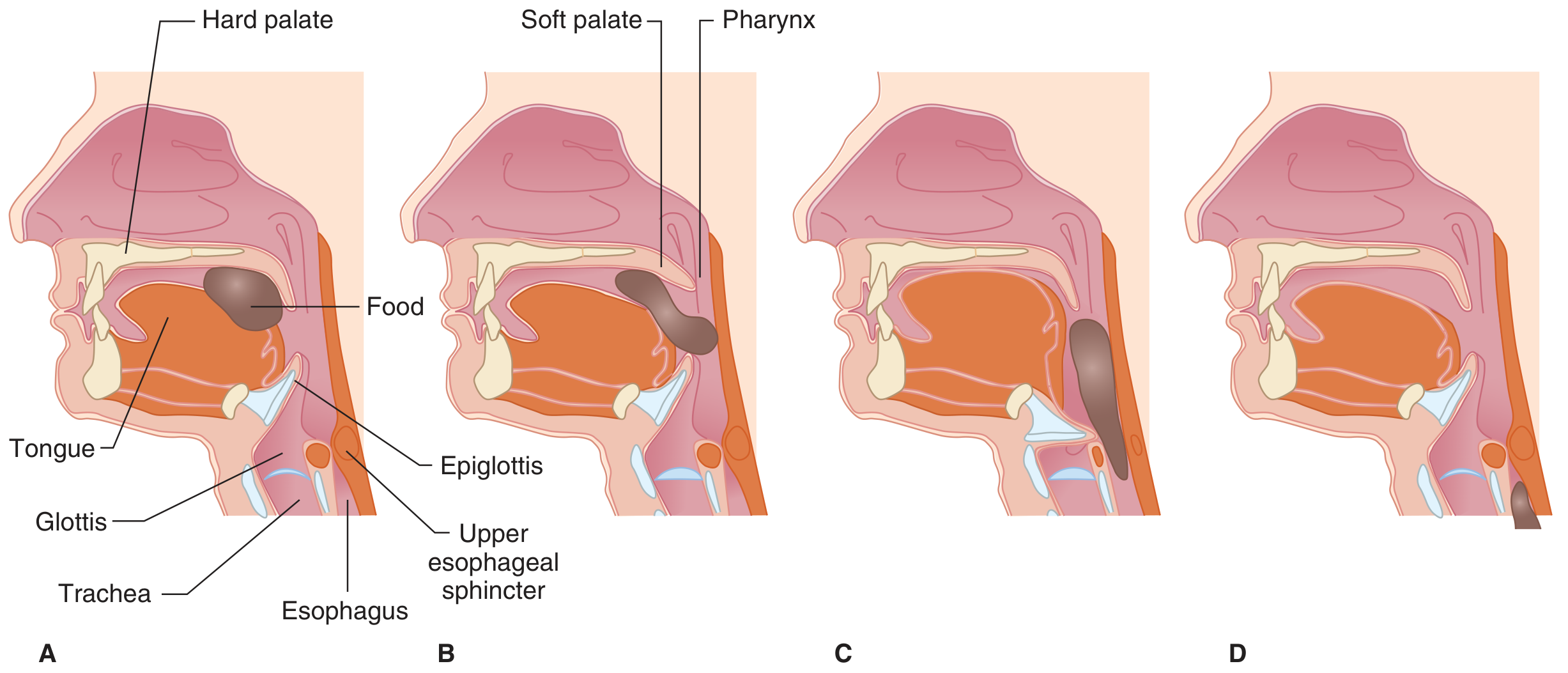
Ganong's Review of Medical Physiology - Movement of food through the pharynx during swallowing:
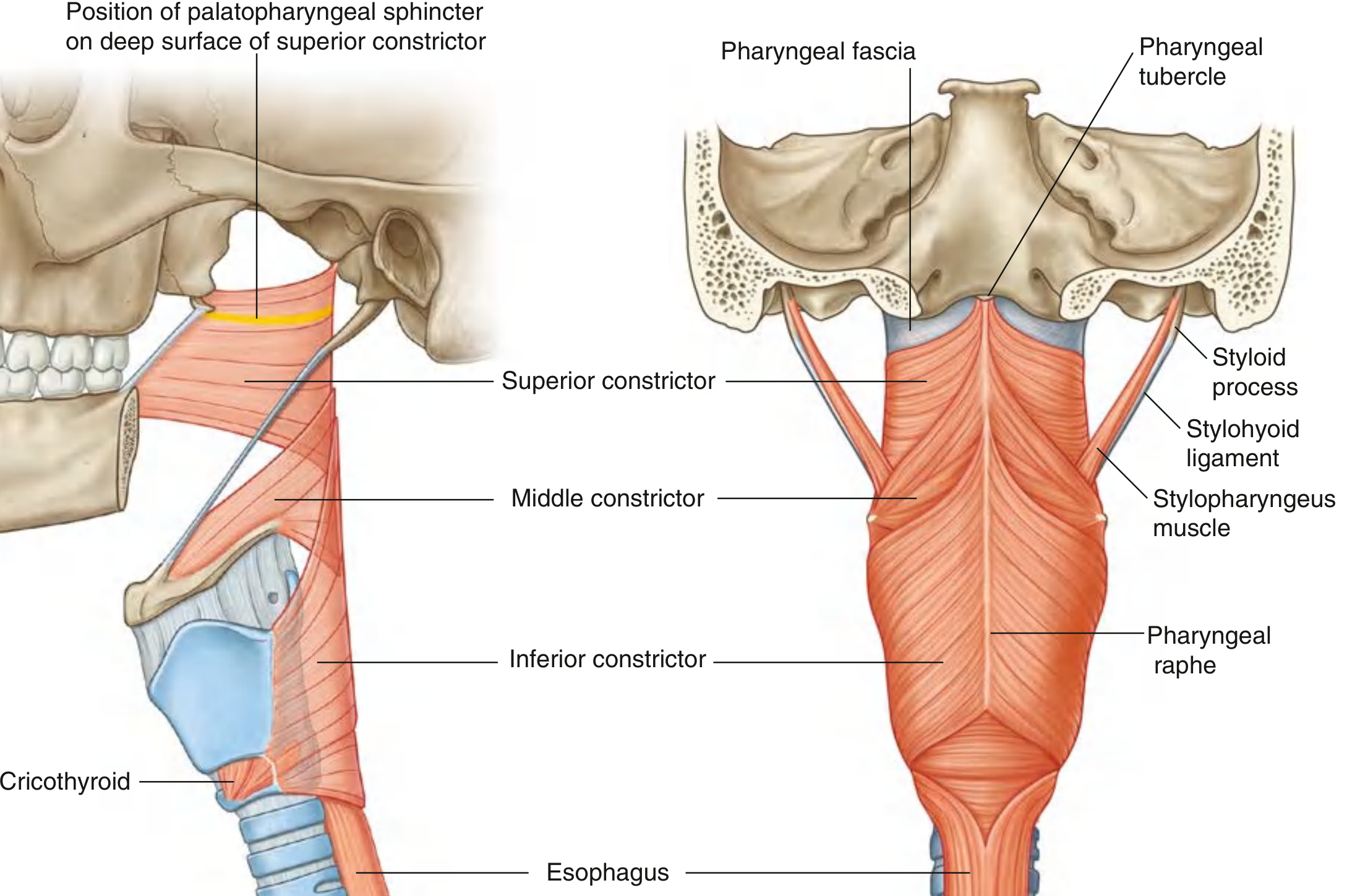
Gray's Anatomy - Constrictor muscles of the pharynx (lateral and posterior views):
The Pharyngeal Muscles and Their Roles
Group 1: Pharyngeal Constrictors (all insert into the median pharyngeal raphe)
| Muscle | Origin | Function During Swallowing |
|---|---|---|
| Superior constrictor | Medial pterygoid plate, mandible, base of tongue | Forms Passavant's ridge by contracting superiorly; presses against the elevated soft palate to seal the nasopharynx from the oropharynx (velopharyngeal closure); initiates peristaltic wave |
| Middle constrictor | Hyoid bone, stylohyoid ligament | Continues the peristaltic contraction wave, propelling the bolus inferiorly through the oropharynx |
| Inferior constrictor | Oblique line of thyroid cartilage | Propels the bolus into the hypopharynx; its lower part (cricopharyngeus) forms the upper esophageal sphincter (UES) |
Sequential peristaltic contraction of all three constrictors from superior to inferior generates the propulsive force that drives the bolus from oropharynx to esophagus. Contact of the bolus with sensory receptors in the oropharynx is the trigger for this wave.
Group 2: Pharyngeal Elevators (shorten the pharynx - longitudinal muscles)
| Muscle | Origin | Function During Swallowing |
|---|---|---|
| Stylopharyngeus | Styloid process (merges with palatopharyngeus) | Elevates and widens the pharynx; pulls it upward and outward over the descending bolus |
| Salpingopharyngeus | Temporal bone / Eustachian tube orifice (merges with palatopharyngeus) | Elevates the pharynx; also opens the pharyngotympanic tube to equalize middle ear pressure during swallowing |
| Palatopharyngeus | Hard palate/soft palate | Elevates the pharynx and larynx; also depresses the soft palate after velopharyngeal closure is achieved |
Group 3: Cricopharyngeus - The Upper Esophageal Sphincter (UES)
- Composed primarily of the cricopharyngeus muscle, along with the cervical esophagus and inferior pharyngeal constrictor
- At rest: tonically contracted, preventing air entry into the esophagus and reflux upward
- During swallowing: actively dilated by laryngeal elevation (hyoid and larynx pulled up by suprahyoid muscles) - relaxes to allow bolus passage into the esophagus
- The Killian dehiscence is a weakness between the cricopharyngeus and inferior constrictor; with age this can lead to a Zenker's diverticulum
Step-by-Step Events in the Pharyngeal Phase
-
Velopharyngeal sealing: The superior constrictor contracts at its upper border, forming Passavant's ridge. The soft palate is elevated against this ridge, sealing off the nasopharynx and preventing nasal regurgitation.
-
Laryngeal elevation and airway protection: Suprahyoid muscles (mylohyoid, digastric) and thyrohyoid elevate the hyoid bone and larynx. The laryngeal inlet approaches the epiglottis. The epiglottis is pulled down by the base-of-tongue muscles and aryepiglottic muscles. The rima glottidis closes. Respiration is briefly interrupted - the lower airways are sealed.
-
Pharyngeal expansion: As the larynx elevates, the pharynx expands anteriorly and superiorly, creating a low-pressure receiving chamber.
-
Bolus transport: The tongue is drawn posteriorly (styloglossus, hyoglossus), pushing the bolus through the fauces into the enlarged pharynx. Most food travels through the piriform recesses on either side; fluid courses over the epiglottis. Sequential contraction of the superior → middle → inferior constrictors propels the bolus downward.
-
UES opening: Laryngeal elevation physically dilates the cricopharyngeus (UES), and the sphincter reflexly relaxes, allowing the bolus into the esophagus.
-
Recovery: The larynx descends, glottis reopens, respiration resumes (typically during expiration), and the constrictors return to resting tone.
Neural Control Summary
- Afferent trigger: Receptors in the posterior upper pharyngeal wall, soft palate, and oropharyngeal mucosa send signals via CN IX and X to the swallowing center in the medulla (nucleus tractus solitarius + nucleus ambiguus)
- Efferent output: Motor commands via the pharyngeal plexus (CN IX + X) to all constrictors; CN IX exclusively to stylopharyngeus; XII to tongue
- Central pattern generator: Located in the caudal NTS and medullary reticular formation adjacent to nucleus ambiguus; controls the entire involuntary sequence without requiring continuous peripheral feedback
Sources:
- Cummings Otolaryngology: Head and Neck Surgery - Oral Phase of Deglutition
- Ganong's Review of Medical Physiology (26th ed.) - Swallowing, pp. 499
- Color Atlas of Human Anatomy Vol. 2 - The Act of Swallowing, pp. 286-287
- K.J. Lee's Essential Otolaryngology - Pharyngeal Walls
- Gray's Anatomy for Students - Constrictor Muscles
just sum up in short the points I asked for
Functions of Pharyngeal Muscles During Deglutition
Constrictors (superior → middle → inferior):
- Contract sequentially in a peristaltic wave to propel the bolus from oropharynx into the esophagus
- Superior constrictor forms Passavant's ridge to seal the nasopharynx (prevents nasal regurgitation)
Longitudinal muscles (stylopharyngeus, palatopharyngeus, salpingopharyngeus):
- Elevate and widen the pharynx, pulling it upward over the descending bolus
- Salpingopharyngeus also opens the Eustachian tube to equalize middle ear pressure
Cricopharyngeus (UES):
- Tonically contracted at rest (prevents reflux/air entry)
- Relaxes during swallowing (aided by laryngeal elevation) to let the bolus enter the esophagus
Overall pharyngeal phase functions:
- Seal nasopharynx (velopharyngeal closure)
- Protect airway (epiglottis down, glottis closed, respiration briefly stopped)
- Propel bolus downward via peristaltic constriction
- Open UES to allow esophageal entry
This is a shared conversation. Sign in to Orris to start your own chat.