
Give Kitone body synthetesis question
I'll look up ketone body synthesis from the medical library for you.
Reading File
Now let me search the medical library for ketone body synthesis content.
Finding Sources
Finding Sources
Excellent! Found two great sources. Let me read both in parallel.
Reading File
Reading File
Let me fetch the diagram and read the regulation section.
Loading Image
Reading File
I now have everything needed for a thorough, exam-quality answer. Here it is:
Ketone Body Synthesis (Ketogenesis)
What are Ketone Bodies?
The three ketone bodies are:
- Acetoacetate - the primary/parent ketone body
- 3-Hydroxybutyrate (β-hydroxybutyrate) - the major circulating form
- Acetone - a volatile, non-metabolized side product
They are organic acids (not true ketones in the chemical sense), water-soluble, and do NOT require lipoprotein carriers.
Site of Synthesis
Ketogenesis occurs exclusively in the mitochondrial matrix of hepatocytes (liver cells). The liver synthesizes them but cannot use them - peripheral tissues use them.
Pathway: Step-by-Step
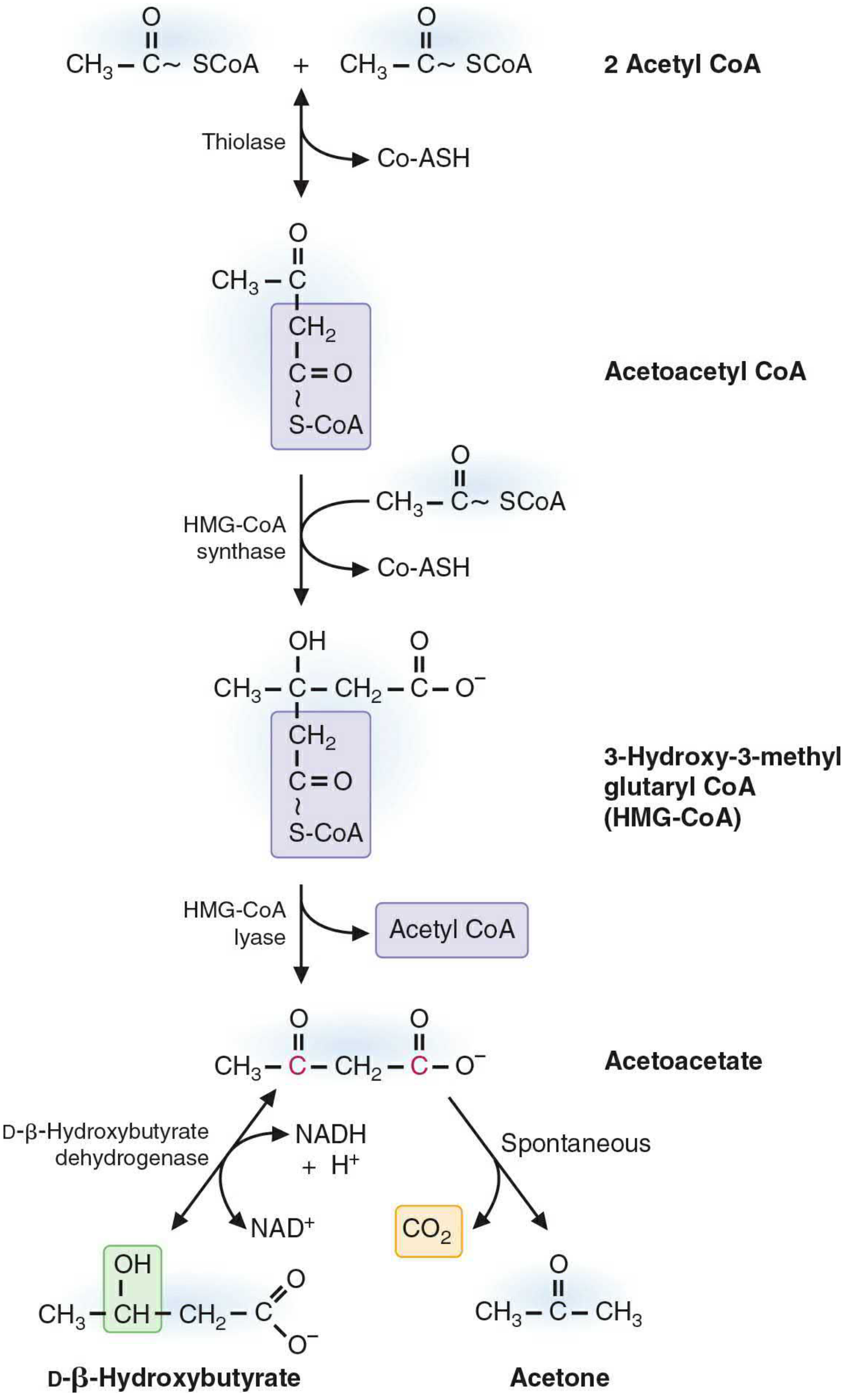
Step 1 - Formation of Acetoacetyl CoA
Enzyme: Thiolase (reversal of the last step of β-oxidation)
2 Acetyl CoA → Acetoacetyl CoA + CoA-SH
This is a reversal of the thiolase cleavage step in fatty acid oxidation. When acetyl CoA levels are high, the equilibrium shifts toward acetoacetyl CoA.
Step 2 - Formation of HMG-CoA ⭐ (Rate-Limiting Step)
Enzyme: Mitochondrial HMG-CoA synthase
Acetoacetyl CoA + Acetyl CoA → HMG-CoA + CoA-SH
- This is the rate-limiting step of ketogenesis
- HMG-CoA synthase is present in significant quantities only in the liver - this is why only the liver makes ketone bodies
- Important distinction: mitochondrial HMG-CoA synthase is for ketogenesis; cytosolic HMG-CoA synthase is for cholesterol synthesis
Step 3 - Cleavage to Acetoacetate
Enzyme: HMG-CoA lyase
HMG-CoA → Acetoacetate + Acetyl CoA
The HMG-CoA molecule is split: one portion becomes acetoacetate, and the "tinted box" portion is released as acetyl CoA.
Step 4a - Reduction to β-Hydroxybutyrate (favored in fasting)
Enzyme: D-β-hydroxybutyrate dehydrogenase
Acetoacetate + NADH + H⁺ → D-β-Hydroxybutyrate + NAD⁺
- The equilibrium between these two is determined by the NADH/NAD⁺ ratio
- During active fatty acid oxidation (fasting), NADH is high → β-hydroxybutyrate is favored
- Normal blood ratio of β-hydroxybutyrate : acetoacetate = ~3:1
- Note: The dehydrogenase here is specific for the D-isomer, unlike β-oxidation enzymes which act on L-isomers
Step 4b - Spontaneous Decarboxylation to Acetone (minor pathway)
Acetoacetate → Acetone + CO₂ (non-enzymatic, spontaneous)
- Acetone is volatile and exhaled through the lungs
- This is why diabetic ketoacidosis (DKA) patients have a fruity/sweet breath odor
- Acetone is biologically non-metabolized (clinically a dead end)
Why Ketone Bodies Are Formed: The Metabolic Logic
During fasting, several simultaneous events converge to drive ketogenesis:
| Event | Consequence |
|---|---|
| Fatty acids flood the liver from adipose lipolysis | Excess acetyl CoA generated from β-oxidation |
| High NADH/NAD⁺ ratio (from β-oxidation) | OAA shifts to malate → less OAA available for TCA cycle |
| Glucagon activates; insulin falls | Acetyl CoA carboxylase is inhibited → malonyl CoA falls |
| Low malonyl CoA | CPT-I is activated → more fatty acyl CoA enters mitochondria |
| OAA diverted to gluconeogenesis | Citrate synthase slowed → acetyl CoA cannot enter TCA |
| Acetyl CoA "overflow" | Funneled into ketogenesis |
The net effect: the liver acts as an "altruistic" ketone factory, providing fuel for the brain, heart, skeletal muscle, intestinal mucosa, and renal cortex during fasting.
Regulation of Ketogenesis
| Regulator | Effect |
|---|---|
| Low insulin/glucagon ratio | Promotes ketogenesis |
| High NADH/NAD⁺ | Favors β-hydroxybutyrate; shifts OAA to malate |
| Malonyl CoA (low in fasting) | CPT-I active → fatty acids enter mitochondria |
| Mitochondrial HMG-CoA synthase gene transcription | Increased during prolonged fasting |
| Acetyl CoA | Activates pyruvate carboxylase (OAA → gluconeogenesis, not TCA) |
Key Exam Points
- Only the liver synthesizes ketone bodies (HMG-CoA synthase present only there)
- RBCs cannot use ketone bodies - they lack mitochondria
- Brain CAN use ketone bodies when levels rise sufficiently (e.g., prolonged fasting/starvation) - this spares glucose
- Disorders of fatty acid oxidation present with hypoketosis (decreased acetyl CoA) + hypoglycemia
- In DKA: insulin deficiency → unopposed lipolysis → massive ketogenesis → metabolic acidosis (pH <7.3)
- Acetone is the only ketone body not used for energy
Sources: Biochemistry, 8th ed. Lippincott Illustrated Reviews, pp. 555-556; Basic Medical Biochemistry: A Clinical Approach, 6e, pp. 1097-1104
This is a shared conversation. Sign in to Orris to start your own chat.