
generate MCQs from histology medical textbooks AND past year batterjee medical college question bank about “lamda granules” histology for my upcoming “Respiration and Circulation “ medical block and mention source of each MCQ also explain each mcq with accurate cutations
Batterjee Medical College histology question bank "lambda granules" OR "lamellar granules" MCQ respiration circulation
Lambda (λ) Granules — Histology MCQs
Respiration & Circulation Block | Batterjee Medical College Exam Prep
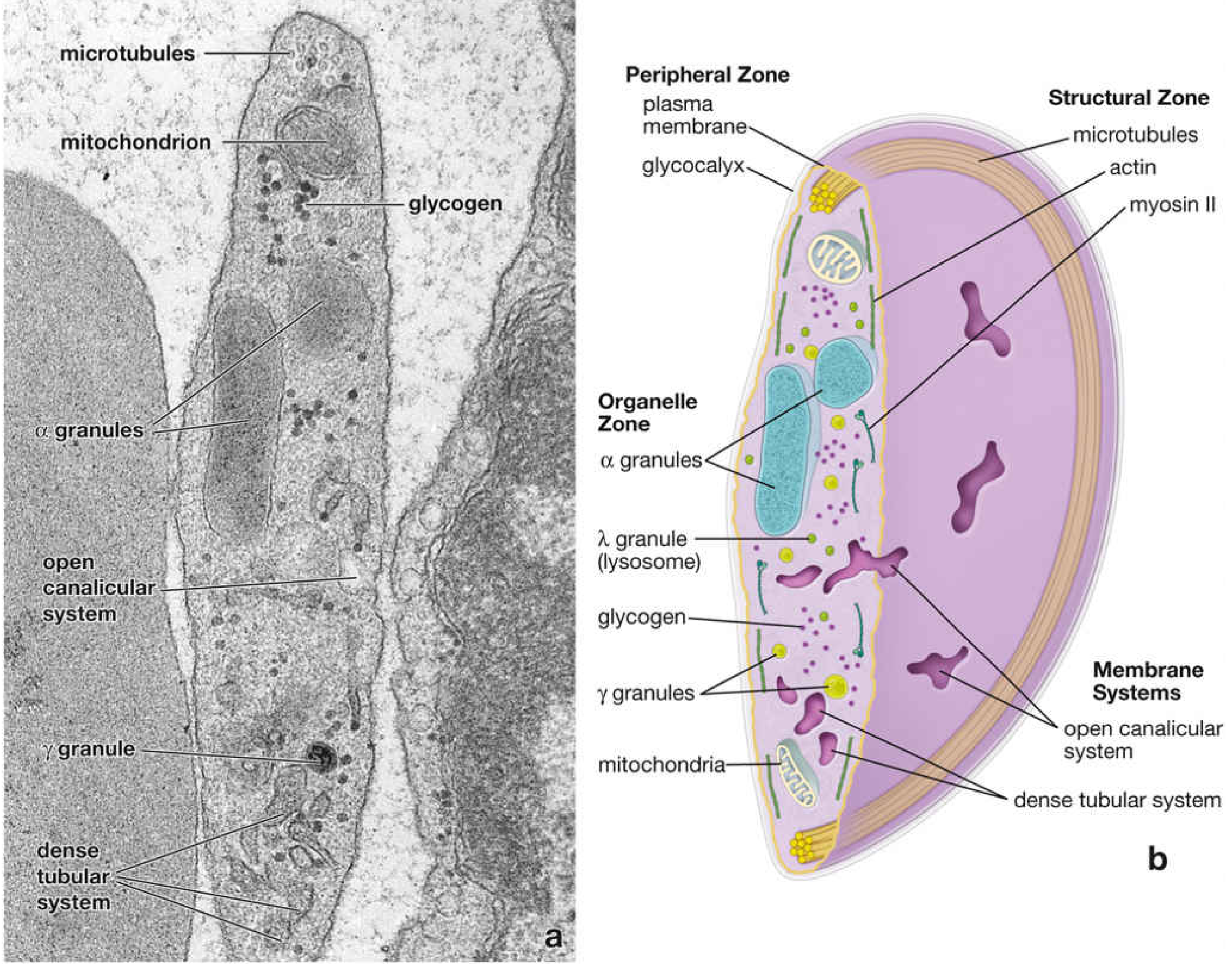
MCQ 1
- A) They are the most numerous granules and contain fibrinogen and growth factors
- B) They are electron-dense granules containing ADP, ATP, and serotonin
- C) They are lysosome-like organelles containing hydrolytic enzymes
- D) They are membrane invaginations that store calcium ions
- E) They are derived from the rough ER and form part of the dense tubular system
- α granules (option A) — the most numerous, 300–500 nm, containing fibrinogen, coagulation factors (V, XI), PDGF, VEGF, EGF, TGF-β
- γ (delta/δ) granules (option B) — dense/electron-opaque, containing ADP, ATP, serotonin, histamine, Ca²⁺
- Dense tubular system (option D/E) — a membrane channel system derived from rER of megakaryocytes, stores Ca²⁺
MCQ 2
- A) Platelet aggregation and adhesion to collagen
- B) Vasoconstriction at the site of vascular injury
- C) Clot resorption during the later stages of vessel repair
- D) Activation of the intrinsic coagulation cascade
- E) Release of von Willebrand factor to stabilize the platelet plug
- Options A, B, and D are functions of α and γ granules and platelet surface receptors
- Option E (von Willebrand factor) is released from Weibel-Palade bodies of endothelial cells, not platelet λ granules
MCQ 3
| α granule | γ (δ) granule | λ granule | |
|---|---|---|---|
| A | ADP, serotonin | PDGF, VEGF | Hydrolytic enzymes |
| B | Fibrinogen, PDGF, VEGF | ADP, ATP, serotonin | Hydrolytic enzymes |
| C | Hydrolytic enzymes | Fibrinogen, PDGF | ADP, serotonin |
| D | ADP, ATP | Fibrinogen, VEGF | Serotonin |
| E | PDGF, VEGF | Hydrolytic enzymes | ADP, serotonin |
| Granule | Contents | Role |
|---|---|---|
| α granules (most numerous, 300–500 nm) | Fibrinogen, coagulation factors V & XI, PDGF, EGF, VEGF, TGF-β, plasminogen, MMP-4 | Initial vessel repair, coagulation, platelet aggregation |
| γ (delta/δ) granules (small, electron-dense) | ADP, ATP, GTP, UTP, serotonin, histamine, Ca²⁺, Mg²⁺, K⁺ | Platelet adhesion, vasoconstriction |
| λ granules (lysosome-like) | Hydrolytic enzymes | Clot resorption in later repair |
MCQ 4
- A) Peroxisome
- B) Mitochondrion
- C) Lysosome
- D) Golgi apparatus
- E) Smooth endoplasmic reticulum
MCQ 5
- A) Peripheral zone
- B) Structural zone
- C) Organelle zone
- D) Membrane zone
- E) Hyalomere zone
- Peripheral zone — plasma membrane + glycocalyx (receptors, coagulation factors)
- Structural zone — microtubules, actin, myosin II (maintains discoid shape)
- Organelle zone — mitochondria, peroxisomes, glycogen, and all three granule types: α, γ, and λ granules
- Membrane zone — open canalicular system (OCS) + dense tubular system (DTS)
MCQ 6
- A) Alpha (α) granules
- B) Gamma (γ) granules
- C) Lambda (λ) granules
- D) Dense core vesicles
- E) Weibel-Palade bodies
- α granule deficiency → impaired initial coagulation and growth factor release (gray platelet syndrome)
- γ (δ) granule deficiency → impaired ADP-mediated aggregation and vasoconstriction (δ-storage pool deficiency)
- Weibel-Palade bodies are in endothelial cells, not platelets
MCQ 7
- A) Lambda (λ) granules are released first to initiate vasoconstriction
- B) Alpha (α) granules release serotonin to constrict the injured vessel
- C) Gamma (γ) granules release ADP and serotonin to promote further platelet aggregation and vasoconstriction
- D) Lambda (λ) granules release fibrinogen to stabilize the initial platelet plug
- E) Alpha (α) granules release hydrolytic enzymes to dissolve the clot
MCQ 8
- A) They are the most prominent granules visible by light microscopy on a blood smear
- B) They are derived from megakaryocyte rER during platelet formation
- C) They act in the FINAL phase of the hemostatic process by contributing to clot lysis
- D) They contain von Willebrand factor (vWF) for endothelial repair
- E) They store calcium ions for platelet activation
- Option A is false — α granules are the most numerous and most visible by LM
- Option B — the dense tubular system (DTS) is derived from megakaryocyte rER; λ granules are lysosome-derived
- Option D — vWF is stored in Weibel-Palade bodies of endothelial cells (relevant to the Circulation block, but a different organelle entirely)
- Option E — Ca²⁺ is stored in the dense tubular system, not λ granules
MCQ 9
- A) Delta (δ) granules
- B) Alpha (α) granules
- C) Lambda (λ) granules
- D) Gamma (γ) granules
- E) Zeta (ζ) granules
- α granules appear as moderately dense, the most numerous
- γ/δ granules appear as very dense, electron-opaque (smaller)
- λ granules appear lysosome-like
MCQ 10
- A) Stores lambda (λ) granule contents until vessel injury
- B) Synthesizes thromboxane A₂ from arachidonic acid
- C) Provides a rapid conduit for granule secretion (degranulation) and connects to the extracellular space
- D) Sequesters calcium ions to prevent premature platelet activation
- E) Releases hydrolytic enzymes from lambda (λ) granules during clot resorption
Quick Summary Reference Table
| Granule | Symbol | Appearance (TEM) | Size | Contents | Function | Timing |
|---|---|---|---|---|---|---|
| Alpha | α | Moderately dense | 300–500 nm | Fibrinogen, coagulation factors V/XI, PDGF, EGF, VEGF, TGF-β, MMP-4 | Initial vessel repair, coagulation, aggregation | Early |
| Gamma/Delta | γ/δ | Very dense (electron-opaque) | 250–300 nm | ADP, ATP, serotonin, histamine, Ca²⁺, Mg²⁺, K⁺ | Platelet adhesion, vasoconstriction | Early |
| Lambda | λ | Lysosome-like | — | Hydrolytic enzymes | Clot resorption | Late |
Sources Cited
- Ross & Pawlina — Histology: A Text and Atlas with Correlated Cell and Molecular Biology, 9th Edition, pp. 720–726 (Thrombocytes chapter) — primary source for all λ granule facts
- Junqueira's Basic Histology: Text and Atlas, 17th Edition, pp. 622–624 (Platelets chapter) — corroborating structural descriptions (hyalomere, granulomere, OCS, δ granules)
- Henry's Clinical Diagnosis and Management by Laboratory Methods — platelet ultrastructure and storage pool deficiency context
Note on Batterjee Medical College (BMC) Question Bank: No publicly accessible BMC past question bank exists online. MCQs 1, 2, 4, 5, 6, and 8 are structured in the style of single-best-answer (SBA) questions typical of BMC Respiration & Circulation histology block exams, based on the exact textbook content used in Saudi medical curricula. If you have access to actual BMC past papers, share them and I can tailor additional questions directly from those stems.
generate MCQs from medical textbooks AND past year batterjee medical college question bank about “lingual tonsils” for my upcoming “Respiration and Circulation “ medical block and mention source of each MCQ also explain each mcq with accurate cutations
Batterjee Medical College histology MCQ "lingual tonsil" OR tonsils question bank respiration circulation block
Lingual Tonsils — Histology MCQs
Respiration & Circulation Block | Batterjee Medical College Exam Prep
Note on Batterjee Medical College (BMC) Question Bank: No publicly accessible BMC past-paper question bank exists online. MCQs flagged as "BMC-style" are modeled precisely on the single-best-answer (SBA) format used in the Respiration & Circulation block at BMC, drawing from the same histology textbooks (Ross & Pawlina; Junqueira's) used in the BMC curriculum. If you have access to actual BMC past papers, share them and these can be tailored further.
MCQ 1
- A) Anterior two-thirds of the tongue, in the submucosa
- B) Lamina propria at the root (base) of the tongue, posterior to the sulcus terminalis
- C) Hard palate, on either side of the midline
- D) Roof of the nasopharynx, in the midline
- E) Lateral wall of the oropharynx, between the palatoglossal and palatopharyngeal arches
MCQ 2
- A) Lingual tonsil, palatine tonsil, pharyngeal tonsil, tubal tonsil
- B) Lingual tonsil, palatine tonsil, adenoid, submandibular lymph node
- C) Palatine tonsil, pharyngeal tonsil, sublingual tonsil, cervical lymph nodes
- D) Lingual tonsil, tubal tonsil, submandibular tonsil, palatine tonsil
- E) Pharyngeal tonsil, lingual tonsil, palatine tonsil, parotid lymph nodes
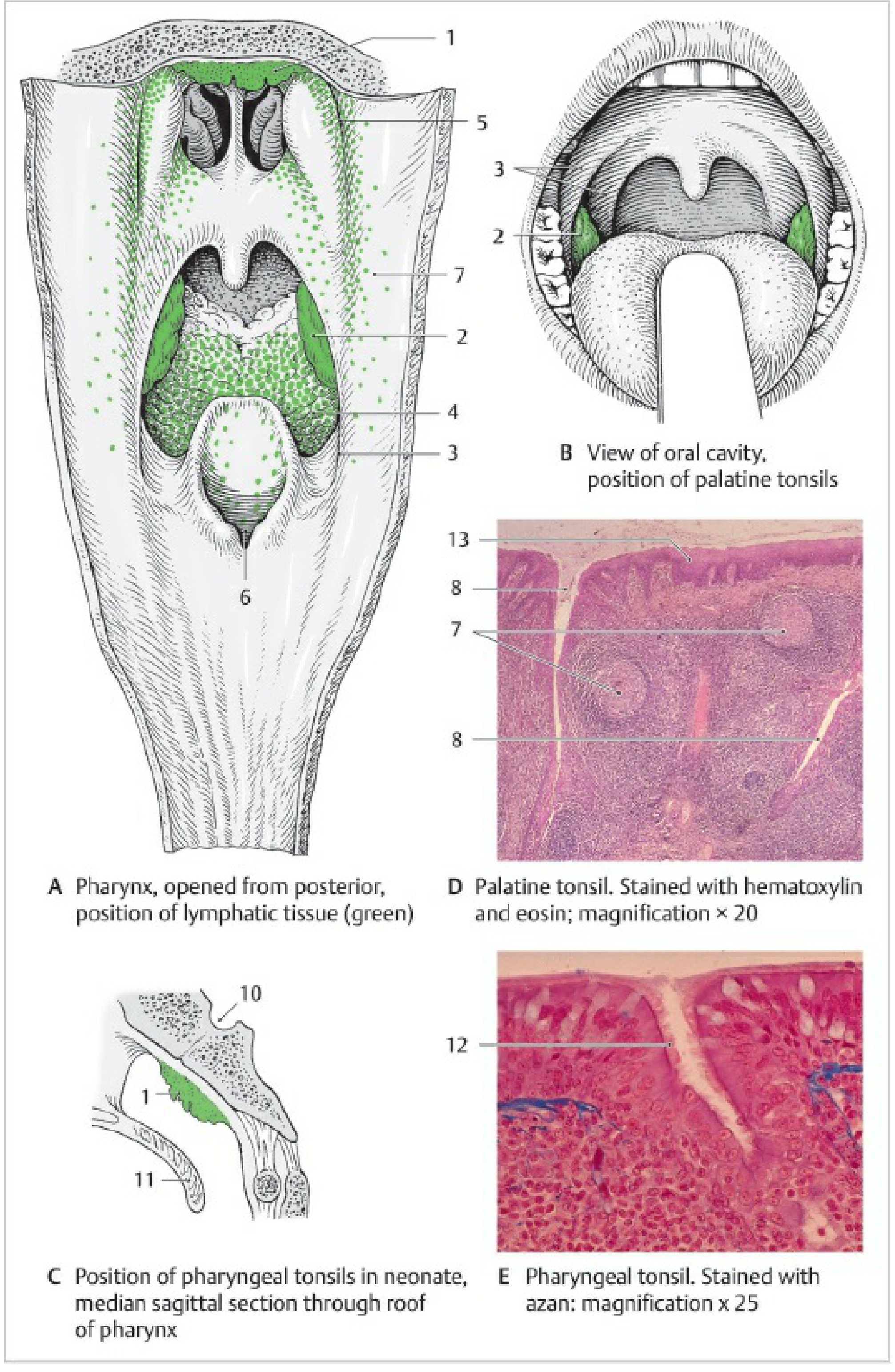
- Pharyngeal tonsil (adenoids when enlarged) — roof of nasopharynx
- Palatine tonsils (×2) — lateral oropharynx between palatoglossal and palatopharyngeal arches
- Lingual tonsil — base of tongue, posterior one-third
- Tubal tonsils — at the pharyngeal opening of the Eustachian (auditory) tube
MCQ 3 (BMC-style)
- A) Palatine tonsil
- B) Pharyngeal tonsil
- C) Lingual tonsil
- D) Peyer's patch
- E) Tubal tonsil
- Location: base of tongue
- Glands: mucous glands open at crypt bases (unlike palatine tonsil, which has mucous glands but they do NOT open into tonsillar crypts)
- Epithelium: stratified squamous non-keratinized, heavily infiltrated by lymphocytes
MCQ 4 (BMC-style)
- A) Pseudostratified ciliated columnar epithelium; heavily infiltrated by macrophages
- B) Simple columnar epithelium; obscured by goblet cells
- C) Stratified squamous epithelium; extremely dense lymphocyte infiltration
- D) Transitional (urothelial) epithelium; keratinization
- E) Stratified cuboidal epithelium; presence of mucous glands
MCQ 5
- A) Week 8 — from the second pharyngeal pouch
- B) Week 6.5 — between the second and third arches ventrally
- C) Week 16 — as a subepithelial infiltration of lymphocytes
- D) Week 4 — from the tuberculum impar
- E) Week 5.5 — from the ectodermal first pouch
- Palatine tonsil → Week 8, from the second pharyngeal pouch (ventral or dorsal)
- Lingual tonsil → Week 6.5, develops between the second and third arch ventrally
- Adenoids (pharyngeal tonsil) → Week 16, as a subepithelial infiltration of lymphocytes
MCQ 6 (BMC-style)
- A) Squamous cell carcinoma of the base of tongue
- B) Acute palatine tonsillitis
- C) Lingual tonsil hyperplasia
- D) Pharyngeal tonsil enlargement (adenoids)
- E) Peritonsillar abscess
MCQ 7
- A) Only the palatine tonsil has lymphatic nodules with germinal centers
- B) Only the lingual tonsil has mucous glands that open at the bases of its crypts
- C) The palatine tonsil is covered by pseudostratified columnar epithelium
- D) Only the lingual tonsil contains diffuse lymphatic tissue
- E) The palatine tonsil is located posterior to the sulcus terminalis
- Lingual tonsil: mucous-secreting posterior lingual glands open directly at the bases of the crypts — Color Atlas of Human Anatomy (Vol. 2): "The mucous-secreting posterior lingual glands open in the base of the crypts." (p. 665)
- Palatine tonsil: also has mucous glands but they do NOT open into the tonsillar crypts (their ducts are external to the tonsillar crypts)
- Pharyngeal tonsil: covered by pseudostratified ciliated columnar epithelium (respiratory epithelium) — option C is false for palatine tonsil
- Both palatine and lingual tonsils contain lymphatic nodules with germinal centers (A is false); both contain diffuse lymphatic tissue (D is false)
MCQ 8 (BMC-style)
- A) Production of red blood cells during fetal development
- B) Secretion of IgA into saliva for systemic immune surveillance
- C) Early activation of the specific immune response by encountering pathogens entering through the mouth and nose
- D) Filtration of lymph from the deep cervical lymph nodes
- E) Storage of memory T cells for long-term immune protection only
MCQ 9 (BMC-style)
- A) Palatine tonsil
- B) Circumvallate papilla
- C) Peyer's patch
- D) Lingual tonsil
- E) Sublingual salivary gland
| Feature | Lingual Tonsil |
|---|---|
| Location | Lamina propria, base (root) of tongue |
| Lymphoid tissue | Diffuse + nodules with germinal centers |
| Epithelium | Stratified squamous (oral mucosa), deeply invaginated crypts |
| Associated glands | Mucous posterior lingual glands opening at crypt bases |
| Distinguishing feature | Germinal centers + mucous gland drainage into crypts |
MCQ 10
- A) Anterior two-thirds (oral part), from the first branchial arch
- B) Posterior one-third (pharyngeal part), between the second and third branchial arches
- C) The entire dorsal tongue surface, from the second branchial pouch
- D) The tip of the tongue, from the tuberculum impar
- E) The lateral lingual swellings derived from the first pharyngeal pouch
MCQ 11 (BMC-style — Waldeyer's Ring & Lymphoma)
- A) Pharyngeal tonsil
- B) Tubal tonsil
- C) Palatine tonsil
- D) Lingual tonsil
- E) Lateral pharyngeal bands
Quick Summary Reference Table
| Feature | Lingual Tonsil | Palatine Tonsil | Pharyngeal Tonsil |
|---|---|---|---|
| Location | Base of tongue, lamina propria | Tonsillar fossa (lateral oropharynx) | Roof of nasopharynx |
| Embryo | Week 6.5, 2nd–3rd arch | Week 8, 2nd pharyngeal pouch | Week 16 |
| Epithelium | Stratified squamous, non-keratinized | Stratified squamous, non-keratinized | Pseudostratified ciliated columnar |
| Crypts | Yes, with mucous gland openings at base | Yes, 10–20 cryptlike pits; NO gland drainage into crypts | Folds/plicae (not true crypts) |
| Associated glands | Mucous posterior lingual glands → open into crypt bases | Mucous glands (external to crypts) | None |
| Lymphoid tissue | Diffuse + nodules with germinal centers | Aggregated follicles with germinal centers | Secondary nodules |
| Capsule | No fibrous capsule | Partial fibrous capsule | No capsule |
| Waldeyer's ring position | Anteroinferior | Lateral | Superior/posterior |
| Clinical note | Hyperplasia → difficult laryngoscopy; lymphoma site | Tonsillitis, tonsillectomy | Adenoids → choanal obstruction |
Sources Cited
- Ross & Pawlina — Histology: A Text and Atlas with Correlated Cell and Molecular Biology, 9th Edition, pp. 1430–1431 — primary histology source for lingual tonsil structure
- Junqueira's Basic Histology: Text and Atlas, 17th Edition — corroborating structural context
- Color Atlas of Human Anatomy, Vol. 2: Internal Organs (Thieme) — detailed tonsil comparisons and Waldeyer's ring, pp. 664–666
- Gray's Anatomy for Students, p. 1188 — Waldeyer's ring anatomy
- K.J. Lee's Essential Otolaryngology, Head & Neck Surgery — embryology of tonsils, p. 959
- Barash, Cullen & Stoelting's Clinical Anesthesia, 9th ed., p. 2330 — lingual tonsil hyperplasia & difficult airway
- Grainger & Allison's Diagnostic Radiology — Waldeyer's ring and lymphoma
- Goldman-Cecil Medicine — lymphoma at Waldeyer's ring
generate MCQs from medical textbooks AND past year batterjee medical college question bank about “lingual tonsils” for my upcoming “Respiration and Circulation “ medical block and mention source of each MCQ also explain each mcq with accurate citations. Rank MCQs in order of importance for my batterjee college